 plumi
Oxidising agents and redox equations: OCR A‑Level Chemistry A questions
OCR A-Level Chemistry A past-paper questions on 5.2.3.1 Oxidising agents and redox equations, 2016–2025, with mark schemes and examiner’s reports where available.
Paper
All papers
Exam
All years
Calculations
- Your answer
Q4(a)(ii)
The whole paper ↗
Q4(a)(iii)
The whole paper ↗Q3(b)(i)
The whole paper ↗
Q22(d)
The whole paper ↗
Q6(c)(i)
The whole paper ↗
Q6(c)(ii)
The whole paper ↗Q2(b)
The whole paper ↗
Q2(c)
The whole paper ↗- Your answer
- Your answer
Q5(a)(i)
The whole paper ↗
- Your answer
Q18(b)(iii)
The whole paper ↗
Q6(a)(iv)
The whole paper ↗
Q21(c)(i)
The whole paper ↗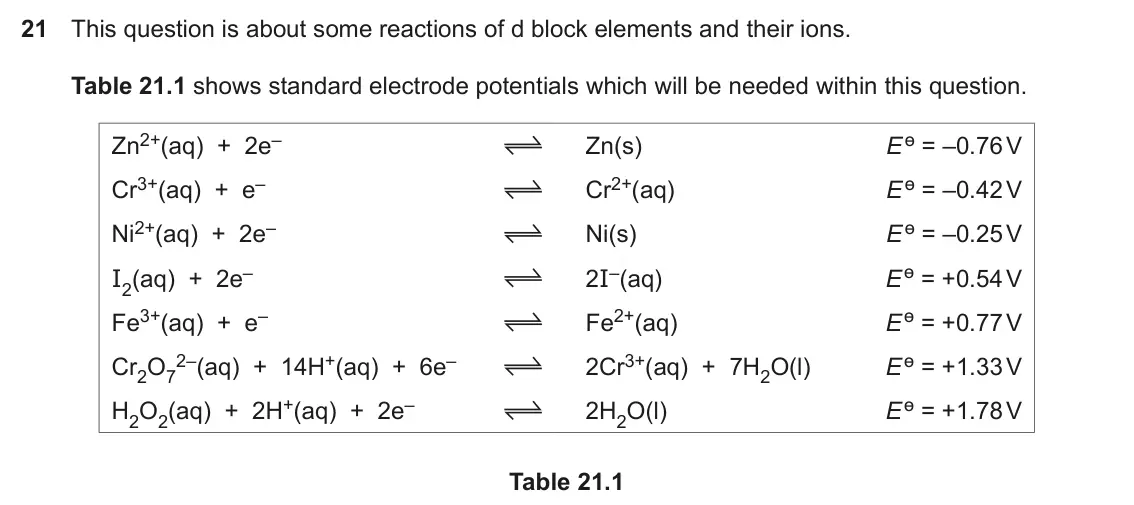
Q2(b)
The whole paper ↗
Q22(b)
The whole paper ↗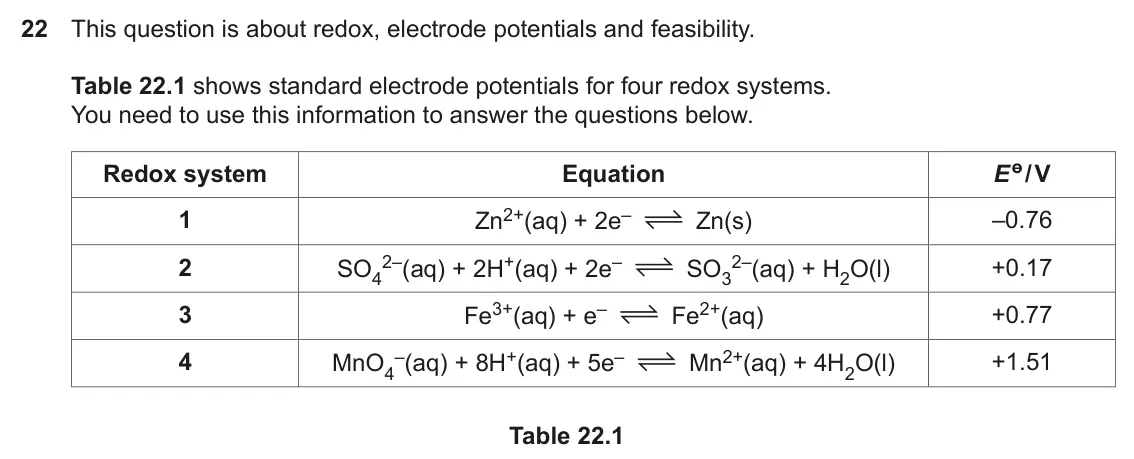
All 18 questions on Oxidising agents and redox equations, as a list
- June 2025, Paper 1, Q11 (1 mark): Two redox systems are shown below. Mg2+(aq) + 2e– E ɵ= – 2.37 V Mg(s) Pb2+(aq) + 2e– E ɵ = – 0.13 V Pb(s) Which species is the strongest reducing agent? Mg2+(aq
- June 2025, Paper 3, Q4(a)(ii) (7 marks): Complete the flowchart by adding formulae in the boxes. white precipitate white precipitate Ag+(aq) Ba2+(aq) acidic solution containing three ions Cl2(aq)/H2O(I
- June 2025, Paper 3, Q4(a)(iii) (2 marks): Construct an ionic equation for the reaction of SO3 [2]
- June 2024, Paper 3, Q3(b)(i) (2 marks): In the titration, both iron(II) ions and ethanedioate, C2O4 Construct half-equations for the oxidation of iron(II) and ethanedioate ions. Oxidation of iron(II)
- June 2023, Paper 1, Q22(d) (2 marks): An acidified solution containing Cr2O7 reaction to form a solution containing Cr3+ ions and VO2 + ions. Construct the overall equation for this reaction. [2]
- June 2023, Paper 3, Q6(c)(i) (1 mark): Balance the half-equation for the oxidation process in this reaction. H+ + AuCl4 – + e– Au + HCl [1]
- June 2023, Paper 3, Q6(c)(ii) (3 marks): In the reduction process in this reaction, HNO3 and H+ react together to form 2 oxides: X (Mr = 30) and Z (Mr = 18). Determine the formulae of X and Z and write
- June 2022, Paper 3, Q2(b) (5 marks): A student analyses the redox reactions shown below. State symbols have been omitted. CH3CHO + 2H+ + 2e– E ө = –0.197 V C2H5OH 2– + 14H+ + 6e– 2Cr3+ + 7H2O E ө =
- June 2022, Paper 3, Q2(c) (2 marks): A student bubbles hydrogen sulfide gas, H2S(g), through an acidified solution containing –(aq). manganate(VII) ions, MnO4 A redox reaction takes place, forming
- November 2021, Paper 1, Q3 (1 mark): The unbalanced equation for the reaction of silver with concentrated nitric acid is shown below. –(aq) + ….. H+(aq) → ….. Ag+(aq) + .…. NO(g) + ..… H2O(l) ….. A
- November 2021, Paper 1, Q12 (1 mark): Two redox systems are shown below. Fe2+(aq) + 2e– Eo– = –0.44 V Fe(s) Cu2+(aq) + 2e– Eo– = +0.34 V Cu(s) Which species in the two redox systems is the strongest
- November 2021, Paper 3, Q5(a)(i) (2 marks): This is a redox reaction. Write half-equations for the reduction and oxidation processes that take place. Reduction Oxidation [2]
- November 2020, Paper 1, Q12 (1 mark): Iodide ions, I−(aq), react with MnO4 −(aq). The unbalanced equation is shown below. I−(aq) + MnO4 −(aq) + H2O(l) IO−(aq) + MnO2(s) + OH−(aq) What is the ratio o
- June 2019, Paper 1, Q18(b)(iii) (1 mark): Construct an equation for the first colour change from blue to green. [1]
- June 2019, Paper 3, Q6(a)(iv) (2 marks): Construct an equation for the reaction of H2S(g) with H+(aq)/MnO4 −(aq). [2]
- June 2018, Paper 1, Q21(c)(i) (1 mark): Write the overall equation for the oxidation of Fe2+ by acidified H2O2. [1]
- June 2018, Paper 3, Q2(b) (2 marks): Hydrogen peroxide can act as an oxidising agent or as a reducing agent. Some standard electrode potentials are shown below. 2H+(aq) + O2(g) + 2e– E o = +0.68 V
- June 2017, Paper 1, Q22(b) (2 marks): In Table 22.1, what is the strongest reducing agent and the strongest oxidising agent? Strongest reducing agent Strongest oxidising agent [2]
Questions, mark schemes and examiner’s reports are © OCR, from their published past papers. Plumi isn’t affiliated with any exam board. Want whole papers? OCR A-Level Chemistry A past papers, or our free OCR-style practice pack.
The Plumi iPad app also offers exam-style questions with AI feedback on your handwritten working.