 plumi
Cell potentials and feasibility: OCR A‑Level Chemistry A questions
OCR A-Level Chemistry A past-paper questions on 5.2.3.4 Cell potentials and feasibility, 2016–2025, with mark schemes and examiner’s reports where available.
Paper
All papers
Exam
All years
Calculations
Q20(a)(ii)
The whole paper ↗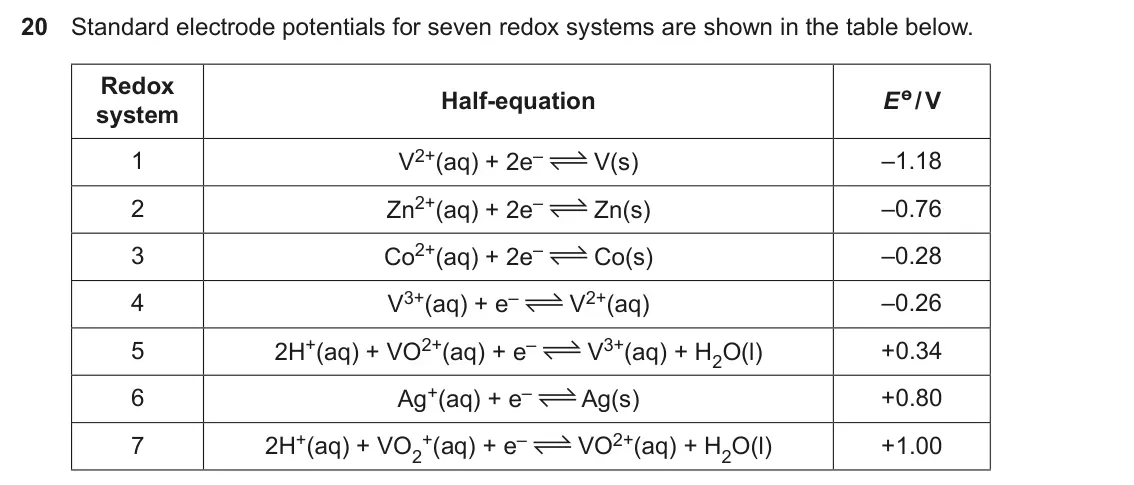
Q20(b)
The whole paper ↗Q22(b)(ii)
The whole paper ↗
Q2(b)
The whole paper ↗
Q19(a)(ii)
The whole paper ↗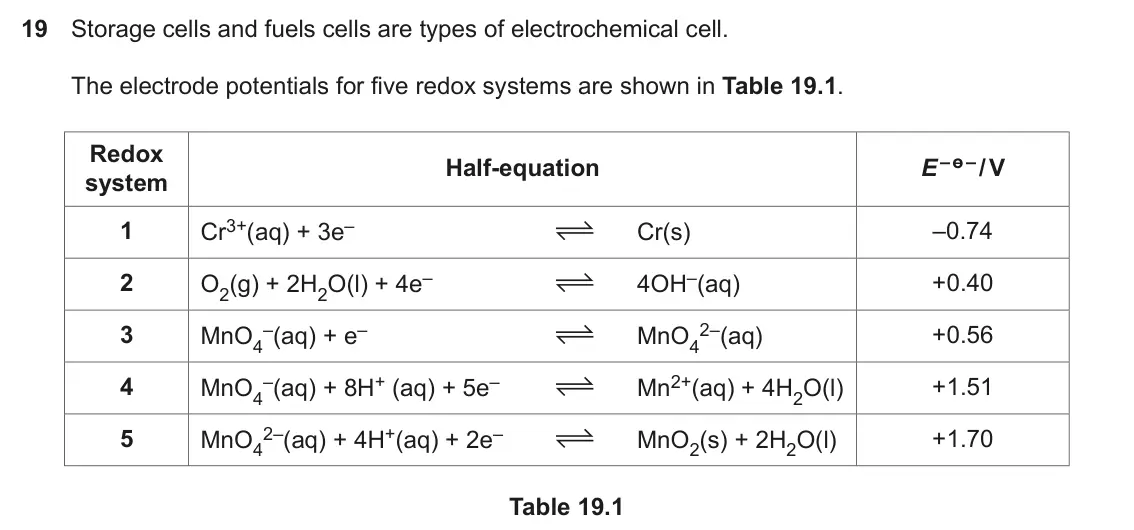
Q19(b)(ii)
The whole paper ↗Q19(c)(ii)
The whole paper ↗Q19(b)
The whole paper ↗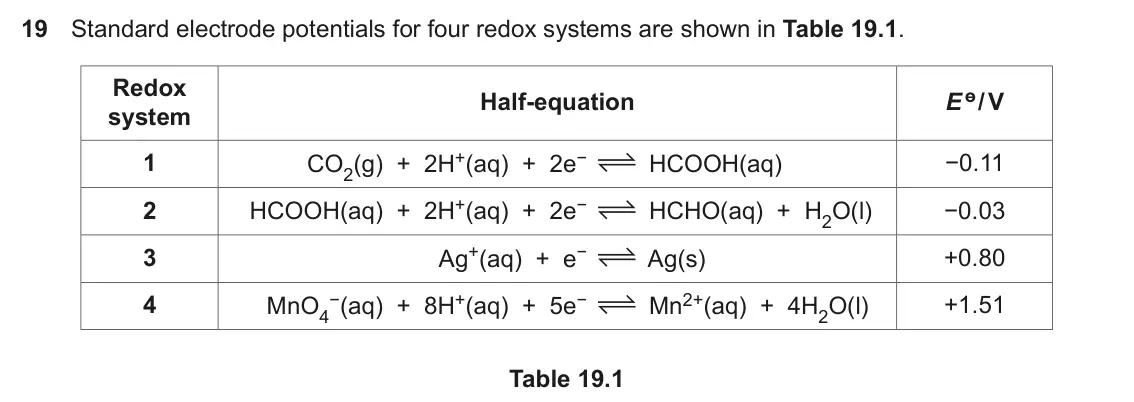
Q18(b)(ii)
The whole paper ↗
Q21(b)(ii)
The whole paper ↗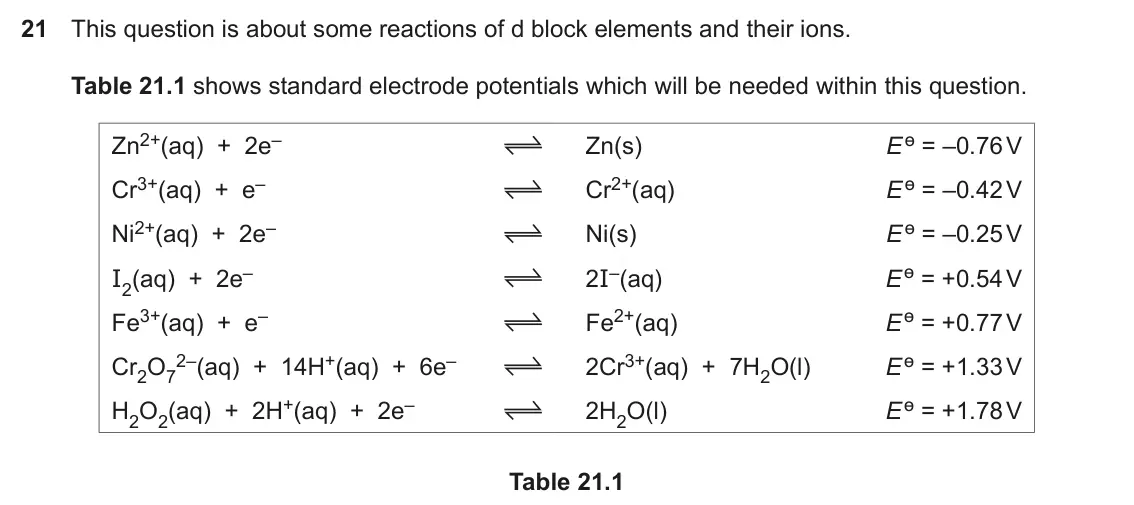
Q21(c)(ii)
The whole paper ↗- Your answer
Q22(a)(ii)
The whole paper ↗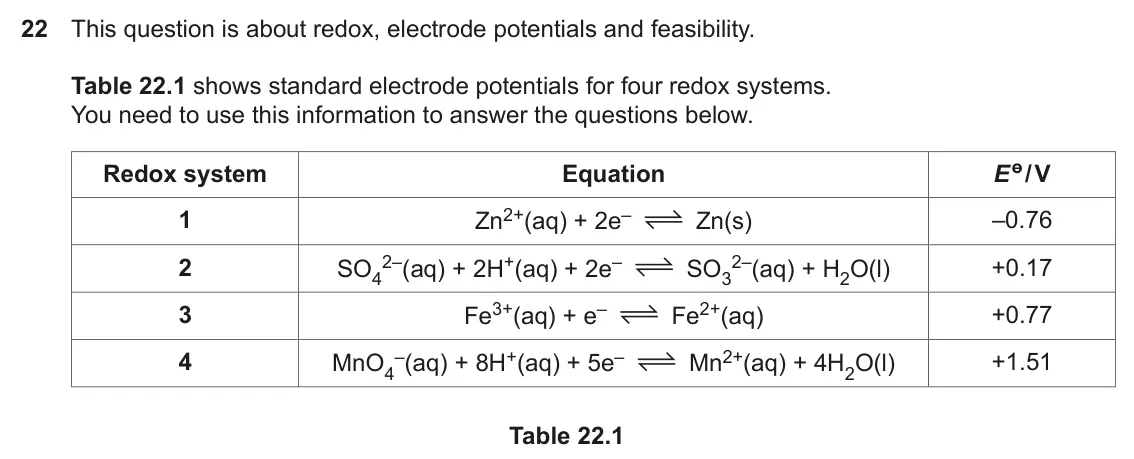
Q22(c)
The whole paper ↗Q3(b)
The whole paper ↗
All 15 questions on Cell potentials and feasibility, as a list
- June 2025, Paper 1, Q20(a)(ii) (1 mark): Calculate the standard cell potential of this cell. standard cell potential = V [1]
- June 2025, Paper 1, Q20(b) (4 marks): A student predicts that cobalt metal will reduce acidified VO2+ ions to form V2+ ions in two stages. Explain why this two-stage reduction should happen in terms
- June 2022, Paper 1, Q22(b)(ii) (4 marks): Use the information below to explain why the pale green precipitate turns brown when left to stand in air and construct an equation for the reaction which occur
- June 2022, Paper 3, Q2(b) (5 marks): A student analyses the redox reactions shown below. State symbols have been omitted. CH3CHO + 2H+ + 2e– E ө = –0.197 V C2H5OH 2– + 14H+ + 6e– 2Cr3+ + 7H2O E ө =
- November 2021, Paper 1, Q19(a)(ii) (1 mark): Construct the equation for the overall cell reaction. [1]
- November 2021, Paper 1, Q19(b)(ii) (2 marks): Explain, in terms of electrode potentials and equilibrium shifts why MnO4 2–(aq) disproportionates in acid conditions. Use the information in Table 19.1. [2]
- November 2021, Paper 1, Q19(c)(ii) (1 mark): The cell potential is 1.23 V. Calculate the electrode potential of the negative electrode. electrode potential = V [1]
- November 2020, Paper 1, Q19(b) (4 marks): A student warms a mixture of methanal, HCHO, and acidified potassium manganate(VII). The student observes gas bubbles. Explain this observation in terms of elec
- June 2019, Paper 1, Q18(b)(ii) (3 marks): The student adds excess iron to a solution containing VO2+(aq) ions, and observes that the colour of the solution changes from blue to green and then to violet.
- June 2018, Paper 1, Q21(b)(ii) (1 mark): Predict the standard cell potential of this cell. standard cell potential = V [1]
- June 2018, Paper 1, Q21(c)(ii) (4 marks): Zinc reacts with acidified Cr2O7 Explain why this happens in terms of electrode potentials and equilibria. Include overall equations for the reactions which occ
- June 2017, Paper 1, Q14 (1 mark): A cell is constructed from the two redox systems below. Cu2+(aq) + 2e– E ө = +0.34 V Cu(s) Ag+(aq) + e– E ө = +0.80 V Ag(s) Which statement(s) is/are correct fo
- June 2017, Paper 1, Q22(a)(ii) (1 mark): Predict the standard cell potential of this cell. standard cell potential = V [1]
- June 2017, Paper 1, Q22(c) (2 marks): Electrode potentials can be used to predict the feasibility of reactions. Construct an overall equation for the predicted reaction between the species in redox
- June 2017, Paper 3, Q3(b) (4 marks): Solutions of hydrogen peroxide decompose slowly into water and oxygen: 2H2O2(aq) 2H2O(l) + O2(g) This reaction is catalysed by manganese dioxide, MnO2(s). Stand
Questions, mark schemes and examiner’s reports are © OCR, from their published past papers. Plumi isn’t affiliated with any exam board. Want whole papers? OCR A-Level Chemistry A past papers, or our free OCR-style practice pack.
The Plumi iPad app also offers exam-style questions with AI feedback on your handwritten working.