 plumi
Infrared spectra and their uses: OCR A‑Level Chemistry A questions
OCR A-Level Chemistry A past-paper questions on 4.2.4.2 Infrared spectra and their uses, 2016–2025, with mark schemes and examiner’s reports where available.
Paper
All papers
Exam
All years
Calculations
- Your answer
Q6(b)(ii)
The whole paper ↗
- Your answer
- Your answer
- Your answer
- Your answer
- Your answer
- Your answer
Q20(b)
The whole paper ↗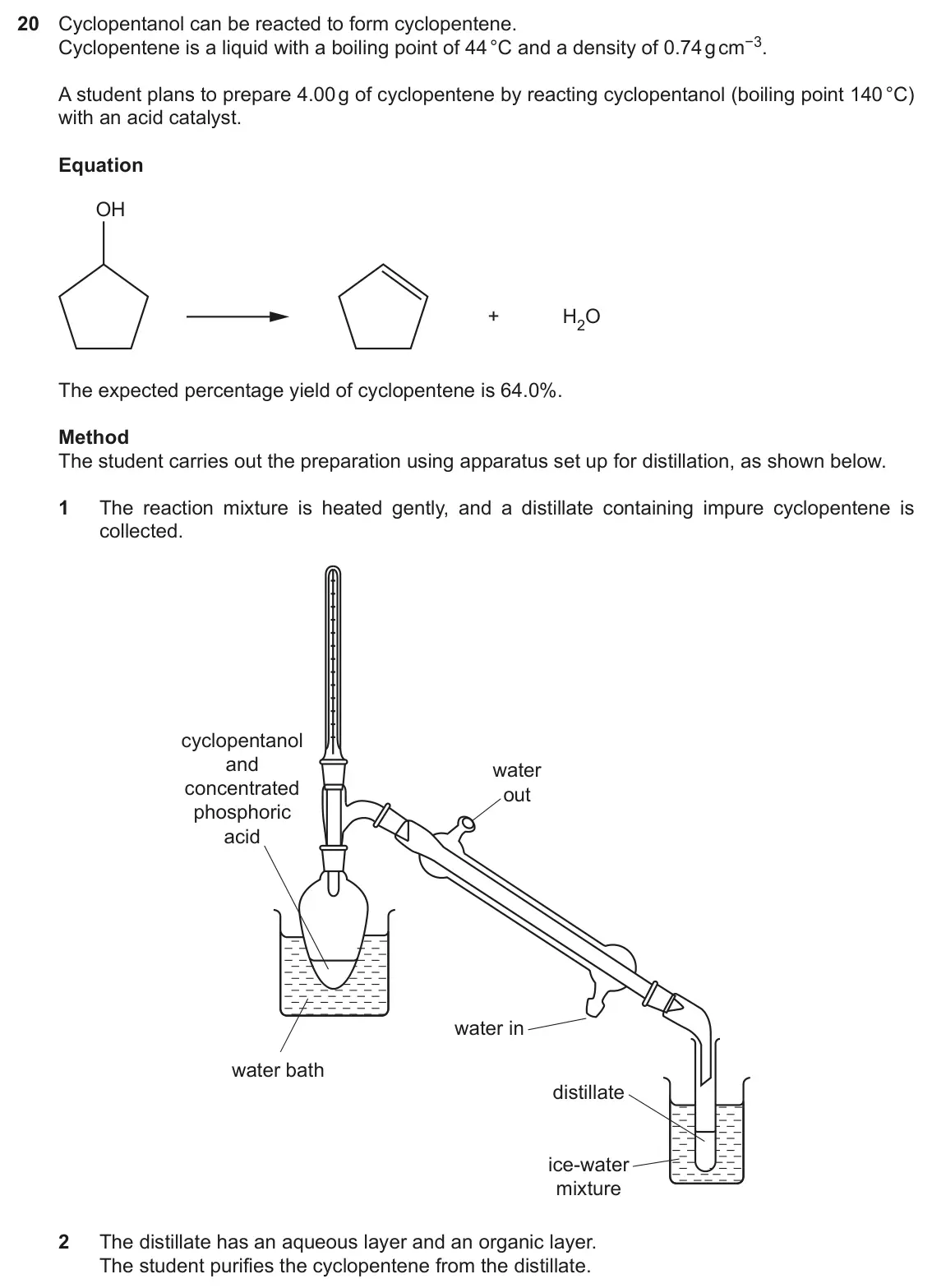
- Your answer
- Your answer
Q25(b)(ii)
The whole paper ↗
- Your answer
Q5(c)
The whole paper ↗
All 14 questions on Infrared spectra and their uses, as a list
- June 2025, AS Paper 1, Q20 (1 mark): The IR spectrum of a compound is shown below. 100 80 60 transmittance (%) 40 20 0 4000 3000 2000 1500 1000 400 wavenumber / cm–1 Which compound could have produ
- June 2025, AS Paper 2, Q6(b)(ii) (2 marks): Identify two functional groups which are likely to be present in Compound B but are not present in Compound A. Explain your answers. Functional group Explanatio
- June 2024, Paper 2, Q11 (1 mark): Which compound could have produced the IR spectrum shown below? 100 Transmittance 50 (%) 0 4000 3000 2000 1500 1000 500 Wavenumber / cm–1 A HOCH2CHO B CH3CH2COO
- June 2023, Paper 2, Q11 (1 mark): The infrared spectrum of an organic compound is shown below. 100 transmittance (%) 50 0 4000 3000 2000 1500 1000 500 wavenumber / cm–1 Which compound could have
- June 2023, AS Paper 1, Q19 (1 mark): An organic compound produces the infrared spectrum below. 100 transmittance 50 (%) 0 4000 3000 2000 1500 1000 500 wavenumber / cm–1 Which compound could have pr
- June 2022, Paper 2, Q11 (1 mark): The infrared spectrum of an organic compound is shown below. 100 Transmittance (%) 0 4000 3000 2000 1500 1000 500 Wavenumber / cm–1 Which compound could have pr
- June 2022, AS Paper 1, Q19 (1 mark): Which organic compound could have produced the infrared spectrum below? 100 transmittance 50 (%) 0 4000 3000 2000 1500 1000 500 wavenumber / cm–1 A CH3COCH2CH3
- November 2021, Paper 2, Q11 (1 mark): Which compound could have produced the IR spectrum below? 100 transmittance (%) 50 0 4000 3000 2000 1500 1000 500 wavenumber / cm–1 A (CH3)2CHCHO B (CH3)2CHCOOH
- November 2020, Paper 2, Q20(b) (2 marks): The organic layer in the distillate was analysed by IR spectroscopy. The IR spectrum is shown below. 100 Transmittance (%) 50 0 4000 3000 2000 1500 1000 500 Wav
- June 2019, AS Paper 1, Q20 (1 mark): An unknown compound produces the infrared spectrum below. 100 transmittance 50 (%) 0 4000 3000 2000 1500 1000 500 wavenumber / cm–1 Which compound could have pr
- June 2018, Paper 2, Q9 (1 mark): Which compound could have produced the IR spectrum below? 100 transmittance (%) 50 0 4000 3000 2000 1500 1000 500 wavenumber / cm–1 A CH3CH2OH B CH3CHOHCN C CH3
- June 2018, AS Paper 1, Q25(b)(ii) (2 marks): The infrared (IR) spectrum for C2H5CHBrCH3 is shown in Fig. 25.2. The C–Br bond absorption is labelled. 100 transmittance 50 (%) C–Br 0 4000 3000 2000 1500 1000
- June 2017, AS Paper 1, Q19 (1 mark): An alcohol A is heated under reflux with sulfuric acid and potassium dichromate(VI). The organic compound formed produces the infrared spectrum below. 100 trans
- June 2017, AS Paper 2, Q5(c) (4 marks): Compound D is a neutral compound which is a structural isomer of propanoic acid, CH3CH2COOH. The infrared spectrum of compound D is shown below. Item removed du
Questions, mark schemes and examiner’s reports are © OCR, from their published past papers. Plumi isn’t affiliated with any exam board. Want whole papers? OCR A-Level Chemistry A past papers, or our free OCR-style practice pack.
The Plumi iPad app also offers exam-style questions with AI feedback on your handwritten working.