 plumi
How conditions affect equilibrium constants: OCR A‑Level Chemistry A questions
OCR A-Level Chemistry A past-paper questions on 5.1.2.3 How conditions affect equilibrium constants, 2016–2025, with mark schemes and examiner’s reports where available.
Paper
All papers
Exam
All years
Calculations
Q17(c)(iii)
The whole paper ↗
Q18(a)(ii)
The whole paper ↗
Q18(a)(iii)
The whole paper ↗Q19(a)(ii)
The whole paper ↗
Q20(b)(i)
The whole paper ↗
Q20(b)(ii)
The whole paper ↗Q20(c)(ii)
The whole paper ↗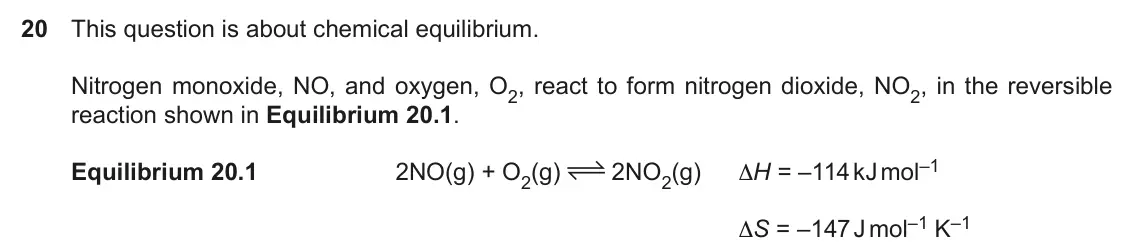
Q5(a)
The whole paper ↗
Q5(b)
The whole paper ↗Q5(c)
The whole paper ↗Q5(d)
The whole paper ↗Q19(b)(iii)
The whole paper ↗
Q19(b)(iv)
The whole paper ↗Q18(c)(i)
The whole paper ↗
Q18(c)(ii)
The whole paper ↗
All 15 questions on How conditions affect equilibrium constants, as a list
- June 2025, Paper 1, Q17(c)(iii) (2 marks): At a second temperature the value of Kp for Equilibrium 17.3 is 129. Explain whether the second temperature is higher or lower than 700 K. [2]
- June 2024, Paper 1, Q18(a)(ii) (2 marks): The numerical values of Kp for Equilibrium 18.1 at temperatures T1 and T2 are shown below. Temperature Kp 3.3 × 10⁻⁵ T1 7.7 × 10⁻² T2 Explain why T2 is a higher
- June 2024, Paper 1, Q18(a)(iii) (2 marks): Suggest how the value of Kp would change if the reaction was repeated with no catalyst added and the pressure of the system increased. Tick (✓) one box in each
- June 2023, Paper 1, Q19(a)(ii) (3 marks): The sealed flask in (a)(i) is then heated to a higher temperature at an increased pressure. The system is allowed to reach equilibrium again. Explain why it is
- June 2022, Paper 1, Q20(b)(i) (1 mark): When the temperature is decreased, the value of Kp decreases. Determine whether the forward reaction is exothermic or endothermic. Explain your answer. [1]
- June 2022, Paper 1, Q20(b)(ii) (1 mark): Two students are discussing the effect of pressure on the equilibrium position of Equilibrium 20.2. Student 1 says: “There are more moles of products than react
- November 2021, Paper 1, Q20(c)(ii) (3 marks): The chemist then repeats the experiment three times. In each experiment, the chemist makes one change but uses the same initial amounts of NO and O2. Complete t
- November 2020, Paper 3, Q5(a) (2 marks): The table shows the values of Kp at different temperatures for an equilibrium. Complete the table by adding the missing values of 1 T and ln Kp. Temperature, T
- November 2020, Paper 3, Q5(b) (1 mark): State and explain how increasing the temperature affects the position of this equilibrium and whether the forward reaction is exothermic or endothermic. [1]
- November 2020, Paper 3, Q5(c) (4 marks): Plot a graph of ln Kp against 1 T using the axes provided on the opposite page. Use your graph and equation 5.1 to determine ∆H, in kJ mol−1, for this equilibri
- November 2020, Paper 3, Q5(d) (2 marks): Explain how ∆S could be calculated from a graph of ln Kp against 1 T . [2]
- June 2019, Paper 1, Q19(b)(iii) (2 marks): The chemist repeats the experiment in (b) at a different temperature. The chemist finds that the value of Kp is greater than the answer to (b)(ii). Explain whet
- June 2019, Paper 1, Q19(b)(iv) (1 mark): Explain the significance of the expression: Kp & 1. [1]
- June 2018, Paper 1, Q18(c)(i) (1 mark): Predict, with a reason, whether the forward reaction is exothermic or endothermic. [1]
- June 2018, Paper 1, Q18(c)(ii) (3 marks): The chemist increases the pressure of the equilibrium mixture at the same temperature. State, and explain in terms of Kp, how you would expect the equilibrium p
Questions, mark schemes and examiner’s reports are © OCR, from their published past papers. Plumi isn’t affiliated with any exam board. Want whole papers? OCR A-Level Chemistry A past papers, or our free OCR-style practice pack.
The Plumi iPad app also offers exam-style questions with AI feedback on your handwritten working.