 plumi
First and successive ionisation energies: OCR A‑Level Chemistry A questions
OCR A-Level Chemistry A past-paper questions on 3.1.1.2 First and successive ionisation energies, 2016–2025, with mark schemes and examiner’s reports where available.
Paper
All papers
Exam
All years
Calculations
Q16(b)(i)
The whole paper ↗
Q16(b)(ii)
The whole paper ↗- Your answer
Q2(a)(i)
The whole paper ↗
Q2(c)(i)
The whole paper ↗
Q2(c)(ii)
The whole paper ↗- Your answer
Q16(b)
The whole paper ↗
Q1(b)
The whole paper ↗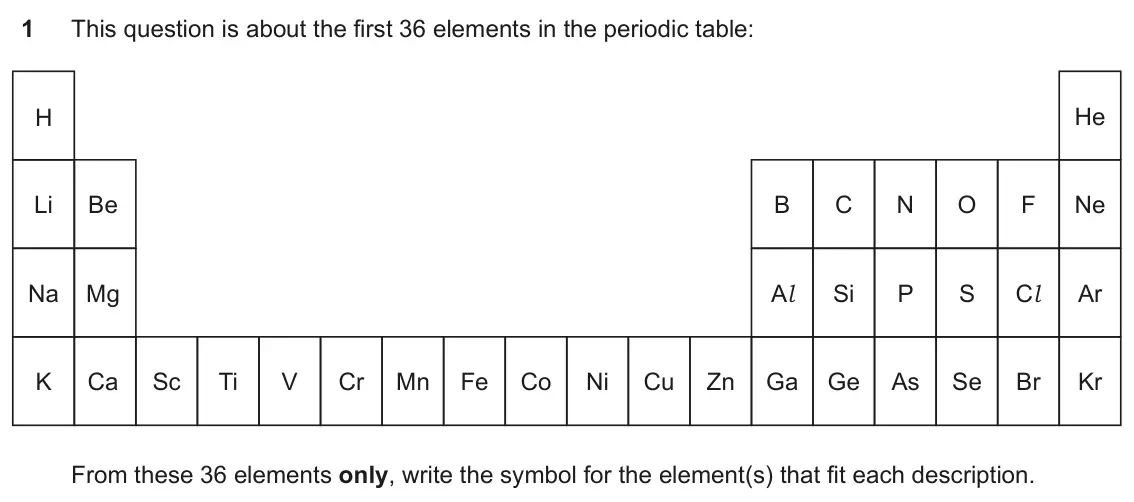
- Your answer
Q18(a)
The whole paper ↗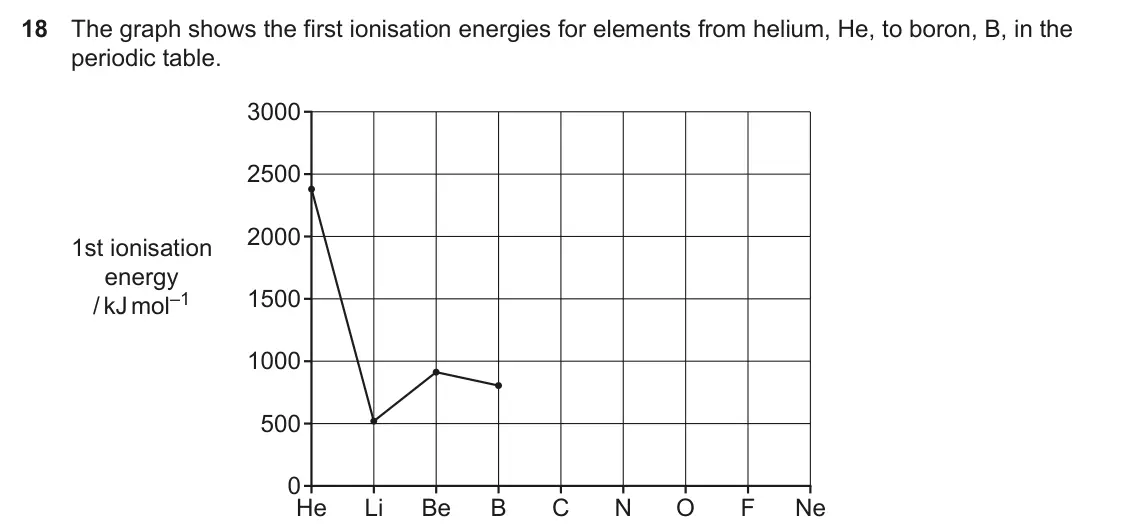
Q18(b)
The whole paper ↗Q18(c)
The whole paper ↗Q18(d)
The whole paper ↗- Your answer
- Your answer
Q16(b)(i)
The whole paper ↗
Q16(b)(ii)
The whole paper ↗- Your answer
Q5(e)
The whole paper ↗
All 33 questions on First and successive ionisation energies, as a list
- June 2025, Paper 1, Q16(b)(i) (1 mark): Write an equation to represent the first ionisation energy of sulfur. Include state symbols. [1]
- June 2025, Paper 1, Q16(b)(ii) (2 marks): The table shows that there is a general increase in first ionisation energies across Period 3, but that this trend is not followed by phosphorus to sulfur. Expl
- June 2025, AS Paper 1, Q9 (1 mark): Which equation describes the second ionisation energy of magnesium? Mg2+(g) + 2e– A Mg(g) Mg2+(g) + 2e– B Mg(s) Mg+(g) Mg2+(g) + e– C Mg2+(g) + e– Mg+(g) D Your
- June 2025, AS Paper 2, Q2(a)(i) (1 mark): Write an equation to represent the second ionisation energy of calcium. Include state symbols. [1]
- June 2024, AS Paper 2, Q2(c)(i) (2 marks): Complete the graph by adding points for the missing values of B and Mg. [2]
- June 2024, AS Paper 2, Q2(c)(ii) (2 marks): Write an equation, including state symbols, to represent the second ionisation energy of B. [2]
- June 2023, Paper 1, Q6 (1 mark): Which element has the largest third ionisation energy? A Li B F C Ne D Na Your answer [1]
- June 2023, Paper 1, Q16(b) (4 marks): The first and second ionisation energies of magnesium, Mg, and strontium, Sr, in Group 2 are given in the table below. First ionisation energy Second ionisation
- June 2023, Paper 3, Q1(b) (1 mark): The element in Period 2 with the successive ionisation energies shown below. Ionisation number 1st 2nd 3rd 4th 5th 6th 7th 8th Ionisation energy 1000 2251 3361
- June 2023, AS Paper 1, Q6 (1 mark): Successive ionisation energies, in kJ mol–1, of an element in Period 3 of the periodic table are 6 shown below. 1st 2nd 3rd 4th 5th 6th 7th 8th 9th 578 1817 274
- June 2022, Paper 1, Q18(a) (2 marks): Complete the graph for C, N, O, F and Ne. [2]
- June 2022, Paper 1, Q18(b) (1 mark): Estimate the energy required to form one Li+(g) ion from one Li(g) atom. Give your answer in kJ, in standard form, and to two significant figures. energy = kJ [
- June 2022, Paper 1, Q18(c) (4 marks): Explain why the first ionisation energies of He and Be are both higher than the first ionisation energy of Li. Explanation for He: Explanation for Be: [4]
- June 2022, Paper 1, Q18(d) (2 marks): Explain why the first ionisation energy of Be is higher than the first ionisation energy of B. [2]
- June 2022, AS Paper 1, Q6 (1 mark): The first four ionisation energies of a Period 3 element X are shown in the table. Ionisation energy / kJ mol–1 1st 2nd 3rd 4th 738 1451 7733 10 541 Element X i
- November 2021, Paper 1, Q7 (1 mark): Which row shows elements in order of increasing first ionisation energy? A Ca < Si < P < N B N < P < Si < Ca C Ca < N < P <Si D C < Si < P < Ca Your answer [1]
- November 2021, Paper 1, Q16(b)(i) (1 mark): Write an equation to represent the fourth ionisation energy of magnesium. Include state symbols. [1]
- November 2021, Paper 1, Q16(b)(ii) (1 mark): Explain how the successive ionisation energies provide evidence that magnesium is in Group 2 of the periodic table. [1]
- November 2021, AS Paper 1, Q8 (1 mark): Which sequence has elements in order of increasing first ionisation energy? A Na < Mg < Al B Mg < Al < Si C Al < Si < P D Si < P < S Your answer [1]
- November 2021, AS Paper 2, Q5(e) (2 marks): Element A is in period 3 of the periodic table (Na-Ar). The first six ionisation energies (I.E.) of element A are shown below. 1st I.E. 2nd I.E. 3rd I.E. 4th I.
- June 2019, Paper 1, Q16(e)(i) (2 marks): The first ionisation energy of sodium is more endothermic than that of potassium. Explain why. [2]
- June 2018, Paper 1, Q5 (1 mark): Which statement best explains why nitrogen has a larger first ionisation energy than oxygen? A N atoms have less repulsion between p-orbital electrons than O at
- June 2018, Paper 3, Q1(a)(ii) (1 mark): The element with the highest first ionisation energy. [1]
- June 2018, Paper 3, Q1(a)(iii) (1 mark): The element in Period 3 which has the successive ionisation energies shown below. Ionisation number 1st 2nd 3rd 4th Ionisation energy/kJ mol–1 738 1451 7733 105
- June 2018, AS Paper 1, Q9 (1 mark): The first five successive ionisation energies of an element Y are shown below. 1st 2nd 3rd 4th 5th 496 4563 6913 9544 13352 What is the formula of a chloride of
- June 2017, AS Paper 1, Q22(c)(i) (1 mark): Add a point to Fig. 22.1 for the first ionisation energy of the element with Z = 10. [1]
- June 2017, AS Paper 1, Q22(c)(ii) (1 mark): Estimate the energy required to form one Na+(g) ion from one Na(g) atom. Give your answer in kJ, in standard form, and to two significant figures. energy = kJ [
- June 2017, AS Paper 1, Q22(c)(iii) (3 marks): Explain why the first ionisation energies in Fig. 22.1 show a general increase across Period 3 (Na–Ar). [3]
- June 2017, AS Paper 1, Q22(c)(iv) (2 marks): Explain why the general increase in first ionisation energies across Period 3 is not followed for Mg (Z = 12) to Al (Z = 13). [2]
- June 2016, AS Paper 1, Q9 (1 mark): Electron configurations for atoms of different elements are shown below. Which electron configuration represents the element with the largest first ionisation e
- June 2016, AS Paper 1, Q10 (1 mark): Successive ionisation energies of four elements in Period 3 are shown below. Which letter could represent magnesium? Ionisation energy / kJ mol–1 1st 2nd 3rd 4t
- June 2016, AS Paper 2, Q1(b)(i) (1 mark): Write an equation, including state symbols, to represent the second ionisation energy of strontium. [1]
- June 2016, AS Paper 2, Q1(b)(ii) (3 marks): Explain why the first ionisation energy of strontium is less than the first ionisation energy of calcium. [3]
Questions, mark schemes and examiner’s reports are © OCR, from their published past papers. Plumi isn’t affiliated with any exam board. Want whole papers? OCR A-Level Chemistry A past papers, or our free OCR-style practice pack.
The Plumi iPad app also offers exam-style questions with AI feedback on your handwritten working.