 plumi
Electrophilic addition and Markownikoff's rule: OCR A‑Level Chemistry A questions
OCR A-Level Chemistry A past-paper questions on 4.1.3.4 Electrophilic addition and Markownikoff's rule, 2016–2025, with mark schemes and examiner’s reports where available.
Paper
All papers
Exam
All years
Calculations
- Your answer
Q16(e)
The whole paper ↗
Q24(c)(i)
The whole paper ↗
Q24(c)(ii)
The whole paper ↗Q5(b)(i)
The whole paper ↗
Q5(b)(ii)
The whole paper ↗Q16(a)(ii)
The whole paper ↗
Q21(a)(ii)
The whole paper ↗
Q16(b)(i)
The whole paper ↗
Q16(b)(ii)
The whole paper ↗Q24(a)
The whole paper ↗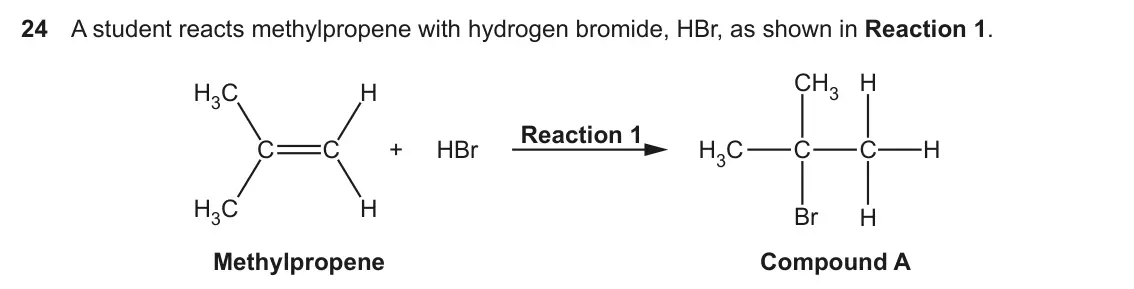
Q24(b)(ii)
The whole paper ↗Q25(b)
The whole paper ↗
Q16(a)(i)
The whole paper ↗
Q16(a)(ii)
The whole paper ↗- Your answer
Q20(d)
The whole paper ↗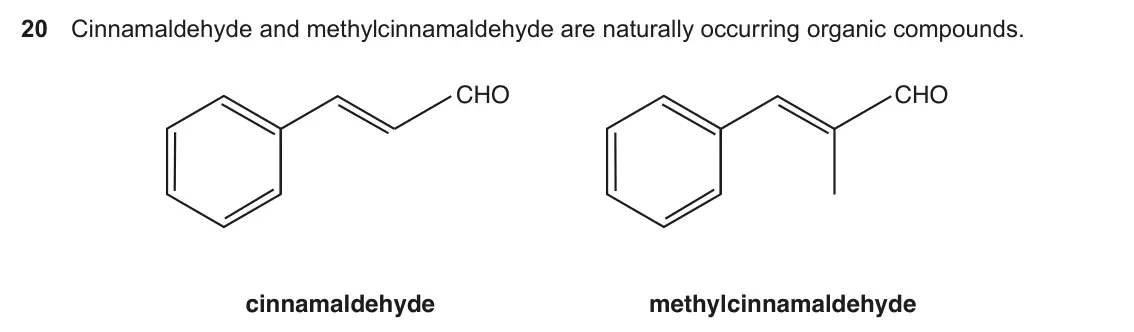
Q6(b)
The whole paper ↗
Q6(b)(ii)
The whole paper ↗
All 28 questions on Electrophilic addition and Markownikoff's rule, as a list
- June 2025, Paper 2, Q8 (1 mark): Ethene can be reacted with hydrogen bromide. Which statement about this reaction is correct? H– acts as a nucleophile. A Br+ acts as an electrophile. B Hδ+ — Br
- June 2025, Paper 2, Q16(e) (3 marks): The flowchart below shows some reactions of compound C. Complete the flowchart to show the missing reagent, catalyst and the structures of the organic products.
- June 2025, AS Paper 1, Q24(c)(i) (5 marks): Outline the mechanism for the formation of the major product, compound A. The structure of (CH3)2C=CH2 has been provided. Include curly arrows and relevant dipo
- June 2025, AS Paper 1, Q24(c)(ii) (1 mark): Explain why compound A is the major product. [1]
- June 2024, Paper 2, Q19 (6 marks): 19* Alkenes and carbonyl compounds take part in addition reactions. Describe one addition reaction of an alkene and one addition reaction of a carbonyl compound
- June 2024, AS Paper 2, Q5(b)(i) (4 marks): Outline the mechanism for the reaction of but-1-ene with HBr to form 2-bromobutane. Include curly arrows, relevant dipoles and the structure of the product. H C
- June 2024, AS Paper 2, Q5(b)(ii) (2 marks): During this reaction, a small amount of 1-bromobutane is also produced. Explain why 2-bromobutane is the major product. [2]
- June 2022, Paper 2, Q16(a)(ii) (3 marks): Outline the mechanism for the reaction of hydrocarbon A with bromine. The structure of hydrocarbon A has been provided. Include curly arrows and relevant dipole
- June 2022, AS Paper 1, Q21(a)(ii) (5 marks): (CH3)3CCH=CH2 decolourises bromine. Outline the reaction mechanism for the reaction of (CH3)3CCH=CH2 and bromine. The structure of (CH3)3CCH=CH2 has been provid
- November 2021, Paper 2, Q16(b)(i) (4 marks): Outline the reaction mechanism for the formation of this major organic product. The structure of but-1-ene has been provided. Include curly arrows and relevant
- November 2021, Paper 2, Q16(b)(ii) (2 marks): Explain why one organic product is formed in a much greater quantity than the other organic product. [2]
- November 2021, AS Paper 1, Q24(a) (4 marks): Outline the reaction mechanism for Reaction 1. The structures of methylpropene and compound A have been provided. Include curly arrows and relevant dipoles. CH3
- November 2021, AS Paper 1, Q24(b)(ii) (1 mark): Show the structure for compound B. [1]
- November 2020, AS Paper 1, Q25(b) (4 marks): Propene also reacts with bromine. Outline the mechanism for the reaction of propene with bromine, Br2. The structure of propene has been provided. Show curly ar
- June 2019, Paper 2, Q16(a)(i) (4 marks): Outline the reaction mechanism for the formation of one of the organic products. Include curly arrows and relevant dipoles. [4]
- June 2019, Paper 2, Q16(a)(ii) (2 marks): Explain why one of the organic products forms in a much greater quantity than the other organic product. [2]
- June 2019, AS Paper 1, Q16 (1 mark): Which statement about an electrophile is correct? A It is an electron pair acceptor. B It is a proton donor. C It is a negative ion. D It is a species with an u
- June 2018, Paper 2, Q20(d) (6 marks): Cinnamaldehyde and methylcinnamaldehyde are naturally occurring organic compounds. CHO CHO cinnamaldehyde methylcinnamaldehyde (d)* Methylcinnamaldehyde reacts
- June 2018, Paper 3, Q6(b) (6 marks): This question is about organic reactions. (b)* Many organic reactions use electrophiles as reagents. Explain the role of electrophiles in organic chemistry. You
- June 2018, AS Paper 2, Q6(b)(ii) (3 marks): Outline the mechanism for reaction 2. Include curly arrows, charges and relevant dipoles. [3]
- June 2017, Paper 2, Q16(d)(i) (1 mark): Suggest how an HBr molecule can act as an electrophile. [1]
- June 2017, Paper 2, Q16(d)(ii) (2 marks): Draw the structures of the two organic compounds E and F. E F [2]
- June 2017, Paper 2, Q16(d)(iii) (3 marks): Outline the mechanism of the reaction between compound D and hydrogen bromide to form either compound E or compound F. Include curly arrows and relevant dipoles
- June 2017, Paper 2, Q16(d)(iv) (1 mark): Which of E or F is the major organic product? Explain your answer. Major organic product Explanation [1]
- June 2017, AS Paper 1, Q21(a)(i) (3 marks): Complete the flowchart to show the organic products formed in the reactions. Cl Cl H Br2 H2/ Ni C C H3C H 2-chloropropene steam major product [3]
- June 2017, AS Paper 2, Q6(b) (4 marks): Cyclohexene is reacted with bromine to prepare the organic compound F. Give the structure of compound F and outline the mechanism for this reaction. Include cur
- June 2016, AS Paper 1, Q19 (1 mark): A reaction sequence is shown below: → Step 1 CH3CH=CHCH3 + HBr CH3CH2CHBrCH3 → Step 2 CH3CH2CHBrCH3 + NaOH CH3CH2CH(OH)CH3 + NaBr Which type of reaction mechani
- June 2016, AS Paper 2, Q3(c) (6 marks): Compound A is an alkene. H3C CH3 C C H CH3 compound A (c)* Compound A reacts with hydrogen bromide to form a mixture of two different organic products. H3C CH3
Questions, mark schemes and examiner’s reports are © OCR, from their published past papers. Plumi isn’t affiliated with any exam board. Want whole papers? OCR A-Level Chemistry A past papers, or our free OCR-style practice pack.
The Plumi iPad app also offers exam-style questions with AI feedback on your handwritten working.