 plumi
Alkenes: OCR A‑Level Chemistry A questions
Every OCR A-Level Chemistry A exam question on 4.1.3 Alkenes, 2016–2025, with its mark scheme and examiner’s report.
Find questions1,820
Calculations


Q16(b)
The whole paper ↗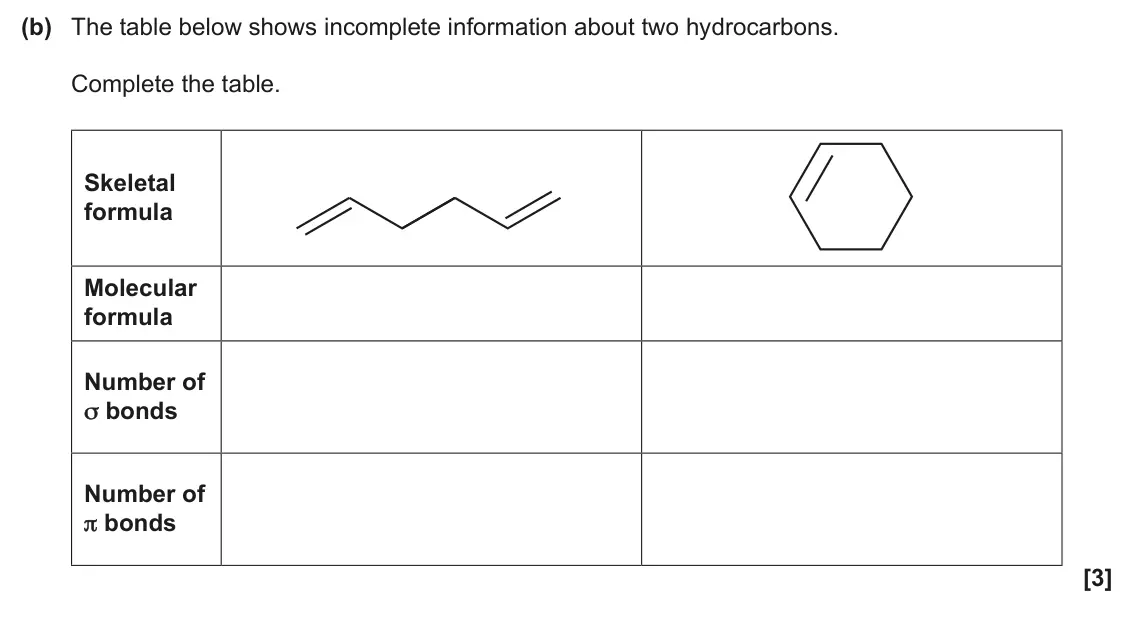
Q16(c)(i)
The whole paper ↗
Q16(c)(ii)
The whole paper ↗
Q16(e)
The whole paper ↗
Q18(a)
The whole paper ↗
Q18(b)(i)
The whole paper ↗

Q24(a)(i)
The whole paper ↗
Q24(a)(ii)
The whole paper ↗
Q24(b)
The whole paper ↗
Q24(c)(i)
The whole paper ↗
Q24(c)(ii)
The whole paper ↗
Q3(c)
The whole paper ↗


Q16(e)
The whole paper ↗

All 115 questions on Alkenes, as a list
- June 2025, Paper 2, Q8 (1 mark): Ethene can be reacted with hydrogen bromide. Which statement about this reaction is correct? H– acts as a nucleophile. A Br+ acts as an electrophile. B Hδ+ — Br
- June 2025, Paper 2, Q10 (1 mark): How many stereoisomers does the compound CH3CH(Br)CH=CHCH(Cl )CH3 have? A 2 B 4 C 6 D 8 Your answer [1]
- June 2025, Paper 2, Q16(b) (3 marks): The table below shows incomplete information about two hydrocarbons. Complete the table. Skeletal formula Molecular formula Number of σ bonds Number of π bonds
- June 2025, Paper 2, Q16(c)(i) (2 marks): Draw the structures of the E and Z stereoisomers of compound B. E Z [2]
- June 2025, Paper 2, Q16(c)(ii) (2 marks): Explain why compound B can form E and Z stereoisomers. [2]
- June 2025, Paper 2, Q16(e) (3 marks): The flowchart below shows some reactions of compound C. Complete the flowchart to show the missing reagent, catalyst and the structures of the organic products.
- June 2025, Paper 2, Q18(a) (4 marks): 1-Chlorobut-2-ene and 3-hydroxybutanoic acid can both form polymers. Draw two repeat units of each of the polymers formed. State the type of polymerisation reac
- June 2025, Paper 2, Q18(b)(i) (1 mark): Suggest why a polymer made from monomers containing chlorine, such as 1-chlorobut-2-ene, is difficult to dispose of by incineration. [1]
- June 2025, AS Paper 1, Q15 (1 mark): A compound is shown below. What is the systematic name of this compound? F CH3 C C CH3CH2 H A E-3-fluoropent-2-ene B E-3-fluoropent-3-ene C Z-3-fluoropent-2-ene
- June 2025, AS Paper 1, Q24(a)(i) (1 mark): Draw two repeat units of the polymer formed by 2-chloropropene. [1]
- June 2025, AS Paper 1, Q24(a)(ii) (1 mark): 2-Chloropropene can be disposed of by combustion. This process releases the greenhouse gas carbon dioxide. State one other problem with this method of disposal.
- June 2025, AS Paper 1, Q24(b) (1 mark): Pentene, C5H10, can undergo complete combustion to produce the same products as the combustion of an alkane. Write the equation for the complete combustion of C
- June 2025, AS Paper 1, Q24(c)(i) (5 marks): Outline the mechanism for the formation of the major product, compound A. The structure of (CH3)2C=CH2 has been provided. Include curly arrows and relevant dipo
- June 2025, AS Paper 1, Q24(c)(ii) (1 mark): Explain why compound A is the major product. [1]
- June 2025, AS Paper 2, Q3(c) (2 marks): The structure of malic acid is shown below. OH H HOOC C C COOH H H When malic acid is heated with an acid catalyst, a mixture of cis and trans stereoisomers is
- June 2024, Paper 2, Q2 (1 mark): Hydrogen reacts much more readily with alkenes than with alkanes. Why is this? A Alkenes are polar molecules whereas alkanes are not. B All atoms in an alkane h
- June 2024, Paper 2, Q4 (1 mark): The structure of but-1-ene is shown below. x y Which row has the correct shape around carbon atoms labelled x and y? x y A Tetrahedral Pyramidal B Trigonal plan
- June 2024, Paper 2, Q15 (1 mark): Polymers, such as poly(chloroethene), shown below, are difficult to dispose of. H Cl C C H H Poly(chloroethene) Which statement(s) is/are true about poly(chloro
- June 2024, Paper 2, Q16(e) (2 marks): Explain why hydrocarbon D is a Z-stereoisomer. [2]
- June 2024, Paper 2, Q19 (6 marks): 19* Alkenes and carbonyl compounds take part in addition reactions. Describe one addition reaction of an alkene and one addition reaction of a carbonyl compound
- June 2024, Paper 2, Q22(b) (3 marks): The amino acid below can form addition and condensation polymers. H H O C C H CH C H2N OH Draw 2 repeat units of these polymers. Display the sections linking th
- June 2024, AS Paper 1, Q17 (1 mark): The repeat unit of an addition polymer is shown below. CH3 Cl C C H H Which statement about this addition polymer is correct? A Combustion produces toxic alkali
- June 2024, AS Paper 2, Q5(a) (4 marks): Complete the flowchart for the reactions of but-1-ene, by adding the structures of the organic products in each box. Br2 H2 / Ni H CH2CH3 C C H H but-1-ene H2O(
- June 2024, AS Paper 2, Q5(b)(i) (4 marks): Outline the mechanism for the reaction of but-1-ene with HBr to form 2-bromobutane. Include curly arrows, relevant dipoles and the structure of the product. H C
- June 2024, AS Paper 2, Q5(b)(ii) (2 marks): During this reaction, a small amount of 1-bromobutane is also produced. Explain why 2-bromobutane is the major product. [2]
- June 2023, AS Paper 1, Q25(c) (4 marks): Alkenes are used in organic synthesis. Three reactions of an alkene are shown in the flowchart. Complete the flowchart to show the missing reagents, catalysts a
- June 2023, AS Paper 2, Q5(a)(iii) (2 marks): The skeletal formulae of alkenes B and C are shown below. Alkene B Alkene C Skeletal formula Isomer Z E Use the Cahn-Ingold-Prelog priority rules to explain why
- June 2023, AS Paper 2, Q5(b)(i) (2 marks): Draw a section of the polymer formed, showing two repeat units, and suggest why this polymer is likely to be soluble in water. Section of polymer (two repeat un
- June 2023, AS Paper 2, Q5(b)(ii) (2 marks): Outline two ways that waste hydrocarbon polymers can be processed usefully, rather than being disposed of in landfill sites. 1 2 [2]
- June 2022, Paper 2, Q2 (1 mark): Which statement about absorption of radiation is correct? A Infrared radiation can result in the breakdown of the ozone layer. B Ultraviolet radiation can cause
- June 2022, Paper 2, Q16(a)(ii) (3 marks): Outline the mechanism for the reaction of hydrocarbon A with bromine. The structure of hydrocarbon A has been provided. Include curly arrows and relevant dipole
- June 2022, Paper 2, Q16(b)(ii) (1 mark): What is meant by the term stereoisomers? [1]
- June 2022, Paper 2, Q16(b)(iii) (2 marks): Draw structures for the cis and trans isomers of the branched hydrocarbon B. cis isomer trans isomer [2]
- June 2022, Paper 2, Q16(c)(i) (2 marks): Draw the structures of the products you would expect from the ozonolysis of the two compounds below. [2]
- June 2022, Paper 2, Q19(c)(i) (2 marks): Poly(pent-3-enoic acid) is an addition polymer. Draw the structure of pent-3-enoic acid and two repeat units of this polymer. Pent-3-enoic acid Two repeat units
- June 2022, Paper 2, Q20(e) (4 marks): 1-phenylethanol is a naturally occurring compound found in many vegetables and flowers. 1-phenylethanol can be synthesised from 2-phenylethanol in two stages. H
- June 2022, AS Paper 1, Q14 (1 mark): What is the number of σ-bonds in the molecule below? A 1 B 3 C 7 D 9 Your answer [1]
- June 2022, AS Paper 1, Q17 (1 mark): Which alkene is an E stereoisomer? CH3CH2 CH3 C C A H H H3C CH2CH3 C C B H CH3 H CH3 C C C CH3CH2 C(CH3)3 H3C CH3 C C D H CH(CH3)2 Your answer [1]
- June 2022, AS Paper 1, Q21(a)(ii) (5 marks): (CH3)3CCH=CH2 decolourises bromine. Outline the reaction mechanism for the reaction of (CH3)3CCH=CH2 and bromine. The structure of (CH3)3CCH=CH2 has been provid
- June 2022, AS Paper 1, Q21(b)(i) (1 mark): Draw one repeat unit for this polymer. [1]
- June 2022, AS Paper 1, Q21(b)(ii) (1 mark): State one advantage and one disadvantage of using combustion as a method for the disposal of a polymer after it has exceeded its useful life. Advantage Disadvan
- November 2021, Paper 2, Q2 (1 mark): Which type(s) of stereoisomerism is/are shown by 2,4-dimethylhex-2-ene? A E / Z isomerism only. B Optical isomerism only. C Both E / Z isomerism and optical iso
- November 2021, Paper 2, Q16(a)(i) (2 marks): Explain what is meant by the terms σ-bond and π-bond. σ-bond: π-bond: [2]
- November 2021, Paper 2, Q16(a)(ii) (2 marks): How many σ- and π-bonds are in one molecule of buta-1,3-diene? σ-bonds: π-bonds: [2]
- November 2021, Paper 2, Q16(b)(i) (4 marks): Outline the reaction mechanism for the formation of this major organic product. The structure of but-1-ene has been provided. Include curly arrows and relevant
- November 2021, Paper 2, Q16(b)(ii) (2 marks): Explain why one organic product is formed in a much greater quantity than the other organic product. [2]
- November 2021, Paper 2, Q16(b)(iii) (1 mark): Buta-1,3-diene is reacted with an excess of hydrogen bromide, forming a mixture of saturated organic products. How many saturated organic products could be pres
- November 2021, Paper 2, Q16(c)(i) (1 mark): Explain the term stereoisomerism. [1]
- November 2021, Paper 2, Q16(c)(ii) (1 mark): Explain, with a reason, whether the student is correct or incorrect. [1]
- November 2021, Paper 2, Q16(d)(ii) (2 marks): Two more Diels-Alder reactions of buta-1,3-diene are shown below. In the boxes, draw the organic product of each reaction. O OCH3 + OCH3 O + [2]
- November 2021, Paper 2, Q17(b)(i) (1 mark): Draw the repeat unit of this oligomer. [1]
- November 2021, Paper 3, Q3(b) (7 marks): The student prepares a 100.0 cm3 solution containing 3.215 g of acid D. The student titrates 25.0 cm3 samples of the solution of D with 0.150 mol dm–3 Ba(OH)2(a
- November 2021, AS Paper 1, Q13 (1 mark): What is the number of unsaturated isomers (structural and stereoisomers) that have the molecular formula C4H8? A 3 B 4 C 5 D 6 Your answer [1]
- November 2021, AS Paper 1, Q20 (1 mark): The repeat unit of an addition polymer is shown below. H CH2OH C C H H What is the monomer? OH A B OH OH C D OH Your answer [1]
- November 2021, AS Paper 1, Q24(a) (4 marks): Outline the reaction mechanism for Reaction 1. The structures of methylpropene and compound A have been provided. Include curly arrows and relevant dipoles. CH3
- November 2021, AS Paper 1, Q24(b)(ii) (1 mark): Show the structure for compound B. [1]
- November 2020, Paper 2, Q1 (1 mark): What is the name of the compound below? H3C CH2CH3 C C H Br A E-3-bromopent-2-ene B E-3-bromopent-3-ene C Z-3-bromopent-2-ene D Z-3-bromopent-3-ene Your answer
- November 2020, Paper 2, Q2 (1 mark): Which statement about bonds is correct? A The C=C bond in ethene is more polar than the C−C bond in ethane. B A σ-bond is stronger than a π-bond. C The H−C−H bo
- November 2020, Paper 2, Q5 (1 mark): Which structure shows a section of poly(propene)? A B C D Your answer [1]
- November 2020, Paper 2, Q17(a)(i) (2 marks): Draw the structures of the organic product of each reaction. Organic product with B Organic product with C [2]
- November 2020, AS Paper 1, Q25(a) (3 marks): Two reactions of propene are shown below. In the boxes, show the structures of the organic products of the reactions. H CH3 polymerisation C C H H one repeat un
- November 2020, AS Paper 1, Q25(b) (4 marks): Propene also reacts with bromine. Outline the mechanism for the reaction of propene with bromine, Br2. The structure of propene has been provided. Show curly ar
- November 2020, AS Paper 1, Q25(c)(iii) (2 marks): Propyne reacts with bromine to form a saturated compound. Write an equation for the reaction, showing the structure of the organic product. [2]
- June 2019, Paper 2, Q4 (1 mark): The structure of a stereoisomer is shown below. H3C CH(CH3)2 C C CH3CH2 CH2CH2CH3 Which term correctly describes this stereoisomer? A cis- B trans- C E- D Z- Yo
- June 2019, Paper 2, Q5 (1 mark): Which types of bonds are broken and formed in the reaction of ethene and bromine? Types of bond broken Types of bond formed A σ π B π σ C σ and π π D σ and π σ
- June 2019, Paper 2, Q16(a)(i) (4 marks): Outline the reaction mechanism for the formation of one of the organic products. Include curly arrows and relevant dipoles. [4]
- June 2019, Paper 2, Q16(a)(ii) (2 marks): Explain why one of the organic products forms in a much greater quantity than the other organic product. [2]
- June 2019, Paper 2, Q16(b)(iv) (1 mark): Explain the term stereoisomerism. [1]
- June 2019, Paper 2, Q16(b)(v) (4 marks): The structures of geraniol and citronellal are repeated below with the carbon atoms numbered. 1 1 7 7 5 4 3 5 3 2 4 8 OH 8 2 6 O 6 Geraniol Citronellal Explain
- June 2019, Paper 2, Q19(b)(i) (3 marks): Draw two repeat units of these polymers. Two repeat units of polymer formed from D Two repeat units of polymer formed from E [3]
- June 2019, Paper 2, Q19(b)(ii) (1 mark): State the type of polymer formed from compounds D and E. From compound D From compound E [1]
- June 2019, Paper 3, Q4(b)(ii) (4 marks): α-Terpineol meets the requirements for E / Z isomerism. However, only one E / Z isomer of α-terpineol exists. Explain • why α-terpineol meets the requirements f
- June 2019, Paper 3, Q4(b)(iii) (4 marks): α-Terpineol contains two functional groups. For each functional group, choose a reagent that reacts with that group only. Draw the structures for the organic pr
- June 2019, AS Paper 1, Q14 (1 mark): What is the best description for the bonding between the carbon atoms in an ethene molecule? A One σ-bond and one π-bond B One π-bond C Two σ-bonds D Two π-bond
- June 2019, AS Paper 1, Q16 (1 mark): Which statement about an electrophile is correct? A It is an electron pair acceptor. B It is a proton donor. C It is a negative ion. D It is a species with an u
- June 2019, AS Paper 1, Q17 (1 mark): A section of a polymer is shown below. CN CN CN Which monomer could form this polymer? A CH3CH(OH)CN B HOCH2CH2CN C H2C=CHCN D NCCH=CHCN Your answer [1]
- June 2019, AS Paper 2, Q5(a)(i) (3 marks): Complete the flowchart to show the structures of the organic products of these reactions. major product Reaction 1 H2 HCl Reaction 2 hex-1-ene Br2 Reaction 3 [3
- June 2019, AS Paper 2, Q5(a)(ii) (1 mark): State the catalyst needed in reaction 1. [1]
- June 2019, AS Paper 2, Q5(a)(iii) (1 mark): What would you observe in reaction 3? [1]
- June 2019, AS Paper 2, Q5(c)(i) (1 mark): Draw a section of poly(hex-1-ene) containing two repeat units. [1]
- June 2019, AS Paper 2, Q5(c)(ii) (2 marks): Waste poly(hex-1-ene) can be disposed of usefully by recycling. State two other methods of disposing of polymers that can be beneficial to the environment. 1 2
- June 2018, Paper 2, Q16(c) (3 marks): The flowchart below shows some reactions of compound C. In the boxes, draw the organic products of these reactions. excess CH3OH/H2SO4 Steam COOH HOOC H3PO4 com
- June 2018, Paper 2, Q20(a) (2 marks): Methylcinnamaldehyde is an E stereoisomer. Explain this statement in terms of the Cahn-Ingold-Prelog (CIP) rules. [2]
- June 2018, Paper 2, Q20(d) (6 marks): Cinnamaldehyde and methylcinnamaldehyde are naturally occurring organic compounds. CHO CHO cinnamaldehyde methylcinnamaldehyde (d)* Methylcinnamaldehyde reacts
- June 2018, Paper 3, Q6(b) (6 marks): This question is about organic reactions. (b)* Many organic reactions use electrophiles as reagents. Explain the role of electrophiles in organic chemistry. You
- June 2018, AS Paper 1, Q18 (1 mark): A student reacts pent-2-ene with bromine in the laboratory. Which compound is formed? A 1,1-dibromopentane B 1,2-dibromopentane C 2,2-dibromopentane D 2,3-dibro
- June 2018, AS Paper 1, Q19 (1 mark): The molecule below has two double bonds, labelled 1 and 2. 1 2 The arrangement around each double bond can be identified as E or Z. Which row in the table is co
- June 2018, AS Paper 2, Q6(a) (1 mark): State the reagents and conditions for reaction 1. [1]
- June 2018, AS Paper 2, Q6(b)(ii) (3 marks): Outline the mechanism for reaction 2. Include curly arrows, charges and relevant dipoles. [3]
- June 2018, AS Paper 2, Q6(c)(i) (2 marks): Write a balanced equation for this reaction. Show displayed formulae. [2]
- June 2018, AS Paper 2, Q6(c)(ii) (2 marks): State one advantage and one disadvantage of using combustion as a method for the disposal of waste polymer E. Advantage Disadvantage [2]
- June 2017, Paper 2, Q4 (1 mark): Which molecule is a Z-isomer? H3C H Cl F F CH3 H CH3 C C C C C C C C H F H CH3 Cl H H F A B C D Your answer [1]
- June 2017, Paper 2, Q16(b)(ii) (1 mark): Define the term stereoisomers. [1]
- June 2017, Paper 2, Q16(b)(iii) (2 marks): Draw the structures of the cis and trans stereoisomers of compound C. cis trans [2]
- June 2017, Paper 2, Q16(c) (1 mark): The C=C group in an alkene contains a π-bond. Complete the diagram below to show how p-orbitals are involved in the formation of a π-bond. [1]
- June 2017, Paper 2, Q16(d)(i) (1 mark): Suggest how an HBr molecule can act as an electrophile. [1]
- June 2017, Paper 2, Q16(d)(ii) (2 marks): Draw the structures of the two organic compounds E and F. E F [2]
- June 2017, Paper 2, Q16(d)(iii) (3 marks): Outline the mechanism of the reaction between compound D and hydrogen bromide to form either compound E or compound F. Include curly arrows and relevant dipoles
- June 2017, Paper 2, Q16(d)(iv) (1 mark): Which of E or F is the major organic product? Explain your answer. Major organic product Explanation [1]
- June 2017, Paper 2, Q16(e)(ii) (4 marks): β-Carotene is a naturally occurring unsaturated hydrocarbon found in carrots. A β-carotene molecule contains 40 carbon atoms, has two rings, and a branched chai
- June 2017, AS Paper 1, Q14 (1 mark): What is the systematic name of the compound below? Br A E-2-bromobut-2-ene B Z-2-bromobut-2-ene C E-1,2-dimethyl-1-bromoethene D Z-1,2-dimethyl-1-bromoethene Yo
- June 2017, AS Paper 1, Q21(a)(i) (3 marks): Complete the flowchart to show the organic products formed in the reactions. Cl Cl H Br2 H2/ Ni C C H3C H 2-chloropropene steam major product [3]
- June 2017, AS Paper 1, Q21(a)(ii) (1 mark): The reaction of 2-chloropropene with steam requires a catalyst. State a suitable catalyst for this reaction. [1]
- June 2017, AS Paper 1, Q21(b)(i) (2 marks): Write a balanced equation for the formation of this polymer. The equation should include the structure of the repeat unit of the polymer. [2]
- June 2017, AS Paper 1, Q21(b)(ii) (1 mark): After their useful life, waste polymers can be disposed of by combustion. State one particular problem with disposal of poly(2-chloropropene) by combustion. [1]
- June 2017, AS Paper 2, Q6(b) (4 marks): Cyclohexene is reacted with bromine to prepare the organic compound F. Give the structure of compound F and outline the mechanism for this reaction. Include cur
- June 2016, AS Paper 1, Q15 (1 mark): Which compound has non-polar molecules? A E-1,2-dichlorobut-2-ene B E-2,3-dichlorobut-2-ene C Z-2,3-dichlorobut-2-ene D Z-1,4-dichlorobut-2-ene Your answer [1]
- June 2016, AS Paper 1, Q16 (1 mark): The displayed formula for a hydrocarbon is shown below. H H H C H C C H C C H H H How many σ and π bonds are present in a molecule of this hydrocarbon? σ bonds
- June 2016, AS Paper 1, Q19 (1 mark): A reaction sequence is shown below: → Step 1 CH3CH=CHCH3 + HBr CH3CH2CHBrCH3 → Step 2 CH3CH2CHBrCH3 + NaOH CH3CH2CH(OH)CH3 + NaBr Which type of reaction mechani
- June 2016, AS Paper 1, Q26(a)(ii) (1 mark): What reagents and conditions are needed to convert compound B into a saturated hydrocarbon? [1]
- June 2016, AS Paper 1, Q26(b) (2 marks): Some reactions involving compound B are shown in the flowchart below. Complete the flowchart, showing the structures of organic compounds C and D. H CH3 concent
- June 2016, AS Paper 2, Q3(a)(i) (1 mark): Describe one difference between the σ bond and the π bond. [1]
- June 2016, AS Paper 2, Q3(a)(ii) (1 mark): Explain why compound A does not have E/Z isomers. [1]
- June 2016, AS Paper 2, Q3(a)(iii) (2 marks): A structural isomer of compound A has E/Z isomers. Draw the structure of the Z isomer and then name this isomer. structure of Z isomer name [2]
- June 2016, AS Paper 2, Q3(c) (6 marks): Compound A is an alkene. H3C CH3 C C H CH3 compound A (c)* Compound A reacts with hydrogen bromide to form a mixture of two different organic products. H3C CH3
Questions, mark schemes and examiner’s reports are © OCR, from their published past papers. Plumi isn’t affiliated with any exam board. Want whole papers? Every OCR A-Level Chemistry A paper, or our free OCR-style practice pack.
Rather write your answers by hand on iPad? Plumi marks them against the same mark schemes.