 plumi
Carbonyl compounds: OCR A‑Level Chemistry A questions
Every OCR A-Level Chemistry A exam question on 6.1.2 Carbonyl compounds, 2016–2025, with its mark scheme and examiner’s report.
Find questions1,820
Calculations
Q21(b)
The whole paper ↗
Q21(d)
The whole paper ↗
Q5(a)(iv)
The whole paper ↗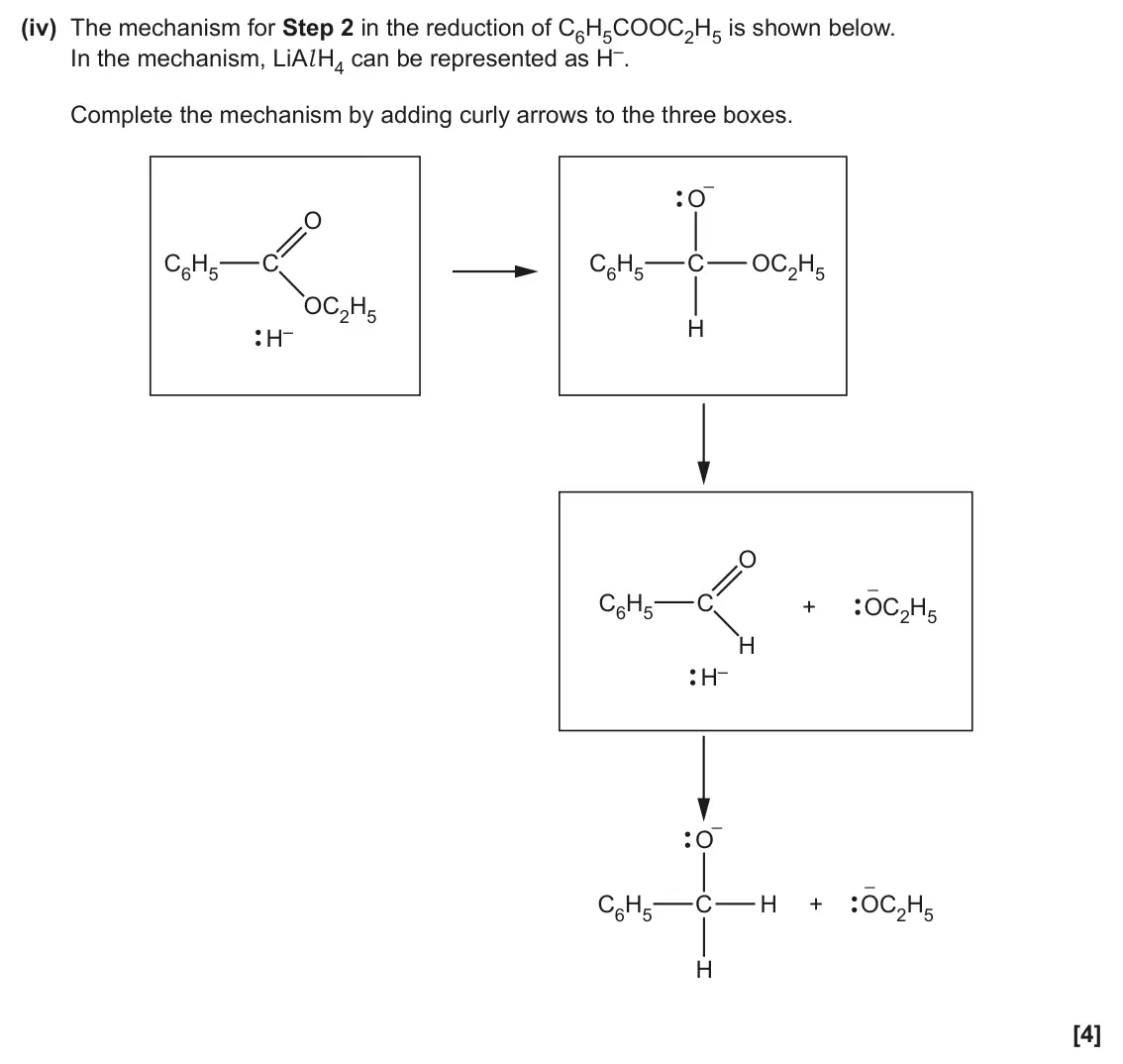
Q5(a)(v)
The whole paper ↗


Q22(a)(i)
The whole paper ↗
Q22(a)(ii)
The whole paper ↗
Q18(a)(i)
The whole paper ↗
Q18(a)(ii)
The whole paper ↗

Q19(b)
The whole paper ↗
Q19(c)(i)
The whole paper ↗

Q16(b)(i)
The whole paper ↗

Q20(b)(ii)
The whole paper ↗
Q20(b)(iii)
The whole paper ↗
Q20(c)
The whole paper ↗
Q22(c)(ii)
The whole paper ↗
All 22 questions on Carbonyl compounds, as a list
- June 2025, Paper 2, Q21(b) (2 marks): A chemical test is carried out which gives a positive result for all three compounds. Suggest the reagent and observation of this chemical test. Reagent Observa
- June 2025, Paper 2, Q21(d) (4 marks): Pyruvic acid reacts with NaBH4. Outline the mechanism for the reaction of pyruvic acid with NaBH4. Include curly arrows and relevant dipoles. O C H3C COOH [4]
- June 2025, Paper 3, Q5(a)(iv) (4 marks): The mechanism for Step 2 in the reduction of C6H5COOC2H5 is shown below. In the mechanism, LiAl H4 can be represented as H–. Complete the mechanism by adding cu
- June 2025, Paper 3, Q5(a)(v) (1 mark): Suggest why the student heated the mixture from Step 2 with dilute aqueous acid in Step 3. [1]
- June 2024, Paper 2, Q19 (6 marks): 19* Alkenes and carbonyl compounds take part in addition reactions. Describe one addition reaction of an alkene and one addition reaction of a carbonyl compound
- June 2023, Paper 2, Q2 (1 mark): Which compound reacts with 2,4-dinitrophenylhydrazine but does not react with Tollens’ reagent? A C6H5COCOOH B C6H5CH(OH)CHO C CH3COCHO D CH3CH2CH(OH)CH3 Your a
- June 2023, Paper 2, Q22(a)(i) (4 marks): Outline the reaction mechanism for this reaction, showing the intermediate and the organic product. The structure of acrolein has been provided. Include curly a
- June 2023, Paper 2, Q22(a)(ii) (1 mark): Name this type of mechanism. [1]
- June 2022, Paper 2, Q18(a)(i) (3 marks): Describe a chemical test to confirm the presence of a carbonyl group. How could the product of this test be used to identify the carbonyl compound? Your answer
- June 2022, Paper 2, Q18(a)(ii) (1 mark): Describe a chemical test that would identify whether a carbonyl compound is an aldehyde. Your answer should include the reagent and observations. [1]
- November 2021, Paper 2, Q5 (1 mark): 2-Methylcyclopentanone, shown below, is reacted with NaCN(aq)/H+(aq) to form an organic 5 product. O CH3 2-methylcyclopentanone Which statement is correct? A In
- November 2020, Paper 2, Q19(b) (4 marks): Describe suitable chemical tests, with observations, that would confirm the presence of the functional groups in F and G. [4]
- November 2020, Paper 2, Q19(c)(i) (5 marks): Outline the mechanism for the reaction of F with NaCN(aq) and H+(aq) and state the name of the mechanism. The structure of F has been provided. Include relevant
- June 2019, Paper 2, Q13 (1 mark): A carbonyl compound is reacted with NaBH4. Which compound(s) could be formed? 1 2-Methylpentan-2-ol 2 2-Methylpentan-1-ol 3 3-Methylpentan-2-ol A 1, 2 and 3 B O
- June 2019, Paper 2, Q16(b)(i) (2 marks): Describe how the observations from a chemical test would distinguish between geraniol and citronellal. [2]
- June 2018, Paper 2, Q3 (1 mark): Which compound does not react with nucleophiles? A CH3CH2CHO B CH3CHCH2 C CH3CH2COCH3 D CH3CH2CH2Cl Your answer [1]
- June 2018, Paper 2, Q20(b)(ii) (1 mark): Describe a chemical test to confirm that both compounds contain an aldehyde functional group. Your answer should include the reagent and observations. [1]
- June 2018, Paper 2, Q20(b)(iii) (3 marks): Describe a chemical test to confirm that cinnamaldehyde and methylcinnamaldehyde contain a carbonyl group. How could the products of this test be used to distin
- June 2018, Paper 2, Q20(c) (5 marks): The flowchart below shows some reactions starting with cinnamaldehyde. Draw the structures of the missing organic compounds in the boxes and add the missing rea
- June 2018, Paper 2, Q22(c)(ii) (2 marks): Solketal has been investigated as a potential fuel additive. O HO O solketal Solketal is synthesised from propane-1,2,3-triol and a carbonyl compound. Construct
- June 2018, Paper 3, Q6(a)(iv) (1 mark): A similar reaction takes place when propanone, (CH3)2CO, is mixed with OH–(aq) ions. Draw the structure of the organic product of this reaction. [1]
- June 2017, Paper 3, Q5(a)(iv) (2 marks): Propane-1,3-dithiol reacts with carbonyl compounds in a condensation reaction to form a cyclic organic sulfur product. Write an equation for the reaction of pro
Questions, mark schemes and examiner’s reports are © OCR, from their published past papers. Plumi isn’t affiliated with any exam board. Want whole papers? Every OCR A-Level Chemistry A paper, or our free OCR-style practice pack.
Rather write your answers by hand on iPad? Plumi marks them against the same mark schemes.