 plumi
Transport in plants: OCR A‑Level Biology A questions
Every OCR A-Level Biology A exam question on 3.1.3 Transport in plants, 2016–2025, with its mark scheme and examiner’s report.
Find questions1,984
Calculations
Q1(a)
The whole paper ↗
Q1(b)(i)
The whole paper ↗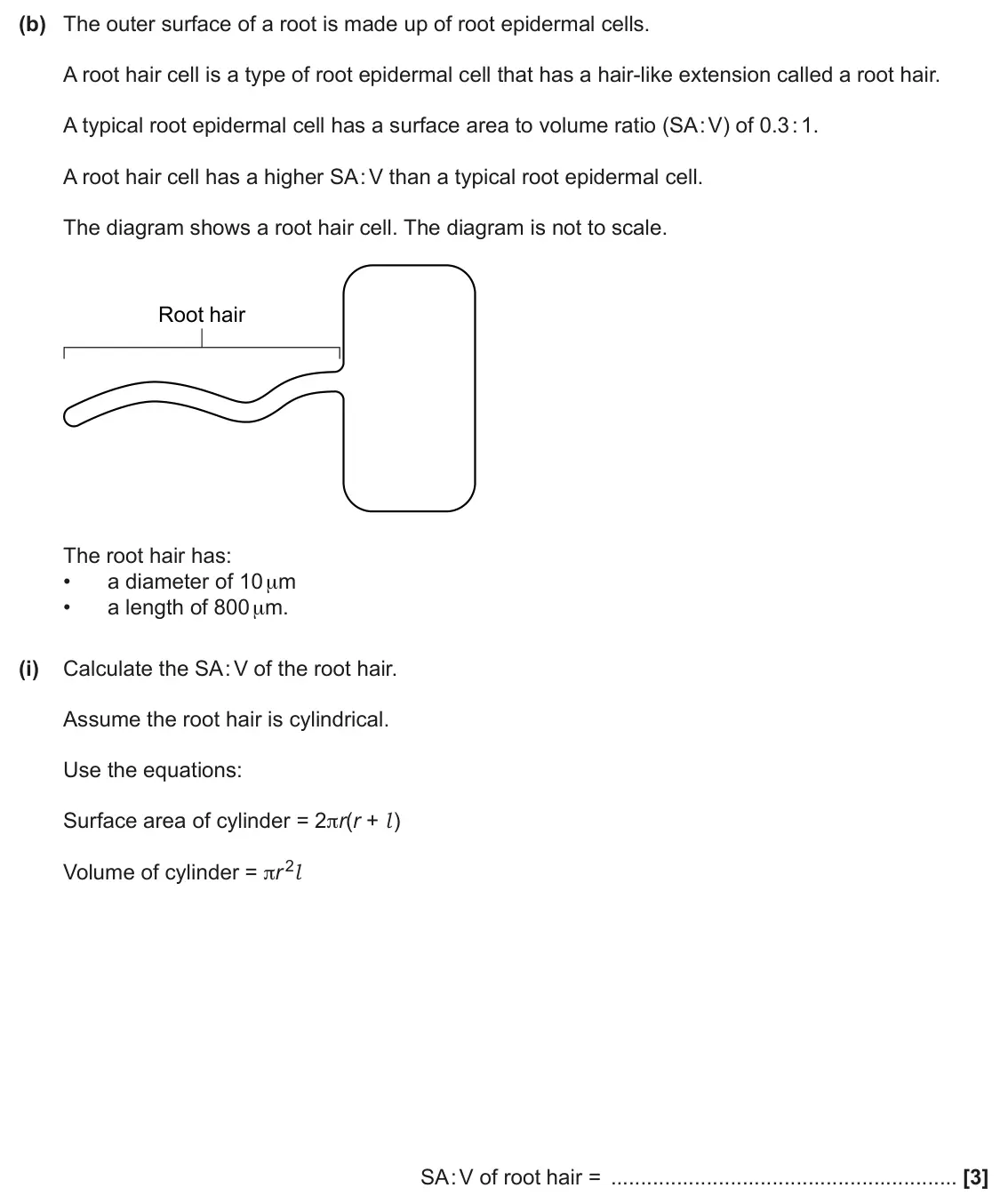
Q1(b)(ii)
The whole paper ↗
Q1(c)
The whole paper ↗
Q24(a)
The whole paper ↗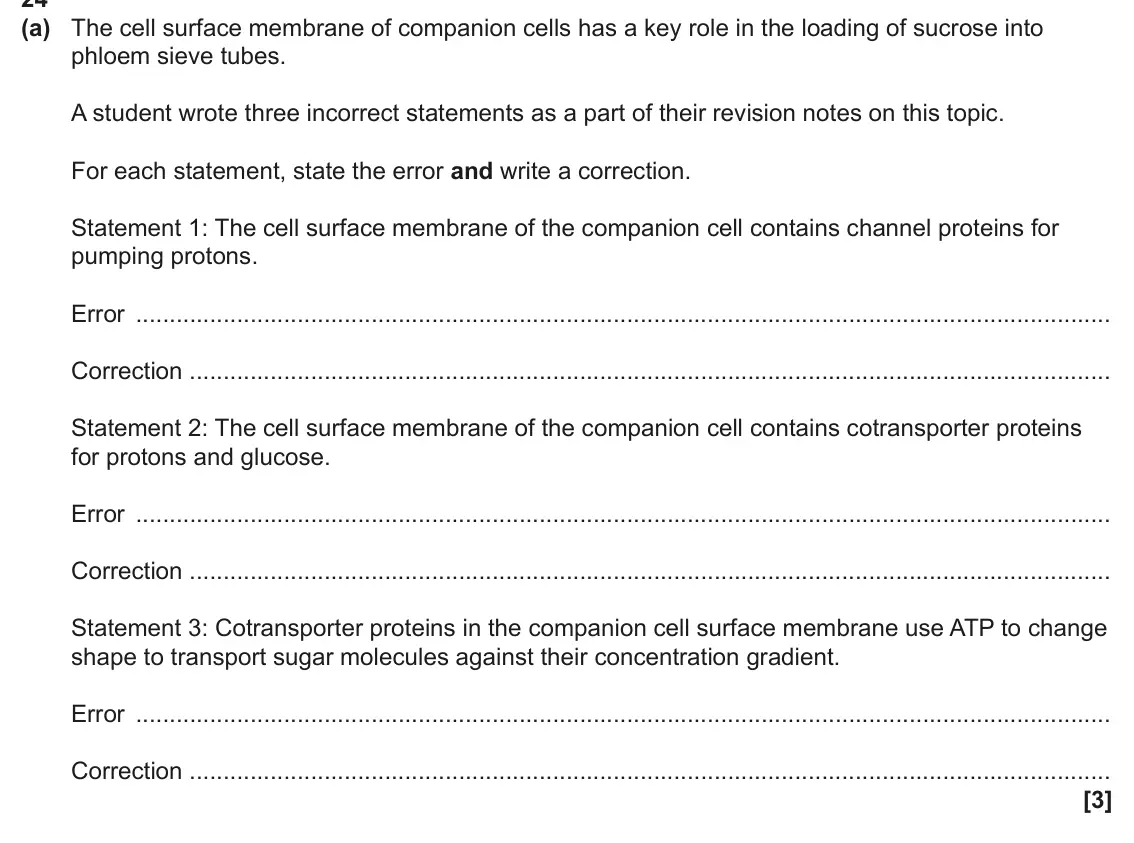
Q3(b)(i)
The whole paper ↗
Q3(c)(i)
The whole paper ↗
Q3(c)(ii)
The whole paper ↗
Q3(d)
The whole paper ↗

Q22(b)(i)
The whole paper ↗
Q22(b)(ii)
The whole paper ↗
Q22(c)
The whole paper ↗
Q22(d)
The whole paper ↗
Q21(a)(i)
The whole paper ↗
Q21(a)(ii)
The whole paper ↗
Q21(a)(iii)
The whole paper ↗
Q21(b)(i)
The whole paper ↗
Q21(b)(ii)
The whole paper ↗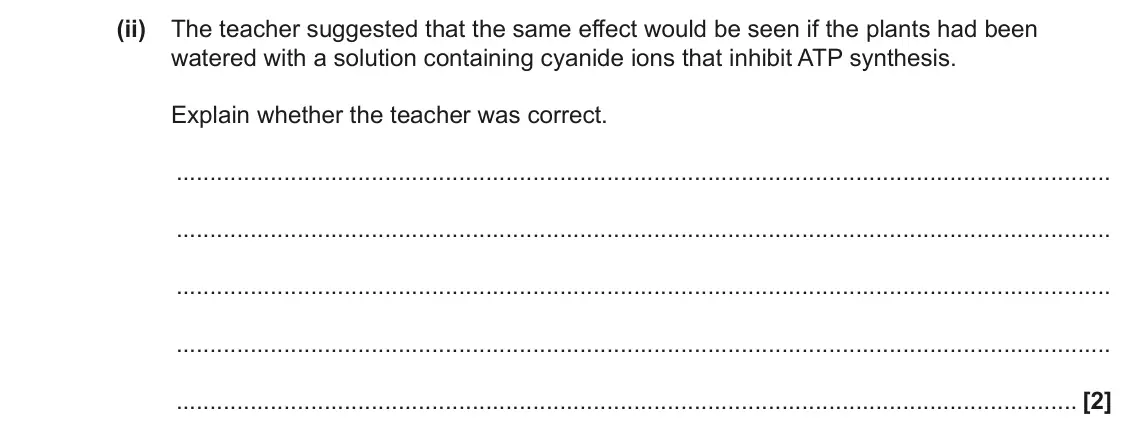
All 100 questions on Transport in plants, as a list
- June 2025, Paper 3, Q1(a) (2 marks): The photomicrograph shows a transverse section through the root of a herbaceous dicotyledonous plant. A B Name the cells labelled A and B in the photomicrograph
- June 2025, Paper 3, Q1(b)(i) (3 marks): Calculate the SA : V of the root hair. Assume the root hair is cylindrical. Use the equations: Surface area of cylinder = 2πr(r + l ) Volume of cylinder = πr 2l
- June 2025, Paper 3, Q1(b)(ii) (1 mark): State how a high SA : V helps a root hair cell perform its function. [1]
- June 2025, Paper 3, Q1(c) (3 marks): Carbohydrates produced in palisade cells are transported in phloem to sinks, such as roots. Describe how carbohydrates move from palisade cells into companion c
- June 2025, AS Paper 1, Q24(a) (3 marks): The cell surface membrane of companion cells has a key role in the loading of sucrose into phloem sieve tubes. A student wrote three incorrect statements as a p
- June 2024, Paper 3, Q3(b)(i) (2 marks): State and explain one safety precaution that the students should take when dissecting the vascular tissue. [2]
- June 2024, Paper 3, Q3(c)(i) (2 marks): The scientist plans to calculate the rate of transpiration by measuring the distance moved by the air bubble. The scientist carries out a preliminary trial by m
- June 2024, Paper 3, Q3(c)(ii) (6 marks): Xylem vessels maintain the transpiration stream by transporting water up plant stems. (ii)* Describe how the scientist could use the potometer to collect the da
- June 2024, Paper 3, Q3(d) (2 marks): Many plants, such as Erica cinerea (bell heather), have evolved adaptations to limit water loss by transpiration. This is a drawing of a leaf of E. cinerea. Air
- June 2024, AS Paper 1, Q7 (1 mark): A potometer was used to estimate the rate of transpiration. The graph below shows the results from the experiment. 80 60 Volume of water taken up 40 by plant sh
- June 2024, AS Paper 1, Q22(b)(i) (2 marks): Identify tissues E and F. Tissue E Tissue F [2]
- June 2024, AS Paper 1, Q22(b)(ii) (2 marks): Explain two ways tissue G is adapted for its function. [2]
- June 2024, AS Paper 1, Q22(c) (3 marks): The sentences are about the transport of water through a plant. Complete the sentences using the most appropriate terms. In the apoplast pathway, water moves th
- June 2024, AS Paper 1, Q22(d) (2 marks): Xerophytes are plants that are adapted to living in dry environments. Explain two ways that xerophytes are adapted to prevent water loss in dry environments. 1
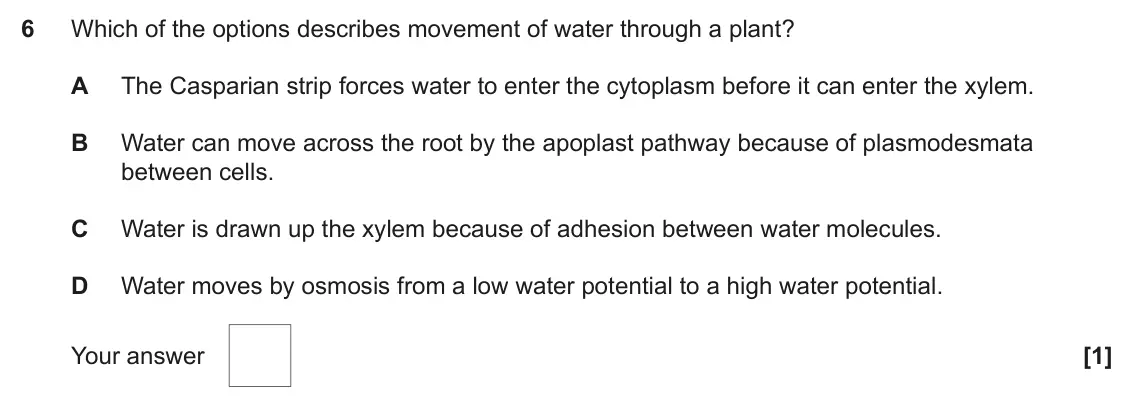
- June 2023, Paper 1, Q6 (1 mark): Which of the options describes movement of water through a plant? A The Casparian strip forces water to enter the cytoplasm before it can enter the xylem. B Wat
- June 2023, Paper 1, Q21(a)(i) (2 marks): Describe what is meant by the term transpiration stream. [2]
- June 2023, Paper 1, Q21(a)(ii) (1 mark): Suggest why the scientists sealed the borehole with tape. [1]
- June 2023, Paper 1, Q21(a)(iii) (2 marks): The scientists found that the dye moved both up and down the stems. A student wanted to investigate this in the laboratory. They devised an experiment using wat
- June 2023, Paper 1, Q21(b)(i) (3 marks): Explain why the plants wilted, even though they were given a lot of water. [3]
- June 2023, Paper 1, Q21(b)(ii) (2 marks): The teacher suggested that the same effect would be seen if the plants had been watered with a solution containing cyanide ions that inhibit ATP synthesis. Expl
- June 2023, Paper 1, Q21(b)(iii) (2 marks): Explain why plants growing in high light intensity require more water than plants growing in shade, even when the temperatures are the same. [2]
- June 2023, AS Paper 1, Q20 (1 mark): Which of the options is an adaptation of a hydrophyte? A A thick waxy cuticle B Fewer leaves, which results in a reduced SA:V ratio C Many stomata on the upper
- June 2023, AS Paper 2, Q1(a)(i) (2 marks): Using the data provided in Fig. 1.1, calculate the surface area : volume of the large multicellular plant. Surface area : volume = [2]
- June 2023, AS Paper 2, Q1(a)(ii) (2 marks): Explain why a large multicellular plant needs a transport system but a small multicellular plant does not. [2]
- June 2023, AS Paper 2, Q1(b) (6 marks): (b)* Fig. 1.2 shows a diagram of phloem tissue in the stem of a herbaceous dicotyledonous plant. Fig. 1.2 Sieve pore Companion cell Sieve tube element Nucleus C
- June 2023, AS Paper 2, Q2(a)(i) (1 mark): State the cause of transpiration in plants. [1]
- June 2023, AS Paper 2, Q2(a)(ii) (1 mark): Two factors that affect the rate of transpiration in plants are humidity and air movement. Name one other factor that affects the rate of transpiration in plant
- June 2023, AS Paper 2, Q2(b)(i) (3 marks): Suggest three improvements the students could have made to their investigation. Improvement 1 Improvement 2 Improvement 3 [3] 8 The students’ results are shown
- June 2023, AS Paper 2, Q2(b)(ii) (2 marks): Complete the table by filling in the missing values for mean and rate of bubble movement for group A. Give your answers to 1 decimal place. Mean = mm Rate of bu
- June 2023, AS Paper 2, Q2(b)(iii) (1 mark): State the conclusion that can be drawn from the students’ results. [1]
- June 2023, AS Paper 2, Q2(c) (2 marks): The students wanted to see how air movement affects rate of transpiration. Describe how you would modify the apparatus shown in Fig. 2.1 and Fig. 2.2 to determi
- June 2022, Paper 1, Q16(a) (3 marks): Explain, using examples of transported substances, why multicellular plants need transport systems. [3]
- June 2022, Paper 1, Q16(b)(i) (1 mark): Identify the tissue labelled B in Fig. 16.1. B [1]
- June 2022, Paper 1, Q16(b)(ii) (2 marks): State two functions of structure A. 1 2 [2]
- June 2022, Paper 1, Q16(c) (4 marks): Fig. 16.2 on the insert is a coloured scanning electron micrograph (SEM) of a longitudinal section through vascular tissue in the stem of a dicotyledon. Explain
- June 2022, Paper 1, Q16(d) (3 marks): A mycorrhiza is mutualistic association between a fungus and a plant. The fungus penetrates root cells and assists with uptake of water and nutrients. A group o
- June 2022, AS Paper 1, Q10 (1 mark): Victoria cruziana is a tropical species of flowering plant, native to South America. Its leaves have stomata only on their upper surface and contain a large amo
- June 2022, AS Paper 1, Q13 (1 mark): Cells in the leaves of plants synthesise amino acids. Which of the statements explains why plants need a vascular system to support amino acid synthesis? A To t
- June 2022, AS Paper 1, Q24(a)(i) (1 mark): Describe what happens inside the model, immediately after the tap on the flask is opened. [1]
- June 2022, AS Paper 1, Q24(a)(ii) (2 marks): Explain why the water level in the capillary tube starts to rise after a few minutes. [2]
- June 2022, AS Paper 1, Q24(a)(iii) (3 marks): With reference to the diagram, name the plant cells or tissues that are represented by: The capillary tube The beaker of distilled water The flask [3]
- June 2022, AS Paper 1, Q24(b) (2 marks): The student measured the increase in the level of the coloured liquid in the capillary tube after 2 minutes. It had risen by 8 mm. The capillary tube has a diam
- June 2022, AS Paper 1, Q25(a)(ii) (3 marks): Explain how the properties of water are related to the transport role of water in a stem. [3]
- November 2021, Paper 1, Q15 (1 mark): Water is transported across the root of a plant by more than one pathway. Which of the following statements about water molecules moving via the symplast pathwa
- November 2021, Paper 1, Q19(b)(ii) (1 mark): Cacti are popular house plants. Suggest why cacti do not grow well in a terrarium. [1]
- November 2021, Paper 1, Q20(a) (2 marks): Besides safety precautions, explain one practical precaution that should be taken when using a potometer. Precaution Explanation [2]
- November 2021, Paper 1, Q20(b)(i) (2 marks): Calculate the standard deviation for the distance travelled when the fan was switched on. 2 / ( x x ) - Use the formula: s = n 1 - Give your answer to 2 signifi
- November 2021, Paper 1, Q20(b)(ii) (1 mark): What can you conclude from comparing the standard deviations of the two means? [1]
- November 2021, Paper 1, Q20(c)(i) (2 marks): The student wanted to estimate the total leaf surface area of the shoot. At the end of the investigation they removed all the leaves from the shoot. They placed
- November 2021, Paper 1, Q20(c)(ii) (2 marks): In this investigation, the student calculated the rate of transpiration to be 30 mm3 min–1. They estimated the total leaf surface area of the shoot to be 37 cm2
- November 2021, Paper 1, Q20(e) (6 marks): The figure shows a potometer used to measure the rate of transpiration in a leafy shoot. leafy shoot water reservoir screw capillary tube clip air-water rubber
- November 2021, AS Paper 1, Q5 (1 mark): The rate of transpiration of water can be estimated by recording the rate of water uptake using a potometer. Two potometers were set up, one with large leaves a
- November 2021, AS Paper 1, Q10 (1 mark): The image below shows a transverse section of a stem vascular bundle of a sunflower, Helianthus annuus. Which of the options, A to D, labels the xylem vessels?
- November 2021, AS Paper 1, Q11 (1 mark): Wolffia arrhiza is one of the smallest flowering plants in the world. Which of the options, A to D, explains the absence of a transport system in Wolffia arrhiz
- November 2020, Paper 1, Q3 (1 mark): The figure below shows a drawing of a light microscope image. The image is a cross-section taken from the stem of a dicotyledonous plant. F E G Which of the row
- November 2020, Paper 1, Q4 (1 mark): Which of the following statements, A to D, does not correctly describe the structure or formation of plant vascular tissues? A Companion cells are linked to xyl
- November 2020, Paper 1, Q5 (1 mark): Large multicellular animals need a transport system for oxygen and carbon dioxide. Large multicellular plants do not need a transport system for oxygen and carb
- November 2020, Paper 1, Q6 (1 mark): Which of the following statements, A to D, describes the movement of water across plant roots? A The Casparian strip blocks movement by the symplast pathway. B
- November 2020, Paper 1, Q7 (1 mark): Which of the following statements about water transport in plants is/are correct? 1 Transpiration happens as a consequence of the need for gas exchange. 2 There
- November 2020, AS Paper 1, Q24(a) (4 marks): Identify two problems with this method and for each problem suggest how the method can be improved. 1 2 [4]
- November 2020, AS Paper 1, Q24(b) (2 marks): The results of the experiment are shown in Fig. 24.2. 0.05 0.04 0.03 volume of water collected after 6 hours per area of leaf (cm3 cm–2) 0.02 0.01 0 tomato wate
- November 2020, AS Paper 1, Q24(c) (4 marks): Describe how a potometer can be used to calculate a more accurate rate of transpiration. [4]
- November 2020, AS Paper 1, Q24(d) (2 marks): Name and describe two pathways that water takes to reach the xylem vessels at the base of the stem. [2]
- June 2019, Paper 3, Q1(b) (3 marks): Sago pondweed has evolved many adaptations to its aquatic environment. Three such adaptations are described below. Explain the advantage of each adaptation. Ada
- June 2019, AS Paper 1, Q11 (1 mark): The giant water lily, Victoria amazonica, grows in the shallow waters of the Amazon river basin. Which of the following adaptations, A to D, enables Victoria am
- June 2019, AS Paper 1, Q24(a) (3 marks): Water enters plants through the roots. Most roots are covered in root hairs. The number of root hairs per mm2 of root surface is described as the density of roo
- June 2019, AS Paper 1, Q24(b)(i) (3 marks): Calculate the standard deviation of root hair density for cress grown in mineral solution B. 2 x x / ( ) - = Use the formula: s n 1 - [Write your answer in the
- June 2019, AS Paper 1, Q24(b)(ii) (1 mark): The scientist thought that mineral solution B might cause a reduction in root hair density. Suggest an appropriate statistical test that the scientist could car
- June 2019, AS Paper 1, Q24(c)(i) (3 marks): Identify A, B and C on Fig. 24. A B C [3]
- June 2019, AS Paper 1, Q24(c)(ii) (1 mark): Some plants, such as mosses, do not have xylem. Mosses are small plants that rarely grow more than a few cm in height. Suggest why mosses do not need structures
- June 2019, AS Paper 2, Q1(a)(i) (1 mark): Phloem tissue is made up of different cell types. Identify the type of phloem cell into which the stylet is inserted to obtain the sap. [1]
- June 2019, AS Paper 2, Q1(b)(ii) (1 mark): Suggest why sucrose is a more suitable transport molecule than glucose. [1]
- June 2019, AS Paper 2, Q4(a)(i) (1 mark): State what assumption is made when using this apparatus to measure the rate of transpiration. [1]
- June 2019, AS Paper 2, Q4(a)(ii) (6 marks): An investigation was carried out into the loss of water from a leafy shoot. The apparatus used is shown in Fig. 4.1. water leafy shoot syringe rubber tube tap a
- June 2019, AS Paper 2, Q4(b)(i) (3 marks): Identify an anomalous reading in the data and evaluate the extent to which it has affected the mean that has been calculated. [3]
- June 2019, AS Paper 2, Q4(b)(ii) (1 mark): Suggest a reason for the reading that you identified as anomalous in (i). [1]
- June 2019, AS Paper 2, Q4(b)(iii) (3 marks): The internal diameter of the capillary tubing was 0.7 mm. Table 4.2 shows the mean rate of transpiration in each of the experimental conditions. Mean rate of tr
- June 2019, AS Paper 2, Q4(b)(iv) (1 mark): The control experiment in this investigation was to measure the mean rate of transpiration in still air. Explain why the control experiment is carried out in th
- June 2019, AS Paper 2, Q4(c) (1 mark): Another student suggested using an alternative apparatus for measuring the rate of transpiration of a leafy shoot. Fig. 4.2 shows this apparatus. leafy shoot ca
- June 2019, AS Paper 2, Q4(d) (2 marks): The student wanted to compare the rates of transpiration of the two leafy shoots shown in Fig. 4.3. Fig. 4.3 Describe how the student could ensure that a valid
- June 2018, Paper 1, Q6 (1 mark): Which of the statements, A to D, applies to transpiration and evaporation? A It occurs at a faster rate at higher humidity. B It occurs at a slower rate at grea
- June 2018, Paper 1, Q18(a) (6 marks): (a)* Plants lose water by transpiration. The rate of transpiration varies between different species of plant. The rate of transpiration can be measured using a
- June 2018, Paper 3, Q1(b) (2 marks): Fig. 1 shows a cross section of the root of an onion plant. M N Fig. 1 Identify the tissues shown at M and N. M N [2]
- June 2018, Paper 3, Q2(b) (3 marks): Glucose and other carbohydrates are present in respiring cells. The concentrations of carbohydrate molecules vary between tissues. A student conducted tests on
- June 2018, AS Paper 1, Q3 (1 mark): A student designed an investigation into the rate of transpiration in plants. They used eight leaves of the same size, age and species. They kept environmental
- June 2018, AS Paper 1, Q9 (1 mark): Which of the following, A to D, is not an adaptation to reduce water loss in plants? A an extensive root system that extends far from the plant B leaves that ar
- June 2018, AS Paper 1, Q14 (1 mark): During translocation of photosynthetic products in the phloem sieve tube, hydrogen ions are moved out of companion cells, then sucrose enters the companion cell
- June 2018, AS Paper 1, Q23(b)(ii) (2 marks): Name the two tissues labelled Q and S on Fig. 23. Q S [2]
- June 2017, Paper 1, Q11 (1 mark): Which of the statements, A to D, correctly describes the process of adhesion? A attraction of water molecules to the impermeable walls of xylem tissue B attract
- June 2017, Paper 1, Q15 (1 mark): Mistletoe is a plant parasite that lives on the stems of other plants. It survives by removing water and assimilates from the host plant. The mistletoe binds to
- June 2017, Paper 1, Q18(c)(ii) (2 marks): Fig. 18 shows a process that occurs in the cell surface membrane of the endodermis in the root. ATP ADP + Pi Fig. 18 Explain how the events shown in Fig. 18 cau
- June 2017, AS Paper 1, Q3 (1 mark): Which of the options, A to D, is a reason why plants require specialised transport tissue? A to allow osmosis to take place B because they all have a large surf
- June 2017, AS Paper 1, Q5 (1 mark): Many plants are adapted to the availability of water in their environment; one group of these plants is the xerophytes. Which one of the following statements co
- June 2017, AS Paper 2, Q2(a) (2 marks): A group of students wanted to observe the position of xylem vessels in the leaf stalks (petioles) of celery. Describe a procedure they could use to do this. [2]
- June 2017, AS Paper 2, Q2(b) (2 marks): Water Starwort is a hydrophyte belonging to the genus Callitriche. It is an aquatic plant which has its stems fully submerged in water. Cholla is a cactus belon
- June 2017, AS Paper 2, Q2(c) (3 marks): Xylem and phloem are two vascular tissues found in plants. State one similarity and two differences between the structure of xylem and phloem. Similarity 1 Diff
- June 2016, AS Paper 1, Q13 (1 mark): A diagram of a potometer is shown below. screw clip air bubble Which of the following options, A to D, is a precaution that is not needed when setting up a poto
- June 2016, AS Paper 1, Q21(c) (2 marks): Halophytes are plants that have the ability to live in soils with a very low water potential. In the UK these plants form part of salt marsh communities. Sugges
- June 2016, AS Paper 1, Q25(a) (4 marks): State all the letters that provide evidence for the following conclusions: Translocation is an active process. Sugars are translocated from source to sink. [4]
- June 2016, AS Paper 1, Q25(b) (3 marks): Explain how mass flow of the phloem sap occurs in plants with a vascular system. [3]
Questions, mark schemes and examiner’s reports are © OCR, from their published past papers. Plumi isn’t affiliated with any exam board. Want whole papers? Every OCR A-Level Biology A paper, or our free OCR-style practice pack.
Rather write your answers by hand on iPad? Plumi marks them against the same mark schemes.