 plumi
Exchange surfaces: OCR A‑Level Biology A questions
Every OCR A-Level Biology A exam question on 3.1.1 Exchange surfaces, 2016–2025, with its mark scheme and examiner’s report.
Find questions1,984
Calculations

Q21(a)(i)
The whole paper ↗
Q21(a)(ii)
The whole paper ↗
Q23(a)(i)
The whole paper ↗
Q5(b)
The whole paper ↗
Q5(c)
The whole paper ↗
Q5(d)
The whole paper ↗
Q6(a)(i)
The whole paper ↗
Q6(a)(ii)
The whole paper ↗
Q6(b)
The whole paper ↗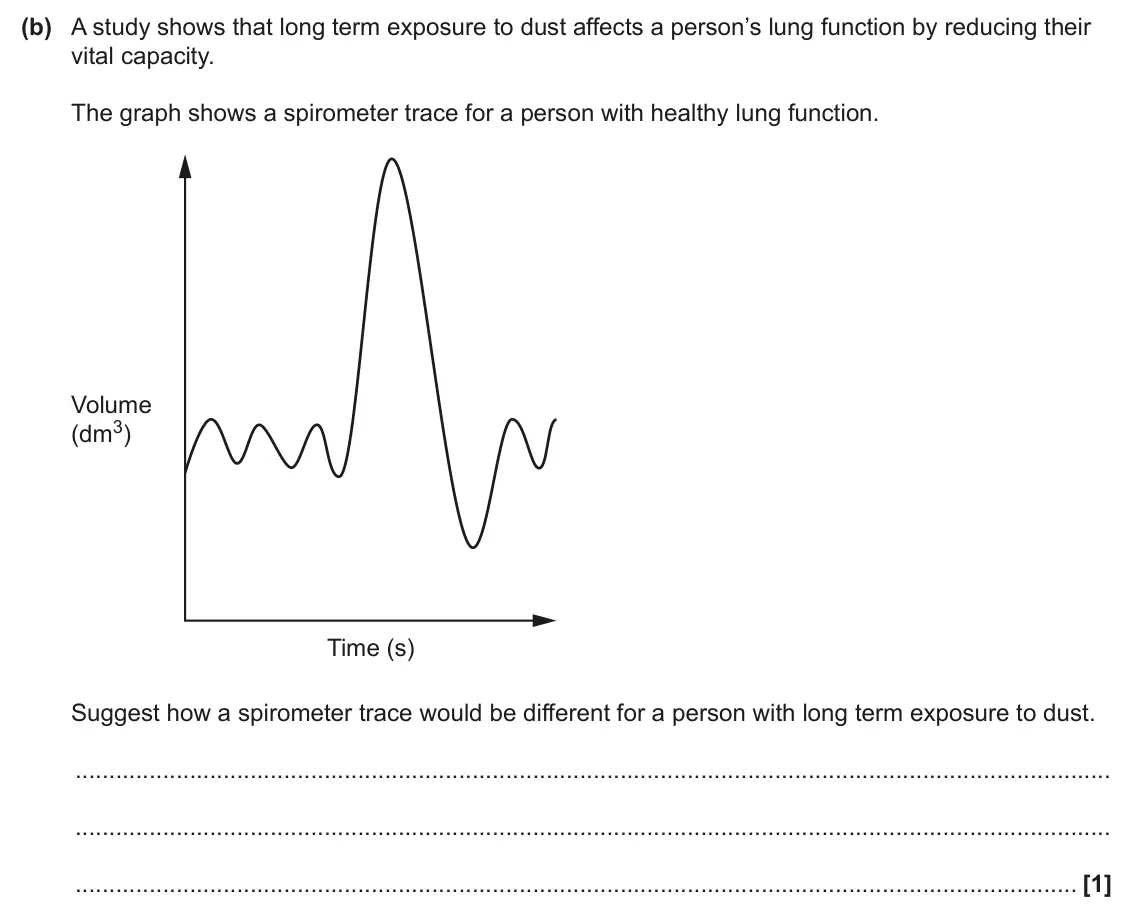
Q6(c)
The whole paper ↗
Q6(d)
The whole paper ↗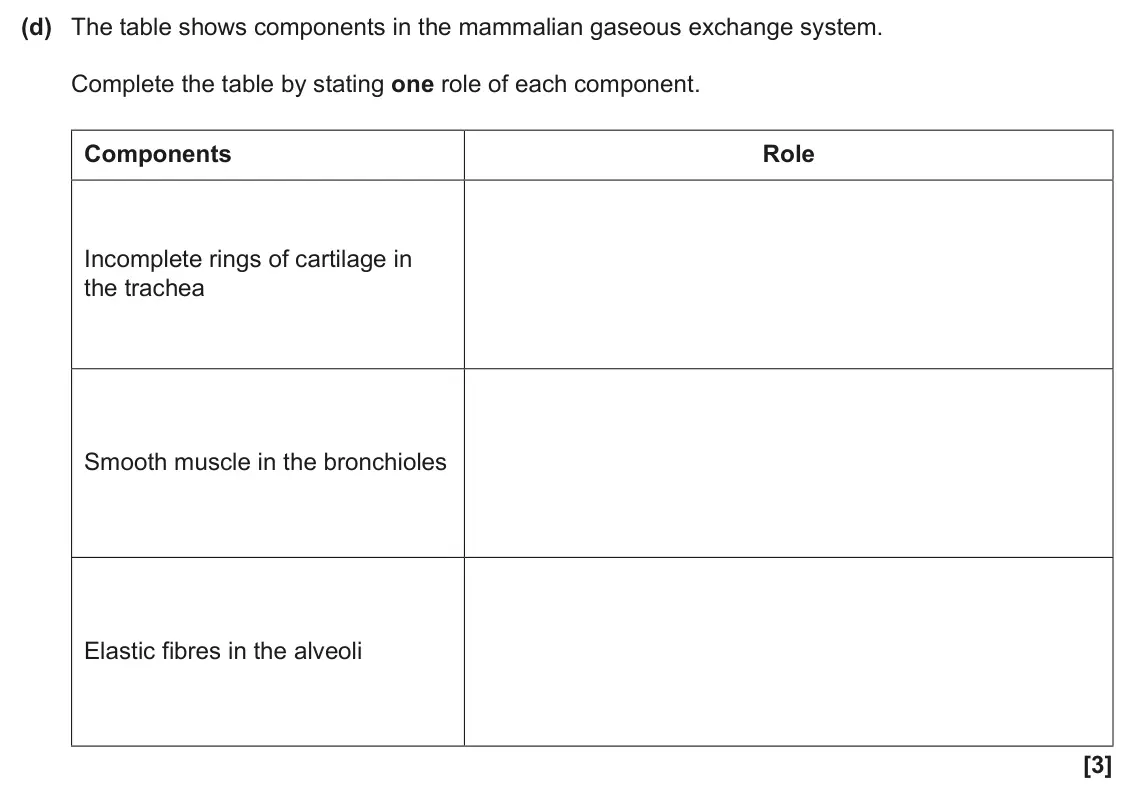


Q20(a)(i)
The whole paper ↗
Q20(a)(ii)
The whole paper ↗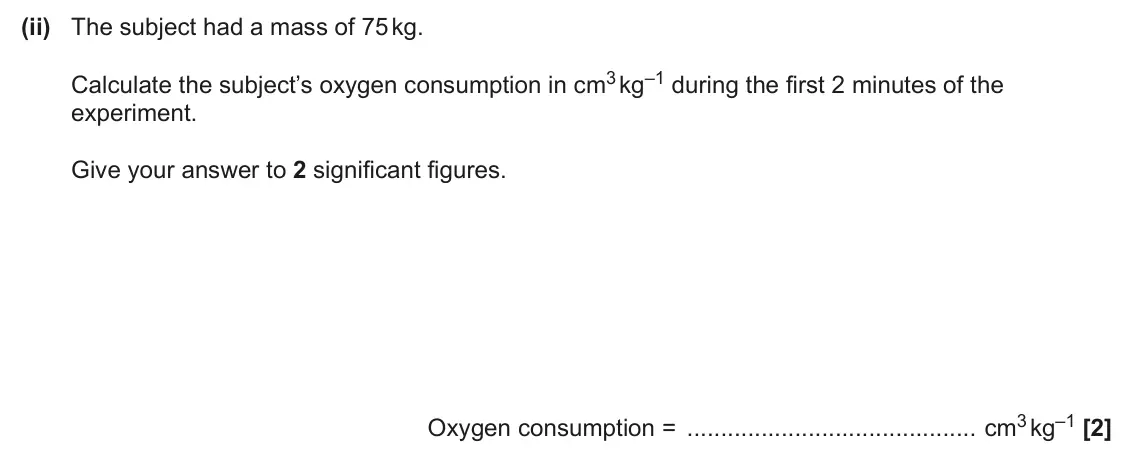
Q20(a)(iii)
The whole paper ↗
Q20(b)
The whole paper ↗


All 94 questions on Exchange surfaces, as a list
- June 2025, Paper 1, Q10 (1 mark): Following a period of intense exercise an athlete breathes out forcefully. Which option describes the mechanism of forceful expiration in this athlete? A The di
- June 2025, Paper 1, Q21(a)(i) (3 marks): Describe three ways fish gills are adapted for efficient gas exchange. 1 2 3 [3]
- June 2025, Paper 1, Q21(a)(ii) (3 marks): Explain why insects can function with open circulatory systems. [3]
- June 2025, AS Paper 1, Q23(a)(i) (2 marks): Calculate the surface area to volume ratio (SA:V) of the plasma cell. Assume the plasma cell is spherical. Use the formulas: surface area of sphere = 4πr2 volum
- June 2025, AS Paper 2, Q5(b) (2 marks): Clownfish are multicellular bony fish. Explain why multicellular organisms need a specialised exchange surface. [2]
- June 2025, AS Paper 2, Q5(c) (1 mark): State one feature that both gill lamellae and root hairs have that makes them efficient as an exchange surface. [1]
- June 2025, AS Paper 2, Q5(d) (4 marks): Explain why bony fish need water to flow over their gills for gaseous exchange to take place. [4]
- June 2025, AS Paper 2, Q6(a)(i) (2 marks): Calculate the breathing rate of the person at rest. Give your answer to the nearest whole number. Breathing rate = breaths per minute [2]
- June 2025, AS Paper 2, Q6(a)(ii) (1 mark): Calculate the person’s tidal volume during exercise. Tidal volume during exercise = cm3 [1]
- June 2025, AS Paper 2, Q6(b) (1 mark): A study shows that long term exposure to dust affects a person’s lung function by reducing their vital capacity. The graph shows a spirometer trace for a person
- June 2025, AS Paper 2, Q6(c) (2 marks): A student makes the following statement about ventilation in humans: “During inspiration the diaphragm contracts and flattens. Internal intercostal muscles cont
- June 2025, AS Paper 2, Q6(d) (3 marks): The table shows components in the mammalian gaseous exchange system. Complete the table by stating one role of each component. Components Role Incomplete rings
- June 2024, Paper 1, Q8 (1 mark): Bumblebees are large insects that have a high demand for oxygen during flight. What adaptation enables bumblebees to obtain sufficient oxygen during flight? A A
- June 2024, Paper 1, Q9 (1 mark): Which option is not an adaptation that helps fish increase the efficiency of gas exchange? A Blood capillaries lie close to the surface of the lamellae to minim
- June 2024, Paper 1, Q20(a)(i) (1 mark): The downward slope of the spirometer trace in Fig. 20.1 is due to oxygen consumption. The subject exhales the same volume of air as they inhale. State why the t
- June 2024, Paper 1, Q20(a)(ii) (2 marks): The subject had a mass of 75 kg. Calculate the subject’s oxygen consumption in cm3 kg–1 during the first 2 minutes of the experiment. Give your answer to 2 sign
- June 2024, Paper 1, Q20(a)(iii) (2 marks): Using Fig. 20.1, compare the breathing pattern between 0–120 s and 120–240 s. [2] 24 The student measured the subject’s heart rate and blood oxygen saturation e
- June 2024, Paper 1, Q20(b) (2 marks): Blood oxygen saturation of less than 90% can be dangerous. Explain one modification that you could make to the experiment to safely study the effect of extended
- June 2024, Paper 2, Q8 (1 mark): The graph shows the results of an investigation into diffusion rates in cubes of agar jelly with different surface area to volume ratios (SA:VOL). 0.4 0.3 Rate
- June 2024, Paper 2, Q9 (1 mark): Calculate the SA:VOL of a cube with edges 4 cm long. A 0.25 B 0.67 C 0.96 D 1.5 Your answer [1]
- June 2024, AS Paper 1, Q1 (1 mark): Which process occurs during ventilation in bony fish? A During expiration, the operculum opens B During expiration, the volume in the buccal cavity increases an
- June 2024, AS Paper 1, Q2 (1 mark): Which change in the mammalian gas exchange system takes place only during forced expiration? A Abdominal muscles relax B Diaphragm contracts to become dome-shap
- June 2024, AS Paper 1, Q3 (1 mark): The blue whale can grow up to 30 m long and can weigh up to 200 000 kg. Whales have specialised surfaces for gas exchange. Which option is not a reason why blue
- June 2024, AS Paper 1, Q4 (1 mark): The graph shows a trace recorded by a spirometer. The trace shows a period of normal breathing whilst at rest, followed by a maximum inhalation and maximum exha
- June 2023, Paper 3, Q1(a)(i) (2 marks): Name the tissues labelled A and B in Fig. 1.1. A B [2]
- June 2023, Paper 3, Q1(a)(ii) (2 marks): Name the two types of cell in the box labelled C in Fig. 1.1 and outline their functions. 1 Name Function 2 Name Function [2]
- June 2023, Paper 3, Q1(b)(i) (3 marks): An alveolus in the lung of a cat has: • a spherical shape • a diameter of 0.13 mm a surface area of 0.053 mm2. • Calculate the SA:V of this alveolus. Use the fo
- June 2023, Paper 3, Q1(b)(ii) (1 mark): Explain why the large SA:V of alveoli is an advantage to mammals. [1]
- June 2023, AS Paper 1, Q21(a) (1 mark): Alveoli provide an efficient gas exchange surface because of their large surface area. State one other feature of alveoli that provides an efficient gas exchang
- June 2023, AS Paper 1, Q21(b) (1 mark): The human lung is part of the gas exchange system. Name the component of the gas exchange system in the circle labelled M in the light micrograph. [1]
- June 2023, AS Paper 1, Q21(c) (2 marks): Name the tissue labelled N in the light micrograph and outline its function in component M. [2]
- June 2022, Paper 1, Q6 (1 mark): Ventilation of the lungs involves muscles working together. Which option describes expiration? A In expiration at rest, the external intercostal muscles and the
- June 2022, AS Paper 1, Q12 (1 mark): The table shows the dimensions of a dividing ball of cells and their surface area to volume ratios. Surface area Number of Number of Radius Surface Volume to vo
- June 2022, AS Paper 1, Q14 (1 mark): Fick’s Law describes the relationship between the rate of diffusion and factors that affect this rate. This can be simplified as the equation: Rate of diffusion
- June 2022, AS Paper 2, Q5 (6 marks): 5* A teacher set up the apparatus shown in Fig. 5.1 to demonstrate ventilation in mammals to a group of students. Bell jar Glass tubing Balloons Elastic sheet t
- November 2021, Paper 3, Q1(a) (2 marks): The figure below shows a light micrograph of an insect’s gas exchange system. A B Name the structures labelled A and B in the figure. A B [2]
- November 2021, Paper 3, Q1(b)(i) (2 marks): In ventilation, water moves into the buccal cavity, across the gills and out of the opercular cavity. Complete the table by placing ticks (3) in the appropriate
- November 2021, Paper 3, Q1(b)(ii) (1 mark): A student described how they dissected a fish to view the gills: ‘I held the fish on a cutting board with one hand. I used scissors and a scalpel to carefully c
- November 2021, Paper 3, Q1(c)(i) (1 mark): The West Highland Terrier develops CPF more often than other breeds of dog. The lung function of a West Highland Terrier was tested. At rest, its ventilation ra
- November 2021, AS Paper 1, Q23(a)(i) (2 marks): Explain why there is a downward trend in the trace. [2]
- November 2021, AS Paper 1, Q23(a)(ii) (2 marks): Using Fig. 23.1, calculate the mean resting breathing rate. Mean = breaths per minute [2]
- November 2021, AS Paper 1, Q23(a)(iii) (2 marks): Using the trace in Fig. 23.1, state the vital capacity. Give your answer in cm3. Vital capacity = cm3 [2]
- November 2021, AS Paper 1, Q23(b)(i) (3 marks): Describe three patterns in the data in Fig. 23.2. 1 2 3 [3]
- November 2021, AS Paper 1, Q23(b)(ii) (2 marks): State one group from Fig. 23.2 that is likely to contain an anomaly. Explain your choice. Group Explanation [2]
- November 2021, AS Paper 1, Q23(b)(iii) (2 marks): Explain why using standard deviation error bars in Fig. 23.2 would increase the confidence in any conclusion made. [2]
- November 2021, AS Paper 1, Q23(b)(iv) (3 marks): The table shows the raw data of resting tidal volume for 13-year-old boys in Fig. 23.2. The mean resting tidal volume for this group is 510 cm3. Resting tidal v
- November 2021, AS Paper 1, Q23(b)(v) (2 marks): Other than increasing the sample size, suggest two ways that the selection of participants in the study could have improved the validity of the data. 1 2 [2]
- November 2020, Paper 1, Q8 (1 mark): The graphs, A to D, represent gas exchange in bony fish. The graphs show the oxygen saturation in blood in the lamellae and water flowing over the lamellae. A 1
- November 2020, Paper 1, Q21(a) (3 marks): The table compares the features of airways in the lungs. Complete the table by putting a tick (3) in each box if the feature is present and a cross (8) if the f
- November 2020, Paper 1, Q21(b)(i) (1 mark): Name the apparatus used to measure and record these air movements. [1]
- November 2020, Paper 1, Q21(b)(ii) (1 mark): The trace below shows a recording of ventilation movements from an individual subject. 5.0 4.5 4.0 3.5 volume of 3.0 air in air chamber 2.5 (dm3) 2.0 1.5 1.0 0.
- November 2020, Paper 1, Q21(b)(iii) (2 marks): After 60 seconds, the subject was told to breathe in as deeply as possible and then breathe out fully. Use the trace to calculate the vital capacity of the subj
- November 2020, Paper 1, Q21(c) (6 marks): (c)* Compare and contrast the mechanism of expiration during the first 60 seconds of the trace with the mechanism of expiration when the subject was told to bre
- November 2020, Paper 1, Q21(d) (5 marks): Complete the following statements about exchange surfaces. Use the correct terms selected from the list below. circulatory system concentration gradient diffusi
- November 2020, AS Paper 1, Q10 (1 mark): The drawing below shows the respiratory system of an insect. A B C D Which of the letters, A to D, shows a spiracle? Your answer [1]
- November 2020, AS Paper 1, Q11 (1 mark): Which of the following muscles in the mammalian ventilation system contract to force air out of the lungs? A all of the muscles in the mammalian ventilation sys
- November 2020, AS Paper 2, Q2(b)(ii) (1 mark): Sjogren’s syndrome is a rare condition that can reduce the production of mucus. Suggest how the upper respiratory tract of a person with Sjogren’s syndrome migh
- November 2020, AS Paper 2, Q6(a) (2 marks): The cubes shown in Fig. 6.1 represent two different sized animals. Small multicellular animal Large multicellular animal Volume = 8 cm3 Volume = 64 cm3 Surface
- November 2020, AS Paper 2, Q6(b) (6 marks): (b)* Fig. 6.2 and Fig. 6.3, on the insert, show images of exchange surfaces in a bony fish and an insect. With reference to both Fig. 6.2 and Fig. 6.3 and your
- November 2020, AS Paper 2, Q6(c) (2 marks): In mammals the lungs act as the gas exchange system. Various components of this system work together to ensure gas exchange is efficient. Two such components ar
- June 2019, Paper 3, Q5(a) (2 marks): Organisms can use simple diffusion to exchange gases when the diffusion pathway is less than 1 mm. A beet armyworm larva: • has a cylindrical shape • is 15 mm l
- June 2019, AS Paper 1, Q18 (1 mark): Ventilation is a process that involves various parts of the body. Which of the following options, A to D, describes exhalation in a mammal? A ribcage moves upwa
- June 2019, AS Paper 1, Q19 (1 mark): The diagram shows part of the gas exchange system of an insect. D outside of organism muscle A tissue B C Which of the labels, A to D, indicates the trachea? Yo
- June 2018, Paper 1, Q1 (1 mark): Which of the following statements, A to D, correctly explains a feature of an efficient gaseous exchange surface? A The layers are thin for a short diffusion di
- June 2018, Paper 1, Q9 (1 mark): Peak expiratory flow (PEF) is a measure of the maximum rate at which a person can exhale. The graph below shows the typical PEF values for men of different ages
- June 2018, Paper 1, Q16(c) (3 marks): During late pregnancy, women find ventilation more difficult, as the developing foetus reduces the volume of the thorax. This can lead to tiredness and difficul
- June 2018, Paper 1, Q21(a)(ii) (2 marks): A common cause of death from TTX poisoning is suffocation (not getting enough oxygen) as a result of paralysis of the diaphragm. Explain how paralysis of the di
- June 2018, AS Paper 1, Q21(c)(i) (2 marks): Suggest why the Titicaca water frog has evolved the unusually large folds of skin seen in Fig. 21.1. [2]
- June 2018, AS Paper 1, Q21(c)(ii) (2 marks): When out of the water, the Titicaca water frog is able to use its lungs to absorb oxygen. Lungs contain specialised gaseous exchange surfaces. Describe and expl
- June 2018, AS Paper 1, Q21(d)(i) (2 marks): State two ways the student could have ensured they had confidence in their results. 1 2 [2]
- June 2018, AS Paper 1, Q21(d)(ii) (2 marks): In Fig. 21.2, Cube A is 10 mm along each side and Cube B is 4 mm along each side. Calculate the surface area to volume ratio (SA:V) for both cubes A and B. Show
- June 2017, Paper 1, Q7 (1 mark): Bony fish absorb dissolved oxygen from the water using gills. Water is passed through the buccal cavity and over the gill lamellae. The oxygen saturation of the
- June 2017, Paper 1, Q13 (1 mark): Different sized mammals have different surface area to volume ratios. The table shows the surface areas and volumes of four different groups of mammals. Surface
- June 2017, Paper 1, Q16(b)(i) (1 mark): Name these holes. [1]
- June 2017, Paper 1, Q16(b)(ii) (1 mark): Fluid is found in the tubes responsible for gaseous exchange in insects. Name this fluid. [1]
- June 2017, Paper 1, Q16(d) (2 marks): A student planned to carry out a dissection of insect and fish gaseous exchange systems. The student planned to complete diagrams of the different tissues. They
- June 2017, Paper 2, Q9 (1 mark): Cut pieces of agar jelly can be used to investigate the factors affecting diffusion rates in cells. Four pieces of agar jelly containing universal indicator wer
- June 2017, Paper 3, Q7(a)(i) (2 marks): Describe how the structures of the insect tracheal system and fish gills provide a large surface area for gas exchange. insect tracheal system fish gills [2]
- June 2017, Paper 3, Q7(a)(ii) (1 mark): The lugworm, Arenicola marina, is a species of segmented worm that lives in burrows in damp sand. They have hair-like external gills that increase the surface a
- June 2017, Paper 3, Q7(b) (4 marks): Mammals use lungs for gas exchange. The following passage describes how gases are moved in and out of the lungs. Complete the passage using the most appropriate
- June 2017, AS Paper 1, Q1 (1 mark): Air moves in and out of human lungs through the trachea, which is lined with cells. The diagram below shows a section containing these cells. Cell X Cell Y Cell
- June 2017, AS Paper 2, Q3(a) (2 marks): Describe how you would carry out the dissection to display maximum detail of either gas exchange system. [2]
- June 2017, AS Paper 2, Q3(b)(i) (2 marks): Put a ring around the error in Table 3 and write the correct answer next to it. Use the space below to show your working. [2]
- June 2017, AS Paper 2, Q3(b)(ii) (1 mark): Fig. 3 shows a diagram of part of the gas exchange system of an insect. muscle trachea spiracle A Fig. 3 Name the structure labelled A. [1]
- June 2017, AS Paper 2, Q3(b)(iii) (2 marks): Describe how the trachea of a mammal is different from the trachea shown in Fig. 3. [2]
- June 2017, AS Paper 2, Q3(c) (6 marks): Bony fish and insects have different gas exchange systems. Both can be observed by dissection. (c)* Alveoli are located in the lungs of mammals. Explain how alv
- June 2016, AS Paper 1, Q5 (1 mark): Ventilation involves various parts of the mammalian respiratory system. Which of the following statements, A to D, describes inhalation? A ribcage moves upwards
- June 2016, AS Paper 1, Q17 (1 mark): Which of the cells below, represented by cubes A to D, has a surface area to volume ratio of 3 : 1 ? 6 μm 4 μm 2 μm 1 μm nucleus nucleus nucleus nucleus A B C D
- June 2016, AS Paper 2, Q1(a): Fig. 1.1 is a diagram that represents inspiration and expiration in a human. trachea rib lung diaphragm diaphragm spine
- June 2016, AS Paper 2, Q1(b)(i) (2 marks): Which of the two diagrams, (a) or (b), represents the body immediately after expiration? Describe how this diagram justifies your choice. [2]
- June 2016, AS Paper 2, Q1(b)(ii) (1 mark): Why can expiration be a passive process? [1]
- June 2016, AS Paper 2, Q1(b)(iii) (8 marks): Some chemicals can act as allergens. If these allergens are inhaled, they can cause breathing problems. Allergens cause the smooth muscle in the walls of the ai
- June 2016, AS Paper 2, Q3(b)(i) (1 mark): What is the function of the circular bands of chitin labelled C? [1]
- June 2016, AS Paper 2, Q3(b)(ii) (1 mark): The mites use their mouthparts to bite through the walls of the trachea. They then feed off the haemolymph, the blood-like liquid that bathes the cells and orga
Questions, mark schemes and examiner’s reports are © OCR, from their published past papers. Plumi isn’t affiliated with any exam board. Want whole papers? Every OCR A-Level Biology A paper, or our free OCR-style practice pack.
Rather write your answers by hand on iPad? Plumi marks them against the same mark schemes.