 plumi
Transport in animals: OCR A‑Level Biology A questions
Every OCR A-Level Biology A exam question on 3.1.2 Transport in animals, 2016–2025, with its mark scheme and examiner’s report.
Find questions1,984
Calculations
Q20(a)
The whole paper ↗
Q20(b)
The whole paper ↗
Q20(c)
The whole paper ↗
Q20(d)
The whole paper ↗
Q20(e)(i)
The whole paper ↗
Q20(e)(ii)
The whole paper ↗
Q21(a)(ii)
The whole paper ↗
Q21(a)(iii)
The whole paper ↗
Q21(b)
The whole paper ↗
Q2(b)
The whole paper ↗


Q25(a)
The whole paper ↗
Q25(c)(i)
The whole paper ↗
Q25(c)(ii)
The whole paper ↗


All 128 questions on Transport in animals, as a list
- June 2025, Paper 1, Q20(a) (3 marks): The table compares features of different types of blood vessel in mammals. Blood vessel type Feature E F G H Diameter of lumen largest large small smallest Thic
- June 2025, Paper 1, Q20(b) (1 mark): Unlike most other veins, pulmonary veins do not have valves. Suggest why valves are not needed in pulmonary veins. [1]
- June 2025, Paper 1, Q20(c) (4 marks): This is a drawing of a dissected human heart. J K L M Identify the structures labelled J to M. J K L M [4]
- June 2025, Paper 1, Q20(d) (6 marks): (d)* This is an electrocardiogram (ECG) trace of a single heartbeat. R T P Q S Describe how contraction of the heart muscle at rest is initiated and relate this
- June 2025, Paper 1, Q20(e)(i) (1 mark): Fig. 20.2 shows an ECG trace from a patient with abnormal heart activity. Fig. 20.2 Identify this abnormality. Give a reason for your identification. Abnormalit
- June 2025, Paper 1, Q20(e)(ii) (1 mark): Fig. 20.3 shows an ECG trace from another patient with abnormal heart activity. Fig. 20.3 Identify this abnormality. Give a reason for your identification. Abno
- June 2025, Paper 1, Q21(a)(ii) (3 marks): Explain why insects can function with open circulatory systems. [3]
- June 2025, Paper 1, Q21(a)(iii) (2 marks): The largest fish is the whale shark. Whale sharks have an average mass of 20 tonnes. The largest marine mammal is the blue whale. Blue whales have an average ma
- June 2025, Paper 1, Q21(b) (4 marks): Explain how the structure of haemoglobin allows it to transport oxygen from the lungs to the tissues. [4]
- June 2025, Paper 3, Q2(b) (4 marks): A scientist studied the health outcomes of people with high blood pressure that were treated with either: • a new beta blocker treatment or • one of four establ
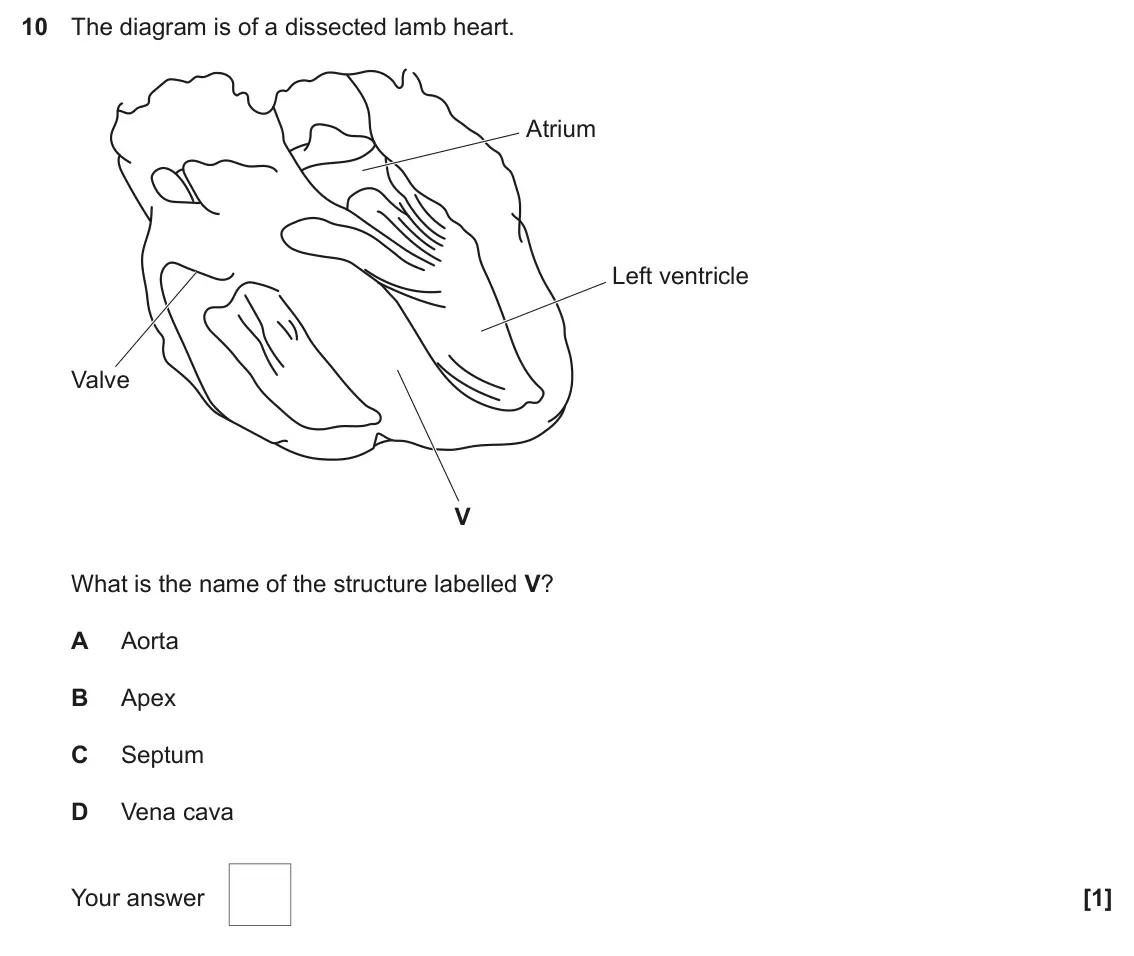
- June 2025, AS Paper 1, Q10 (1 mark): The diagram is of a dissected lamb heart. Atrium Left ventricle Valve V What is the name of the structure labelled V? A Aorta B Apex C Septum D Vena cava Your a
- June 2025, AS Paper 1, Q11 (1 mark): Carbon dioxide is transported around the body either in the blood plasma or inside erythrocytes. Which statement is true about the transport of carbon dioxide?
- June 2025, AS Paper 1, Q12 (1 mark): The graph shows oxygen dissociation curves for adult haemoglobin, fetal haemoglobin and myoglobin. Myoglobin is a respiratory pigment found in muscle that acts
- June 2025, AS Paper 1, Q13 (1 mark): Which option describes the Bohr effect? A At the same partial pressure of oxygen, haemoglobin has a higher percentage saturation of oxygen. B Oxygen dissociates
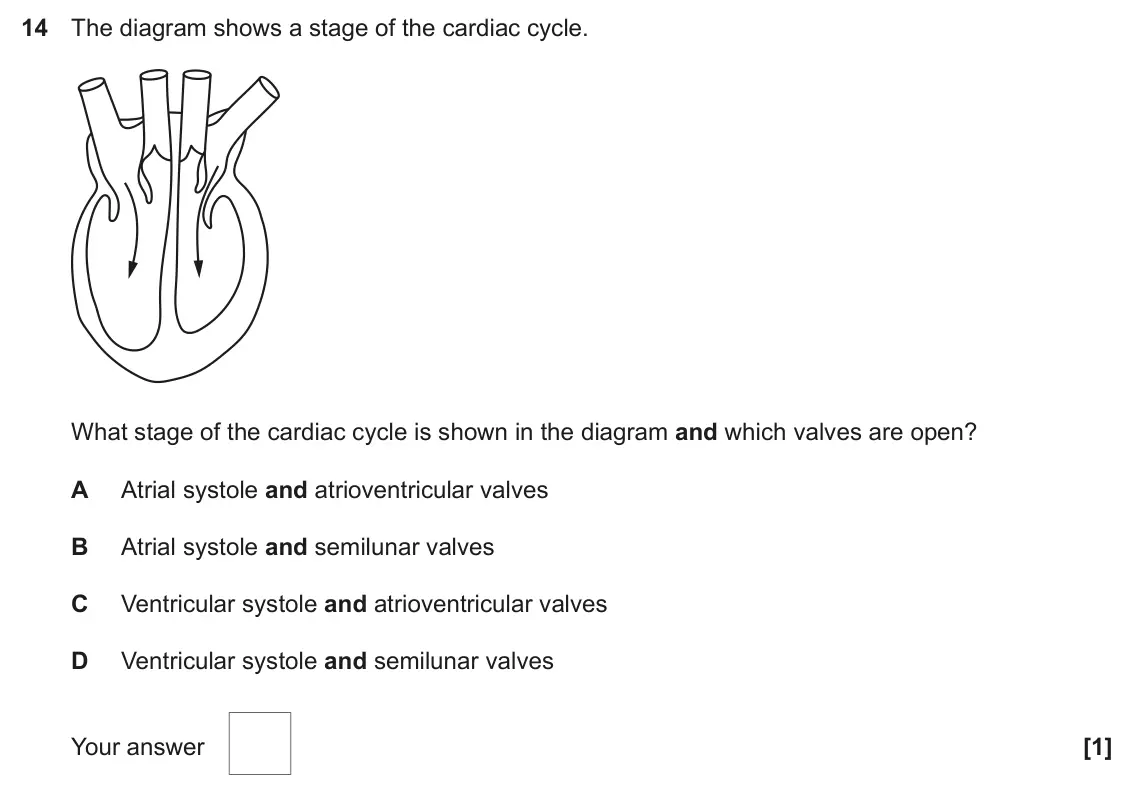
- June 2025, AS Paper 1, Q14 (1 mark): The diagram shows a stage of the cardiac cycle. What stage of the cardiac cycle is shown in the diagram and which valves are open? A Atrial systole and atrioven
- June 2025, AS Paper 1, Q25(a) (2 marks): The Asian elephant, Elephas maximus, is the largest land mammal in Asia. It is an endangered species. Asian elephants need a transport system because they are a
- June 2025, AS Paper 1, Q25(c)(i) (2 marks): Calculate the heart rate of the Asian elephant. Give your answer to the nearest whole number. Heart rate = beats per minute [2]
- June 2025, AS Paper 1, Q25(c)(ii) (2 marks): Describe how the ECG trace would appear differently if the elephant had tachycardia. [2]
- June 2024, Paper 1, Q6 (1 mark): Lymph and tissue fluid are both formed from the blood. Which statement describes the composition of these fluids? A Lymph contains more protein than tissue flui
- June 2024, Paper 1, Q7 (1 mark): Which statement describes features of the mammalian heart? A Branches of the pulmonary artery supply blood to the heart muscle. B Semi-lunar valves prevent back
- June 2024, Paper 1, Q18(c)(i) (2 marks): The net pressure at the arteriole end is +1.3 kPa. Calculate the net pressure at the venule end. Net pressure at venule end = kPa [2]
- June 2024, Paper 1, Q18(c)(ii) (2 marks): Use the information in the table to explain the formation of tissue fluid and its return to the blood. [2]
- June 2024, AS Paper 1, Q5 (1 mark): During exercise the cardiac output of an athlete is 28 dm3 min–1 and their stroke volume is 5 160 cm3. How many heart beats occur when the athlete exercises for
- June 2024, AS Paper 1, Q6 (1 mark): Which option is a feature of tissue fluid? A Tissue fluid carries oxygen away from muscle cells B Tissue fluid does not contain erythrocytes C Tissue fluid form
- June 2024, AS Paper 1, Q24(a)(ii) (1 mark): Name the enzyme in an erythrocyte that allows haemoglobinic acid to be formed. [1]
- June 2024, AS Paper 2, Q4(a)(i) (1 mark): Scientists can measure the size of an aneurysm. An investigation measured the ratio of collagen to elastin in the blood vessel wall in five patients with an ane
- June 2024, AS Paper 2, Q4(a)(ii) (3 marks): Students looked at data on aneurysms in different groups of people of the same age. The table shows their findings. Observed frequency of Expected frequency of
- June 2024, AS Paper 2, Q4(a)(iii) (2 marks): The table shows part of a statistical table for the chi squared test. Probability (%) 10 5 1 0.5 df 1 2.706 3.841 6.635 7.879 2 4.605 5.991 9.210 10.60 3 6.251
- June 2024, AS Paper 2, Q4(b)(i) (2 marks): Explain the role of valves in veins. [2]
- June 2024, AS Paper 2, Q4(b)(ii) (3 marks): The smooth muscle content in some arteriole walls is more than double the smooth muscle content in the walls of some arteries. Explain how arterioles are better
- June 2024, AS Paper 2, Q4(c) (6 marks): (c)* Heart action in a mammalian heart starts at the sino-atrial node (SAN). Describe how heart action is initiated and coordinated by the SAN and explain why t
- June 2023, Paper 1, Q7 (1 mark): Which of the statements about the heart is correct? A Contraction of the ventricles is known as ventricular systole. B Deoxygenated blood enters the heart by th
- June 2023, Paper 1, Q16(a)(i) (3 marks): Use the data in Fig. 16.1 to calculate the cardiac output in week 20. Cardiac output = Unit [3]
- June 2023, Paper 1, Q16(a)(ii) (1 mark): Suggest an advantage of the increase in cardiac output. [1]
- June 2023, Paper 1, Q16(a)(iii) (3 marks): Fig. 16.2 shows how blood pressure varies throughout pregnancy. Fig. 16.2 92 90 88 Mean arterial 86 pressure 84 (mmHg) 82 80 78 9–12 13–16 17–20 21–24 25–28 29–
- June 2023, Paper 1, Q16(b) (6 marks): During pregnancy the mother’s body undergoes several physiological changes to support the developing fetus. These changes affect every organ system in the body.
- June 2023, Paper 1, Q16(c)(i) (1 mark): Sketch the oxygen dissociation curve for fetal haemoglobin. Answer on Fig. 16.3. [1]
- June 2023, Paper 1, Q16(c)(ii) (3 marks): Explain how the different affinities of maternal and fetal haemoglobin enable transfer of oxygen from the maternal circulation to the fetus. [3]
- June 2023, AS Paper 1, Q26(a) (3 marks): Fig. 26.1 shows a dissected human heart. Fig. 26.1 Back (dorsal) half of heart Front (ventral) half of heart Draw a simple diagram of the front half of the hear
- June 2023, AS Paper 1, Q26(b)(i) (1 mark): Describe the type of circulatory system shown in Fig. 26.2. [1]
- June 2023, AS Paper 1, Q26(b)(ii) (2 marks): Explain why larger organisms, such as a bird, need a circulatory system but some smaller organisms do not need a circulatory system. [2]
- June 2023, AS Paper 1, Q26(c) (2 marks): An electrocardiogram (ECG) trace from a bird and an ECG trace from a human have many differences. The ECG trace below is from a bird. Time = 1 second Describe h
- June 2022, Paper 3, Q1(c) (2 marks): Fig. 1.2 shows two electrocardiogram (ECG) traces: • an ECG of normal heart activity • an ECG of a person with a type of heart disease Normal Heart disease Fig.
- June 2022, Paper 3, Q2(d)(i) (2 marks): State whether L is an artery or a vein and give two pieces of evidence from Fig. 2.2 that allow you to reach your decision. L Evidence 1 Evidence 2 [2]
- June 2022, Paper 3, Q2(d)(ii) (1 mark): State the substance labelled N. [1]
- June 2022, Paper 3, Q4(a)(i) (1 mark): Suggest why A. aerophoba does not need a circulatory system. [1]
- June 2022, Paper 3, Q4(a)(ii) (2 marks): A diagram of the circulatory system of S. fasciatum is shown in Fig. 4.2. Arteries Gills Veins Heart Body tissues Fig. 4.2 Describe the type of circulatory syst
- June 2022, Paper 3, Q6(b) (3 marks): Haemoglobin plays a crucial role in transporting oxygen in animals. Several ions also have roles in oxygen transport. Three ions are listed in the table below.
- June 2022, AS Paper 1, Q15 (1 mark): The diagram shows the changes in pressure in the left atrium, left ventricle and aorta in a single cardiac cycle. D 20 Aorta C 15 Pressure 10 (kPa) 5 A B Left a
- June 2022, AS Paper 1, Q23(a)(i) (1 mark): On the diagram, draw an arrow to show the direction of movement of blood through the [1] capillary network.
- June 2022, AS Paper 1, Q23(a)(ii) (2 marks): On the diagram, draw an arrow to show the direction in which oncotic pressure is acting and suggest a value for oncotic pressure. Write the value for oncotic pr
- June 2022, AS Paper 1, Q23(a)(iii) (1 mark): Name the structure labelled W. [1]
- June 2022, AS Paper 1, Q23(b) (3 marks): Describe how oncotic pressure is established. [3]
- June 2022, AS Paper 2, Q3(c) (3 marks): Fig. 3.4 shows the changes in pressure in the left side of the heart and aorta during one cardiac cycle. 16 C 14 12 Aorta 10 Pressure (kPa) 8 Left ventricle 6 4
- June 2022, AS Paper 2, Q4(d)(i) (2 marks): Explain how haemoglobin acts as a buffer. [2]
- June 2022, AS Paper 2, Q4(d)(ii) (2 marks): Fig. 4.2 shows the shape of oxygen dissociation curves for haemoglobin for a person at rest and during exercise. The changes to the dissociation curve at differ
- November 2021, Paper 1, Q16(a)(i) (5 marks): Identify the structures labelled A to E on Fig. 16.1. A B C D E [5]
- November 2021, Paper 1, Q21(a)(i) (1 mark): State the effect on the water potential of the blood if the concentration of glucose increases. [1]
- November 2021, Paper 1, Q21(a)(ii) (2 marks): Explain why the oncotic pressure of the blood depends only on the concentration of large plasma proteins. [2]
- November 2021, Paper 1, Q21(b)(i) (2 marks): In one type of capillary the reflectance factor was found to be 0.75. Use this information and the data in the table to calculate a value for the net driving fo
- November 2021, Paper 1, Q21(b)(ii) (2 marks): Nephrotic syndrome is a kidney disease where protein is excreted in the urine. One group of patients with nephrotic syndrome had a plasma albumin concentration
- November 2021, Paper 1, Q21(b)(iii) (4 marks): A medical student concluded that a patient with kidney disease and a plasma albumin concentration of 0.015 g dm–3 would show signs of swelling, such as swollen
- November 2021, Paper 1, Q21(c) (2 marks): The table below contains statements about the composition of lymph and tissue fluid. Place ticks (✓) in the boxes in the table to indicate whether the statement
- November 2021, AS Paper 1, Q2 (1 mark): Which of the options, A to D, would result in the formation of tissue fluid? A hydrostatic pressure 1 oncotic pressure B hydrostatic pressure = oncotic pressure
- November 2021, AS Paper 1, Q3 (1 mark): Which of the options, A to D, on the diagram below shows the time at which the SAN sends out a wave of excitation to initiate a heartbeat? 20 Aorta 15 Pressure
- November 2021, AS Paper 1, Q4 (1 mark): The sounds of the heartbeat due to heart valves closing can be described as ‘lub-dub’. The ‘lub’ sound occurs at the beginning of ventricular systole. Which of
- November 2021, AS Paper 1, Q13 (1 mark): The ECG traces below show four abnormal heartbeats recorded for six seconds. A B C D Which of the traces, A to D, shows atrial fibrillation? Your answer [1]
- November 2021, AS Paper 1, Q15 (1 mark): Which of the options, A to D, best describes the chloride shift? A hydrogen carbonate ions and chloride ions moving into red blood cells B hydrogen carbonate io
- November 2021, AS Paper 2, Q2(a)(i) (3 marks): The table below shows some data on these two organisms. Surface area (cm2) Volume (cm3) Organism Immortal jellyfish 10.5 1.5 Sea bass 270.0 810.0 A student made
- November 2021, AS Paper 2, Q2(a)(ii) (1 mark): Fig. 2.1 shows the circulatory system of the sea bass. Heart Capillaries in gill Capillaries in rest of the body Fig. 2.1 Name the type of circulatory system sh
- November 2021, AS Paper 2, Q2(a)(iii) (1 mark): The circulatory systems of the sea bass and mammals are described as closed circulatory systems. Define the term closed circulatory system. [1]
- November 2021, AS Paper 2, Q2(a)(iv) (2 marks): State two differences between the closed circulatory system of the sea bass and the closed circulatory system of a mammal. 1 2 [2]
- November 2021, AS Paper 2, Q2(b)(i) (2 marks): Name two arteries that could be seen by the students. 1 2 [2]
- November 2021, AS Paper 2, Q2(b)(ii) (1 mark): The students then carried out a dissection of the heart. Fig. 2.2 is an example of a drawing from one of the students. Left ventricle Tricuspid valve Right vent
- November 2021, AS Paper 2, Q2(b)(iii) (3 marks): Another student pointed out that there were structural and labelling errors in the drawing in Fig. 2.2. In the space below, list three of these errors and the c
- November 2021, AS Paper 2, Q2(c) (6 marks): (c)* Three types of blood vessels found in mammals are arteries, veins and capillaries. Fig. 2.3 shows data on these blood vessels. Elastic layer 330 μm Artery
- November 2020, Paper 1, Q5 (1 mark): Large multicellular animals need a transport system for oxygen and carbon dioxide. Large multicellular plants do not need a transport system for oxygen and carb
- November 2020, Paper 3, Q2(a) (2 marks): Valves control the flow of blood through the heart. Complete the table below to show the roles of two valves in the heart. Source Valve that controls Destinatio
- November 2020, Paper 3, Q2(b) (4 marks): A ventricular septal defect (VSD) is a hole in the septum of the heart. The diagram below shows a heart with VSD. ventricular septal defect 7 Describe and expla
- November 2020, Paper 3, Q6(a)(i) (2 marks): Outline why it is important that fetal haemoglobin has a higher oxygen affinity than adult haemoglobin. [2]
- November 2020, Paper 3, Q6(a)(ii) (2 marks): Myoglobin is a protein found in muscles. Oxygen binds to myoglobin. A student described the oxygen dissociation curve for myoglobin as follows: • When oxygen fi
- November 2020, Paper 3, Q6(b) (1 mark): Haemocyanin is an oxygen‑binding pigment that is found in many invertebrate animals, including lobsters. Fig. 6.2 shows the oxygen dissociation curves for haemo
- November 2020, AS Paper 1, Q7 (1 mark): The table below shows the different percentages of three different components of blood vessels. elastin (%) smooth muscle (%) collagen (%) A 8 33 58 B 17 39 43
- November 2020, AS Paper 1, Q9 (1 mark): The trace below is an electrocardiogram (ECG) of an abnormal heart activity. 4 5 0 1 2 3 time (s) What is the name for this abnormal heart activity? A bradycard
- November 2020, AS Paper 1, Q17 (1 mark): The graph below shows the oxygen dissociation curve for adult human haemoglobin. 100 80 60 saturation of haemoglobin with oxygen (%) 40 20 0 0 20 40 60 80 100 p
- June 2019, Paper 1, Q2 (1 mark): Myoglobin is a protein found in muscle. Myoglobin has a very high affinity for oxygen at most partial pressures of oxygen. The figure below shows dissociation c
- June 2019, Paper 1, Q16(a)(i) (4 marks): Using Fig. 16, compare the changes in pressure in the left ventricle with the changes in pressure in the left atrium. [4]
- June 2019, Paper 1, Q16(a)(ii) (1 mark): Using Fig. 16, calculate the heart rate of this individual. Give your answer to 2 significant figures. heart rate = [1]
- June 2019, Paper 1, Q16(a)(iii) (2 marks): Using Fig. 16, calculate the percentage change between minimum and maximum pressure in the aorta. Give your answer to 2 significant figures. percentage change =
- June 2019, Paper 1, Q16(a)(iv) (1 mark): Name the valve which closes at point X on Fig. 16. [1]
- June 2019, Paper 1, Q16(b) (3 marks): The heart supplies oxygenated blood to the tissues. max is a measurement of the maximum volume of oxygen that an individual can use VO2 during intense exercise
- June 2019, Paper 1, Q18(a) (6 marks): Mammals and fish both need circulatory systems to transport oxygen to respiring tissues. They have different circulatory systems because they have different oxy
- June 2019, Paper 1, Q18(c) (2 marks): Squid blood contains a blue oxygen-carrying protein called haemocyanin. High partial pressures of carbon dioxide reduce the affinity for oxygen of haemocyanin.
- June 2019, Paper 1, Q19(a) (3 marks): Explain why the visible blood vessels are likely to be veins. [3]
- June 2019, Paper 1, Q21(b)(i) (2 marks): Identify patients X, Y and Z by labelling the traces in Fig. 21.2. [2]
- June 2019, Paper 1, Q21(b)(ii) (2 marks): Sketch a trace for a patient who has entered atrial fibrillation. 1.0 s [2]
- June 2019, Paper 1, Q21(b)(iii) (2 marks): Suggest why reduced heart rate is sometimes seen in people who are very aerobically fit. [2]
- June 2019, AS Paper 1, Q9 (1 mark): The diagram below shows an internal view of the mammalian heart with the atria removed so valves can be seen. B C D A Which of the valves, labelled A to D, is p
- June 2019, AS Paper 1, Q10 (1 mark): Which of the following, A to D, shows the reaction catalysed by carbonic anhydrase? CO2 + H2O → H2CO3 A CO2 + Hb → HbCO2 B H+ + Hb → HHb C Hb + 4O2 → HbO8 D You
- June 2018, Paper 1, Q7 (1 mark): Which of the statements, A to D, explains why diastole follows systole in the mammalian heart? A Cardiac muscle is myogenic. B Cardiac muscle takes a short time
- June 2018, Paper 1, Q21(a)(iii) (3 marks): TTX is also known to reduce the speed of conduction in the Purkyne fibres of the heart. Suggest and explain what effect this would have on the heart rate. [3]
- June 2018, Paper 3, Q6(a) (6 marks): The process of ultrafiltration in the kidney shares similarities with the formation of tissue fluid. (a)* Describe the similarities and differences between ultr
- June 2018, AS Paper 1, Q6 (1 mark): The aquatic crustacean Daphnia magna has a heart that pumps a blood-like liquid called haemolymph around the body cavity. Which of the statements, A to D, descr
- June 2018, AS Paper 1, Q13 (1 mark): Carbon dioxide release during respiration can affect the % oxygen saturation of haemoglobin. The tertiary structure of haemoglobin is affected when carbon dioxi
- June 2018, AS Paper 1, Q21(d)(iii) (3 marks): Explain why the surface area to volume ratio of an organism determines whether it needs a circulatory system. [3]
- June 2018, AS Paper 2, Q2(a)(i) (1 mark): Using the traces shown in Fig. 2.1, name the heart rhythm abnormality that the patient is suffering from. [1]
- June 2018, AS Paper 2, Q2(a)(ii) (3 marks): The equation for working out cardiac output is: cardiac output = stroke volume × heart rate Stroke volume is the volume of blood pumped per heart beat. The stro
- June 2018, AS Paper 2, Q2(a)(iii) (2 marks): Explain how the heart is controlling the electrical activity at Y on Fig. 2.1(b). [2]
- June 2018, AS Paper 2, Q2(b)(i) (1 mark): Looking at the two hearts in Fig. 2.2, a student decided that Heart 2 was a better choice for the dissection because it had more structures present. What eviden
- June 2018, AS Paper 2, Q2(b)(ii) (1 mark): Name the structure labelled Z on Fig. 2.2. [1]
- June 2018, AS Paper 2, Q2(c) (6 marks): (c)* Fig. 2.3 shows the heart at different stages of the cardiac cycle. A B C D Fig. 2.3 11 Box A shows atrial diastole. Blood is entering the atria, which are
- June 2018, AS Paper 2, Q4(a)(ii) (2 marks): Dissolved ions diffuse between blood plasma and tissue fluid. Pressure differences at the arterial and venous ends of capillaries are responsible for the format
- June 2017, Paper 1, Q16(c) (3 marks): Outline the reasons why insects and other animals need well-developed transport systems. [3]
- June 2017, Paper 3, Q6 (6 marks): 6* A student investigated the heart rates of smokers and non-smokers. • Each test subject had their resting heart rate measured using an electronic heart rate m
- June 2017, AS Paper 1, Q9 (1 mark): Which of the options, A to D, is a correct statement about tissue fluid? A Tissue fluid carries carbon dioxide to muscle cells. B Oncotic pressure in the capill
- June 2017, AS Paper 1, Q12 (1 mark): In the graph below, the top electrocardiogram (ECG) trace shows normal heart activity and the ECG trace below shows abnormal heart activity. What is the heart c
- June 2017, AS Paper 1, Q17 (1 mark): A student studied the structure of a blood vessel and found: • an outer layer of collagen fibres, • a thick middle layer of smooth muscle and elastic tissue, •
- June 2016, AS Paper 1, Q7 (1 mark): The pressure changes in one mammalian cardiac cycle are shown in the graph below. Key 16 ventricular pressure atrial pressure 12 pressure (kPa) 8 4 0 0 0.2 0.4
- June 2016, AS Paper 1, Q12 (1 mark): Pressure varies in different parts of the mammalian circulatory system. Blood in Blood in Tissue fluid Lymph aorta vena cava Pressure Which of the following opt
- June 2016, AS Paper 1, Q24(a) (2 marks): Calculate the percentage increase in oxygen carried in fully saturated blood compared with oxygen carried in fully saturated plasma. Show your working. Answer =
- June 2016, AS Paper 1, Q24(b)(iii) (2 marks): Explain why erythrocytes do not make use of any of the oxygen that they are transporting. [2]
- June 2016, AS Paper 1, Q24(c)(i) (2 marks): • 100 cm3 of blood contains 20.1 cm3 of oxygen when fully saturated. • Calculate the volume (cm3) of oxygen being transported to the tissues per minute. Show yo
- June 2016, AS Paper 1, Q24(c)(ii) (2 marks): With reference to the structure of blood vessels, explain why oxygen is not released until the blood reaches the capillaries. [2]
- June 2016, AS Paper 1, Q24(d)(i) (1 mark): What name is given to a change in the oxygen dissociation curve due to increasing carbon dioxide concentration? [1]
- June 2016, AS Paper 1, Q24(d)(ii) (2 marks): Letter T in Fig. 24 indicates the partial pressure of oxygen in actively respiring tissues. Explain why the blood off-loads more oxygen to actively respiring ti
- June 2016, AS Paper 2, Q5(a)(i) (1 mark): What type of circulatory system is shown in all these animals? [1]
- June 2016, AS Paper 2, Q5(a)(ii) (1 mark): How does the circulatory system of a fish compare to that of a mammal? [1]
- June 2016, AS Paper 2, Q5(b) (6 marks): (b)* Fig. 5.2, on the insert, shows the flow of blood through the heart of an amphibian such as a frog. Use the information in Fig. 5.1 and Fig. 5.2 to compare
Questions, mark schemes and examiner’s reports are © OCR, from their published past papers. Plumi isn’t affiliated with any exam board. Want whole papers? Every OCR A-Level Biology A paper, or our free OCR-style practice pack.
Rather write your answers by hand on iPad? Plumi marks them against the same mark schemes.