 plumi
Investigating respiration rates: OCR A‑Level Biology A questions
OCR A-Level Biology A past-paper questions on 5.2.2.7 Investigating respiration rates, 2016–2025, with mark schemes and examiner’s reports where available.
Paper
All papers
Exam
All years
Calculations
Q5(a)(i)
The whole paper ↗
Q5(a)(ii)
The whole paper ↗Q5(b)(i)
The whole paper ↗Q20(a)(i)
The whole paper ↗Q20(a)(ii)
The whole paper ↗Q20(a)(iii)
The whole paper ↗Q20(a)(iv)
The whole paper ↗Q20(b)(i)
The whole paper ↗Q20(b)(ii)
The whole paper ↗- Your answer
- Your answer
Q20(a)(i)
The whole paper ↗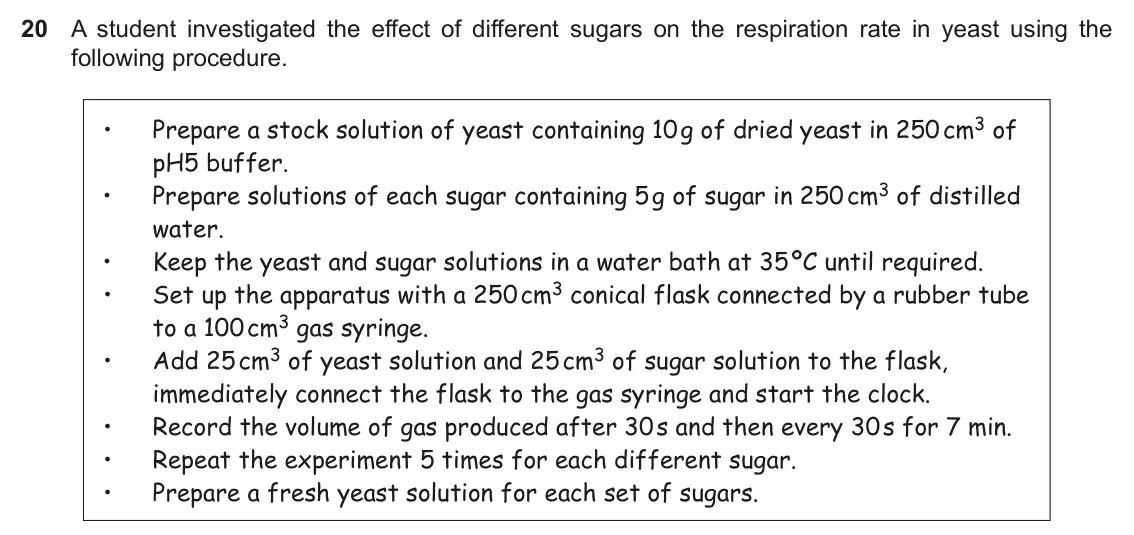
Q20(a)(ii)
The whole paper ↗Q20(b)(i)
The whole paper ↗Q20(b)(ii)
The whole paper ↗Q22(a)(i)
The whole paper ↗Q2(b)(iv)
The whole paper ↗
Q2(b)(v)
The whole paper ↗
All 18 questions on Investigating respiration rates, as a list
- June 2023, Paper 3, Q5(a)(i) (2 marks): Compare CO2 production when the substrate is glucose and CO2 production when the substrate is maltose. [2]
- June 2023, Paper 3, Q5(a)(ii) (2 marks): The student wrote a note: ‘The CO2 production with fructose is approximately the same as the CO2 production with sucrose’. Explain whether you agree with the st
- June 2023, Paper 3, Q5(b)(i) (2 marks): The student uses glucose as the respiratory substrate in their experiment. The student produces a 0.01 mol dm–3 glucose solution for each yeast population. This
- June 2022, Paper 1, Q20(a)(i) (2 marks): Suggest two modifications the researcher would need to make to this apparatus to investigate the effect of temperature on the rate of respiration. 1 2 [2]
- June 2022, Paper 1, Q20(a)(ii) (1 mark): Suggest one advantage of using a computer to collect data. [1]
- June 2022, Paper 1, Q20(a)(iii) (2 marks): A constant flow of water past the oxygen probe allows continuous monitoring of oxygen concentration. Explain one other reason why it is necessary to maintain a
- June 2022, Paper 1, Q20(a)(iv) (2 marks): Suggest and explain one other precaution that the scientists should take to ensure that the results obtained using this apparatus are valid. [2]
- June 2022, Paper 1, Q20(b)(i) (2 marks): Calculate the Q10 for respiration in the largest fish. Give your answer to 3 significant figures. Q10 = [2]
- June 2022, Paper 1, Q20(b)(ii) (4 marks): The scientists concluded that the best temperature for farming of O. insignis was 18 °C. Evaluate their conclusion. [4]
- November 2021, Paper 1, Q14 (1 mark): A respirometer, shown below, can be used to investigate respiration. tap capillary U-tube containing coloured liquid A student placed 5 cm3 of potassium hydroxi
- November 2020, Paper 1, Q11 (1 mark): Which of the following would be necessary to ensure valid results? 1 Keeping the respirometer in the dark during the experiment. 2 Keeping the respirometer at t
- November 2020, Paper 1, Q20(a)(i) (2 marks): Describe two precautions the student should take between each experiment to ensure repeatable results. 1 2 [2]
- November 2020, Paper 1, Q20(a)(ii) (1 mark): The student’s procedure did not include a negative control. Describe one negative control that the student could have used. [1]
- November 2020, Paper 1, Q20(b)(i) (3 marks): Describe how the student could use the graph to calculate the rate of respiration for each type of sugar. [3]
- November 2020, Paper 1, Q20(b)(ii) (6 marks): A student investigated the effect of different sugars on the respiration rate in yeast using the following procedure. Prepare a stock solution of yeast containi
- June 2018, Paper 1, Q22(a)(i) (3 marks): The diameter of the capillary tubing was 0.1 mm. The volume of a cylinder can be calculated using the following formula: volume of cylinder = πr2l Calculate the
- June 2017, Paper 3, Q2(b)(iv) (3 marks): A group of students were designing an experiment to investigate the effect of temperature on the respiration rate of S. cerevisiae. Their planned method include
- June 2017, Paper 3, Q2(b)(v) (1 mark): The students used a Student’s t-test to compare the results at 30 °C and 35 °C. They calculated a t value of 2.200. The critical value for p = 0.05 is 2.306. As
Questions, mark schemes and examiner’s reports are © OCR, from their published past papers. Plumi isn’t affiliated with any exam board. Want whole papers? OCR A-Level Biology A past papers, or our free OCR-style practice pack.
The Plumi iPad app also offers exam-style questions with AI feedback on your handwritten working.