 plumi
Genetic engineering: OCR A‑Level Biology A questions
OCR A-Level Biology A past-paper questions on 6.1.3.3 Genetic engineering, 2016–2025, with mark schemes and examiner’s reports where available.
Paper
All papers
Exam
All years
Calculations
- Your answer
Q4(e)(i)
The whole paper ↗
Q4(e)(ii)
The whole paper ↗Q18(b)(ii)
The whole paper ↗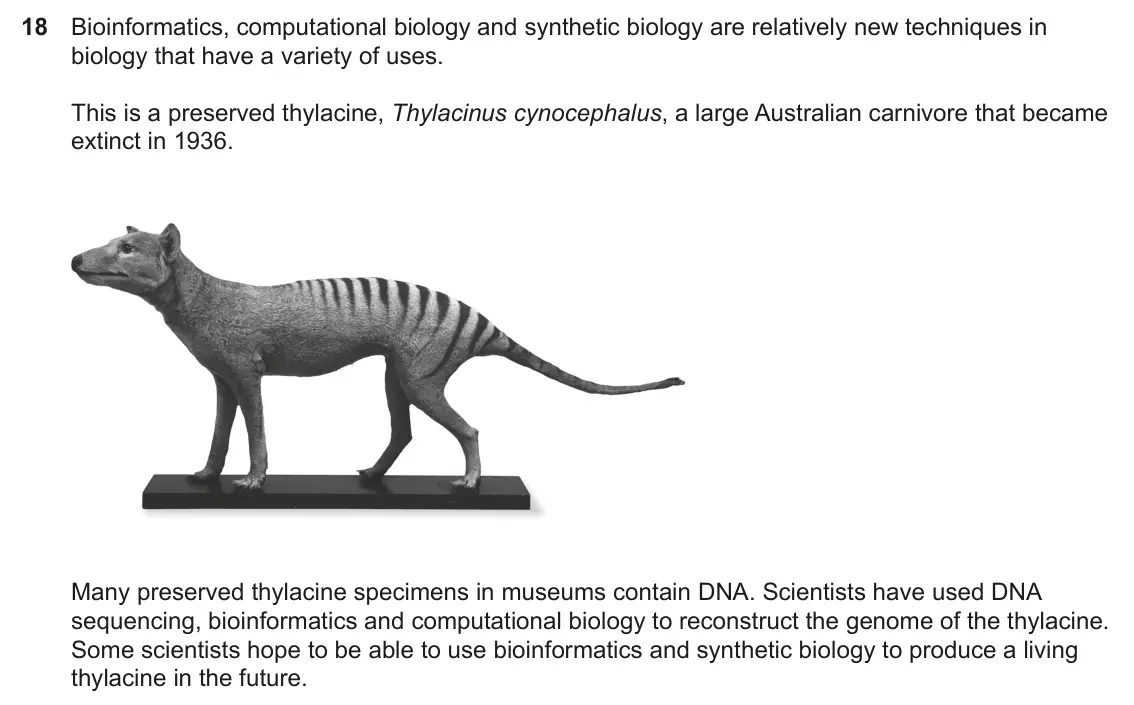
Q5(e)(i)
The whole paper ↗
Q5(e)(ii)
The whole paper ↗Q3(a)(iii)
The whole paper ↗
Q6(a)
The whole paper ↗
Q4(c)(i)
The whole paper ↗Q4(c)(ii)
The whole paper ↗Q4(c)(iii)
The whole paper ↗Q4(c)(v)
The whole paper ↗- Your answer
Q21(a)
The whole paper ↗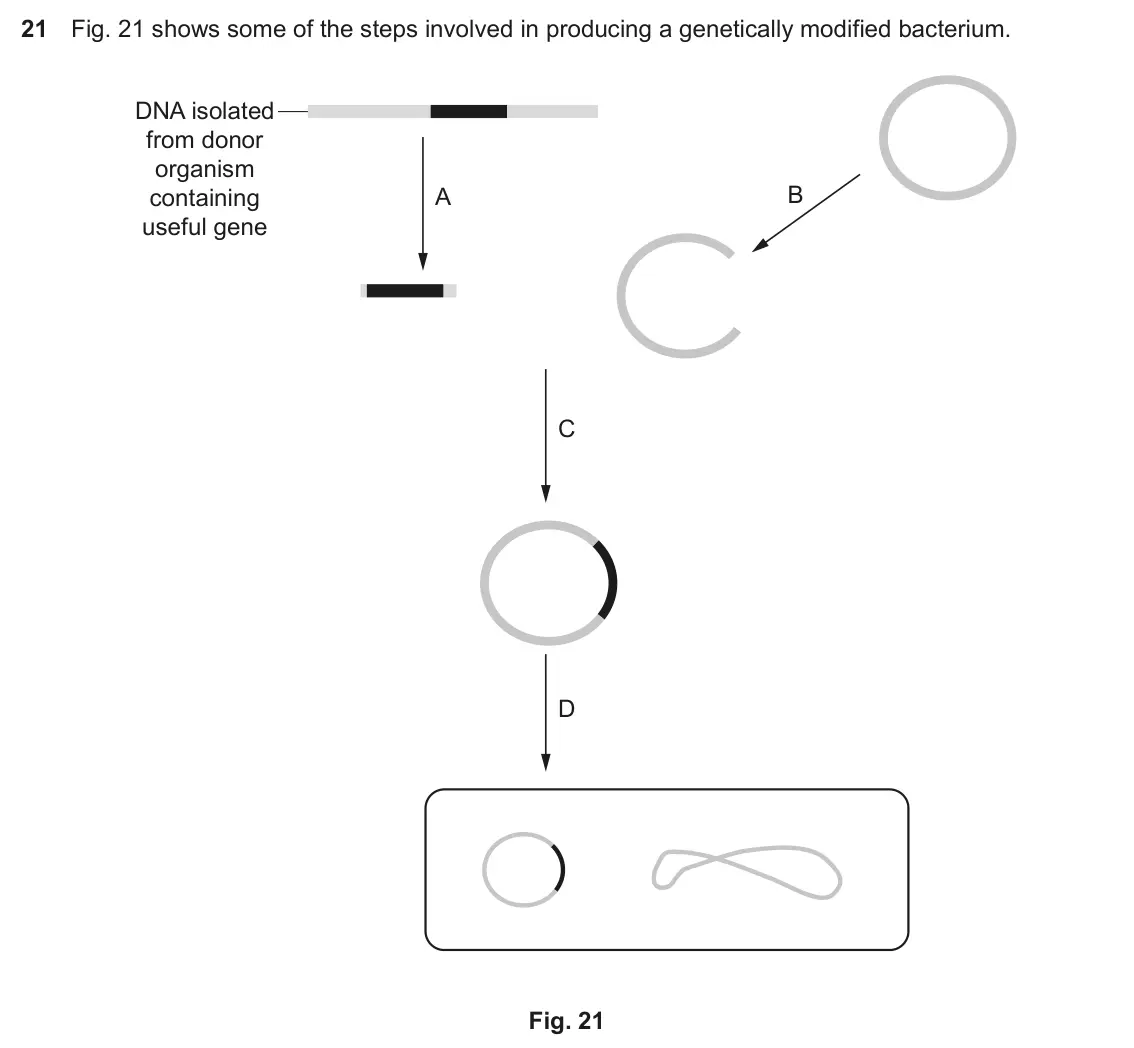
Q21(b)
The whole paper ↗Q21(c)
The whole paper ↗Q21(d)
The whole paper ↗Q21(e)
The whole paper ↗
All 18 questions on Genetic engineering, as a list
- June 2025, Paper 2, Q10 (1 mark): The use of genetically modified (GM) crops in agriculture raises certain concerns. What is not a valid concern about the use of GM crops in agriculture? A Eatin
- June 2025, Paper 3, Q4(e)(i) (2 marks): A scientist estimates that 40% of their plasmids join to the donor gene to form recombinant DNA. One in 2500 bacterial cells takes up a plasmid to form a transf
- June 2025, Paper 3, Q4(e)(ii) (1 mark): The percentage of plasmids that are taken up by bacterial cells is known as the transformation efficiency. Suggest one factor that scientists could change to im
- June 2024, Paper 2, Q18(b)(ii) (1 mark): Suggest why some people might be concerned about the increase of synthetic biology. [1]
- June 2024, Paper 3, Q5(e)(i) (1 mark): State how a plasmid containing the gene coding for insulin can be transferred into a bacterial cell. [1]
- June 2024, Paper 3, Q5(e)(ii) (1 mark): Suggest how bacterial cells can be screened to check if they have taken up a recombinant plasmid. [1]
- June 2023, Paper 3, Q3(a)(iii) (1 mark): Often a single company holds the patent for a GM crop plant. Suggest a potential ethical issue that may exist if one company holds the patent for a GM crop plan
- June 2022, Paper 3, Q6(a) (4 marks): Sickle cell disease (SCD) is a disease caused by the production of abnormal haemoglobin. A treatment for SCD is based on a technique called CRISPR gene editing
- November 2020, Paper 3, Q4(c)(i) (3 marks): Complete the diagram above by writing the missing words or phrases in the boxes labelled X, Y and Z. Answer on the diagram [3]
- November 2020, Paper 3, Q4(c)(ii) (1 mark): Suggest why the scientists used a plasmid that contained an antibiotic resistance gene. [1]
- November 2020, Paper 3, Q4(c)(iii) (2 marks): The scientists observed the following: • 1 in 400 bacteria took up the plasmid • 1 in 1000 of the plasmids taken up by bacteria contained the β‑galactosidase ge
- November 2020, Paper 3, Q4(c)(v) (1 mark): Some people think that the genetic engineering of certain organisms is unethical. However, there are very few ethical concerns about the genetic engineering of
- June 2019, Paper 2, Q9 (1 mark): Which of the following is not a valid concern about the use of genetic modification? A that antibiotic resistance genes could transfer to pathogenic bacteria B
- June 2017, Paper 2, Q21(a) (3 marks): The following passage describes steps A and B. Complete the passage using the most appropriate terms. A gene is cut from the DNA of the donor organism using a .
- June 2017, Paper 2, Q21(b) (3 marks): Describe the events that are taking place at the step labelled C. [3]
- June 2017, Paper 2, Q21(c) (3 marks): Step D results in a transformed bacterium. Many individual bacteria are not transformed successfully during this procedure. Explain how scientists can determine
- June 2017, Paper 2, Q21(d) (2 marks): Bacteria can be genetically modified to produce human insulin. The process is similar to that shown in Fig. 21 with some differences. First, instead of isolatin
- June 2017, Paper 2, Q21(e) (1 mark): Some people are concerned about genetic modification. State one valid concern that people have about the genetic modification of bacteria. [1]
Questions, mark schemes and examiner’s reports are © OCR, from their published past papers. Plumi isn’t affiliated with any exam board. Want whole papers? OCR A-Level Biology A past papers, or our free OCR-style practice pack.
The Plumi iPad app also offers exam-style questions with AI feedback on your handwritten working.