 plumi
DNA profiling, PCR and electrophoresis: OCR A‑Level Biology A questions
OCR A-Level Biology A past-paper questions on 6.1.3.2 DNA profiling, PCR and electrophoresis, 2016–2025, with mark schemes and examiner’s reports where available.
Paper
All papers
Exam
All years
Calculations
Q4(d)(i)
The whole paper ↗
Q4(d)(ii)
The whole paper ↗Q16(a)
The whole paper ↗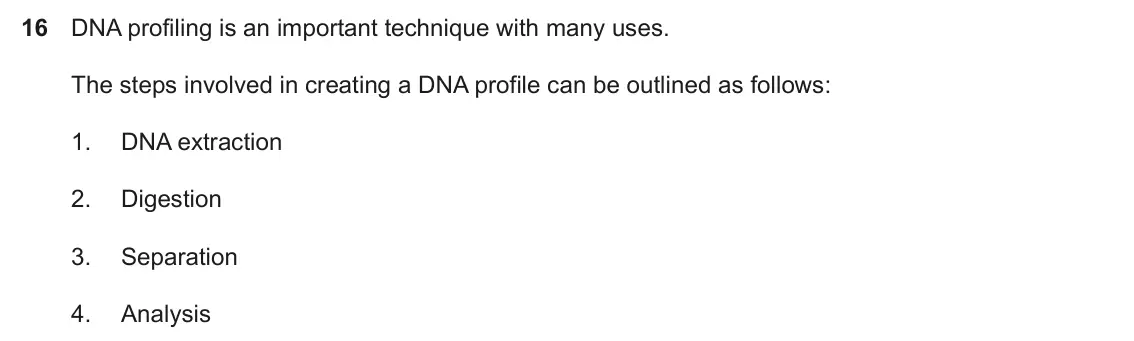
Q16(b)(i)
The whole paper ↗Q16(b)(ii)
The whole paper ↗Q16(b)(iii)
The whole paper ↗Q16(b)(iv)
The whole paper ↗Q16(c)(i)
The whole paper ↗Q16(c)(ii)
The whole paper ↗- Your answer
- Your answer
Q16(b)(i)
The whole paper ↗
Q16(b)(ii)
The whole paper ↗Q16(b)(iii)
The whole paper ↗Q4(c)(iv)
The whole paper ↗Q4(c)(i)
The whole paper ↗
Q4(c)(ii)
The whole paper ↗Q4(c)(iii)
The whole paper ↗Q4(c)(iv)
The whole paper ↗Q4(c)(v)
The whole paper ↗
All 21 questions on DNA profiling, PCR and electrophoresis, as a list
- June 2025, Paper 3, Q4(d)(i) (4 marks): The diagram shows an electrophoresis box. Solutions of DNA samples have been added to three of the wells in the box. Solutions containing DNA samples Negative e
- June 2025, Paper 3, Q4(d)(ii) (2 marks): Electrophoresis can be used to detect disease‑causing alleles, such as the mutant HBB allele that causes sickle cell disease. Restriction enzymes are used to pr
- June 2024, Paper 2, Q16(a) (1 mark): DNA profiling is used in the investigation of crime and in paternity cases. State one other use of DNA profiling. [1]
- June 2024, Paper 2, Q16(b)(i) (1 mark): Name the technique known as PCR. [1]
- June 2024, Paper 2, Q16(b)(ii) (3 marks): Outline the process of PCR, with reference to steps X, Y and Z. X Y Z [3]
- June 2024, Paper 2, Q16(b)(iii) (3 marks): Explain why a temperature of 72–75 °C is used for step Z. [3]
- June 2024, Paper 2, Q16(b)(iv) (1 mark): Suggest why a PCR step is usually necessary when creating a DNA profile from a crime scene sample in particular. [1]
- June 2024, Paper 2, Q16(c)(i) (2 marks): Suggest why some loci have two peaks but some have only one. [2]
- June 2024, Paper 2, Q16(c)(ii) (3 marks): Using the evidence in the DNA profile it was claimed that suspect S had been at the crime scene. Explain how strongly the evidence supports this claim. [3]
- June 2022, Paper 2, Q12 (1 mark): Some students incubated plasmid DNA with a restriction enzyme. After 24 h they used gel electrophoresis to analyse the products of the incubation. Which option
- November 2021, Paper 2, Q10 (1 mark): DNA fragments can be separated using gel electrophoresis. Which of the following explains how gel electrophoresis is able to separate DNA fragments? A DNA carri
- November 2021, Paper 2, Q16(b)(i) (4 marks): When creating a DNA profile, DNA is first extracted from a sample of tissue. Outline the subsequent steps involved in producing a DNA profile. [4]
- November 2021, Paper 2, Q16(b)(ii) (2 marks): Fig. 16.2 shows a DNA profile used to determine fatherhood in a paternity case. Mother M Child Ch Individual A Individual B In nd Individual C Fig. 16.2 Identif
- November 2021, Paper 2, Q16(b)(iii) (1 mark): DNA profiling can be used in cases of paternity and forensics. State one other use of DNA profiling. [1]
- November 2020, Paper 3, Q4(c)(iv) (2 marks): A technique called quantitative PCR is used to check that the E. coli population is growing on the mice liver tumours rather than on healthy tissue. Suggest how
- June 2018, Paper 3, Q4(c)(i) (1 mark): To produce a DNA profile, DNA first needs to be purified. Explain why a protease enzyme is added to the mixture during the DNA purification process. [1]
- June 2018, Paper 3, Q4(c)(ii) (2 marks): DNA samples can be amplified using the polymerase chain reaction (PCR). In theory, how many fragments of DNA might be present after 12 cycles of PCR? Assume one
- June 2018, Paper 3, Q4(c)(iii) (1 mark): Suggest why the figure you calculated in (ii) may not be achieved in practice. [1]
- June 2018, Paper 3, Q4(c)(iv) (1 mark): State the name of the enzyme used in PCR to synthesise new DNA strands. [1]
- June 2018, Paper 3, Q4(c)(v) (2 marks): DNA fragments are separated to produce a DNA profile using electrophoresis. A student wrote the following description of the electrophoresis procedure: We will
- June 2017, Paper 3, Q1(c) (3 marks): When sequencing DNA, fragments of DNA are separated by electrophoresis. Describe three differences between the process of thin layer chromatography and the form
Questions, mark schemes and examiner’s reports are © OCR, from their published past papers. Plumi isn’t affiliated with any exam board. Want whole papers? OCR A-Level Biology A past papers, or our free OCR-style practice pack.
The Plumi iPad app also offers exam-style questions with AI feedback on your handwritten working.