 plumi
Transition metals: electron configurations and oxidation numbers: Edexcel International A Level Chemistry questions
Edexcel International A Level Chemistry past-paper questions on 17.1.1 Transition metals: electron configurations and oxidation numbers, 2019–2025, with mark schemes and examiner’s reports where available.
Paper
All papers
Exam
All years
Calculations
- Your answer
Q7(b)
The whole paper ↗ Your answer
- Your answer
- Your answer
Q21(a)(i)
The whole paper ↗
Q21(a)(ii)
The whole paper ↗- Your answer
- Your answer
Q5(a)
The whole paper ↗ Your answer
Q5(b)
The whole paper ↗Your answer- Your answer
- Your answer
- Your answer
Q21(a)
The whole paper ↗
- Your answer
Q20(a)(i)
The whole paper ↗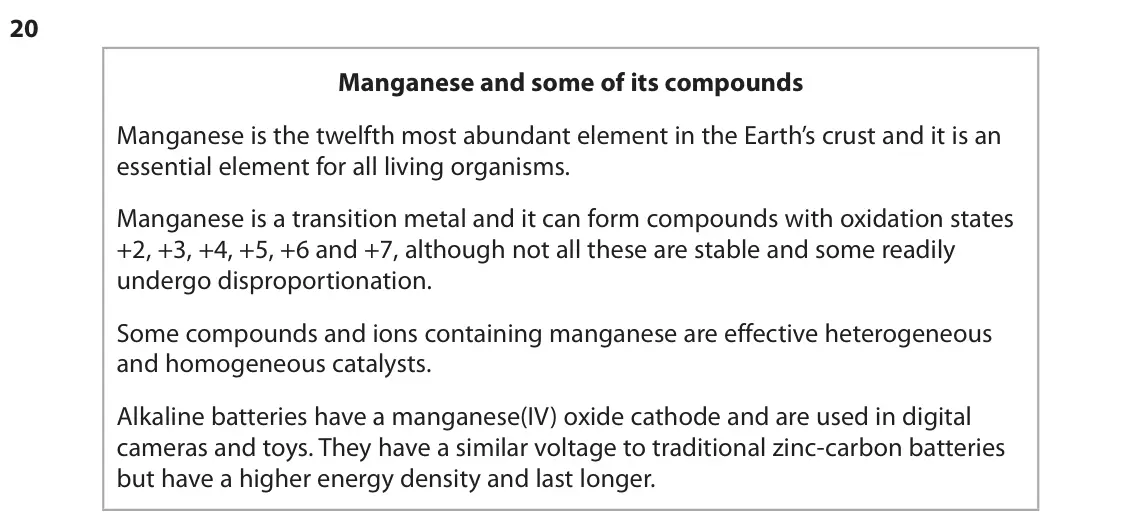
Q20(a)(ii)
The whole paper ↗- Your answer
- Your answer
Q19(a)
The whole paper ↗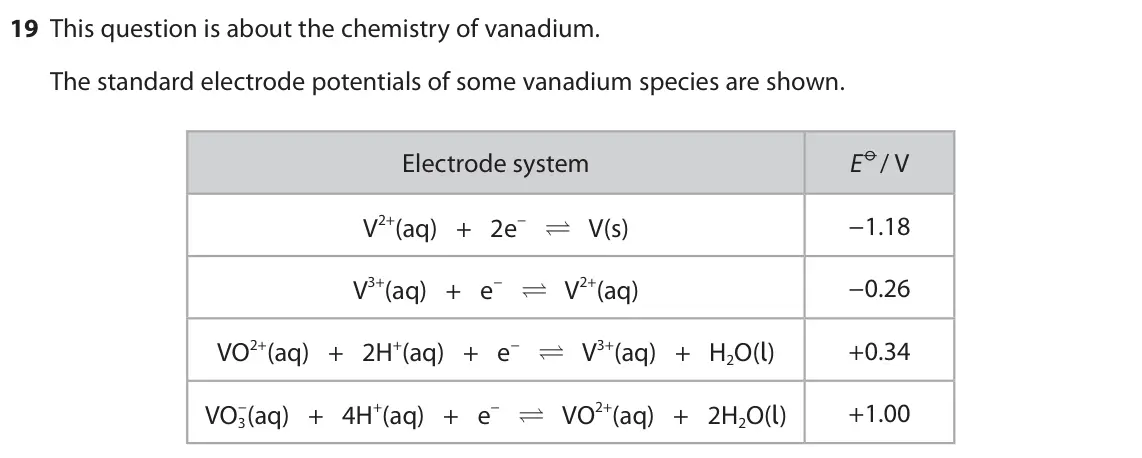
All 29 questions on Transition metals: electron configurations and oxidation numbers, as a list
- June 2025, Unit 5, Q4 (1 mark): 2+ ion? 4 What is the electronic configuration of a Zn 10 A [Ar] 3d 10 4s 2 B [Ar] 3d 9 4s 1 C [Ar] 3d 8 4s 2 D [Ar] 3d
- June 2025 (A), Unit 5, Q7(b) (1 mark): Which complex contains a metal in the +1 oxidation state? (1) A [CuCl2]– B [CrCl4]– C [Pt(NH3)2Cl2] D [Ni(CO)4]
- January 2025, Unit 5, Q3 (1 mark): The first five ionisation energies of four elements are shown. Which are the ionisation energies of a transition metal? A 419 3051 4412 5877 7975 B 578 1817 274
- January 2025, Unit 5, Q6 (1 mark): Which of these pairs of elements are both transition metals? A gold and scandium B gold and titanium C scandium and zinc D titanium and zinc
- January 2025, Unit 5, Q21(a)(i) (1 mark): The electronic configuration for Fe is shown. (1) Fe [Ar] 3d 4s Complete the electronic configuration for the Fe2+ ion in iron(II) sulfate. Fe2+ [Ar] 3d 4s
- January 2025, Unit 5, Q21(a)(ii) (3 marks): An aqueous solution of iron(II) sulfate is pale green in colour. When left exposed to the air the solution turns brown. Explain why this colour change occurs. I
- October 2024, Unit 5, Q1 (1 mark): What is the electronic configuration of the chromium atom? A [Ar] 3d4 4s2 B [Ar] 3d5 4s1 C [Ar] 3d6 D [Ar] 3d1 4s2 4p3
- January 2024, Unit 5, Q3 (1 mark): Which successive ionisation energies (in kJ mol–1) are most likely to be those of a transition element? A 578 1817 2745 11 578 14 831 B 759 1561 2958 5290 7236
- January 2024, Unit 5, Q5(a) (1 mark): What are the electronic structures of the three copper species? (1) Cu+ Cu2+ Cu [Ar] 3d9 4s2 [Ar] 3d9 4s1 [Ar] 3d9 A [Ar] 3d9 4s2 [Ar] 3d8 4s2 [Ar] 3d7 4s2 B [A
- January 2024, Unit 5, Q5(b) (1 mark): Which rows show the substances with their correct oxidation states? (1) Cu(0) Cu(I) Cu(II) A S U P B S R Q C T S P D T U Q
- October 2023, Unit 5, Q1 (1 mark): Which of these is a d-block element but is not a transition element? A cobalt B copper C nickel D zinc
- October 2023, Unit 5, Q2 (1 mark): In which of these pairs does the transition metal have the same oxidation number? A CrO2Cl2 and [Cr(NH3)4Cl2]+ B [Cu(NH3)2]+ and [CuCl4]2− C Mn2O3 and MnO2 D VO
- June 2023, Unit 5, Q6 (1 mark): Which electronic configuration is correct? A Ti2+ [Ar]4s2 B Cr [Ar]3d44s2 C Fe3+ [Ar]3d34s2 D Cu [Ar]3d104s1
- June 2023, Unit 5, Q21(a) (3 marks): Mercury forms compounds in either the +1 or +2 oxidation states. Explain why mercury is classified as a d-block element but is not a transition element. (3)
- January 2023, Unit 5, Q1 (1 mark): In which species does the transition metal have the lowest oxidation number? A [Cu(NH3)2]+ B [Fe(CN)6]3– C MnSO4 D Ni(CO)4
- January 2023, Unit 5, Q20(a)(i) (1 mark): Complete the electronic configurations for a manganese atom and a manganese(II) ion, using the electron-in-boxes notation. (1) Mn atom: [Ar] 3d 4s Mn2+ ion: [Ar
- January 2023, Unit 5, Q20(a)(ii) (3 marks): The standard electrode potentials, E , for the half-cells involving the oxidation states +3 and +2 for manganese and iron are shown. Mn3+(aq) + e– Mn2+(aq) E
- October 2022, Unit 5, Q5 (1 mark): The element zinc is not classified as a transition metal. This is because A the 3d subshell of a zinc atom is full B zinc only forms one stable ion C the only s
- October 2022, Unit 5, Q6 (1 mark): What is the electronic configuration of the Fe2+ ion? A [Ar] ↑ ↑ ↑ ↑ ↑ ↑ B [Ar] ↑↓ ↑ ↑ ↑ ↑ C [Ar] ↑ ↑ ↑ ↑ ↑↓ D [Ar] ↑↓ ↑↓ ↑ ↑ 3d 4s
- October 2022, Unit 5, Q19(a) (3 marks): Explain the highest stable oxidation state formed by vanadium, by referring to its electronic configuration. (3)
- January 2022, Unit 5, Q9 (1 mark): The formulae of four ions are shown. Formula of ion 2− CrO4 AlO2 − [Fe(CN)6]4− [CrCl2(H2O)4]+ How many of these ions contain a metal with an oxidation number of
- October 2021, Unit 5, Q20(a) (1 mark): Titanium(III) chloride is used as a catalyst in the production of poly(propene). State the property of transition metals, such as titanium, that makes their com
- June 2021, Unit 5, Q3 (1 mark): What is the electronic configuration of a chromium atom? 3d 4s ↑ ↑ ↑ ↑ ↑ ↑ A (Ar) ↑ ↑ ↑ ↑ ⇅ B (Ar) ⇅ ⇅ ↑ ↑ C (Ar) ⇅ ↑ ↑ ⇅ D (Ar)
- June 2021, Unit 5, Q21(a) (2 marks): Explain, in terms of electronic structure, why iron(III) compounds are more stable than iron(II) compounds. (2)
- June 2021, Unit 5, Q21(b)(ii) (3 marks): Explain how stable iron(III) ions can be formed from iron(II) ions in aqueous solution. Refer to the relevant energy changes of these ions only. (3)
- January 2021, Unit 5, Q5 (1 mark): Which of these has the greatest number of unpaired electrons in each of its atoms? A chromium B iron C manganese D vanadium
- January 2021, Unit 5, Q6 (1 mark): Nickel is classified as a transition metal. This is because nickel A is a d block element B has partially filled d orbitals C forms stable ions with partially f
- October 2020, Unit 5, Q16 (1 mark): The electronic configuration of the atoms of an element is 1s22s22p63s23p63d54s1. What is the maximum oxidation number shown in compounds of this element? A +1
- October 2020, Unit 5, Q25(b)(i) (1 mark): The Lanthanides The lanthanides form a series in the Periodic Table comprising the elements from lanthanum, La (Z = 57) to lutetium, Lu (Z = 71). They have impo
Questions, mark schemes and examiner’s reports are © Pearson Edexcel, from their published past papers. Plumi isn’t affiliated with any exam board. Want whole papers? Edexcel International A Level Chemistry past papers.
The Plumi iPad app also offers exam-style questions with AI feedback on your handwritten working.