 plumi
Lattice energy and Born-Haber cycles: Edexcel International A Level Chemistry questions
Edexcel International A Level Chemistry past-paper questions on 12.B.1 Lattice energy and Born-Haber cycles, 2019–2025, with mark schemes and examiner’s reports where available.
Paper
All papers
Exam
All years
Calculations
- Your answer
- Your answer
Q17(a)(i)
The whole paper ↗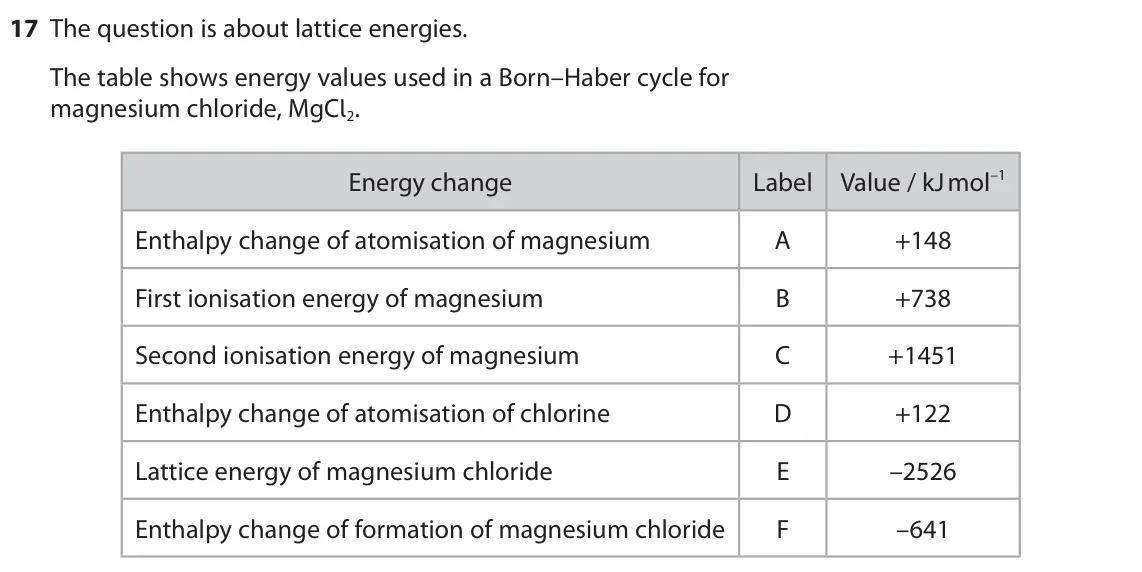
Q17(a)(ii)
The whole paper ↗Q17(a)(iii)
The whole paper ↗Q17(a)
The whole paper ↗
Q17(b)
The whole paper ↗Q7(a)
The whole paper ↗ Your answer
Q7(b)
The whole paper ↗Your answerQ3(a)
The whole paper ↗ Your answer
Q3(b)
The whole paper ↗Your answerQ21(c)(i)
The whole paper ↗
Q21(c)(ii)
The whole paper ↗Q21(c)(iii)
The whole paper ↗Q1(a)
The whole paper ↗ Your answer
Q1(b)
The whole paper ↗Your answerQ7(a)
The whole paper ↗ Your answer
Q7(b)
The whole paper ↗Your answerQ7(c)
The whole paper ↗Your answer- Your answer
All 27 questions on Lattice energy and Born-Haber cycles, as a list
- January 2025, Unit 4, Q6 (1 mark): Which equation represents the standard enthalpy change of atomisation of iodine? A ½I2(s) → I(g) B ½I2(g) → I(g) C I2(s) → 2I(g) D I2(g) → 2I(g)
- January 2025, Unit 4, Q7 (1 mark): Which equation represents the second electron affinity of oxygen? A O–(g) + e– → O2–(g) B O(g) + 2e– → O2–(g) C O+(g) → O2+(g) + e– D O(g) → O2+(g) + 2e–
- January 2024, Unit 4, Q17(a)(i) (3 marks): Complete the Born–Haber cycle for magnesium chloride by adding labels for each of the four energy changes and writing formulae in the two empty boxes. (3) Mg2+(
- January 2024, Unit 4, Q17(a)(ii) (2 marks): Calculate a value for the electron affinity of chlorine, in kJ mol–1, using the data in the table and the completed Born–Haber cycle. (2)
- January 2024, Unit 4, Q17(a)(iii) (2 marks): Explain why, when magnesium reacts with chlorine, MgCl2 is formed rather than MgCl3. (2)
- June 2023, Unit 4, Q17(a) (1 mark): State the value of the ΔatH for calcium. (1)
- June 2023, Unit 4, Q17(b) (2 marks): Calculate the enthalpy change of formation for calcium chloride. (2)
- January 2023, Unit 4, Q7(a) (1 mark): Which energy change in the cycle does y represent? (1) A the first electron affinity of oxygen B the second electron affinity of oxygen C the sum of the first a
- January 2023, Unit 4, Q7(b) (1 mark): Which expression gives the enthalpy change of formation of sodium oxide, ΔfH? (1) A ΔfH = v + w + x – y – z B ΔfH = v + w + x + y – z C ΔfH = v + w + x – y + z
- October 2022, Unit 4, Q3(a) (1 mark): Which of the following statements is not true? (1) A the lattice energy of strontium iodide is exothermic B the first electron affinity of iodine is −295 kJ mol
- October 2022, Unit 4, Q3(b) (1 mark): Using the Born–Haber cycle, it can be calculated that the standard enthalpy change of atomisation of iodine, in kJ mol−1 , is (1) A +542 B +271 C +214 D +107
- June 2022, Unit 4, Q21(c)(i) (3 marks): Complete the Born‑Haber cycle by putting letters in the boxes to label the energy changes. (3) Fe2+(g) + O2−(g) Fe2+(g) + O(g) Fe2+(g) + ½O2(g) Fe2+(g) + O−(g)
- June 2022, Unit 4, Q21(c)(ii) (2 marks): Calculate the value for second ionisation energy of iron, C. (2)
- June 2022, Unit 4, Q21(c)(iii) (2 marks): Suggest why the second electron affinity of oxygen is positive. (2)
- January 2022, Unit 4, Q1(a) (1 mark): The enthalpy change of atomisation of iodine (+107 kJ mol–1) is given by the equation (1) A ½I2(g) → I(g) B ½I2(s) → I(g) C I2(g) → 2I(g) D I2(s) → 2I(g)
- January 2022, Unit 4, Q1(b) (1 mark): Use the information in the cycle to calculate the electron affinity of iodine. (1) A –298 kJ mol–1 B –242 kJ mol–1 C +242 kJ mol–1 D +298 kJ mol–1
- October 2021, Unit 4, Q7(a) (1 mark): Which of these is the electron affinity of chlorine? (1) A y B y/2 C (w + y) D (w + y)/2
- October 2021, Unit 4, Q7(b) (1 mark): Which expression gives the lattice energy (LE) for magnesium chloride? (1) A LE = u − (v + w + x + y) B LE = v + w + x + y − u C LE = y − u − (v + w + x) D LE =
- October 2021, Unit 4, Q7(c) (1 mark): Which energy change in the cycle does x represent? (1) A the first ionisation energy of magnesium B the second ionisation energy of magnesium C the sum of the f
- January 2021, Unit 4, Q3 (1 mark): Which equation represents the standard enthalpy change of atomisation, ¨atH , of bromine? A ½ Br2(l) → Br(g) B Br2(l) → 2Br(g) C ½ Br2(g) → Br(g) D Br2(g) → 2Br
- January 2021, Unit 4, Q4(a) (1 mark): Which of these compounds would be expected to have the least exothermic lattice energy? (1) A calcium chloride B magnesium chloride C potassium bromide D sodium
- October 2020, Unit 4, Q16(a)(i) (4 marks): Complete the Born-Haber cycle by writing appropriate chemical formulae on the horizontal lines. Include state symbols and relevant electrons. (4) ∆H5 ∆H6 Ca2+(g
- October 2020, Unit 4, Q16(a)(ii) (3 marks): Calculate the second ionisation energy of calcium using the cycle and the values given in the table. Include a sign and units with your value. (3)
- October 2020, Unit 4, Q16(c) (3 marks): The table shows the theoretical lattice energies of some chlorides of Group 2. magnesium calcium strontium barium Group 2 metal chloride chloride chloride chlor
- January 2020, Unit 4, Q19(b)(i) (3 marks): Complete the Born-Haber cycle by adding letters in the boxes for the energy changes, relevant species on the blank lines and arrowheads to show the direction of
- January 2020, Unit 4, Q19(b)(ii) (2 marks): Use the data to calculate the value for the enthalpy change of formation of calcium iodide. (2)
- January 2020, Unit 4, Q19(c) (3 marks): The electron affinity of iodine is –295.4 kJ mol–1. Explain how the electron affinity of chlorine differs from that of iodine. (3)
Questions, mark schemes and examiner’s reports are © Pearson Edexcel, from their published past papers. Plumi isn’t affiliated with any exam board. Want whole papers? Edexcel International A Level Chemistry past papers.
The Plumi iPad app also offers exam-style questions with AI feedback on your handwritten working.