 plumi
Covalent character and polarisation: Edexcel International A Level Chemistry questions
Edexcel International A Level Chemistry past-paper questions on 12.B.2 Covalent character and polarisation, 2019–2025, with mark schemes and examiner’s reports where available.
Paper
All papers
Exam
All years
Calculations
- Your answer
Q20(d)(i)
The whole paper ↗
Q20(d)(ii)
The whole paper ↗- Your answer
Q17(b)
The whole paper ↗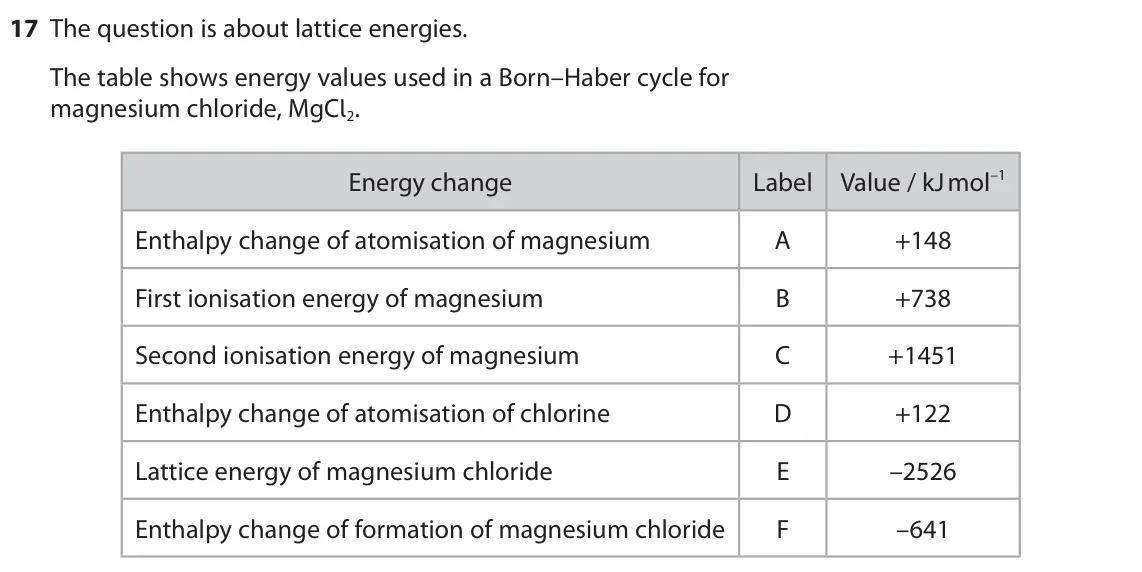
Q17(c)
The whole paper ↗
- Your answer
Q3(c)
The whole paper ↗ Your answer
- Your answer
Q4(b)
The whole paper ↗ Your answer
Q16(b)
The whole paper ↗
Q19(b)(iii)
The whole paper ↗
All 13 questions on Covalent character and polarisation, as a list
- January 2025, Unit 4, Q8 (1 mark): Which compound has the greatest covalent character? A CaBr2 B CaI2 C MgBr2 D MgI2 Use this space for any rough working. Anything you write in this space will ga
- October 2024, Unit 4, Q20(d)(i) (2 marks): Give two assumptions used in theoretical calculations of lattice energy. (2)
- October 2024, Unit 4, Q20(d)(ii) (3 marks): Explain the difference between the theoretical and experimental values for the lattice energy of magnesium chloride, MgCl2(s). (3)
- June 2024, Unit 4, Q2 (1 mark): Some data on lattice energies are shown. Experimental lattice energy / Theoretical lattice energy / Compound kJ mol–1 kJ mol–1 NaI –705 –687 AgBr –891 –816 Rb2S
- January 2024, Unit 4, Q17(b) (6 marks): Lattice energies from the Born–Haber cycle are based on experimental values. Theoretical lattice energies can also be calculated. Experimental and theoretical v
- June 2023, Unit 4, Q17(c) (4 marks): Some energy data are shown. Theoretical lattice energy Experimental lattice energy Compound / kJ mol–1 / kJ mol–1 CaCl2 –2223 –2258 CaI2 –1905 –2074 Explain why
- January 2023, Unit 4, Q8 (1 mark): An ionic compound is found to have some degree of covalent bonding. What will be the cause of the covalency and how will the lattice energy obtained from a Born
- October 2022, Unit 4, Q3(c) (1 mark): Theoretical lattice energies are calculated assuming only ionic bonding is present. Which of these is most likely to be the theoretical lattice energy of stront
- June 2022, Unit 4, Q15 (1 mark): Experimental lattice energy values determined using the Born‑Haber cycle often differ from calculated theoretical values. The ionic radii and charges of some io
- June 2021, Unit 4, Q18 (6 marks): The table shows the theoretical and experimental (Born-Haber) lattice energy data for * two metal halide compounds, sodium chloride and magnesium iodide. Lattic
- January 2021, Unit 4, Q4(b) (1 mark): Which of these compounds would be expected to have the largest difference between their experimental (Born–Haber) and theoretical lattice energies? (1) A calciu
- October 2020, Unit 4, Q16(b) (3 marks): The theoretical lattice energy of formation of CaCl2 is −2 223 kJ mol−1. Explain why the experimental lattice energy of CaCl2 is more exothermic than the theore
- January 2020, Unit 4, Q19(b)(iii) (4 marks): The value for the lattice energy of calcium iodide determined experimentally by using the Born-Haber cycle differs significantly from the theoretical calculated
Questions, mark schemes and examiner’s reports are © Pearson Edexcel, from their published past papers. Plumi isn’t affiliated with any exam board. Want whole papers? Edexcel International A Level Chemistry past papers.
The Plumi iPad app also offers exam-style questions with AI feedback on your handwritten working.