 plumi
Activation energy from experimental data: Edexcel International A Level Chemistry questions
Edexcel International A Level Chemistry past-paper questions on 11.2.1 Activation energy from experimental data, 2019–2025, with mark schemes and examiner’s reports where available.
Paper
All papers
Exam
All years
Calculations
Q3(d)(ii)
The whole paper ↗
Q4(b)(i)
The whole paper ↗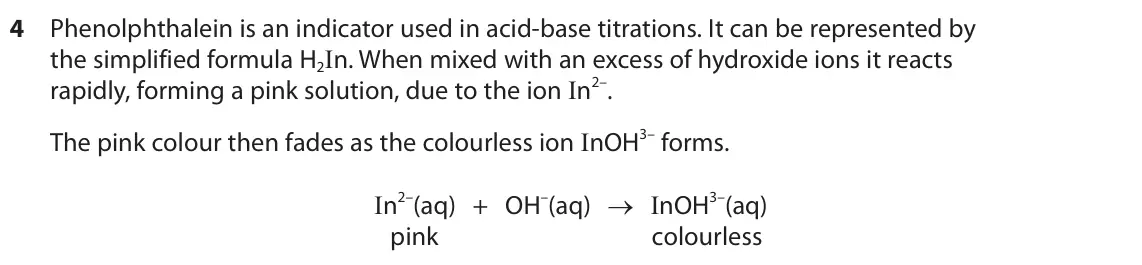
Q4(b)(ii)
The whole paper ↗Q2(d)
The whole paper ↗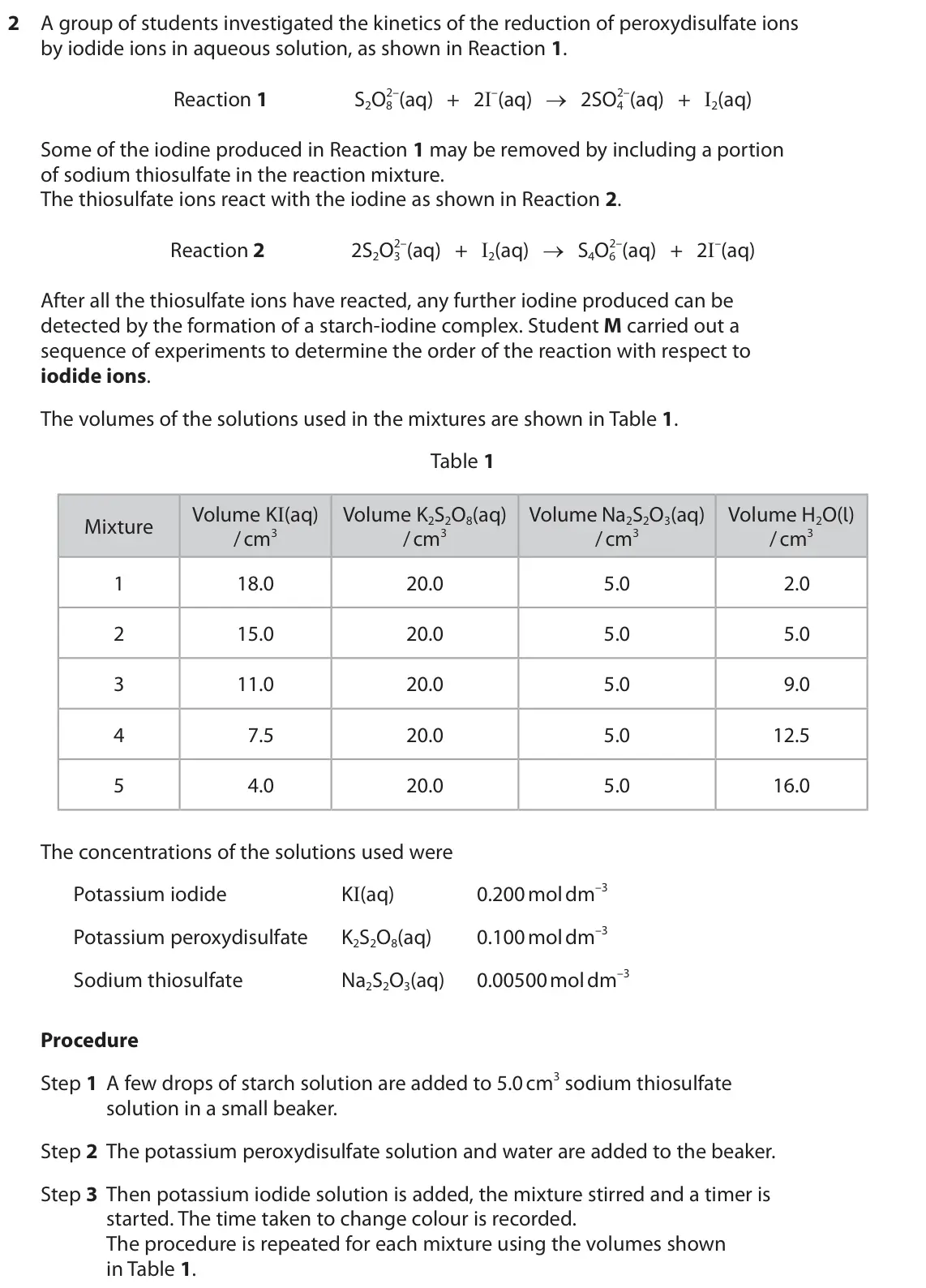
Q16(b)
The whole paper ↗
Q16(c)(i)
The whole paper ↗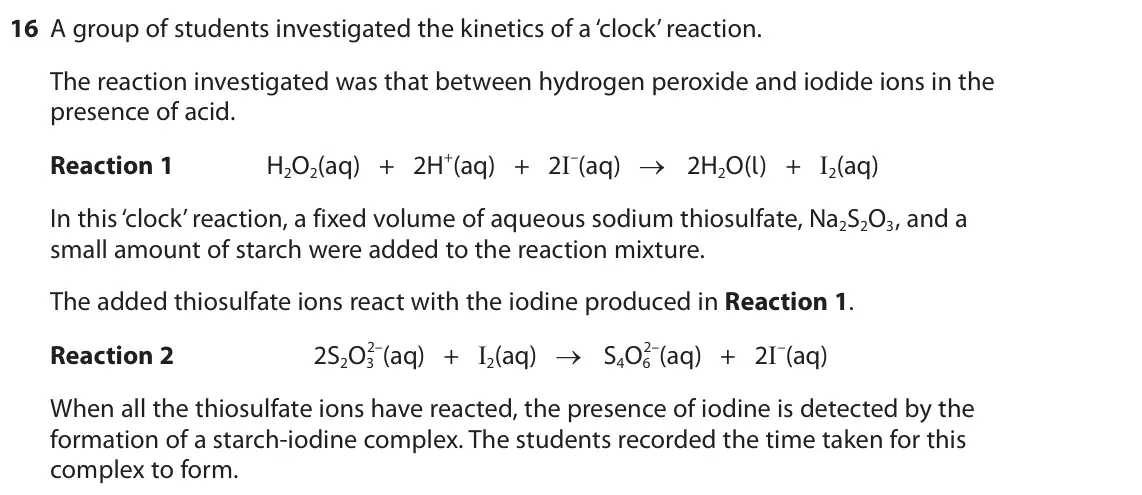
Q16(c)(ii)
The whole paper ↗- Your answer
Q20(b)
The whole paper ↗
Q20(c)
The whole paper ↗Q17(b)
The whole paper ↗
Q16(c)(i)
The whole paper ↗
Q16(c)(ii)
The whole paper ↗Q16(d)
The whole paper ↗- Your answer
Q17(b)(i)
The whole paper ↗
Q17(b)(ii)
The whole paper ↗Q17(b)(iii)
The whole paper ↗Q17(b)(iv)
The whole paper ↗- Your answer
All 26 questions on Activation energy from experimental data, as a list
- June 2025, Unit 6, Q3(d)(ii) (1 mark): The experimental data was plotted on a graph of ln (1 / t) against 1 / T, giving a straight line with gradient, m = –6045 K. Calculate the activation energy, Ea
- January 2025, Unit 6, Q4(b)(i) (3 marks): Calculate the activation energy for the reaction, using the gradient of the graph and the Arrhenius equation shown. Give your answer to an appropriate number of
- January 2025, Unit 6, Q4(b)(ii) (1 mark): A value for ln(collision factor) of –4.4, given to two significant figures, was suggested by the student. State whether or not you agree with this value. Justif
- October 2024, Unit 6, Q2(d) (3 marks): A group of students investigated the kinetics of the reduction of peroxydisulfate ions by iodide ions in aqueous solution, as shown in Reaction 1. 2–(aq) + 2I–(
- June 2024, Unit 4, Q16(b) (4 marks): The rate constant, k, for the decomposition of CH3CHO was determined between 1000 K and 1700 K. The results are plotted on the graph of ln k against 1 / T. 10 8
- January 2024, Unit 4, Q16(c)(i) (5 marks): Determine the value for Ea for Reaction 1 by plotting a graph using the axes provided. You should take into account the error made by one of the students. ln ra
- January 2024, Unit 4, Q16(c)(ii) (2 marks): The students all used thermometers capable of reading to the same precision. Use your graph to deduce the temperature that the student who made the error should
- October 2023, Unit 4, Q4 (1 mark): The graph shown can be used to obtain a value for the activation energy, Ea, of a reaction. 1 / K–1 T ln(rate constant) The activation energy is related to the
- June 2023, Unit 4, Q20(b) (2 marks): Rate experiments on the decomposition of nitrous oxide produced the following graph. 1 T / K–1 0.0064 0.0065 0.0066 0.0067 0.0068 –188 –190 –192 ln k –194 –196
- June 2023, Unit 4, Q20(c) (2 marks): Explain whether or not this reaction occurs at 2048 K by considering the values calculated in (a) and (b). (2)
- January 2023, Unit 4, Q17(b) (4 marks): The student carried out a second series of experiments with this reaction at 313 K. The rate of reaction was found to be 4.45 times faster at 313 K than at 293
- October 2022, Unit 4, Q16(c)(i) (2 marks): Explain why the rate constant for this reaction is higher at 623 K than at 523 K . (2)
- October 2022, Unit 4, Q16(c)(ii) (3 marks): The rate constant changes with temperature according to the expression shown. k E 1 1 1 a log = − − 10 k 2.3 R T T 2 1 2 Calculate the activa
- October 2022, Unit 4, Q16(d) (1 mark): The activation energy for the decomposition of azomethane is high because the reaction involves covalent bond fission. Identify on the structure of azomethane t
- June 2022, Unit 4, Q12 (1 mark): A series of experiments was carried out to determine the rate constant, k, of the reaction between bromate(V) ions and bromide ions at different temperatures, T
- October 2021, Unit 4, Q17(b)(i) (2 marks): Use the rate constant that you have calculated in (a)(iii) to obtain data for a point on the graph for 333 K. (2)
- October 2021, Unit 4, Q17(b)(ii) (1 mark): Plot your data from (b)(i) on the graph. (1)
- October 2021, Unit 4, Q17(b)(iii) (3 marks): Determine the gradient of the graph by drawing a best-fit line. Include a sign and units in your answer. (3)
- October 2021, Unit 4, Q17(b)(iv) (3 marks): Use the gradient determined in (b)(iii) to calculate the activation energy for the decomposition of benzenediazonium chloride. Include a sign and units with you
- June 2021, Unit 4, Q7 (1 mark): The Arrhenius equation can be shown as 1 Ea In k = – × + constant T R A graph is plotted of ln k against 1/T for a reaction. The activation energy, Ea , of this
- January 2021, Unit 4, Q20(c) (7 marks): The rate constant for the reaction between bromoalkane and cyanide ions is determined at five different temperatures. The results are given in the table. Temper
- January 2020, Unit 4, Q18(a)(i) (1 mark): Complete the table. (1)
- January 2020, Unit 4, Q18(a)(ii) (3 marks): Plot a graph of ln k against 1 / T. (3)
- January 2020, Unit 4, Q18(a)(iii) (3 marks): Use your graph to determine the activation energy, Ea, in kJ mol−1. You should include the value and units of the gradient of the line. The Arrhenius equation i
- January 2020, Unit 4, Q18(b) (2 marks): The activation energy for many reactions is around +50 kJ mol–1. Given this information, comment on your value for Ea. (2)
- January 2020, Unit 4, Q18(c) (3 marks): Explain the trend in the value of the rate constant k as the temperature increases. (3)
Questions, mark schemes and examiner’s reports are © Pearson Edexcel, from their published past papers. Plumi isn’t affiliated with any exam board. Want whole papers? Edexcel International A Level Chemistry past papers.
The Plumi iPad app also offers exam-style questions with AI feedback on your handwritten working.