 plumi
Feasibility and thermodynamic versus kinetic stability: Edexcel International A Level Chemistry questions
Edexcel International A Level Chemistry past-paper questions on 12.A.4 Feasibility and thermodynamic versus kinetic stability, 2019–2025, with mark schemes and examiner’s reports where available.
Paper
All papers
Exam
All years
Calculations
Q19(a)(iii)
The whole paper ↗
- Your answer
Q19(b)
The whole paper ↗
- Your answer
Q20(a)(ii)
The whole paper ↗
Q15(a)(v)
The whole paper ↗
Q16(a)(iii)
The whole paper ↗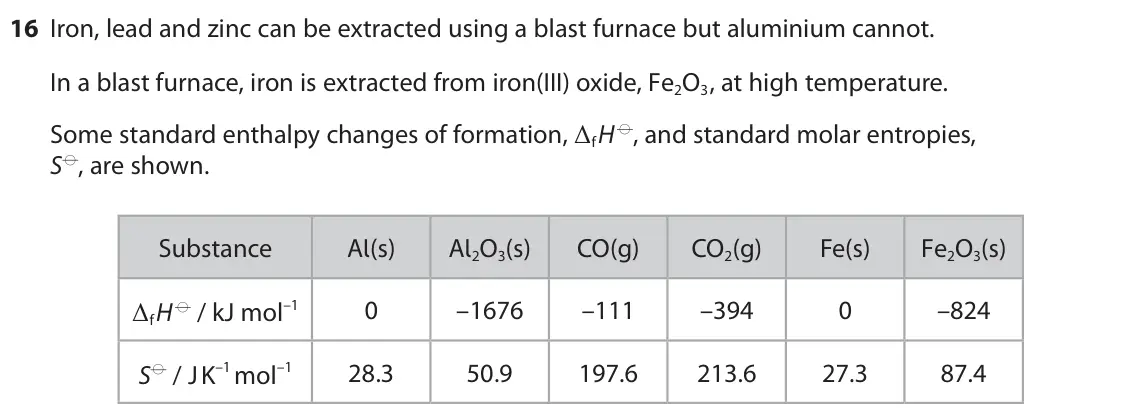
Q16(b)(i)
The whole paper ↗Q16(b)(ii)
The whole paper ↗Q20(c)
The whole paper ↗
- Your answer
Q20(a)(v)
The whole paper ↗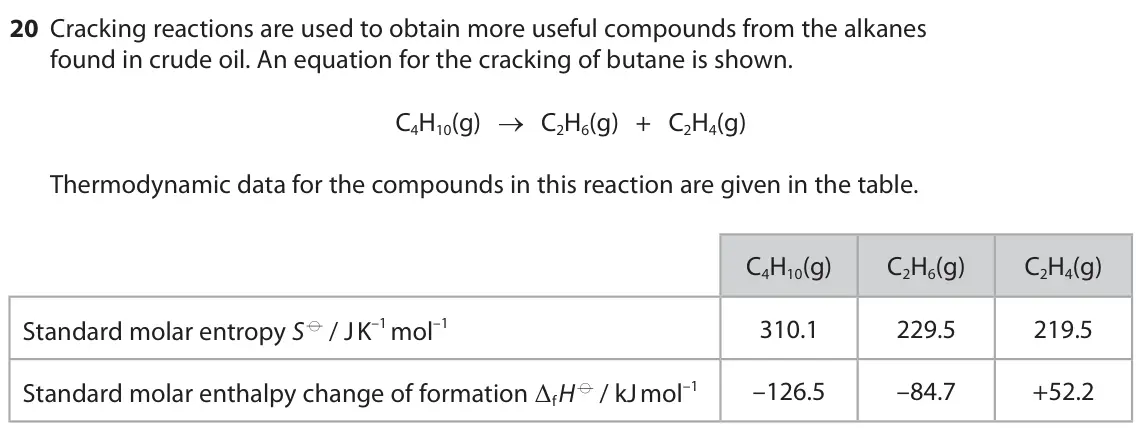
Q18(c)(v)
The whole paper ↗
Q18(d)
The whole paper ↗Q21(a)(iii)
The whole paper ↗
Q21(b)(i)
The whole paper ↗Q21(b)(ii)
The whole paper ↗Q22(b)
The whole paper ↗
Q22(c)(i)
The whole paper ↗Q22(c)(iii)
The whole paper ↗
All 23 questions on Feasibility and thermodynamic versus kinetic stability, as a list
- June 2025, Unit 4, Q19(a)(iii) (3 marks): Using your answers from (a)(i) and (a)(ii), calculate the lowest temperature at which hydrated copper(II) sulfate will decompose. (3)
- January 2025, Unit 4, Q9 (1 mark): Which pair of values will always give a thermodynamically feasible reaction? Entropy change of the system Enthalpy change of reaction A negative positive B nega
- January 2025, Unit 4, Q19(b) (3 marks): Describe, in terms of the particles involved, why the reaction does not occur until the tablets are dissolved in water. (3)
- October 2024, Unit 4, Q11 (1 mark): Some thermodynamic information is shown for four reactions, W, X, Y and Z, at 298 K. ΔH TΔSsystem Reaction negative and with a larger W negative negative value
- October 2024, Unit 4, Q20(a)(ii) (3 marks): The lowest temperature at which barium carbonate, BaCO3 , decomposes is 712 °C. Use this information and your answer from (a)(i) to calculate the standard entha
- June 2024, Unit 4, Q15(a)(v) (1 mark): Reaction 1 does not occur at room temperature due to its very high activation energy. Suggest why the activation energy for Reaction 1 is very high. (1)
- October 2023, Unit 4, Q16(a)(iii) (3 marks): Explain how your answers to (a)(i) and (a)(ii) show that this reaction is feasible at all temperatures. (3)
- October 2023, Unit 4, Q16(b)(i) (4 marks): Calculate the temperature at which this reaction becomes feasible. (4)
- October 2023, Unit 4, Q16(b)(ii) (1 mark): Suggest why aluminium is not extracted from its oxide using a blast furnace. (1)
- June 2023, Unit 4, Q20(c) (2 marks): Explain whether or not this reaction occurs at 2048 K by considering the values calculated in (a) and (b). (2)
- January 2023, Unit 4, Q6 (1 mark): When hydrogen and oxygen are mixed in a flask, there is no reaction. When a platinum gauze is added to the flask, the mixture explodes. It can be deduced that,
- January 2023, Unit 4, Q20(a)(v) (2 marks): Calculate the temperature at which the cracking reaction becomes feasible. (2)
- October 2022, Unit 4, Q18(c)(v) (2 marks): The free energy change for the reaction, ∆G , is related to entropy and can be calculated from Kc . ∆G = −RT ln Kc Calculate ∆G at 620 K , using this equation a
- October 2022, Unit 4, Q18(d) (3 marks): Explain, in terms of the total entropy change, ∆Stotal , why this reaction is feasible at any temperature. Assume that both ∆H and ∆Ssystem are independent of t
- June 2022, Unit 4, Q21(a)(iii) (3 marks): Calculate the temperature at which this reaction becomes feasible, using your answers from (a)(i) and (a)(ii). (3)
- June 2022, Unit 4, Q21(b)(i) (2 marks): Explain why the reaction should be feasible at any temperature. (2)
- June 2022, Unit 4, Q21(b)(ii) (3 marks): Explain how an increase in temperature would affect ∆Stotal of this reaction. No calculation is required. (3)
- January 2022, Unit 4, Q22(b) (2 marks): The value of the total entropy change, ΔS total, varies with temperature. Data for the value of ΔS total at different temperatures but at standard pressure of 1
- January 2022, Unit 4, Q22(c)(i) (1 mark): Determine the gradient of the line plotted in (b), including units in your answer. (1)
- January 2022, Unit 4, Q22(c)(iii) (1 mark): Determine the temperature at which the reaction ceases to be thermodynamically feasible at a pressure of 100 kPa. (1)
- January 2022, Unit 4, Q22(d)(iii) (3 marks): Explain why ΔS total decreases with an increase in temperature. (3)
- January 2021, Unit 4, Q2 (1 mark): The entropy change of the surroundings, ¨Ssurroundings , and the entropy change of the system, ¨Ssystem , for four different reactions are given. ¨Ssurroundings
- January 2020, Unit 4, Q19(a)(ii) (3 marks): In industry, the reaction is carried out at 700 °C. By considering entropy and other relevant factors, justify the use of this temperature. (3)
Questions, mark schemes and examiner’s reports are © Pearson Edexcel, from their published past papers. Plumi isn’t affiliated with any exam board. Want whole papers? Edexcel International A Level Chemistry past papers.
The Plumi iPad app also offers exam-style questions with AI feedback on your handwritten working.