 plumi
Calculating ∆Ssystem, ∆Ssurroundings and ∆Stotal: Edexcel International A Level Chemistry questions
Edexcel International A Level Chemistry past-paper questions on 12.A.3 Calculating ∆Ssystem, ∆Ssurroundings and ∆Stotal, 2019–2025, with mark schemes and examiner’s reports where available.
Paper
All papers
Exam
All years
Calculations
Q19(a)(ii)
The whole paper ↗
Q19(a)(iii)
The whole paper ↗Q19(c)
The whole paper ↗
Q20(a)(i)
The whole paper ↗
Q20(a)(ii)
The whole paper ↗Q15(a)(iii)
The whole paper ↗
Q15(a)(iv)
The whole paper ↗Q15(c)(i)
The whole paper ↗Q15(c)(ii)
The whole paper ↗- Your answer
- Your answer
Q16(a)(i)
The whole paper ↗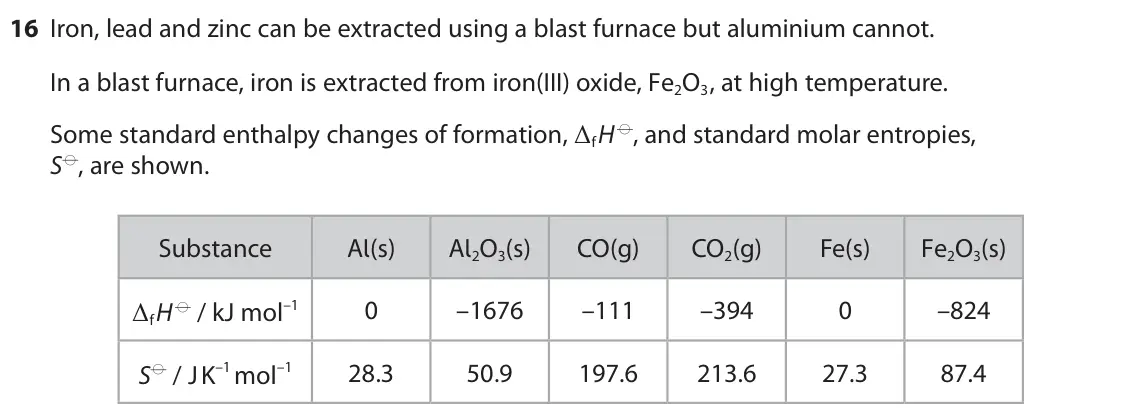
Q16(a)(iii)
The whole paper ↗Q16(b)(i)
The whole paper ↗Q20(a)(i)
The whole paper ↗
Q20(a)(ii)
The whole paper ↗Q20(a)(iii)
The whole paper ↗Q20(a)(i)
The whole paper ↗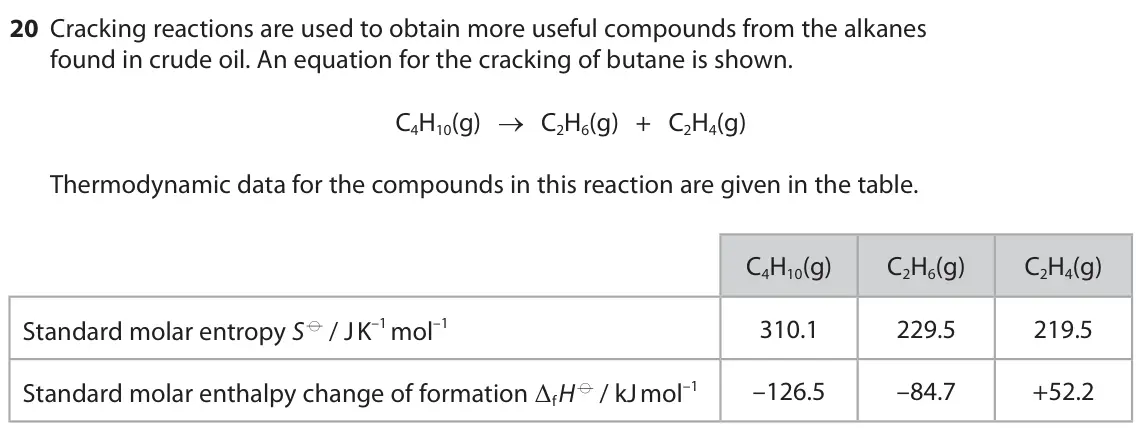
Q20(a)(iii)
The whole paper ↗Q20(a)(iv)
The whole paper ↗
All 35 questions on Calculating ∆Ssystem, ∆Ssurroundings and ∆Stotal, as a list
- June 2025, Unit 4, Q19(a)(ii) (2 marks): Using the data in the table, calculate the standard molar entropy change, ΔSd system , for this reaction. (2)
- June 2025, Unit 4, Q19(a)(iii) (3 marks): Using your answers from (a)(i) and (a)(ii), calculate the lowest temperature at which hydrated copper(II) sulfate will decompose. (3)
- January 2025, Unit 4, Q19(c) (2 marks): For the reaction at 25°C, the standard entropy change of the surroundings, ∆Ssurroundings = −234.9 J K−1 mol−1 . Calculate the enthalpy change of the reaction.
- October 2024, Unit 4, Q20(a)(i) (2 marks): Calculate the standard entropy change for the system, ∆Ssystem . Standard molar entropy Compound / J K–1 mol–1 BaCO3 112.1 BaO 70.4 CO2 213.6 (2)
- October 2024, Unit 4, Q20(a)(ii) (3 marks): The lowest temperature at which barium carbonate, BaCO3 , decomposes is 712 °C. Use this information and your answer from (a)(i) to calculate the standard entha
- June 2024, Unit 4, Q15(a)(iii) (2 marks): The enthalpy change, ΔH, for Reaction 1 is –370 kJ mol–1. Calculate the entropy change of the surroundings, ΔSsurroundings , in J K–1 mol–1, for Reaction 1 at 2
- June 2024, Unit 4, Q15(a)(iv) (2 marks): Calculate the total entropy change, ΔStotal , for Reaction 1 at 23.0 °C. Give your answer to an appropriate number of significant figures, and in units of J K–1
- June 2024, Unit 4, Q15(c)(i) (2 marks): Calculate the entropy change of the system, ΔSsystem , in J K–1 mol–1, for Reaction 2. (2)
- June 2024, Unit 4, Q15(c)(ii) (1 mark): State why the entropy change of the surroundings for Reaction 2 is highly positive, in terms of the bond strengths of the reactants and products. (1)
- January 2024, Unit 4, Q5 (1 mark): Methane reacts with steam to produce carbon dioxide and hydrogen. CH4(g) + 2H2O(g) → CO2(g) + 4H2(g) The standard molar entropies of the reactants and products
- January 2024, Unit 4, Q6 (1 mark): What are the signs of the entropy changes at 373 K when water vapour condenses? H2O(g) → H2O(l) ΔSsystem ΔSsurroundings A positive positive B positive negative
- October 2023, Unit 4, Q16(a)(i) (3 marks): Calculate the standard entropy change of the system for this reaction. (3)
- October 2023, Unit 4, Q16(a)(iii) (3 marks): Explain how your answers to (a)(i) and (a)(ii) show that this reaction is feasible at all temperatures. (3)
- October 2023, Unit 4, Q16(b)(i) (4 marks): Calculate the temperature at which this reaction becomes feasible. (4)
- June 2023, Unit 4, Q20(a)(i) (2 marks): Some standard molecular entropy data are shown. Standard molecular entropy S Substance / J K–1 mol–1 nitrogen, N2 192 oxygen, O2 205 nitrous oxide, N2O 220 Calc
- June 2023, Unit 4, Q20(a)(ii) (2 marks): The standard enthalpy change of the forward reaction is –82 kJ mol–1. Calculate the entropy change of the surroundings at 2048 K. Include a sign and units in yo
- June 2023, Unit 4, Q20(a)(iii) (1 mark): Calculate the total entropy change of the reaction at 2048 K. Include a sign and units in your answer. (1)
- January 2023, Unit 4, Q20(a)(i) (2 marks): Calculate the entropy change in the system, ΔS d system , for the cracking of butane. Include a sign and units with your answer. (2)
- January 2023, Unit 4, Q20(a)(iii) (2 marks): Calculate the entropy change in the surroundings, ΔS d surroundings, at 298 K for the cracking of butane, using your answer to (a)(ii). Include a sign and units
- January 2023, Unit 4, Q20(a)(iv) (1 mark): Calculate the total entropy change, ΔS d total, at 298 K for the cracking of butane, using your answers to (a)(i) and (a)(iii). Include a sign and units with yo
- January 2023, Unit 4, Q20(a)(v) (2 marks): Calculate the temperature at which the cracking reaction becomes feasible. (2)
- October 2022, Unit 4, Q18(c)(vi) (2 marks): The equation relating ∆G, ∆H and ∆Ssystem is shown. ∆G = ∆H − T∆Ssystem Calculate ∆Ssystem at 620 K , using your answers to (c)(iv) and (c)(v). (2)
- June 2022, Unit 4, Q21(a)(ii) (3 marks): Calculate the entropy change, ∆Ssystem , for this reaction. (3)
- January 2022, Unit 4, Q22(a) (2 marks): At 298 K the standard entropy change of the system, ΔS d system = –98 J K–1 mol–1. Calculate the standard entropy of one mole of ammonia. Use the value of ΔS d
- January 2022, Unit 4, Q22(c)(ii) (1 mark): Identify the thermodynamic quantity that can be obtained from this gradient. (1)
- October 2021, Unit 4, Q4 (1 mark): The decomposition of calcium carbonate is an important reaction in the manufacture of cement. CaCO3(s) → CaO(s) + CO2(g) ∆H = +178 kJ mol−1 What are the signs o
- June 2021, Unit 4, Q2 (1 mark): What is the standard entropy change of the system, in J K–1 mol–1, for the reaction between nitrogen and hydrogen to form ammonia? N2 + 3H2 → 2NH3 Standard mola
- June 2021, Unit 4, Q15(a) (2 marks): Calculate the value for the standard entropy change in the surroundings, ∆Ssurroundings , when ammonium nitrate dissolves in water at 298 K. Include a sign and
- June 2021, Unit 4, Q15(b) (3 marks): Explain what can be deduced from your answer in (a) about the sign and the value of the standard entropy change in the system, ∆Ssystem , when NH4NO3 dissolves.
- January 2021, Unit 4, Q20(a) (5 marks): Potassium bromate(V) decomposes to form potassium bromide and oxygen. 2KBrO3(s) o 2KBr(s) + 3O2(g) ¨rH = −67.2 kJ mol−1 The standard molar entropies of these su
- October 2020, Unit 4, Q6 (1 mark): The equation for an exothermic reaction is shown. Mg(s) + 2HCl(aq) → MgCl2(aq) + H2(g) Which of these is true? A ΔH is positive B ΔSsurroundings is positive C Δ
- October 2020, Unit 4, Q19(a)(i) (2 marks): Calculate ∆Ssystem for this reaction at 298 K. Include a sign and units with your answer. [Standard molar entropy, S , for 1 mol of each gas, in J K−1 mol−1 : N
- October 2020, Unit 4, Q19(a)(iii) (2 marks): At 700 K, the enthalpy change for this reaction is ∆H = −110.2 kJ mol−1. Calculate the entropy change of the surroundings, ∆Ssurroundings , at 700 K. Include a
- October 2020, Unit 4, Q19(a)(iv) (1 mark): At 700 K, the total entropy change, ∆Stotal = −78.7 J K−1 mol−1. Calculate ∆Ssystem for this reaction at 700 K. Include a sign and units in your answer. (1)
- January 2020, Unit 4, Q19(a)(i) (5 marks): Calculate the total entropy change, ¨Stotal, for this reaction, at 298 K, using the information given. Include a sign and units in your answer which should be g
Questions, mark schemes and examiner’s reports are © Pearson Edexcel, from their published past papers. Plumi isn’t affiliated with any exam board. Want whole papers? Edexcel International A Level Chemistry past papers.
The Plumi iPad app also offers exam-style questions with AI feedback on your handwritten working.