 plumi
Water and mineral ions in plants: Edexcel International A Level Biology questions
Edexcel International A Level Biology past-paper questions on 4.2.3 Water and mineral ions in plants, 2019–2025, with mark schemes and examiner’s reports where available.
Paper
All papers
Exam
All years
Calculations
Q7(a)(i)
The whole paper ↗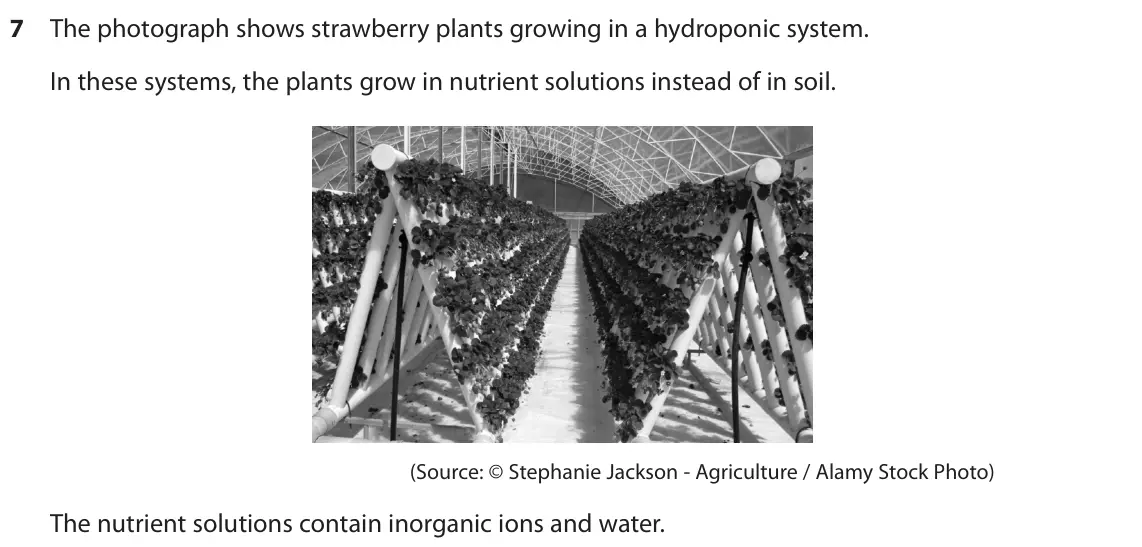
Q7(a)(ii)
The whole paper ↗Q7(b)
The whole paper ↗Your answerQ7(c)(i)
The whole paper ↗Q7(c)(ii)
The whole paper ↗Q3(b)(i)
The whole paper ↗
Q3(b)(ii)
The whole paper ↗Q2(c)
The whole paper ↗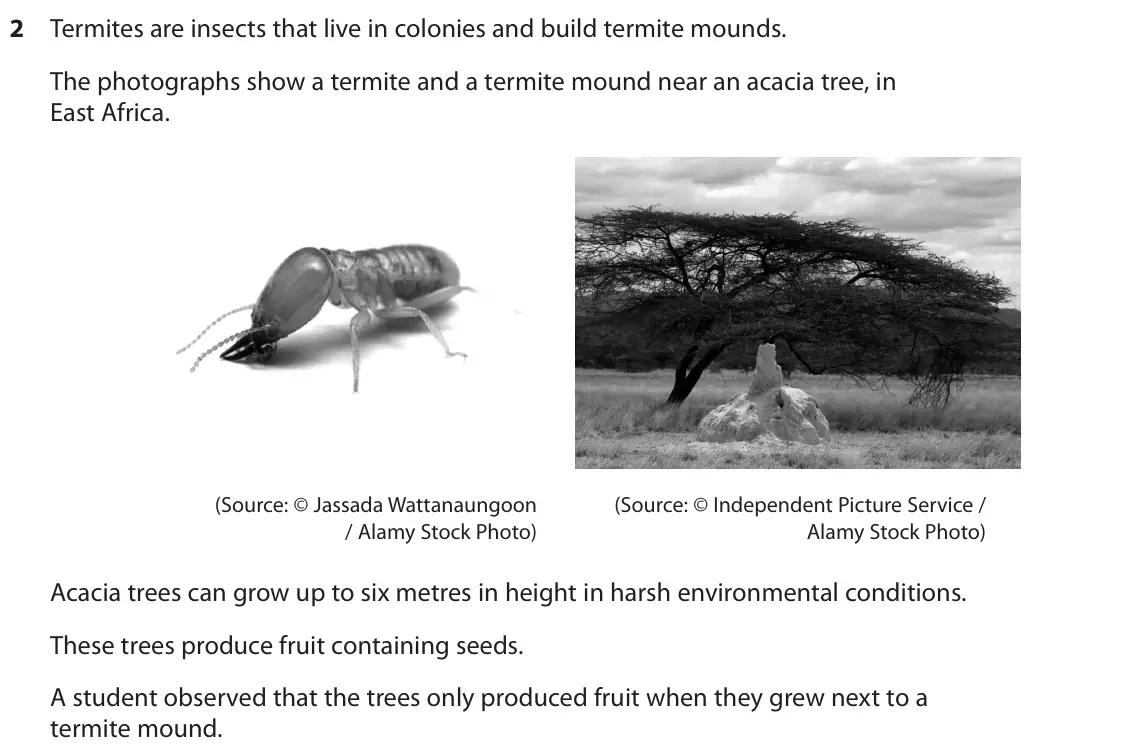
Q5(b)(i)
The whole paper ↗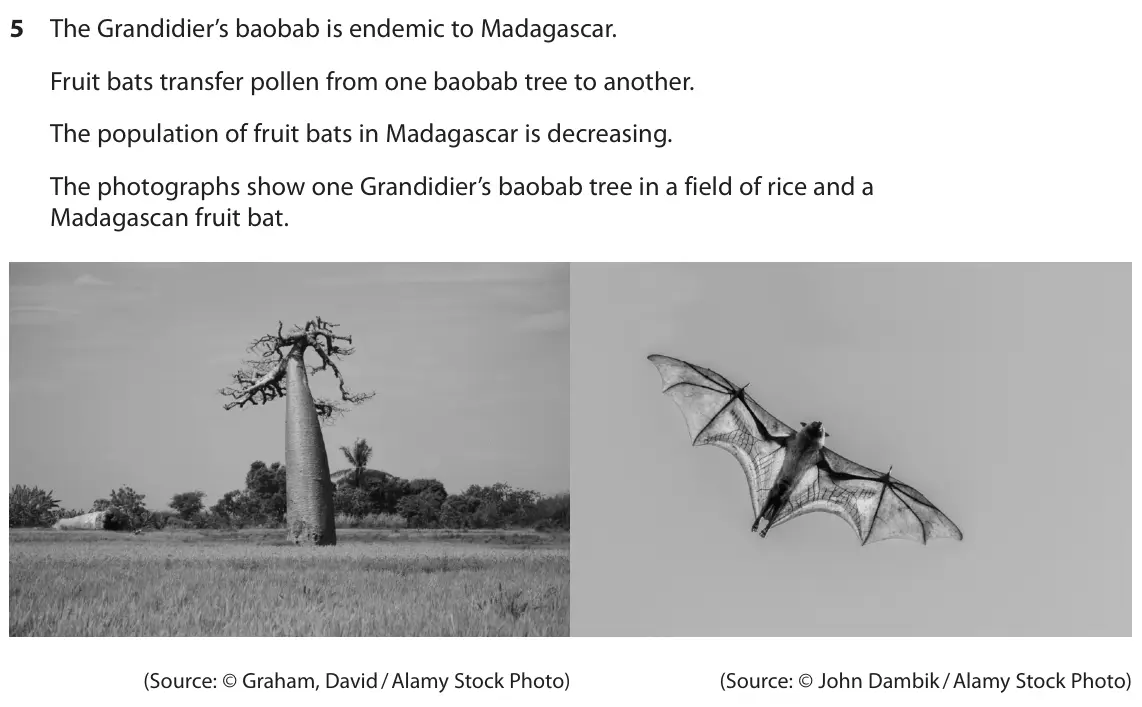
Q5(c)
The whole paper ↗Q5(d)
The whole paper ↗Q2(a)(i)
The whole paper ↗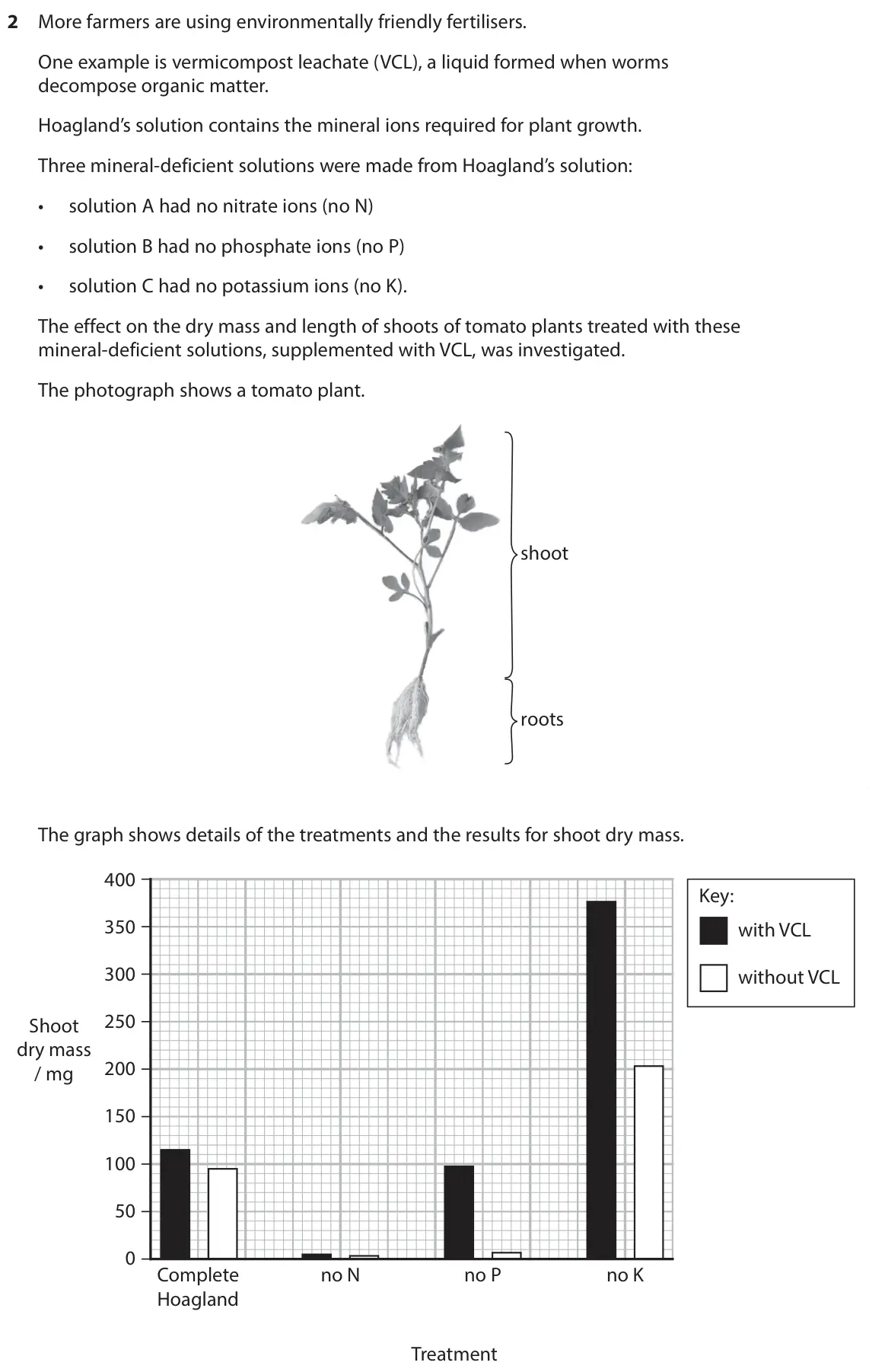
Q2(a)(ii)
The whole paper ↗Q2(b)(ii)
The whole paper ↗Q2(b)(iii)
The whole paper ↗Q6(a)(ii)
The whole paper ↗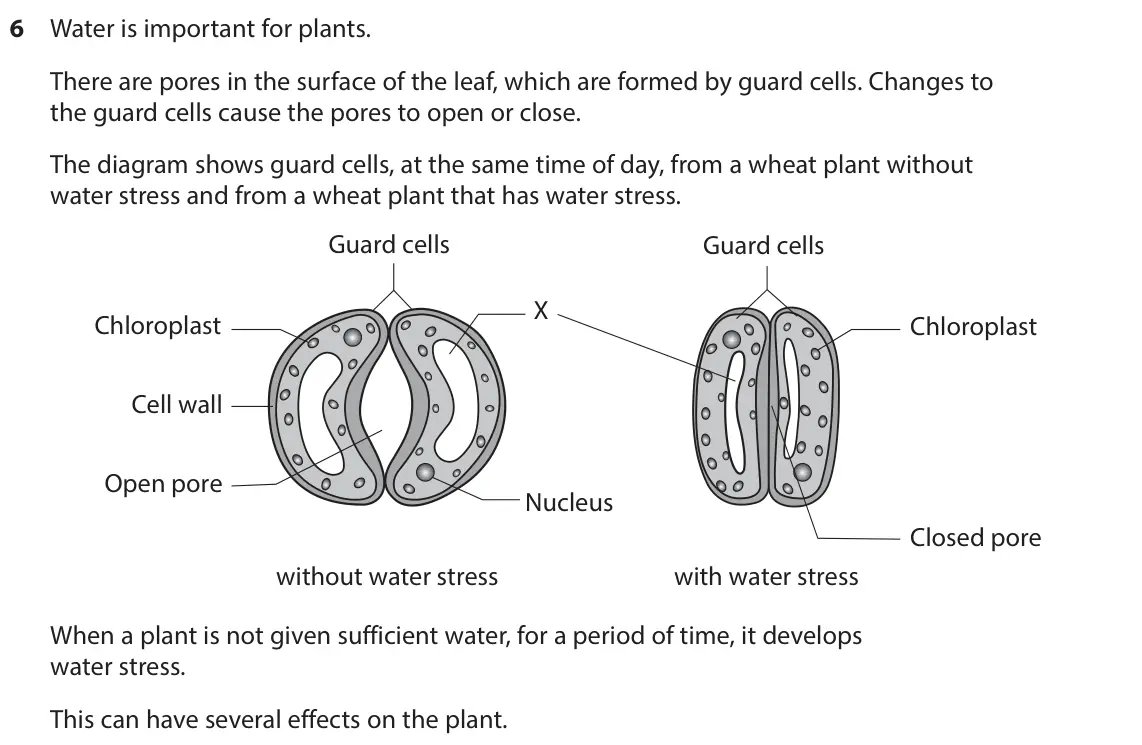
Q6(b)
The whole paper ↗Your answerQ6(c)
The whole paper ↗Q7(d)
The whole paper ↗
Q5(a)(ii)
The whole paper ↗
All 49 questions on Water and mineral ions in plants, as a list
- June 2025, AS Unit 2, Q7(a)(i) (2 marks): Give two reasons why water is important to the strawberry plants. (2) 1 2
- June 2025, AS Unit 2, Q7(a)(ii) (3 marks): The nutrient solution contains nitrate ions and calcium ions. Explain the importance of these ions to the strawberry plants. (3)
- June 2025, AS Unit 2, Q7(b) (1 mark): The diagram shows the strawberry production in five continents, P, Q, R, S and T, in 2021. P 2.4 Q 24.9 T R 177.9 69.1 S 85.7 Continent Q produced 634 288 000 k
- June 2025, AS Unit 2, Q7(c)(i) (2 marks): In plants, magnesium ions are needed to activate enzymes required for: • inorganic ion uptake • protein synthesis • photosynthesis. The diagram shows how the at
- June 2025, AS Unit 2, Q7(c)(ii) (6 marks): Farmers concluded that they would make more money if magnesium ions were added to growing wheat plants. Discuss this conclusion. Use all the information in part
- January 2025, AS Unit 2, Q3(b)(i) (2 marks): Give two conclusions for the effect of these treatments on the calcium ion content in the roots of these two types of maize. (2) 1 2
- January 2025, AS Unit 2, Q3(b)(ii) (2 marks): Explain the effect EDTA would have on new cell walls in the roots of type A maize plants. (2)
- January 2025, Unit 6, Q2(c) (2 marks): The analysis showed that there is a positive relationship between the closeness of the mounds and the fruiting of the trees. The soil near termite mounds has an
- October 2024, AS Unit 2, Q5(b)(i) (2 marks): Explain the role of one named molecule that uses calcium ions. (2) Name of molecule Role of molecule
- October 2024, AS Unit 2, Q5(c) (2 marks): The photograph shows pods on a soybean plant. pod (Source: © B Christopher / Alamy Stock Photo) The effect of magnesium ions on the number of pods per soybean p
- October 2024, AS Unit 2, Q5(d) (4 marks): In another investigation, the effect of magnesium ions on the mass of soybeans and maize grains was studied. The graph shows the results of this investigation.
- October 2024, AS Unit 3, Q2(a)(i) (4 marks): Describe a method that could be used to obtain the results for the complete Hoagland treatment, so that it can be compared with the other treatments. (4)
- October 2024, AS Unit 3, Q2(a)(ii) (2 marks): Calculate the percentage increase in shoot dry mass when VCL is added to Hoagland’s solution. (2) Answer %
- October 2024, AS Unit 3, Q2(b)(ii) (2 marks): The photographs show the appearance of plants following each treatment. The photograph for each pair of plants has its own scale bar. X Y 30 mm 10 mm 30 mm 50 m
- October 2024, AS Unit 3, Q2(b)(iii) (5 marks): Discuss the use of VCL as a fertiliser. Use all the information from this investigation. (5)
- June 2024, AS Unit 2, Q6(a)(ii) (1 mark): Suggest why the closing of the pores reduces water stress in the plant. (1)
- June 2024, AS Unit 2, Q6(b) (1 mark): Another effect is the reduction in the absorption of mineral ions, for example magnesium ions. Magnesium ions are needed in the formation of chlorophyll. The ef
- June 2024, AS Unit 2, Q6(c) (6 marks): The graphs show three more effects of water stress on wheat plants. Graph A shows the effect of water stress on percentage survival rate. 100 80 Mean percentage
- June 2024, Unit 4, Q7(d) (4 marks): The roots of most land plants are associated with microscopic fungi called mycorrhizal fungi. These fungi provide the plants with nitrate ions. The effect of tw
- October 2023, AS Unit 2, Q5(a)(ii) (3 marks): Explain how a lack of magnesium ions could result in yellow leaves and reduced growth. (3)
- October 2023, AS Unit 2, Q5(b) (6 marks): Calcium ions are also needed for the growth of vine plants and fruit production. Chicken eggshells contain calcium ions. Some farmers add crushed eggshells to t
- June 2023, AS Unit 2, Q1(a)(ii) (2 marks): Explain why, after one hour, this part of the stem would be a different colour. (2)
- June 2023, AS Unit 2, Q3(b) (2 marks): The digested insects are a source of nitrogen for the pitcher plant. Give two ways in which this source of nitrogen is used by the pitcher plants. (2) 1 2
- June 2023, Unit 4, Q1(a) (2 marks): Explain the importance of magnesium ions to a plant. (2)
- June 2023, Unit 4, Q7(a)(ii) (2 marks): Nitrates contain nitrogen. Describe the importance of nitrates to plants. (2)
- January 2023, Unit 6, Q1(a) (6 marks): Describe an experiment to investigate the effect of nitrate ion concentration on the rate of growth of these plants. (6)
- January 2023, Unit 6, Q1(b) (3 marks): Explain the roles of nitrate ions in cell division to produce daughter plants. (3)
- October 2022, AS Unit 2, Q3(a)(i) (2 marks): The nutrient solutions contain magnesium ions and nitrates. Describe the roles of these inorganic ions in the plants. (2) Magnesium ions Nitrates .
- October 2022, AS Unit 2, Q3(a)(ii) (1 mark): Suggest one advantage of the vertical system over the horizontal system. (1)
- October 2022, AS Unit 2, Q3(b)(i) (1 mark): Which is the percentage increase in mean fruit firmness between the cherries from the control plants and those from plants treated three times with the higher c
- October 2022, AS Unit 2, Q3(b)(ii) (1 mark): Give one conclusion for this investigation. (1)
- October 2022, AS Unit 2, Q3(b)(iii) (3 marks): Explain the effect of calcium ion concentration on the firmness of cherry fruits. (3)
- October 2022, AS Unit 3, Q3(a)(i) (4 marks): Devise a procedure to provide a valid comparison of the growth of shoots, bulbs and roots of onion plants grown in these three solutions. (4)
- October 2022, AS Unit 3, Q3(a)(iii) (3 marks): Describe three conclusions that can be drawn from the results of this investigation. Use the information in the graph and table to support your answer. (3) 1 2
- October 2022, AS Unit 3, Q3(b) (2 marks): The table shows the mineral salts used to make a complete mineral ion solution. Mineral salt formula Mineral salt name KNO3 potassium nitrate Ca(NO3)2 calcium n
- October 2022, AS Unit 3, Q3(c) (4 marks): The pH of the soil can affect the uptake of mineral ions by plants. The chart shows the effect of pH on the uptake of some mineral ions. The height of the bar f
- October 2022, Unit 4, Q9(c) (3 marks): Inorganic ions are used by plants to make molecules. The table shows some molecules made by plants. For each molecule, put one cross in the appropriate box, in
- June 2021, AS Unit 2, Q1(a)(iii) (1 mark): Which molecule contains magnesium ions? (1) A calcium pectate B chlorophyll C DNA D starch
- January 2021, AS Unit 2, Q5(a)(iii) (1 mark): Which of the labelled structures is involved in transporting calcium ions from the stem to the leaves? (1) A V B W C X D Y
- January 2021, AS Unit 2, Q5(b)(i) (2 marks): Explain the importance of magnesium ions to plants. (2)
- January 2021, AS Unit 2, Q5(b)(ii) (4 marks): Comment on the results of this investigation. Use the information in the table to support your answer. (4)
- January 2021, AS Unit 3, Q2(a)(i) (2 marks): Describe the contents of two more Petri dishes that could be controls for this investigation. (2) Dish 1 Dish 2
- January 2021, AS Unit 3, Q2(b)(ii) (3 marks): Explain the difference in duckweed growth in the mineral solution missing nitrate and the mineral solution missing phosphate. Use the information in the table t
- January 2021, Unit 4, Q5(b)(iii) (3 marks): Simple sugars are used in the synthesis of new biological molecules. Which row of the table shows the inorganic ions that are needed to synthesise these new bio
- October 2020, Unit 4, Q3(c)(ii) (2 marks): Explain why amino acids cannot be produced from glucose alone. (2)
- January 2020, AS Unit 2, Q6(b)(i) (3 marks): Calculate the percentage decrease in the mean diameter of the fibres from plants in row 2 compared with those from plants in row 1. (3) Answer %
- January 2020, AS Unit 2, Q6(b)(ii) (4 marks): Comment on the results of this investigation. Use the information in the table to support your answer. (4)
- June 2019, AS Unit 2, Q1(b)(i) (1 mark): The concentration of calcium ions is 0.45 mmol dm–3. Plot this concentration on the graph. (1)
- June 2019, AS Unit 2, Q1(b)(ii) (3 marks): Explain the importance of each of these ions to the plant. (3)
Questions, mark schemes and examiner’s reports are © Pearson Edexcel, from their published past papers. Plumi isn’t affiliated with any exam board. Want whole papers? Edexcel International A Level Biology past papers.
The Plumi iPad app also offers exam-style questions with AI feedback on your handwritten working.