 plumi
Water as a solvent: Edexcel International A Level Biology questions
Edexcel International A Level Biology past-paper questions on 1.1.1 Water as a solvent, 2019–2025, with mark schemes and examiner’s reports where available.
Paper
All papers
Exam
All years
Calculations
Q7(a)(i)
The whole paper ↗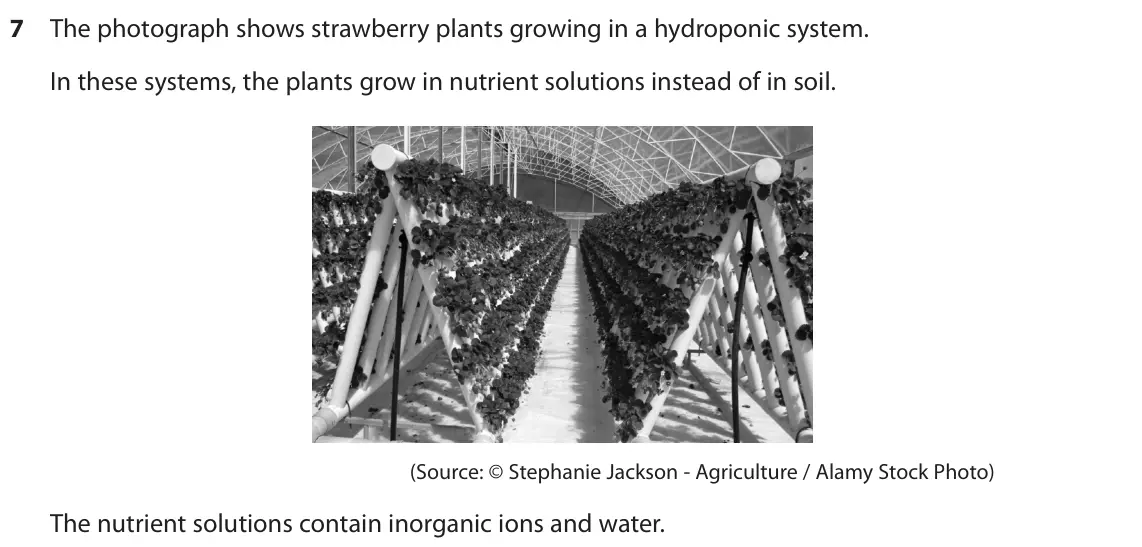
Q1(a)
The whole paper ↗ Your answer
Q4(a)(i)
The whole paper ↗
Q4(a)(ii)
The whole paper ↗Q4(b)
The whole paper ↗Q4(c)
The whole paper ↗Q1(a)
The whole paper ↗
Q5(c)(i)
The whole paper ↗
Q8(c)
The whole paper ↗
Q4(a)(i)
The whole paper ↗
Q4(a)(ii)
The whole paper ↗Q4(a)(iii)
The whole paper ↗Q4(a)(iv)
The whole paper ↗Q4(b)
The whole paper ↗Q1(a)
The whole paper ↗
Q1(b)(i)
The whole paper ↗Q1(b)(ii)
The whole paper ↗Your answer
All 18 questions on Water as a solvent, as a list
- June 2025, AS Unit 2, Q7(a)(i) (2 marks): Give two reasons why water is important to the strawberry plants. (2) 1 2
- January 2025, AS Unit 1, Q1(a) (1 mark): Which of the following statements about water are correct? 1. A single molecule of water is composed of an oxygen atom joined to two hydrogen atoms by hydrogen
- January 2024, AS Unit 1, Q4(a)(i) (2 marks): Explain the dipole nature of water. (2)
- January 2024, AS Unit 1, Q4(a)(ii) (1 mark): The diagram shows three water molecules. Complete the diagram to show a hydrogen bond between two water molecules. (1) O H H H O H O H H
- January 2024, AS Unit 1, Q4(b) (1 mark): Water plays a role as a solvent. Sodium chloride dissolves in water. The diagram shows a sodium ion (Na+). Complete the diagram to show the arrangement of two w
- January 2024, AS Unit 1, Q4(c) (4 marks): Temperature affects the solubility of chemicals in water. The graph shows the effect of temperature on the solubility of four chemicals, A, B, C and D. 90 chemi
- January 2023, AS Unit 1, Q1(a) (2 marks): Draw a diagram of a water molecule to show its dipole nature. (2)
- June 2022, AS Unit 1, Q1 (5 marks): Water is an important biological molecule. Read through the following description of water. Complete the description by writing the most appropriate word on the
- January 2021, AS Unit 1, Q5(c)(i) (2 marks): Describe the dipolar nature of water. (2)
- January 2021, Unit 5, Q8(c) (2 marks): One method of slowing the degradation of vaccine proteins is to dry a mixture of sugars and vaccine on a filter. Explain why flushing with water releases the va
- January 2020, AS Unit 1, Q4(a)(i) (3 marks): Compare and contrast the effect of temperature on the solubilities of sodium chloride and glucose in water. (3)
- January 2020, AS Unit 1, Q4(a)(ii) (2 marks): The formula mass of sodium chloride is 58.44. Calculate the molecular mass of glucose, using the information in the table. (2) Element Atomic mass carbon 12 hyd
- January 2020, AS Unit 1, Q4(a)(iii) (1 mark): Calculate how many times greater the molecular mass of glucose is than the formula mass of sodium chloride. (1) Answer
- January 2020, AS Unit 1, Q4(a)(iv) (2 marks): Suggest why there is a difference in the solubility of sodium chloride and glucose in water. (2)
- January 2020, AS Unit 1, Q4(b) (2 marks): Explain why fatty acids are less soluble in blood than glucose and sodium chloride. (2)
- June 2019, AS Unit 1, Q1(a) (2 marks): Draw a diagram of a water molecule to show its dipole nature. (2)
- June 2019, AS Unit 1, Q1(b)(i) (3 marks): Describe the effect of temperature on the solubility of these three salts. (3)
- June 2019, AS Unit 1, Q1(b)(ii) (1 mark): How many times more soluble is salt G than salt H at 30 °C? (1) A 15.00 B 1.67 C 1.50 D 0.60
Questions, mark schemes and examiner’s reports are © Pearson Edexcel, from their published past papers. Plumi isn’t affiliated with any exam board. Want whole papers? Edexcel International A Level Biology past papers.
The Plumi iPad app also offers exam-style questions with AI feedback on your handwritten working.