 plumi
The kidneys: Edexcel GCSE Biology questions
Every Edexcel GCSE Biology exam question on The kidneys (specification points 7.18–7.22), 2018–2025, with its mark scheme and examiner’s report.
Find questions1,834
Exam
All years
Calculations
Q10(a)(i)
The whole paper ↗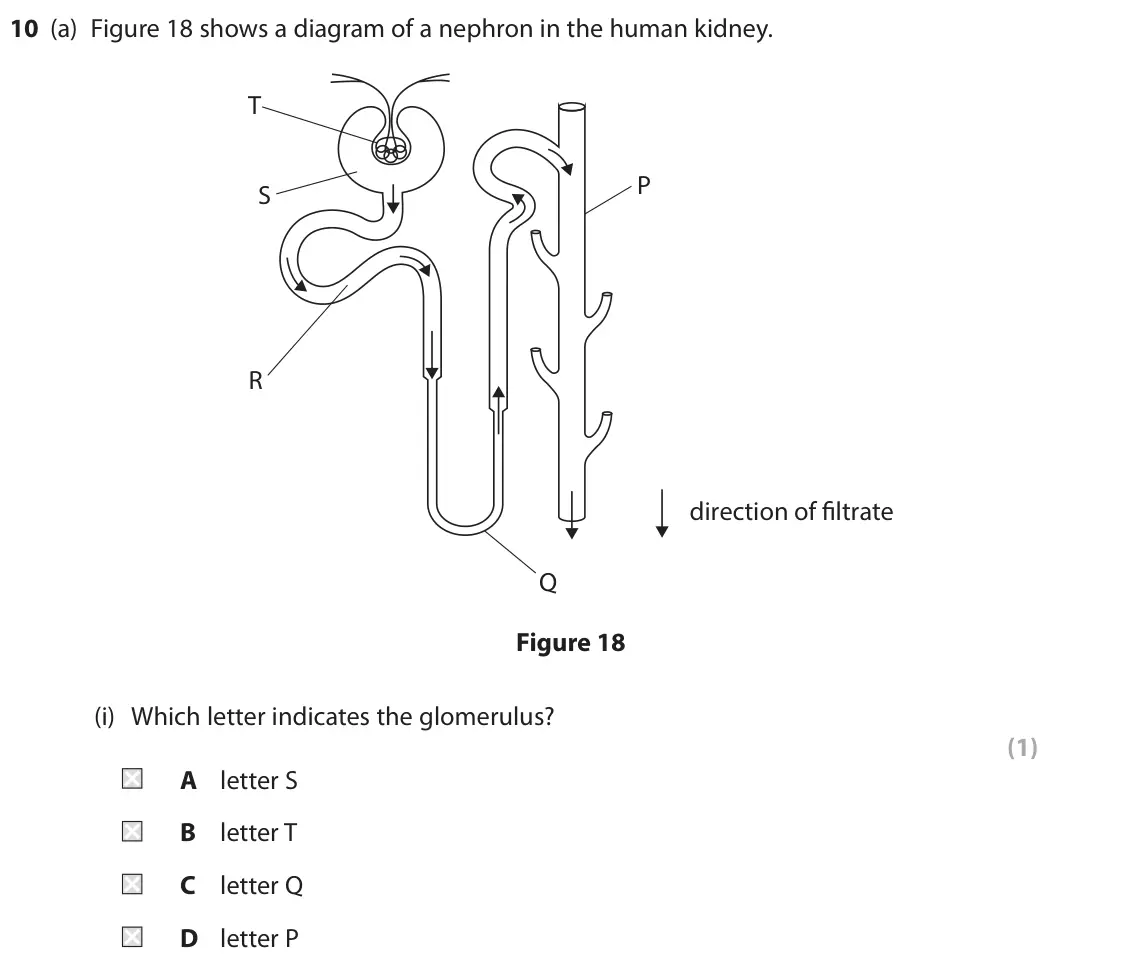
Q10(a)(ii)
The whole paper ↗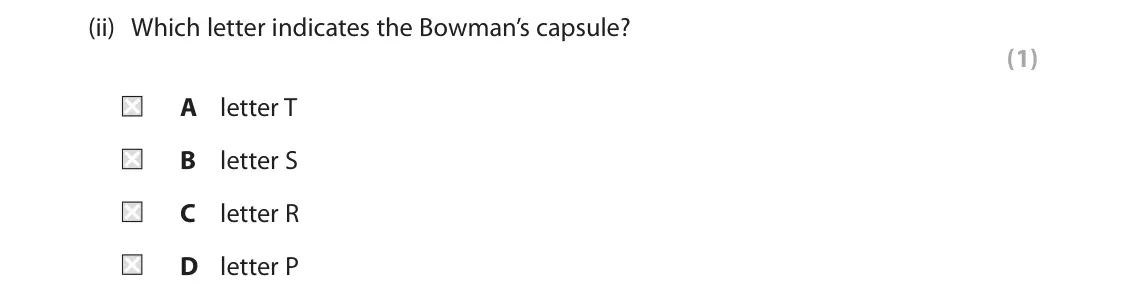
Q10(a)(iii)
The whole paper ↗
Q10(b)
The whole paper ↗
Q7(a)
The whole paper ↗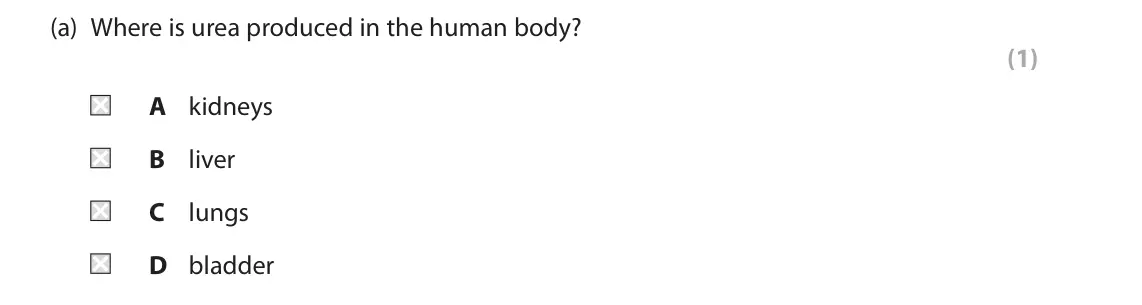
Q7(b)
The whole paper ↗
Q7(c)(i)
The whole paper ↗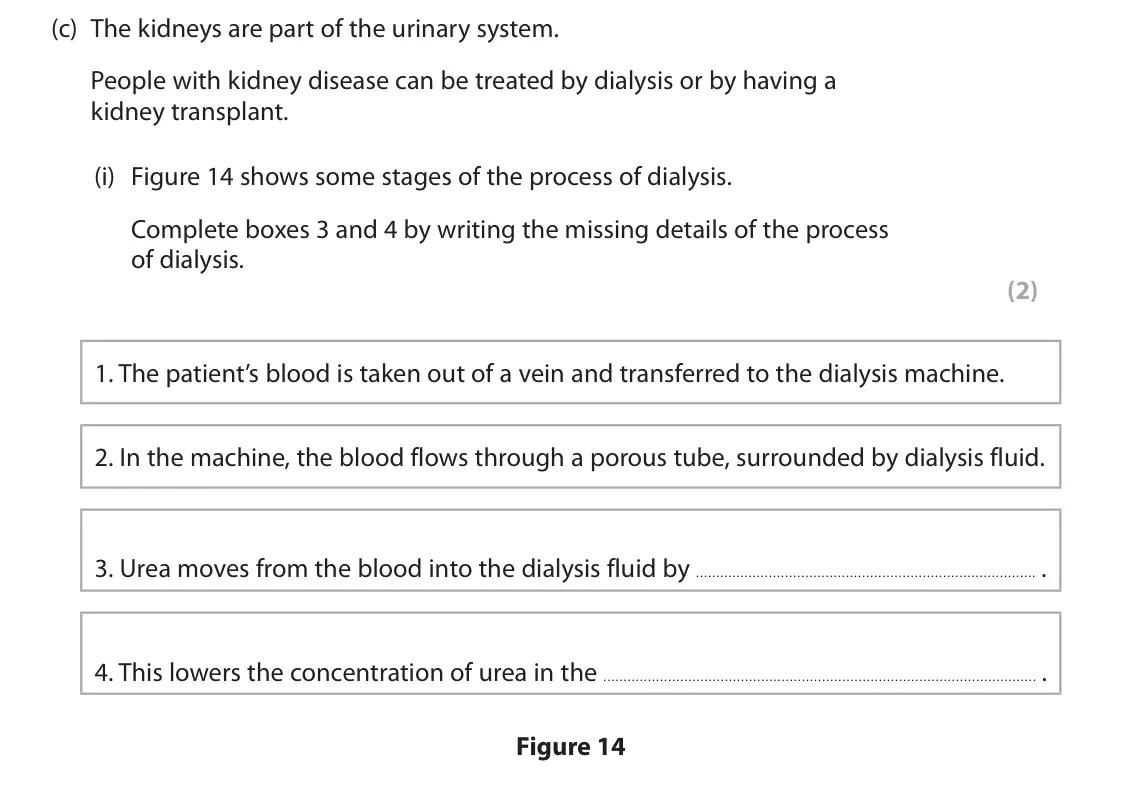
Q7(c)(ii)
The whole paper ↗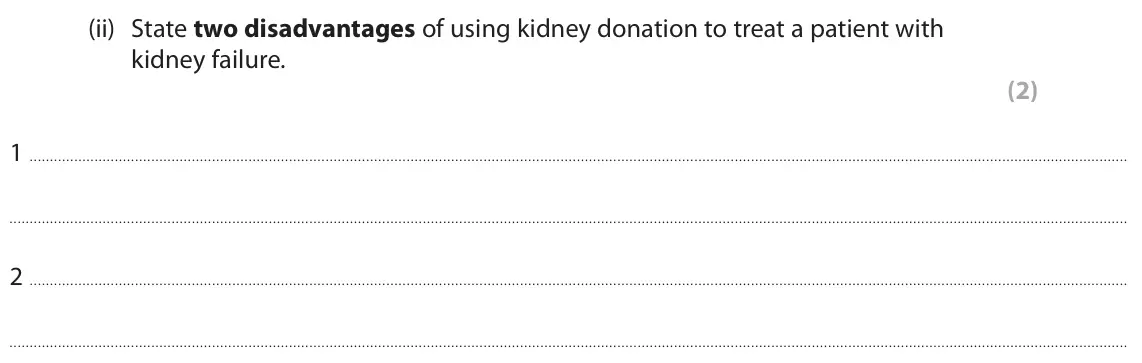
Q7(d)
The whole paper ↗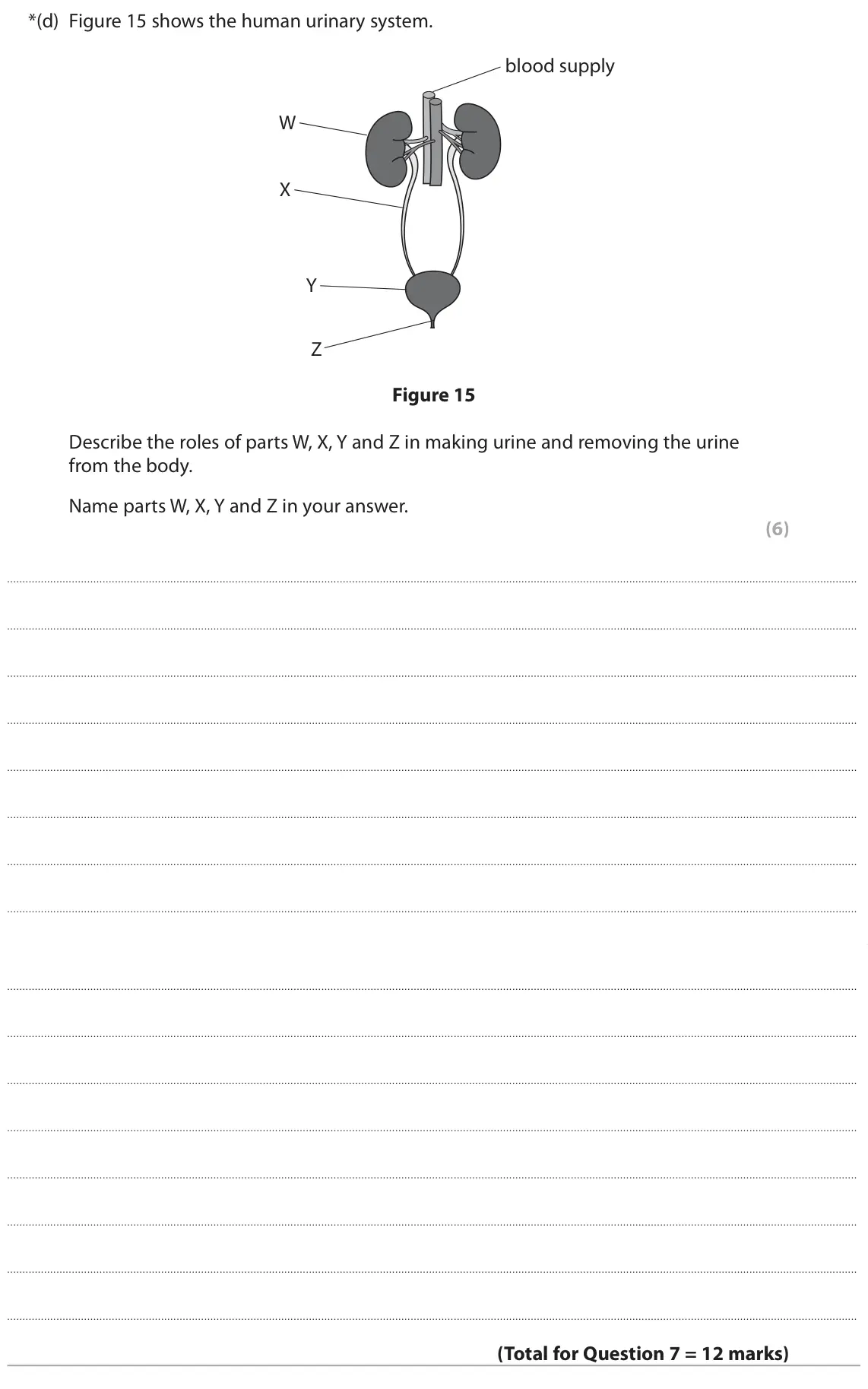
Q10(a)(i)
The whole paper ↗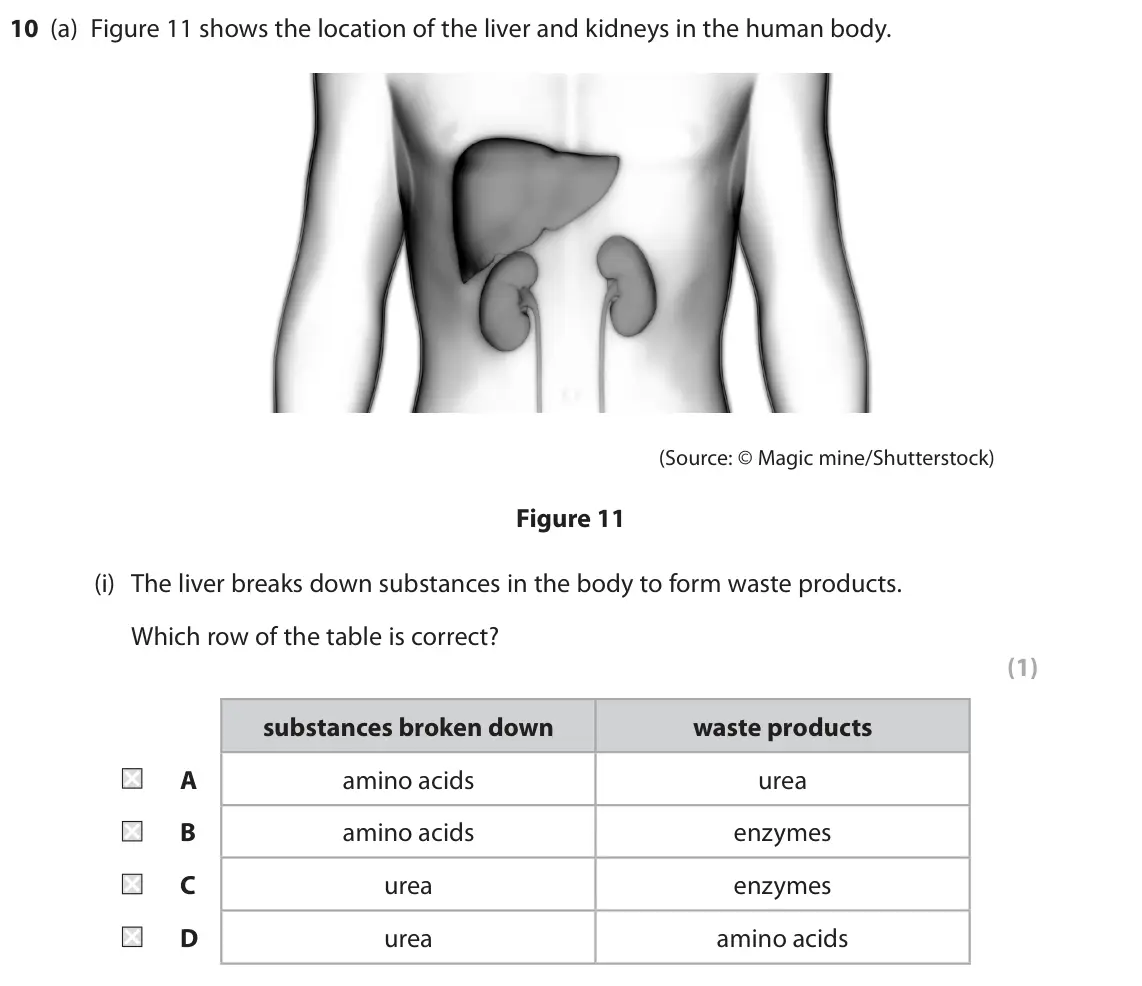
Q10(a)(ii)
The whole paper ↗
Q10(b)(i)
The whole paper ↗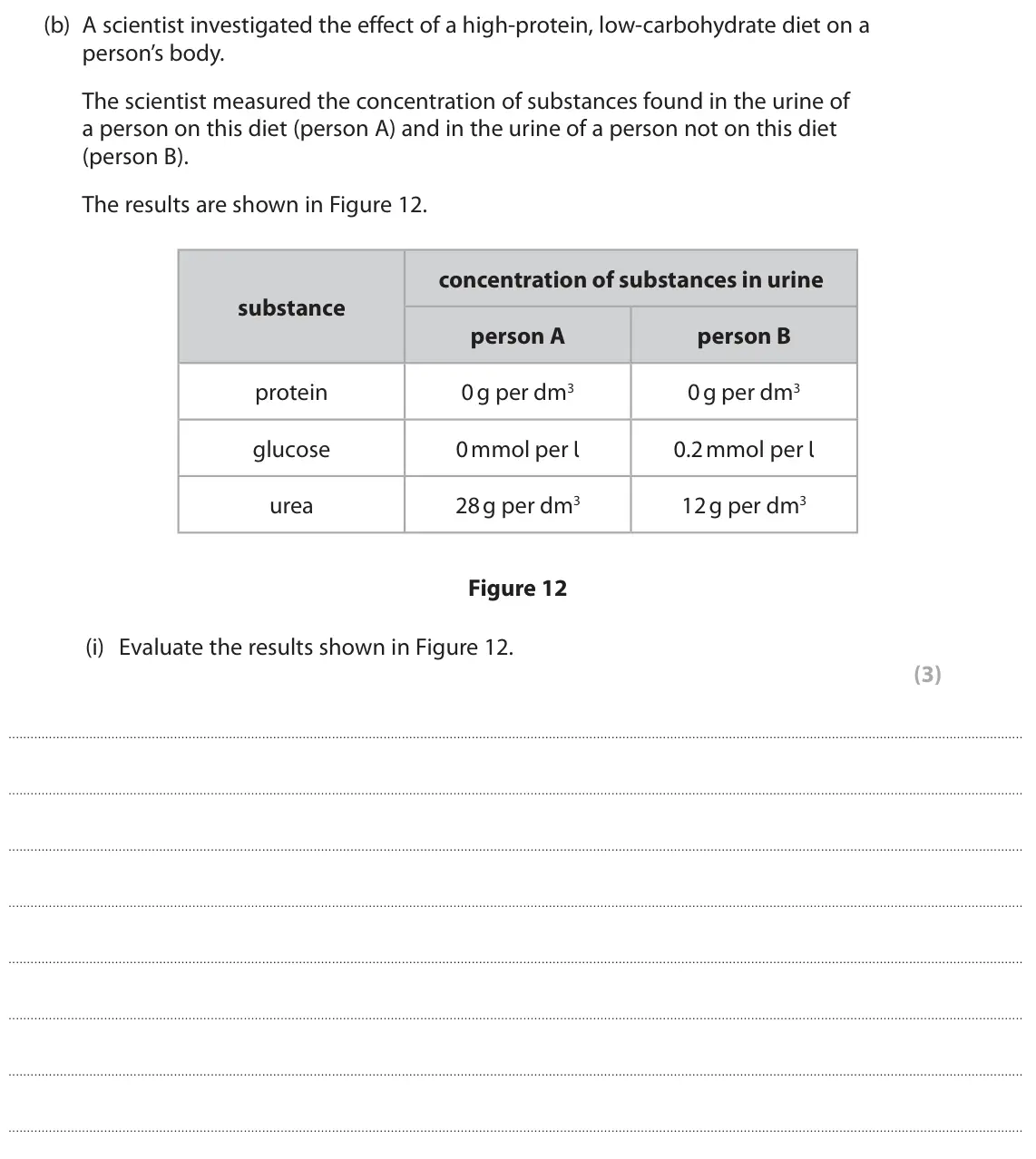
Q10(b)(ii)
The whole paper ↗
Q7(a)
The whole paper ↗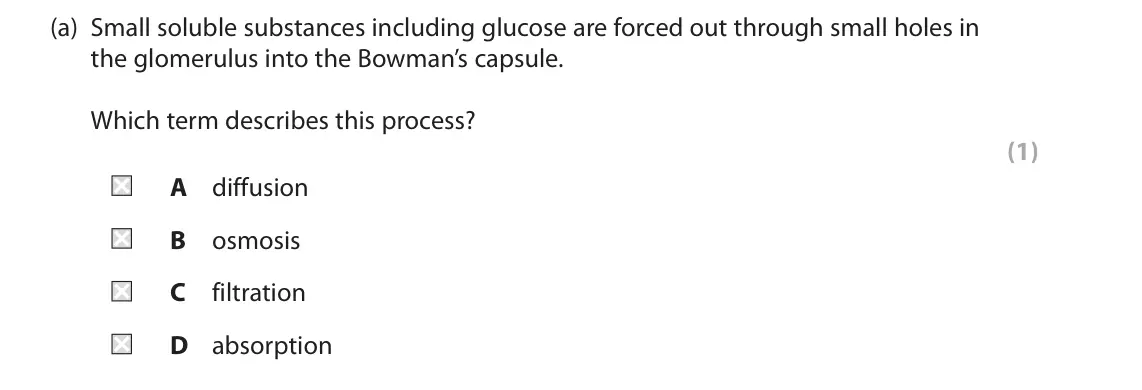
Q7(b)
The whole paper ↗
Q7(c)(i)
The whole paper ↗
Q7(c)(ii)
The whole paper ↗
Q4(c)(ii)
The whole paper ↗
Q10(a)(i)
The whole paper ↗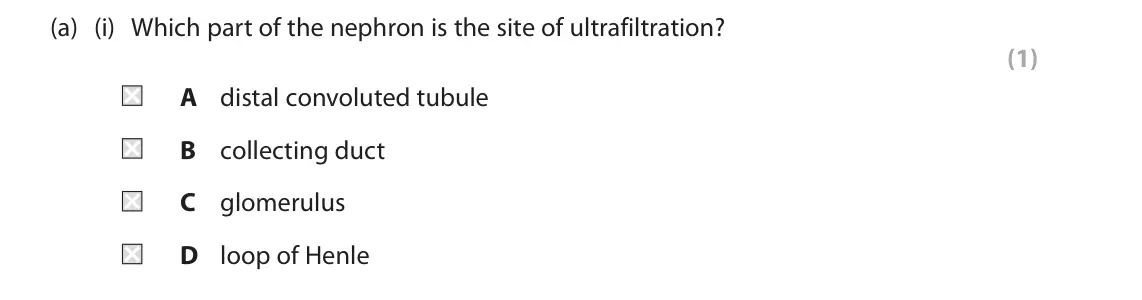
All 63 questions on The kidneys, as a list
- June 2025, Paper 2 Higher, Q10(a)(i) (1 mark): Which letter indicates the glomerulus? (1) A letter S B letter T C letter Q D letter P
- June 2025, Paper 2 Higher, Q10(a)(ii) (1 mark): Which letter indicates the Bowman’s capsule? (1) A letter T B letter S C letter R D letter P
- June 2025, Paper 2 Higher, Q10(a)(iii) (2 marks): Describe the process that occurs in the proximal convoluted tubule (PCT). (2)
- June 2025, Paper 2 Higher, Q10(b) (2 marks): State the role of the ureters and the bladder in the urinary system. (2) ureters bladder
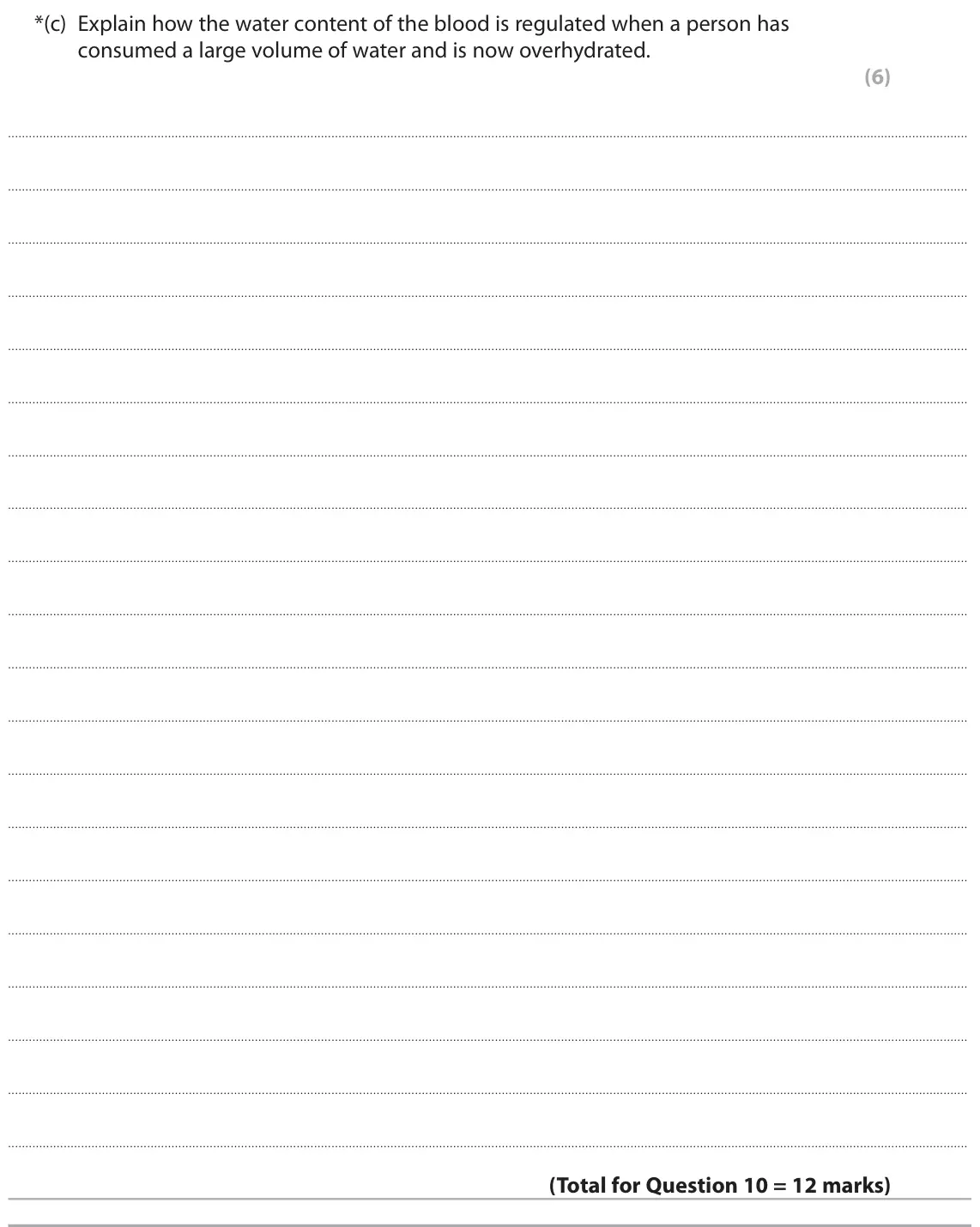
- June 2025, Paper 2 Higher, Q10(c) (6 marks): Explain how the water content of the blood is regulated when a person has consumed a large volume of water and is now overhydrated. (6)
- June 2025, Paper 2 Foundation, Q7(a) (1 mark): Where is urea produced in the human body? (1) A kidneys B liver C lungs D bladder
- June 2025, Paper 2 Foundation, Q7(b) (1 mark): Name the substance that is broken down to produce urea. (1)
- June 2025, Paper 2 Foundation, Q7(c)(i) (2 marks): Figure 14 shows some stages of the process of dialysis. Complete boxes 3 and 4 by writing the missing details of the process of dialysis. (2) 1. The patient’s b
- June 2025, Paper 2 Foundation, Q7(c)(ii) (2 marks): State two disadvantages of using kidney donation to treat a patient with kidney failure. (2) 1 2
- June 2025, Paper 2 Foundation, Q7(d) (6 marks): Figure 15 shows the human urinary system. blood supply W X Y Z Figure 15 Describe the roles of parts W, X, Y and Z in making urine and removing the urine from t
- June 2024, Paper 2 Higher, Q10(a)(i) (1 mark): The liver breaks down substances in the body to form waste products. Which row of the table is correct? (1) substances broken down waste products A amino acids
- June 2024, Paper 2 Higher, Q10(a)(ii) (1 mark): State how the waste products travel from the liver to the kidneys. (1)
- June 2024, Paper 2 Higher, Q10(b)(i) (3 marks): Evaluate the results shown in Figure 12. (3)
- June 2024, Paper 2 Higher, Q10(b)(ii) (6 marks): Explain how a nephron ensures that there is no protein and no glucose in the urine of person A. (6)
- June 2024, Paper 2 Foundation, Q7(a) (1 mark): Small soluble substances including glucose are forced out through small holes in the glomerulus into the Bowman’s capsule. Which term describes this process? (1
- June 2024, Paper 2 Foundation, Q7(b) (2 marks): Explain why red blood cells do not move from blood in the glomerulus into the Bowman’s capsule. (2)
- June 2024, Paper 2 Foundation, Q7(c)(i) (2 marks): Describe what happens in the collecting duct to make the urine more concentrated. (2)
- June 2024, Paper 2 Foundation, Q7(c)(ii) (1 mark): State where urine is stored before it leaves the body. (1)
- June 2023, Paper 2 Higher, Q4(c)(ii) (2 marks): Sweat contains urea. State where and how urea is produced in the human body. (2)
- June 2023, Paper 2 Higher, Q10(a)(i) (1 mark): Which part of the nephron is the site of ultrafiltration? (1) A distal convoluted tubule B collecting duct C glomerulus D loop of Henle
- June 2023, Paper 2 Higher, Q10(a)(ii) (2 marks): Molecule Z is a protein. Explain why protein is not usually found in urine. (2)
- June 2023, Paper 2 Higher, Q10(a)(iii) (3 marks): Haemolytic anaemia is a disease that causes red blood cells to burst. Haemoglobin is not found in the urine of people who do not have haemolytic anaemia. The di
- June 2023, Paper 2 Higher, Q10(b) (6 marks): Describe how the water content of the blood is controlled in the nephron. (6)
- June 2023, Paper 2 Foundation, Q5(a)(i) (2 marks): Calculate the pressure in the glomerulus. Give your answer to one decimal place. (2) kPa
- June 2023, Paper 2 Foundation, Q5(a)(ii) (1 mark): The higher pressure in the glomerulus forces some parts of the blood into the Bowman’s capsule. Which row of the table shows the parts of the blood that move in
- June 2023, Paper 2 Foundation, Q5(b)(ii) (2 marks): Figure 11 shows the concentration of glucose in the three different parts of the nephron. part of nephron Bowman’s start of first end of first capsule coiled tu
- June 2023, Paper 2 Foundation, Q10(c)(ii) (2 marks): Sweat contains urea. State where and how urea is produced in the human body. (2)
- June 2022, Paper 2 Higher, Q10(c) (4 marks): Explain how high levels of amino acids in the blood cause a high concentration of urea in urine. (4)
- June 2022, Paper 2 Foundation, Q7(a) (2 marks): Name structure J and structure K. (2) Structure J Structure K
- June 2022, Paper 2 Foundation, Q7(b)(i) (1 mark): What is urea made from? (1) A excess amino acids B excess carbohydrates C excess vitamins D excess lipids
- June 2022, Paper 2 Foundation, Q7(b)(ii) (2 marks): Figure 13 shows which components of the blood are filtered into the nephron. is the component filtered blood component into the nephron? blood cells no large pr
- June 2022, Paper 2 Foundation, Q7(c) (6 marks): It is estimated that about 3 million people in the UK are at risk of developing chronic kidney disease (CKD). The most severe stages of CKD can result in kidney
- November 2021, Paper 2 Higher, Q4(a) (1 mark): Urine is made by removing water, urea and salts from the blood. Use the letter X to label where urine is made. (1)
- November 2021, Paper 2 Higher, Q4(b) (1 mark): Which substance is converted to urea in the liver? (1) A amino acids B sugars C lipids D potassium ions
- November 2021, Paper 2 Higher, Q4(c)(i) (2 marks): Describe what happens to urea as the blood passes through the dialysis machine. (2)
- November 2021, Paper 2 Higher, Q4(c)(ii) (1 mark): Two patients need to have dialysis treatment. Patient A needs this treatment three times a week. Patient B needs this treatment once a week. Give one reason why
- November 2021, Paper 2 Foundation, Q10(a) (1 mark): Urine is made by removing water, urea and salts from the blood. Use the letter X to label where urine is made. (1)
- November 2021, Paper 2 Foundation, Q10(b) (1 mark): Which substance is converted to urea in the liver? (1) A amino acids B sugars C lipids D potassium ions
- November 2021, Paper 2 Foundation, Q10(c)(i) (2 marks): Describe what happens to urea as the blood passes through the dialysis machine. (2)
- November 2021, Paper 2 Foundation, Q10(c)(ii) (1 mark): Two patients need to have dialysis treatment. Patient A needs this treatment three times a week. Patient B needs this treatment once a week. Give one reason why
- November 2020, Paper 2 Higher, Q10(a)(ii) (2 marks): Explain how this experiment represents a simple model of kidney dialysis treatment. (2)
- November 2020, Paper 2 Higher, Q10(b) (6 marks): The nephrons in the kidney remove unwanted substances from the blood. Figure 16 shows the structure of a nephron. blood vessel collecting duct Figure 16 Explain
- November 2020, Paper 2 Foundation, Q6(a)(i) (1 mark): Structure X is the (1) A glomerulus B Bowman’s capsule C collecting duct D capillary
- November 2020, Paper 2 Foundation, Q6(a)(ii) (2 marks): Figure 14 shows the concentration of glucose in the filtrate in the nephron. mean concentration of glucose filtrate in millimoles per litre filtrate in the star
- November 2020, Paper 2 Foundation, Q6(a)(iii) (1 mark): Name the structure that carries urine from the kidney to the bladder. (1)
- November 2020, Paper 2 Foundation, Q6(b) (2 marks): The concentration of protein in urine from person A and person B was measured each year from 2015 to 2019. Person A had healthy kidneys. Person B had kidney dis
- November 2020, Paper 2 Foundation, Q6(c) (2 marks): Person B needs a kidney transplant. Person B has a twin sister. Explain why this twin sister could be a suitable kidney donor for Person B. (2)
- November 2020, Paper 2 Foundation, Q7(a)(i) (2 marks): Calculate the ratio of the concentration of urea in the sweat of patient A to the concentration of urea in the sweat of patient B. Give your answer in its simpl
- November 2020, Paper 2 Foundation, Q7(a)(ii) (2 marks): Describe how urea is produced in the body. (2)
- November 2020, Paper 2 Foundation, Q7(a)(iii) (1 mark): The blood of patient B has a very high concentration of urea. Which organ removes most urea from the blood? (1) A kidney B lung C liver D stomach
- June 2019, Paper 2 Higher, Q6(a)(ii) (2 marks): Explain why the doctor also concluded that the person had a kidney infection. (2)
- June 2019, Paper 2 Higher, Q6(c) (3 marks): Describe the route taken by urine from the kidney until it leaves the body. (3)
- June 2019, Paper 2 Higher, Q6(d) (2 marks): Urine contains urea. State how urea is formed in the human body. (2)
- June 2018, Paper 2 Higher, Q1(a) (2 marks): Name the structures labelled P and Q. (2) P Q
- June 2018, Paper 2 Higher, Q1(b)(ii) (2 marks): Explain why there are differences in the concentrations of some components in the blood and some components in this part of the nephron. (2)
- June 2018, Paper 2 Higher, Q1(c) (1 mark): State the name of the hormone that regulates the water content of the blood. (1)
- June 2018, Paper 2 Foundation, Q7(a) (2 marks): Name the structures labelled P and Q. (2) P Q
- June 2018, Paper 2 Foundation, Q7(b)(i) (2 marks): Explain the difference in the concentration of protein in the blood plasma and in the filtrate in the nephron. (2)
- June 2018, Paper 2 Foundation, Q7(b)(ii) (3 marks): Explain how glucose moves from the blood plasma into the nephron. (3)
- June 2018, Paper 2 Foundation, Q7(c) (6 marks): Figure 18 shows a patient undergoing kidney dialysis. dialysis membrane dialysis solution fresh used dialysis dialysis solution solution Figure 18 Describe how
- Specimen, Paper 2 Higher, Q9(b)(i) (3 marks): Explain how the blood entering the nephron of the kangaroo rat is filtered to remove excess sodium ions and water. (3) The kangaroo rat has a longer loop of Hen
- Specimen, Paper 2 Higher, Q9(b)(ii) (2 marks): Explain why this adaptation is beneficial to the kangaroo rat. (2) The volume of ADH stored in the pituitary gland of the kangaroo rat was measured. Figure 17 s
- Specimen, Paper 2 Higher, Q9(b)(iii) (6 marks): Explain how ADH helps to control the levels of water and sodium ions in the bloodstream. (6)
Questions, mark schemes and examiner’s reports are © Pearson Edexcel, from their published past papers. Plumi isn’t affiliated with any exam board. Want whole papers? Every Edexcel GCSE Biology paper.
Rather write your answers by hand on iPad? Plumi marks them against the same mark schemes.