 plumi
Photosynthesis: Edexcel A‑Level Biology A questions
Every Edexcel A-Level Biology A exam question on Photosynthesis (specification points 5.5–5.9), 2016–2025, with its mark scheme and examiner’s report.
Find questions1,749
Calculations
Q9(a)
The whole paper ↗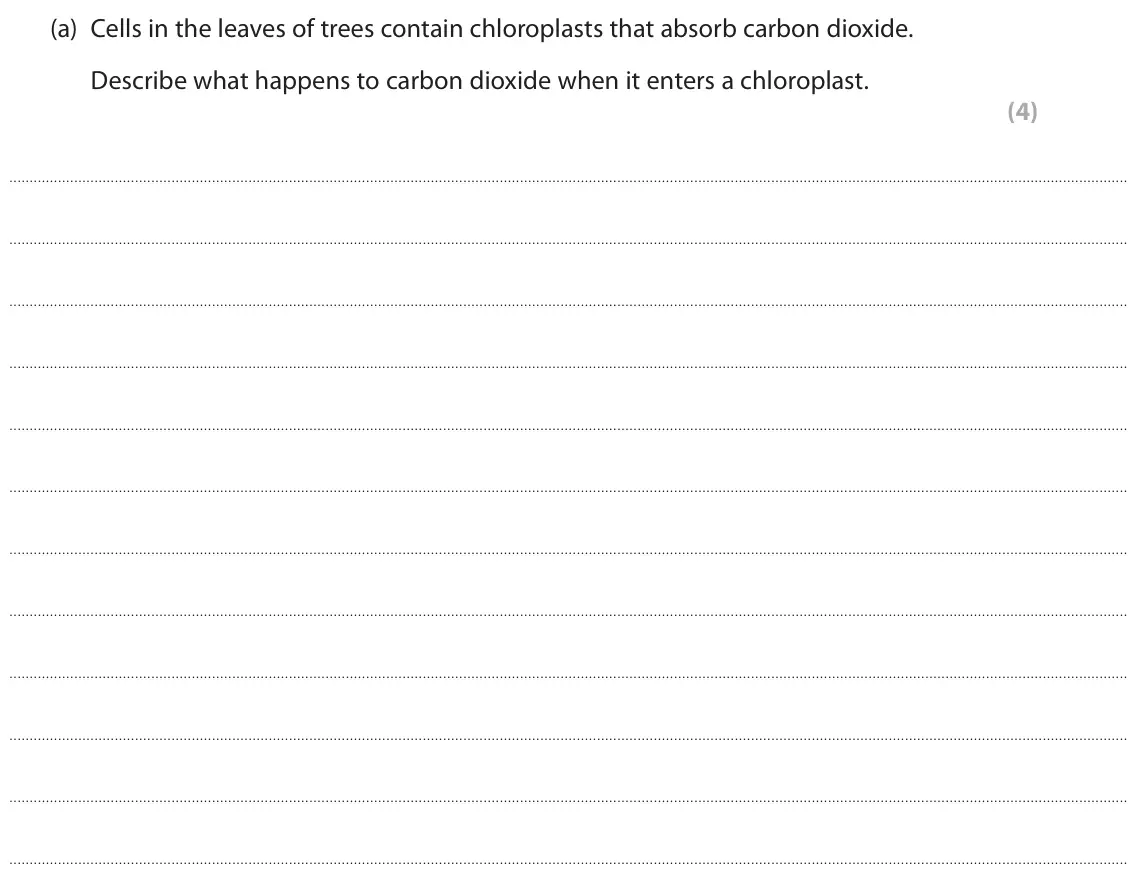
Q2(a)
The whole paper ↗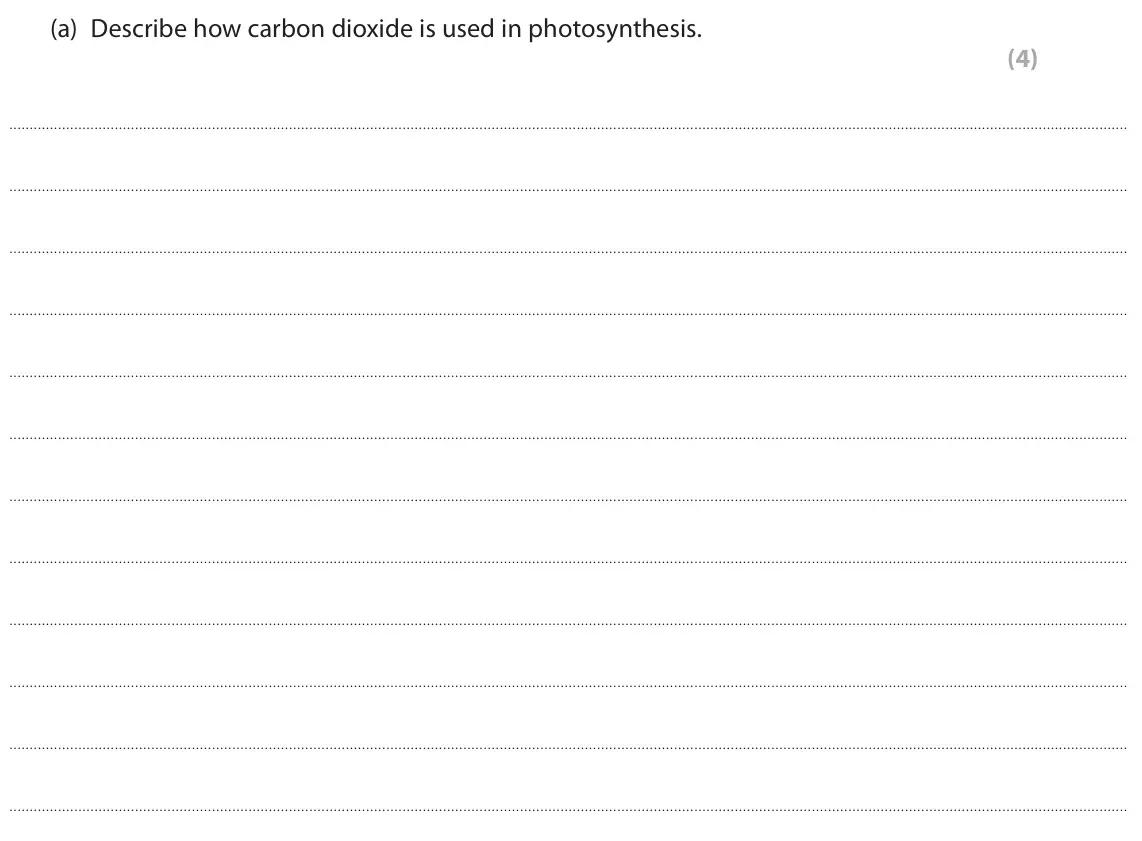
Q2(b)(i)
The whole paper ↗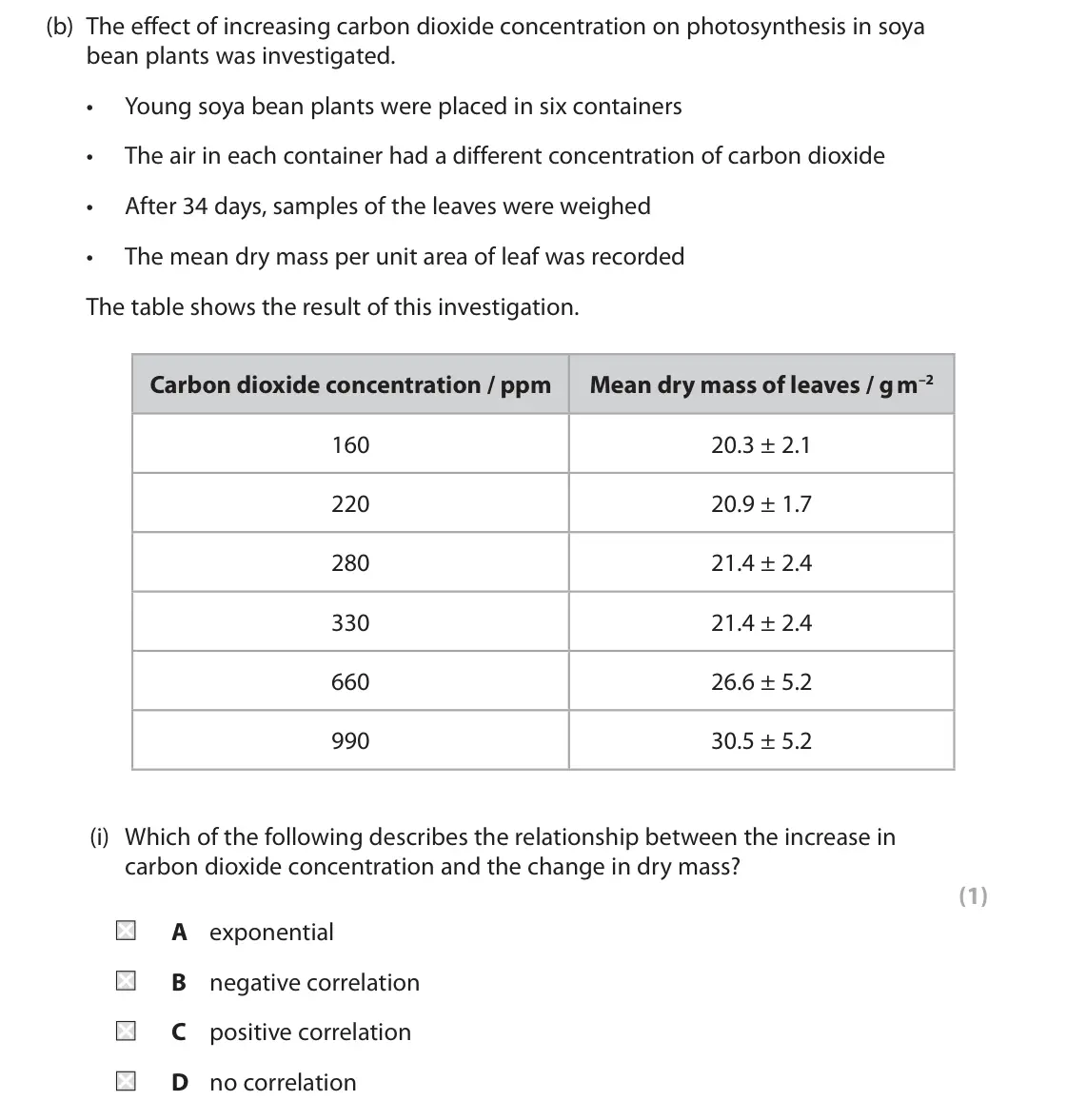
Q2(b)(ii)
The whole paper ↗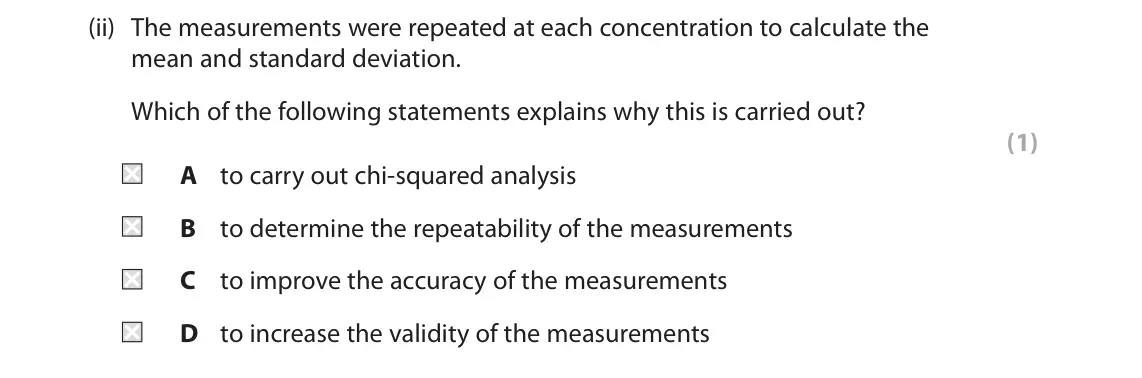
Q2(c)
The whole paper ↗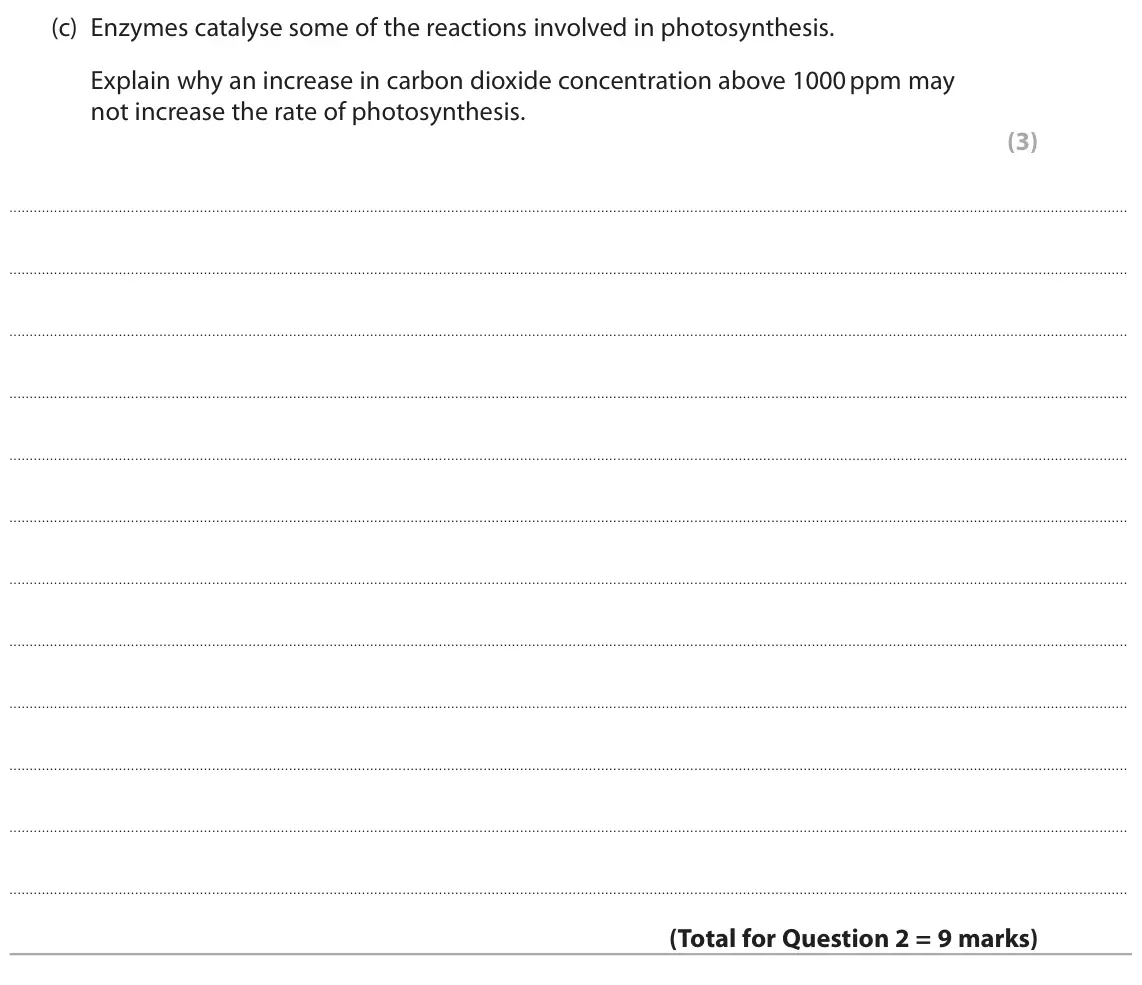
Q5(a)(i)
The whole paper ↗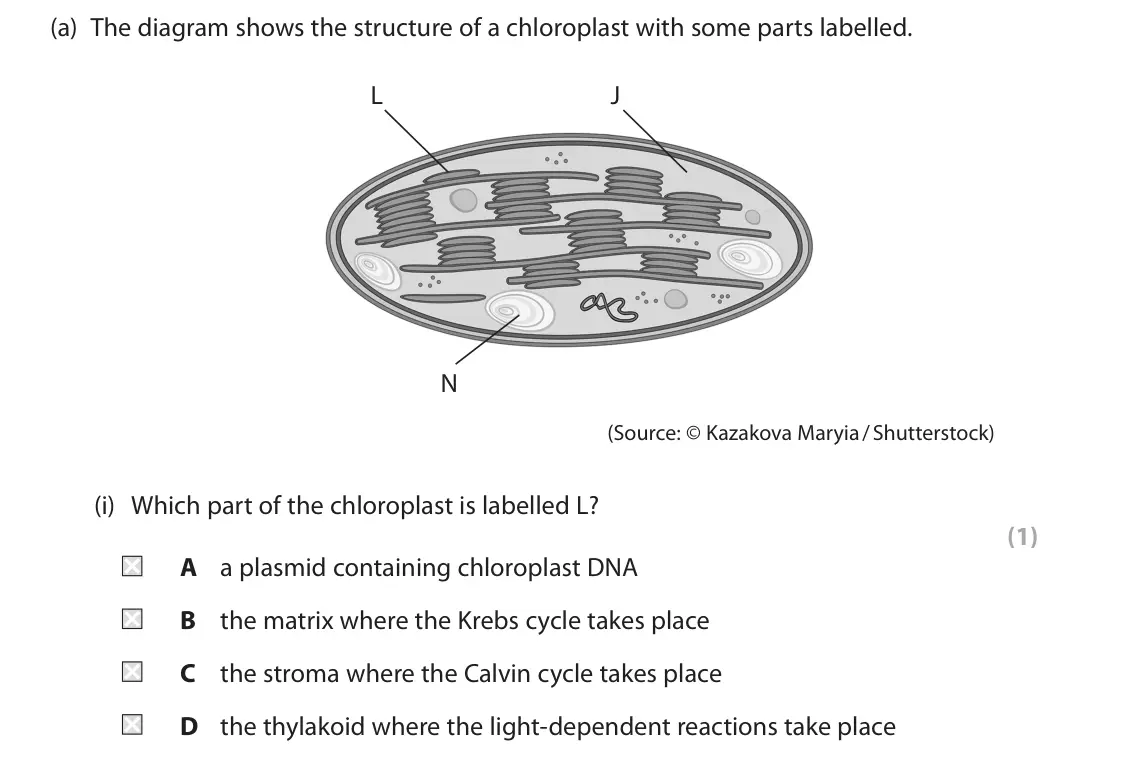
Q5(a)(ii)
The whole paper ↗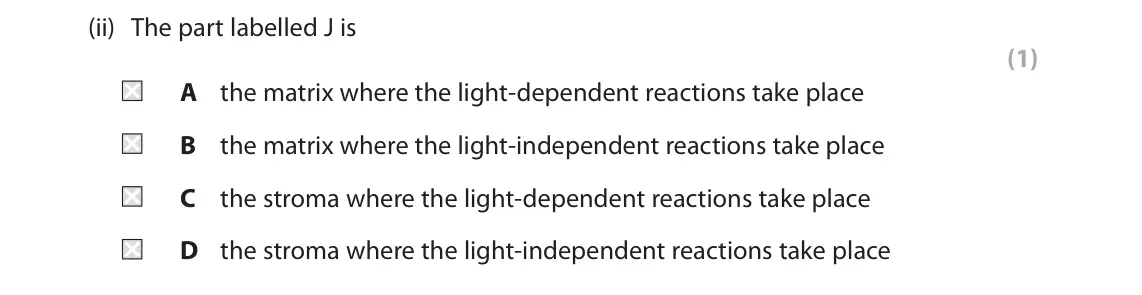
Q5(a)(iii)
The whole paper ↗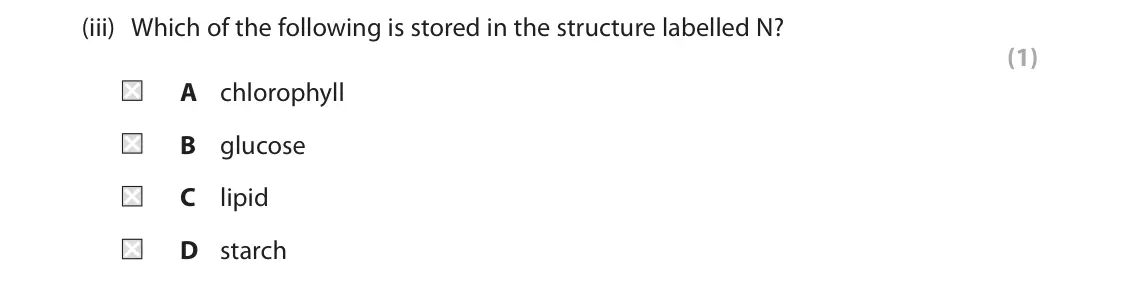
Q5(b)(i)
The whole paper ↗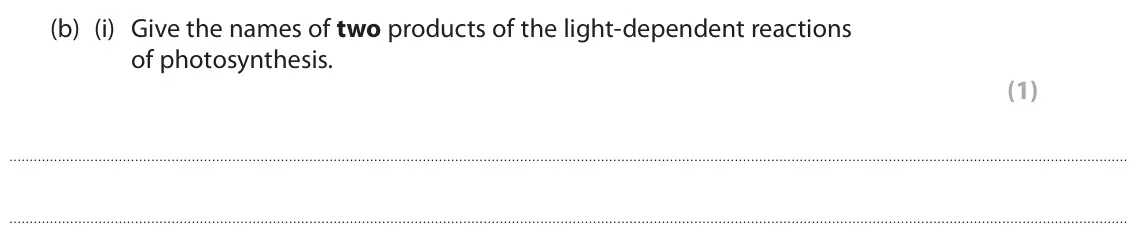
Q5(b)(ii)
The whole paper ↗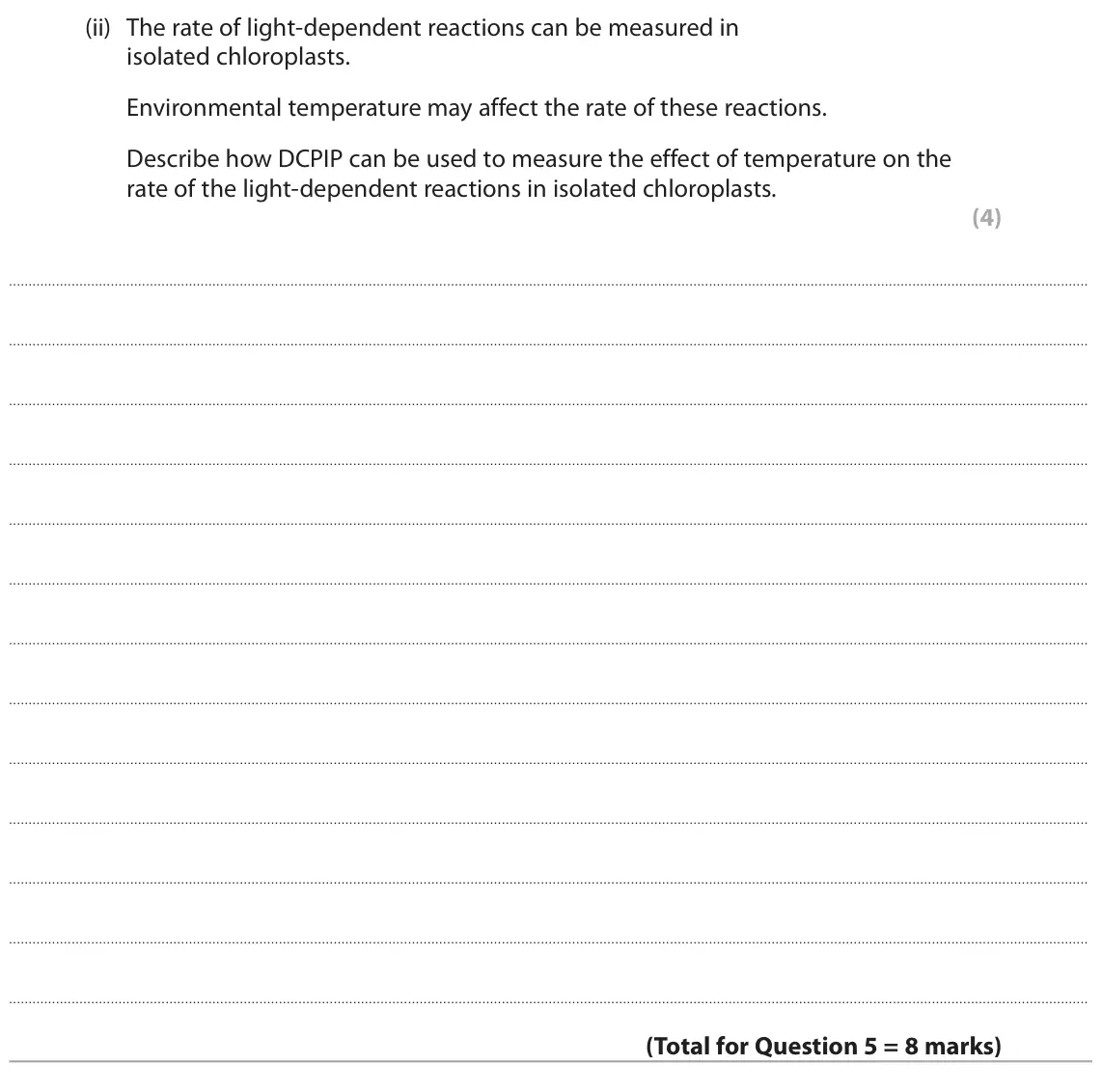
Q3(a)(i)
The whole paper ↗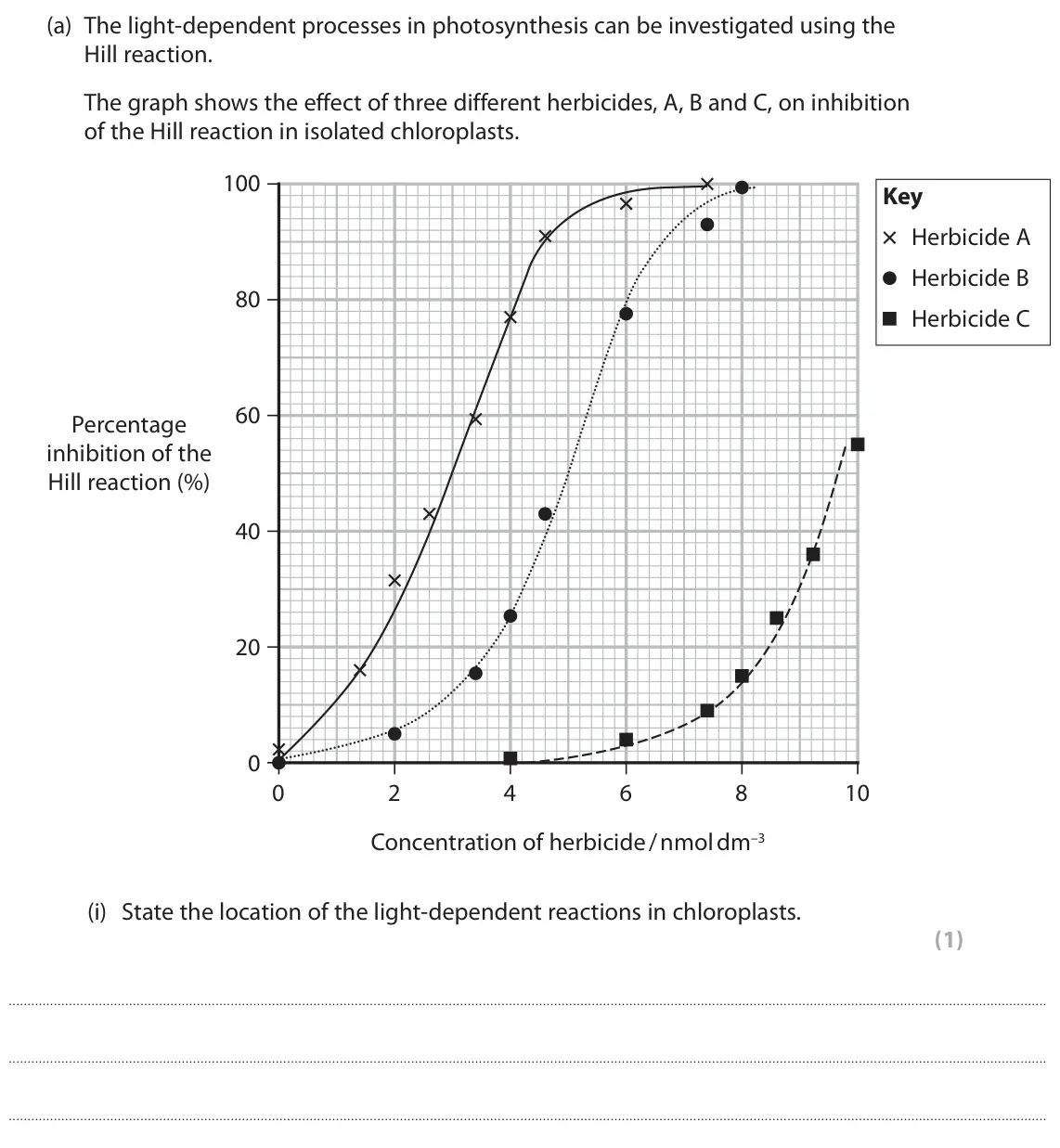
Q3(a)(ii)
The whole paper ↗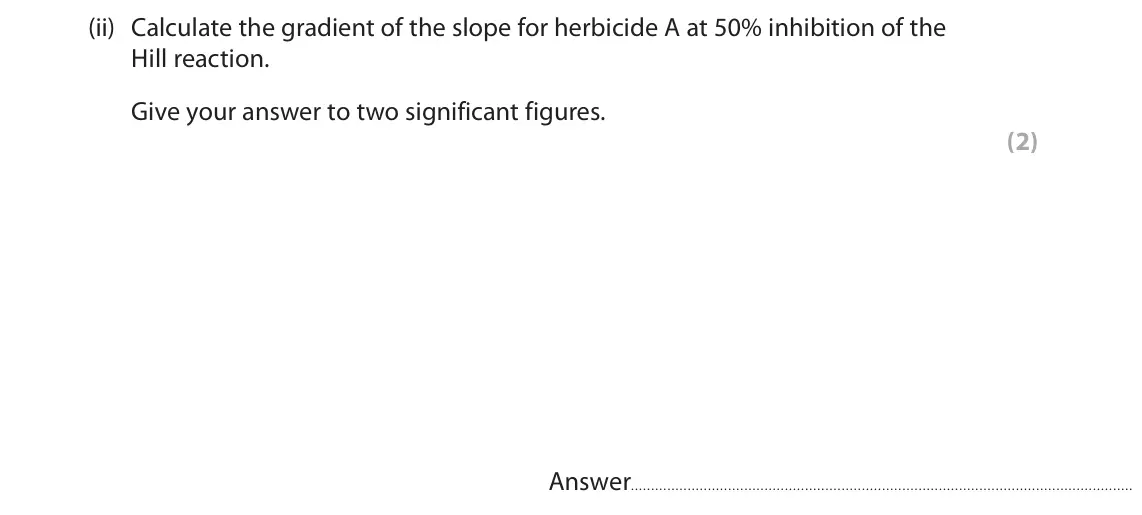
Q3(a)(iii)
The whole paper ↗
Q3(b)
The whole paper ↗
Q8(b)
The whole paper ↗
Q8(c)
The whole paper ↗
Q8(d)
The whole paper ↗
Q8(e)
The whole paper ↗
Q8(f)
The whole paper ↗
Q8(g)
The whole paper ↗
All 48 questions on Photosynthesis, as a list
- June 2025, Paper 1, Q9(a) (4 marks): Cells in the leaves of trees contain chloroplasts that absorb carbon dioxide. Describe what happens to carbon dioxide when it enters a chloroplast. (4)
- June 2024, Paper 1, Q2(a) (4 marks): Describe how carbon dioxide is used in photosynthesis. (4)
- June 2024, Paper 1, Q2(b)(i) (1 mark): Which of the following describes the relationship between the increase in carbon dioxide concentration and the change in dry mass? (1) A exponential B negative
- June 2024, Paper 1, Q2(b)(ii) (1 mark): The measurements were repeated at each concentration to calculate the mean and standard deviation. Which of the following statements explains why this is carrie
- June 2024, Paper 1, Q2(c) (3 marks): Enzymes catalyse some of the reactions involved in photosynthesis. Explain why an increase in carbon dioxide concentration above 1000 ppm may not increase the r
- June 2024, Paper 1, Q5(a)(i) (1 mark): Which part of the chloroplast is labelled L? (1) A a plasmid containing chloroplast DNA B the matrix where the Krebs cycle takes place C the stroma where the Ca
- June 2024, Paper 1, Q5(a)(ii) (1 mark): The part labelled J is (1) A the matrix where the light‑dependent reactions take place B the matrix where the light‑independent reactions take place C the strom
- June 2024, Paper 1, Q5(a)(iii) (1 mark): Which of the following is stored in the structure labelled N? (1) A chlorophyll B glucose C lipid D starch
- June 2024, Paper 1, Q5(b)(i) (1 mark): Give the names of two products of the light‑dependent reactions of photosynthesis. (1)
- June 2024, Paper 1, Q5(b)(ii) (4 marks): The rate of light‑dependent reactions can be measured in isolated chloroplasts. Environmental temperature may affect the rate of these reactions. Describe how D
- June 2024, Paper 3, Q3(a)(i) (1 mark): State the location of the light-dependent reactions in chloroplasts. (1)
- June 2024, Paper 3, Q3(a)(ii) (2 marks): Calculate the gradient of the slope for herbicide A at 50% inhibition of the Hill reaction. Give your answer to two significant figures. (2) Answer
- June 2024, Paper 3, Q3(a)(iii) (2 marks): Describe the role of chlorophyll in the light-dependent reactions of photosynthesis. (2)
- June 2024, Paper 3, Q3(b) (3 marks): Describe the role of RUBISCO in the light-independent reactions of photosynthesis. (3)
- June 2023, Paper 3, Q8(b) (1 mark): Name one product, other than ATP and oxygen, produced by the light dependent reactions of photosynthesis (paragraph 4). (1)
- June 2023, Paper 3, Q8(c) (3 marks): Explain why cells use ‘chemical energy in the form of ATP’ (paragraphs 4 and 5). (3)
- June 2023, Paper 3, Q8(d) (4 marks): Describe how ’plant photosynthesis converts carbon dioxide from the air into simple organic molecules’ (paragraph 5). (4)
- June 2023, Paper 3, Q8(e) (4 marks): Devise an investigation to show that in chloroplasts, the oxygen for photosynthesis comes from water and not carbon dioxide (paragraphs 6 and 7). (4)
- June 2023, Paper 3, Q8(f) (4 marks): Explain how chloroplasts are adapted for their role in photosynthesis (paragraphs 9 and 10). (4)
- June 2023, Paper 3, Q8(g) (3 marks): Explain how energy of the electrons passed along an electron transport chain ‘is used to power the synthesis of ATP’ (paragraph 10). (3)
- June 2023, Paper 3, Q8(h) (3 marks): Explain how ‘tiny changes’ in chlorophyll molecules could result in a change in the wavelength of light absorbed (paragraphs 12 and 13). (3)
- June 2022, Paper 1, Q10(a)(i) (2 marks): Determine which species had the greatest percentage change in rate of photosynthesis when grown in lower light intensities. (2) Answer
- June 2022, Paper 1, Q10(a)(ii) (4 marks): The rate of growth for all nine species of plant was also measured. The graph shows the effects of the rate of photosynthesis on the rate of growth of these pla
- June 2022, Paper 1, Q10(b) (6 marks): Differences in the rate of photosynthesis may be due to the light‑dependent reactions in chloroplasts. Devise an investigation to compare the rate of the light‑
- June 2022, Paper 3, Q3(a)(i) (1 mark): Label a part of this organelle where carbon fixation occurs. (1)
- June 2022, Paper 3, Q3(a)(ii) (1 mark): Give the name of the component labelled X. (1)
- June 2022, Paper 3, Q3(a)(iii) (3 marks): Describe how the structure of a membrane in the part labelled X is related to its function. (3)
- June 2022, Paper 3, Q3(a)(iv) (2 marks): Describe how GP is produced by carbon fixation in this organelle. (2)
- November 2021, Paper 1, Q1(b) (1 mark): Name the plant organelle that fixes carbon dioxide from the atmosphere. (1)
- November 2021, Paper 1, Q10(c) (4 marks): The effect of temperature on the activity of RUBISCO was studied. The results are shown in the graph. 7 6 5 4 3 2 1 0 0 10 20 30 40 50 60 Temperature / °C Analy
- October 2020, Paper 3, Q3(a)(i) (1 mark): State the location of the Calvin cycle. (1)
- October 2020, Paper 3, Q3(a)(ii) (3 marks): Describe the roles of the products of the light-dependent reactions in the Calvin cycle. (3)
- October 2020, Paper 3, Q3(c) (2 marks): Explain the importance of RUBISCO to the productivity of an ecosystem. (2)
- June 2019, Paper 1, Q1(a)(i) (1 mark): Which of the following describes where, in the chloroplast, the light‑dependent reactions take place? (1) A cristae B matrix C stroma D thylakoids
- June 2019, Paper 1, Q1(a)(ii) (1 mark): Which of the following are the products of the light‑dependent reactions? (1) A carbon dioxide and reduced NADP B glucose and oxygen C reduced NAD, ATP and oxyg
- June 2019, Paper 1, Q1(a)(iii) (1 mark): Which of the following is the source of the hydrogen produced by the light‑dependent reactions? (1) A glucose B reduced NAD C reduced NADP D water
- June 2019, Paper 1, Q1(b) (3 marks): In some commercial glasshouses, the concentration of carbon dioxide in the atmosphere is increased. Explain why this increase in carbon dioxide concentration af
- June 2018, Paper 1, Q10(a)(i) (2 marks): The labelled starch grain in the chloroplast is 2.2 µm long. Calculate the width of this chloroplast between T and U. (2) µm
- June 2018, Paper 1, Q10(a)(ii) (3 marks): Explain the relationship between the structure and functions of a granum in photosynthesis. (3)
- June 2018, Paper 1, Q10(b) (4 marks): Describe how starch is formed from the products of the light-independent reactions of photosynthesis. (4)
- June 2018, Paper 1, Q10(c) (6 marks): Herbicides kill weeds by affecting their growth. The effect of herbicides on the production of starch in the leaves of Echinochloa crus-galli (barnyard grass) h
- June 2017, Paper 1, Q4(a) (5 marks): Describe the light-dependent reactions of photosynthesis. (5)
- June 2017, Paper 1, Q4(b)(i) (1 mark): In which part of the chloroplast do the light-independent reactions take place? (1) A envelope B granum C stroma D thylakoid
- June 2017, Paper 1, Q4(b)(ii) (1 mark): What is the name of the enzyme used by plants to fix carbon dioxide? (1) A GALPase (glyceraldehyde-3-phosphatase) B GPase (glycerate-3-phosphatase) C RUBISCO (r
- June 2017, Paper 1, Q4(b)(iii) (1 mark): Which of the following is the immediate product of the light-independent reactions of photosynthesis? (1) A glucose B GP C RuBP D starch
- June 2017, Paper 3, Q5(a) (1 mark): State the location of chlorophyll in a chloroplast. (1)
- June 2017, Paper 3, Q5(c)(ii) (5 marks): As altitude increases on a mountain, the temperature decreases and the UV-B radiation increases. Scientists have found that a rise in temperature decreases flav
- June 2017, Paper 3, Q7(c) (2 marks): State what is meant by the phrase ‘fix carbon into biomass’ (paragraph 4). (2)
Questions, mark schemes and examiner’s reports are © Pearson Edexcel, from their published past papers. Plumi isn’t affiliated with any exam board. Want whole papers? Every Edexcel A-Level Biology A paper.
Rather write your answers by hand on iPad? Plumi marks them against the same mark schemes.