 plumi
Electrical quantities: CAIE IGCSE Physics questions
Every CAIE IGCSE Physics exam question on 4.2 Electrical quantities, June 2024 and the specimen papers, with its mark scheme and examiner’s report.
Find questions355
Calculations
Q8(c)
The whole paper ↗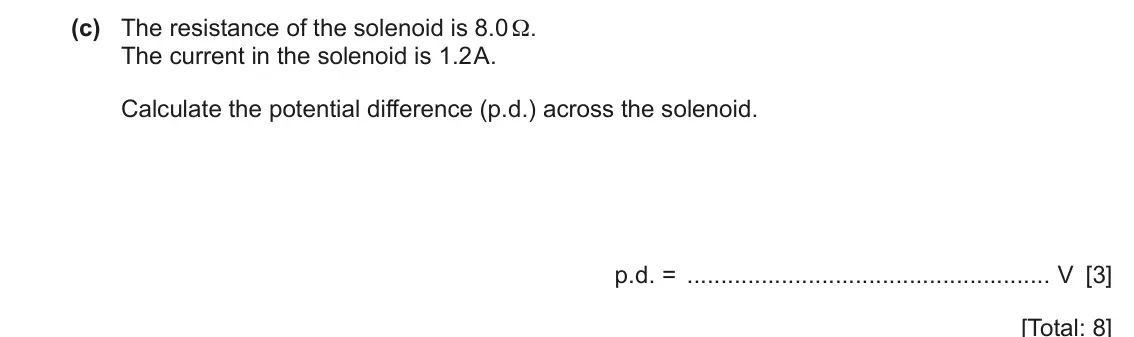
Q9(b)(ii)
The whole paper ↗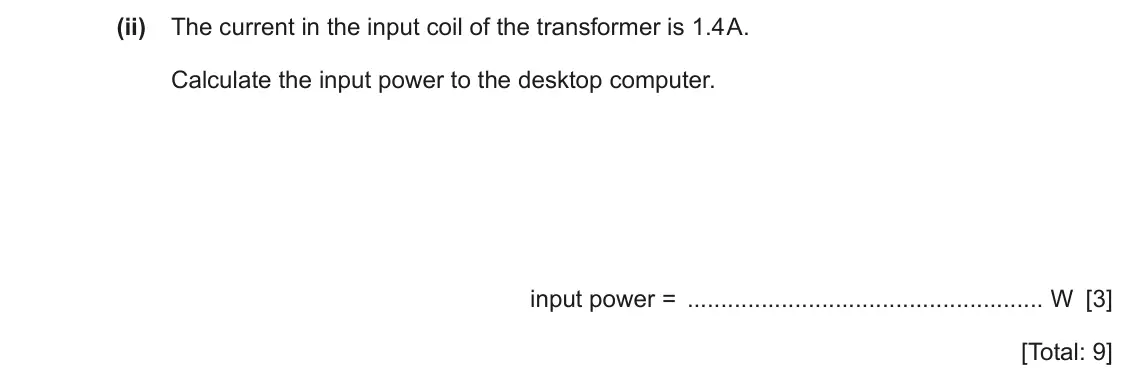
Q6(a)(i)
The whole paper ↗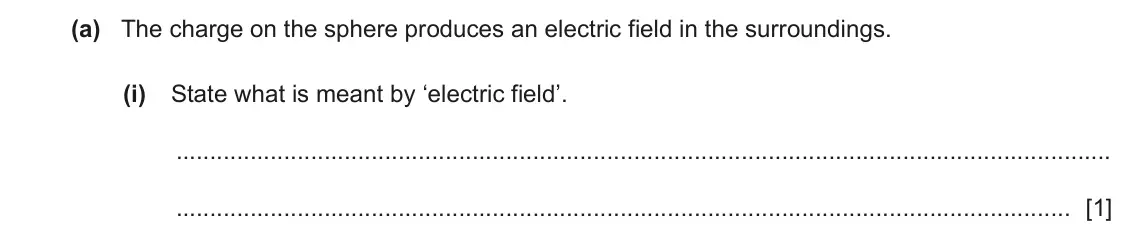
Q6(a)(ii)
The whole paper ↗
Q6(b)(i)
The whole paper ↗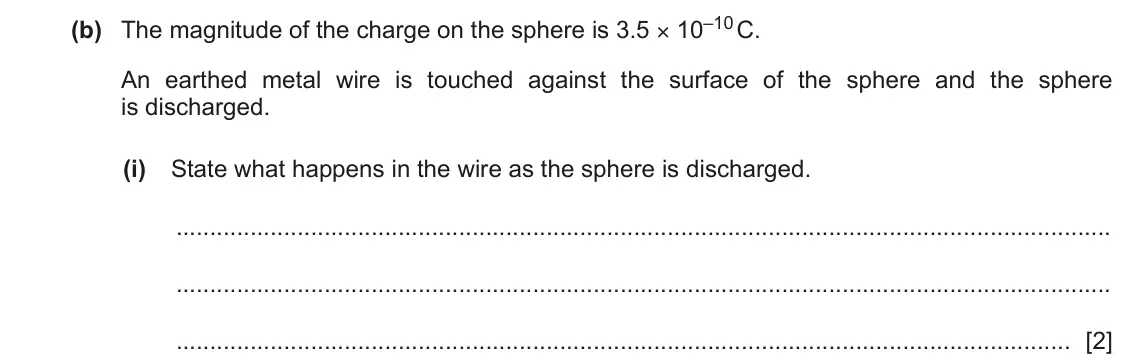
Q6(b)(ii)
The whole paper ↗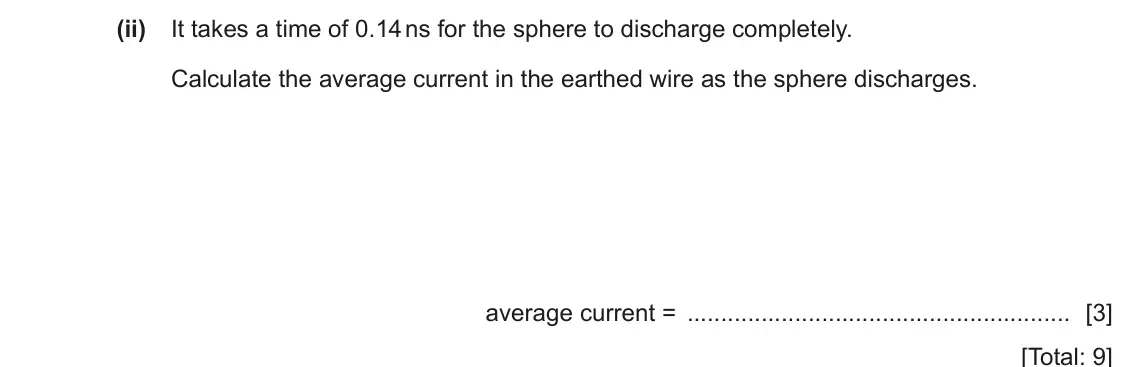
Q7(a)
The whole paper ↗
Q7(b)(ii)
The whole paper ↗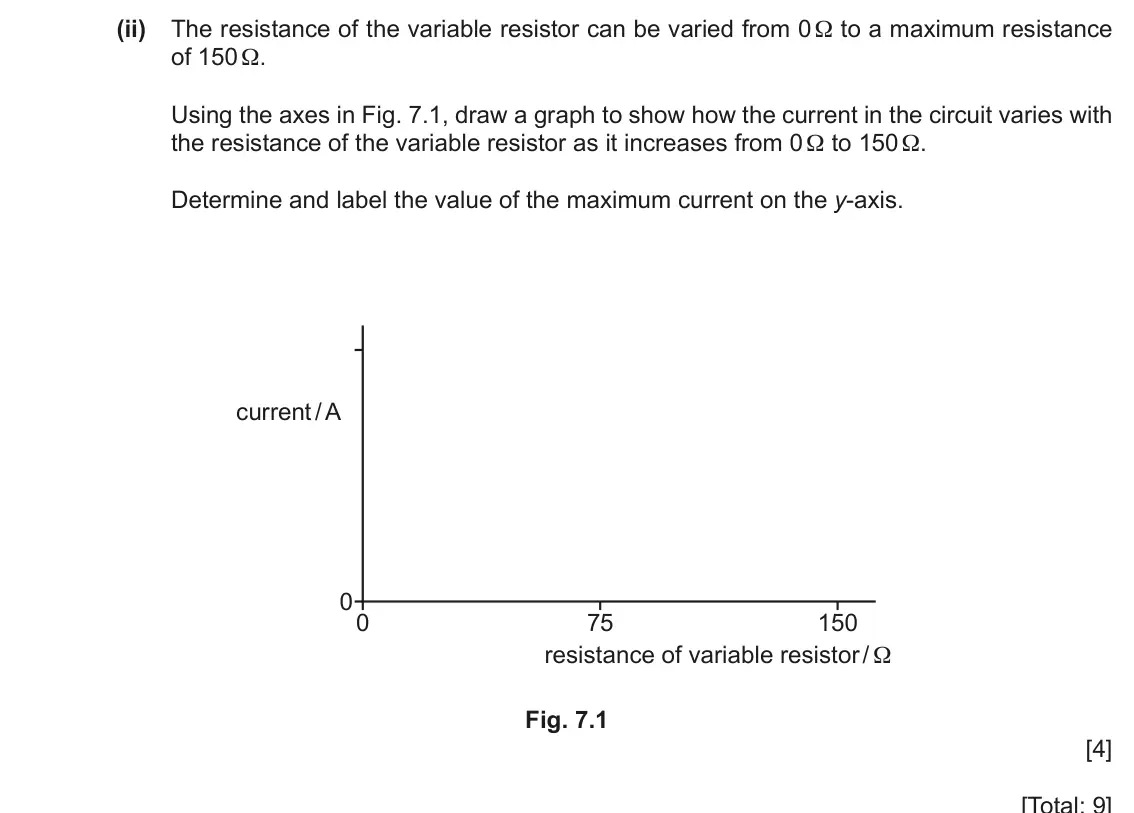
Q2(a)(i)
The whole paper ↗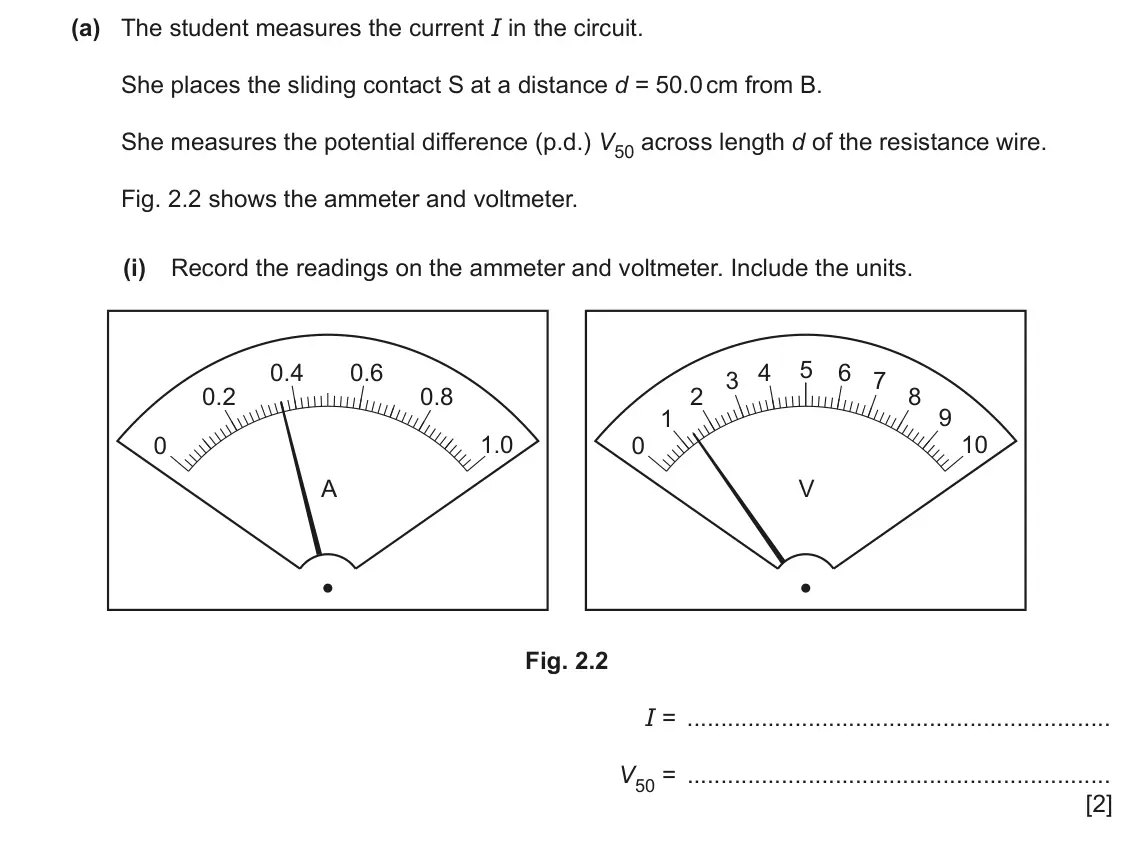
Q2(a)(ii)
The whole paper ↗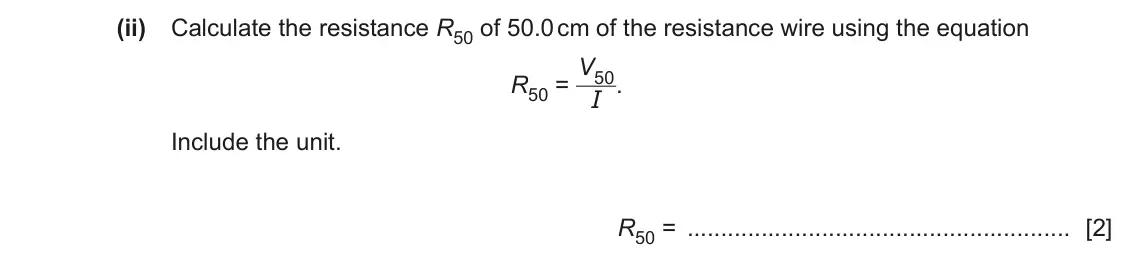
Q2(a)(iii)
The whole paper ↗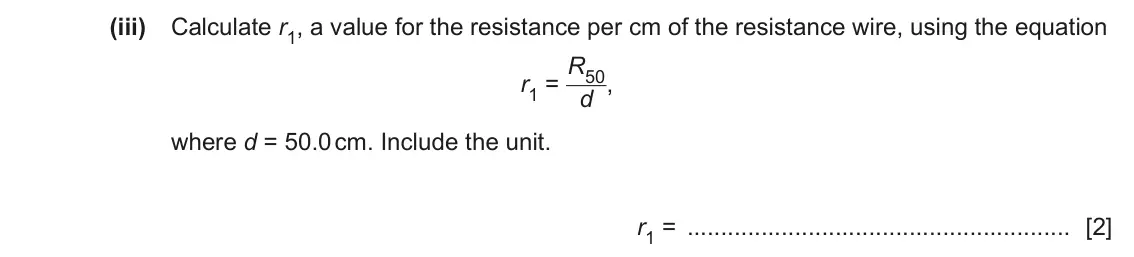
Q2(b)(i)
The whole paper ↗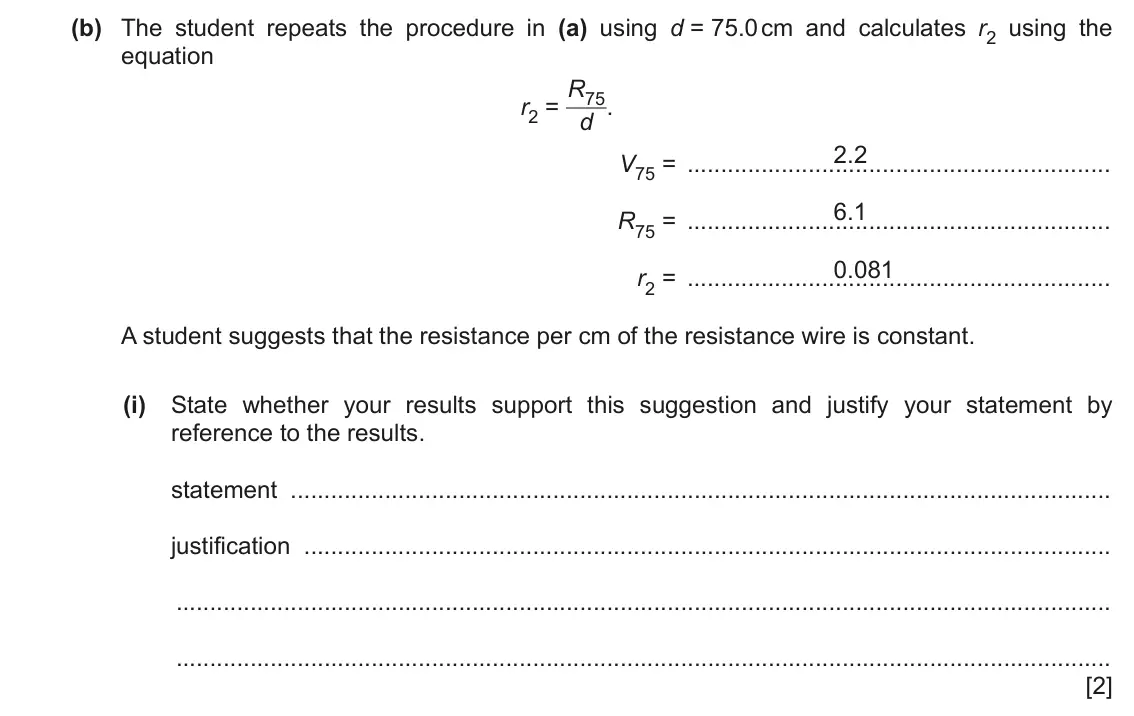
Q2(b)(ii)
The whole paper ↗
All 32 questions on Electrical quantities, as a list
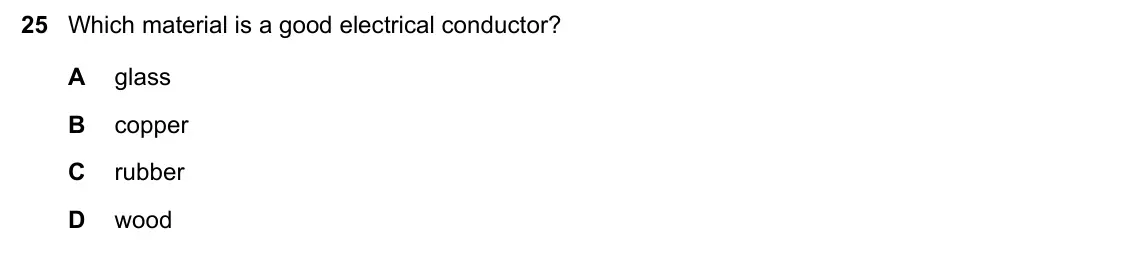
- June 2024, Paper 1, Q25 (1 mark): Which material is a good electrical conductor? A glass B copper C rubber D wood
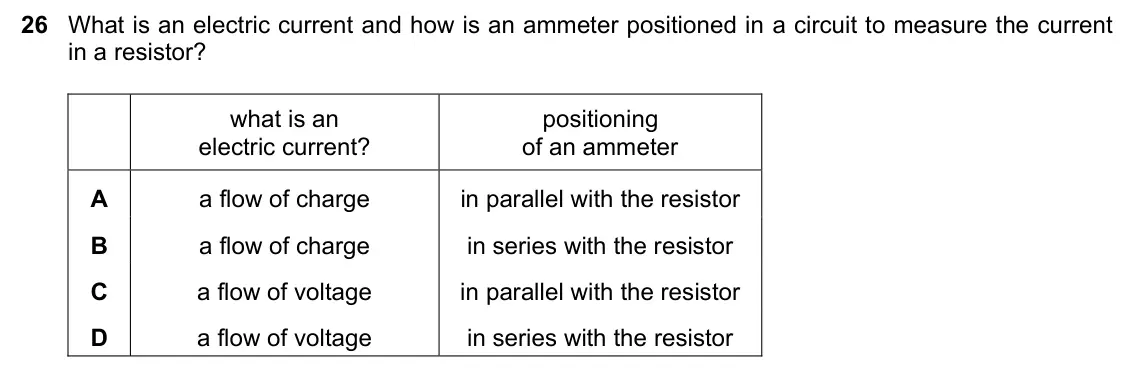
- June 2024, Paper 1, Q26 (1 mark): What is an electric current and how is an ammeter positioned in a circuit to measure the current in a resistor? what is an positioning electric current? of an a
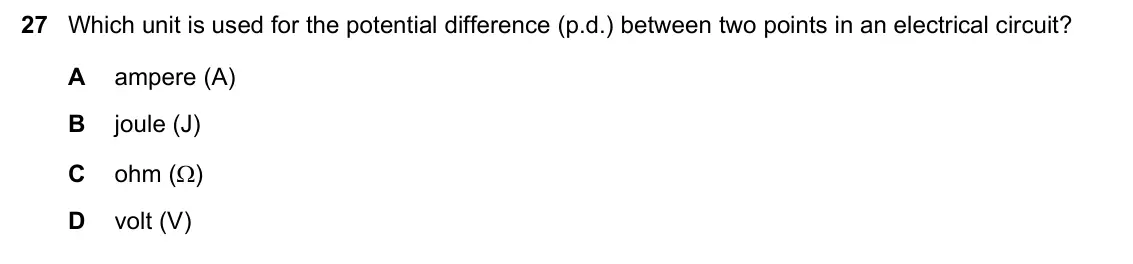
- June 2024, Paper 1, Q27 (1 mark): Which unit is used for the potential difference (p.d.) between two points in an electrical circuit? A ampere (A) B joule (J) C ohm () D volt (V)
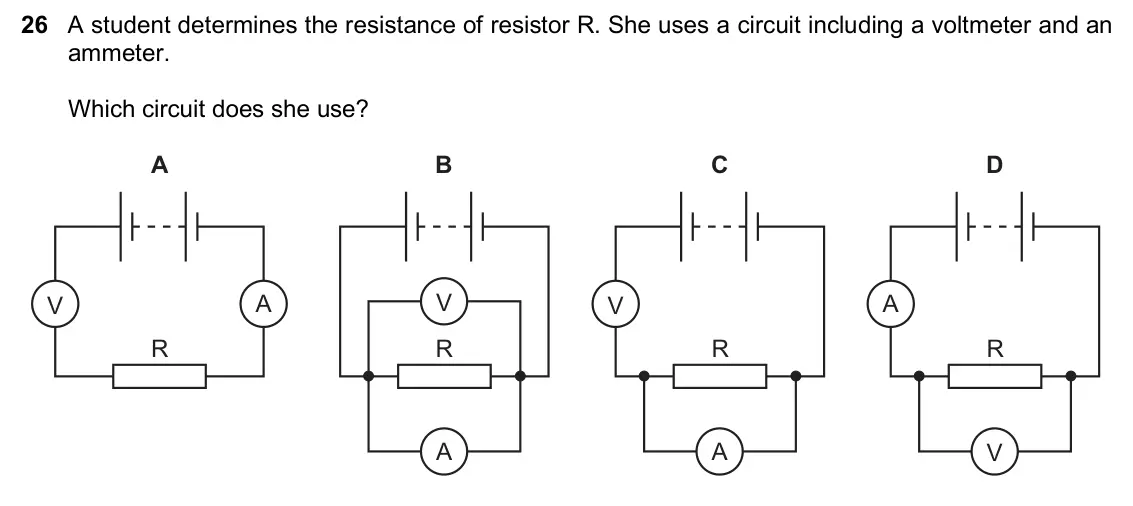
- June 2024, Paper 2, Q26 (1 mark): A student determines the resistance of resistor R. She uses a circuit including a voltmeter and an ammeter. Which circuit does she use? A B C D V A V V A R R R
- June 2024, Paper 3, Q8(c) (3 marks): The resistance of the solenoid is 8.0 Ω. The current in the solenoid is 1.2 A. Calculate the potential difference (p.d.) across the solenoid. p.d. = V [3] [Tota
- June 2024, Paper 3, Q9(b)(ii) (3 marks): The current in the input coil of the transformer is 1.4 A. Calculate the input power to the desktop computer. input power = W [3] [Total: 9]
- June 2024, Paper 4, Q6(a)(i) (1 mark): State what is meant by ‘electric field’. [1]
- June 2024, Paper 4, Q6(a)(ii) (3 marks): Draw on Fig. 6.1 to show the pattern and direction of the electric field produced by the charge on the sphere. Draw at least four lines. [3]
- June 2024, Paper 4, Q6(b)(i) (2 marks): State what happens in the wire as the sphere is discharged. [2]
- June 2024, Paper 4, Q6(b)(ii) (3 marks): It takes a time of 0.14 ns for the sphere to discharge completely. Calculate the average current in the earthed wire as the sphere discharges. average current =
- June 2024, Paper 4, Q7(a) (2 marks): Define the term electromotive force. [2]
- June 2024, Paper 4, Q7(b)(ii) (4 marks): The resistance of the variable resistor can be varied from 0 Ω to a maximum resistance of 150 Ω. Using the axes in Fig. 7.1, draw a graph to show how the curren
- June 2024, Paper 6, Q2(a)(i) (2 marks): Record the readings on the ammeter and voltmeter. Include the units. 0.4 0.6 4 5 6 3 7 0.2 0.8 2 8 1 9 0 1.0 0 10 A V Fig. 2.2 I = V50 = [2]
- June 2024, Paper 6, Q2(a)(ii) (2 marks): Calculate the resistance R50 of 50.0 cm of the resistance wire using the equation R50 = V50 I . Include the unit. R50 = [2]
- June 2024, Paper 6, Q2(a)(iii) (2 marks): Calculate r1, a value for the resistance per cm of the resistance wire, using the equation r1 = R50 d , where d = 50.0 cm. Include the unit. r1 = [2]
- June 2024, Paper 6, Q2(b)(i) (2 marks): State whether your results support this suggestion and justify your statement by reference to the results. statement justification [2]
- June 2024, Paper 6, Q2(b)(ii) (2 marks): The student plans to plot a graph of resistance R against length d to test the suggestion. Suggest suitable additional values of length d to use. [2]
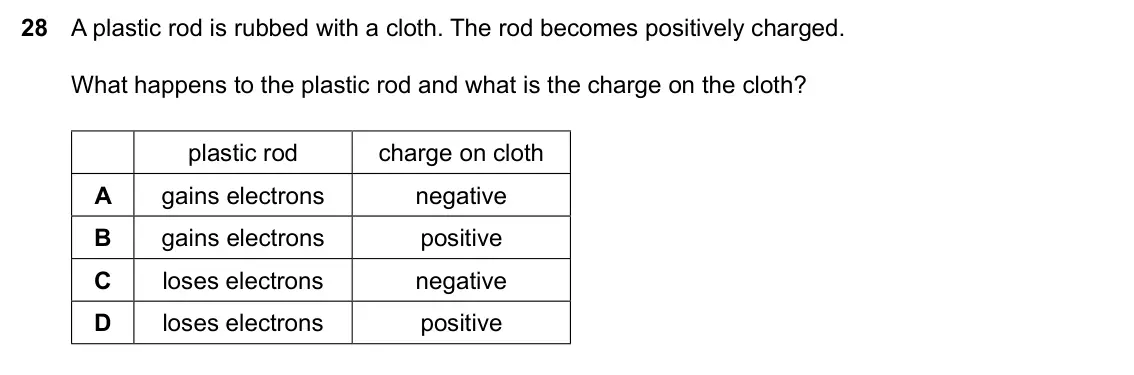
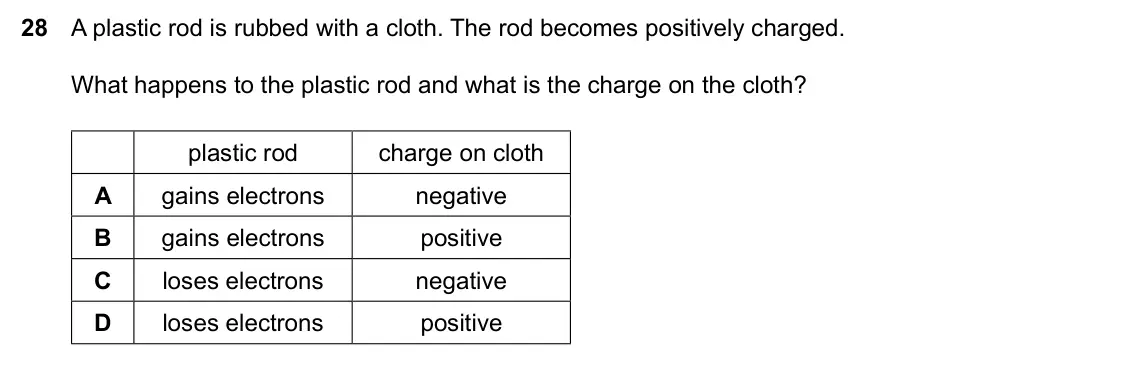
- Specimen, Paper 1, Q28 (1 mark): A plastic rod is rubbed with a cloth. The rod becomes positively charged. What happens to the plastic rod and what is the charge on the cloth? plastic rod charg
- Specimen, Paper 2, Q28 (1 mark): A plastic rod is rubbed with a cloth. The rod becomes positively charged. What happens to the plastic rod and what is the charge on the cloth? plastic rod charg
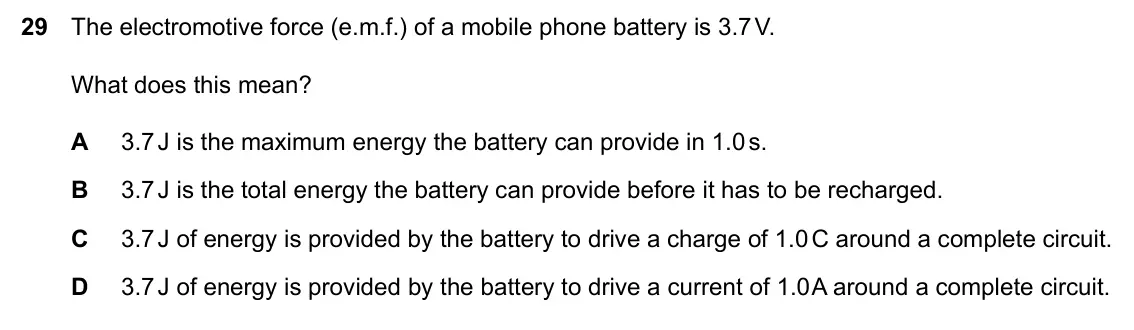
- Specimen, Paper 2, Q29 (1 mark): The electromotive force (e.m.f.) of a mobile phone battery is 3.7 V. What does this mean? A 3.7 J is the maximum energy the battery can provide in 1.0 s. B 3.7
- Specimen, Paper 2, Q31 (1 mark): A water heater is connected to a 230 V supply and there is a current of 26 A in the heater. It takes 20 minutes to heat the water to the required temperature. H
- Specimen, Paper 3, Q10(c) (3 marks): The potential difference across the motor is 250 V. The current in the motor is 2.0 A. Calculate the resistance of the motor. resistance = Ω [3]
- Specimen, Paper 4, Q9(a) (2 marks): Referring to the charge on the ball, explain why the ball moves to the positive plate after touching the negative plate. [2]
- Specimen, Paper 4, Q9(b) (2 marks): State which particles move when there is a current and state the direction in which they move through the sensitive ammeter. particles: direction: [2]
- Specimen, Paper 4, Q9(c) (3 marks): For each complete oscillation of the ball moving between the plates, a charge of 8.5 × 10⁻¹⁰ C is transferred from one plate to the other. The frequency of osci
- Specimen, Paper 6, Q2(a)(i) (1 mark): On Fig. 2.1, draw a voltmeter connected to measure the potential difference (p.d.) V across terminals P and Q. [1]
- Specimen, Paper 6, Q2(a)(ii) (2 marks): The student connects the crocodile clip to a length l = 90.0 cm of the resistance wire and measures the potential difference V across terminals P and Q and the
- Specimen, Paper 6, Q2(b) (1 mark): The student then connects the crocodile clip to lengths l = 60.0 cm and l = 40.0 cm of the resistance wire. She measures the potential difference V across termi
- Specimen, Paper 6, Q2(c)(i) (2 marks): Calculate, and record in Table 2.1, the resistance R of each length l of the wire. V . Use the readings from the table and the equation R = I [2]
- Specimen, Paper 6, Q2(c)(ii) (1 mark): Calculate, and record in Table 2.1, the value of l [1]
- Specimen, Paper 6, Q2(d) (1 mark): Another student suggests that the values of l State whether the results support this suggestion. Justify your statement with reference to values from the result
- Specimen, Paper 6, Q2(e) (1 mark): Suggest one difficulty which explains why different students, doing the experiment carefully with the same equipment, may not obtain identical results. [1]
Questions, mark schemes and examiner’s reports are © Cambridge University Press & Assessment, from their published past papers. Plumi isn’t affiliated with any exam board. Want whole papers? Every CAIE IGCSE Physics paper.
Rather write your answers by hand on iPad? Plumi marks them against the same mark schemes.