 plumi
Identities and algebraic proof: AQA GCSE Maths questions
Every AQA GCSE Maths exam question on A6 Identities and algebraic proof, 2017–2025, with its mark scheme and examiner’s report.
Find questions1,304
Exam
All years
Calculator



All 23 questions on Identities and algebraic proof, as a list
- June 2025, Paper 1H, Q24 (4 marks): Prove that x x x − − − 4 2 60 15 2 1 × 1 6 3 x − can never be positive.
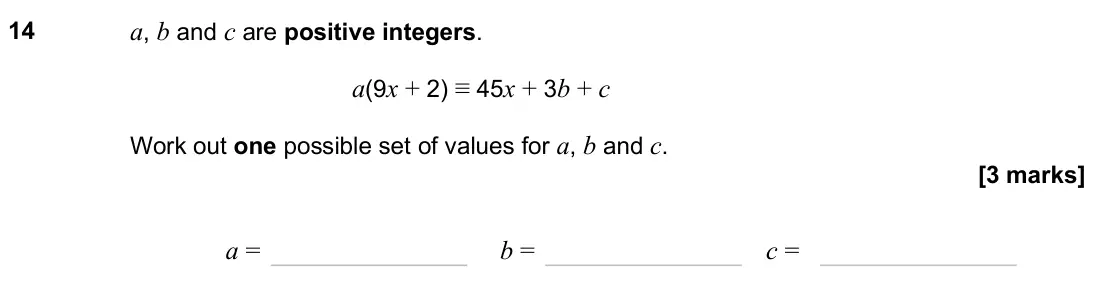
- June 2025, Paper 2H, Q14 (3 marks): a, b and c are positive integers. a(9x + 2) ≡ 45x + 3b + c Work out one possible set of values for a, b and c. a = b = c =
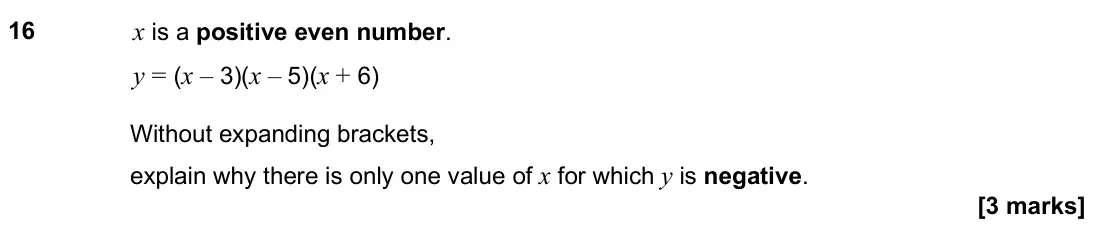
- June 2025, Paper 3H, Q16 (3 marks): x is a positive even number. y = (x – 3)(x – 5)(x + 6) Without expanding brackets, explain why there is only one value of x for which y is negative.
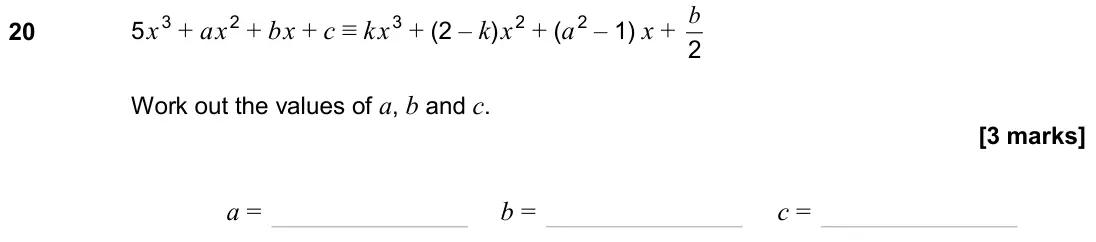
- June 2024, Paper 1H, Q20 (3 marks): 5x3 + ax2 + bx + c ≡ kx3 + (2 – k)x2 + (a2 – 1) x + 2 b Work out the values of a, b and c. a = b = c =
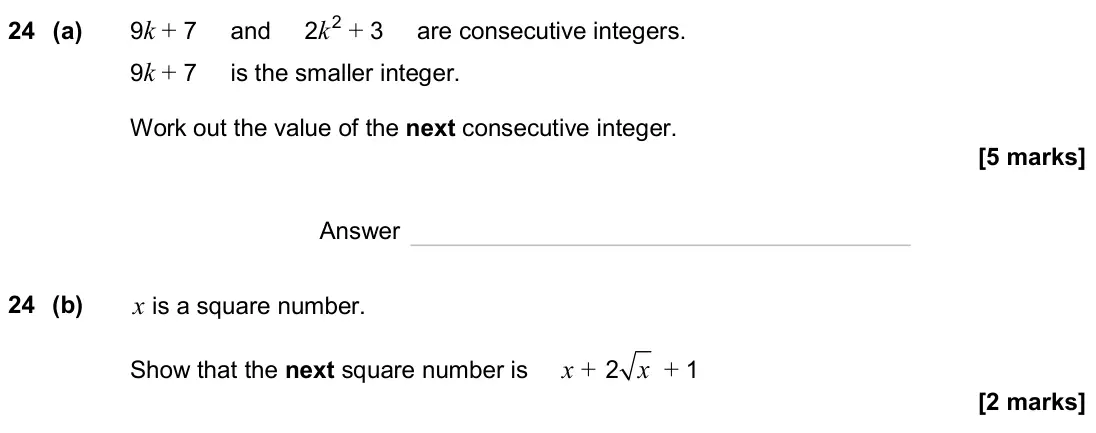
- June 2024, Paper 1H, Q24 (7 marks): (a) 9k + 7 and 2k2 + 3 are consecutive integers. 9k + 7 is the smaller integer. Work out the value of the next consecutive integer. Answer 24 (b) x is a square
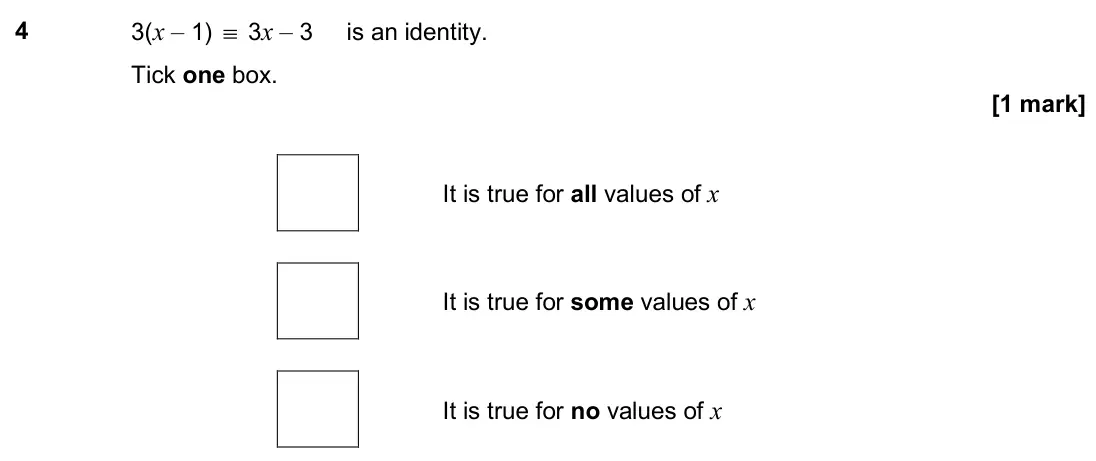
- June 2024, Paper 3H, Q4 (1 mark): 3(x – 1) ≡ 3x – 3 is an identity. Tick one box. It is true for all values of x It is true for some values of x It is true for no values of x
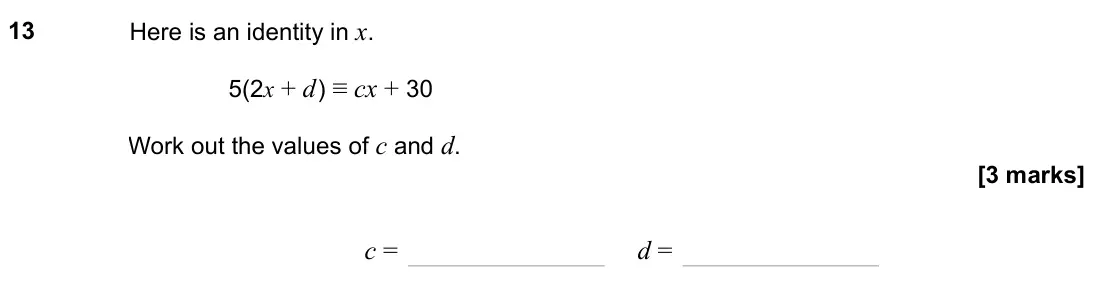
- November 2023, Paper 1H, Q13 (3 marks): Here is an identity in x. 5(2x + d ) ≡ cx + 30 Work out the values of c and d. c = d =
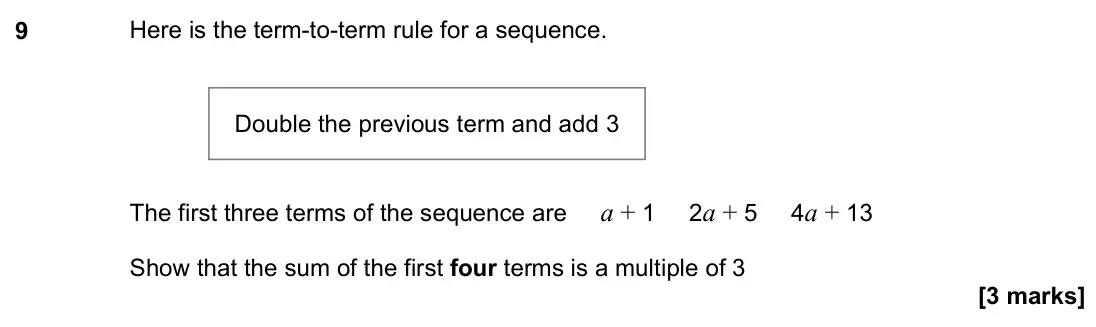
- November 2023, Paper 2H, Q9 (3 marks): Here is the term-to-term rule for a sequence. The first three terms of the sequence are a + 1 2a + 5 4a + 13 Show that the sum of the first four terms is a mult
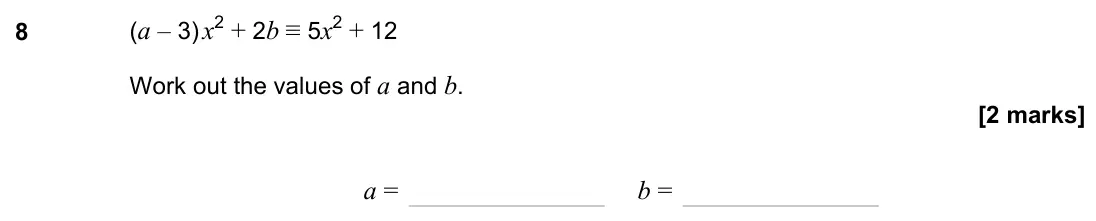
- June 2023, Paper 2H, Q8 (2 marks): (a – 3) x2 + 2b ≡ 5x2 + 12 Work out the values of a and b. a = b =
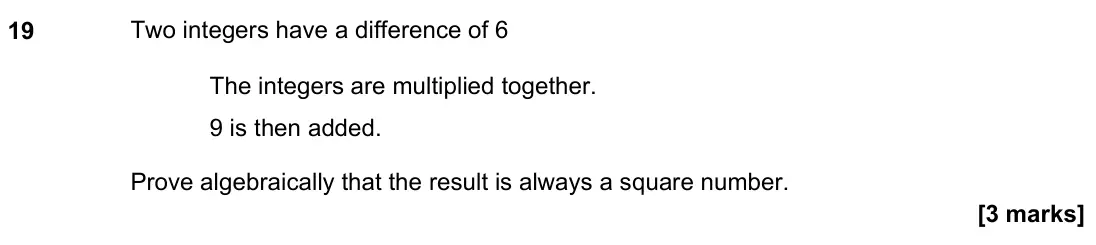
- June 2023, Paper 3H, Q19 (3 marks): Two integers have a difference of 6 The integers are multiplied together. 9 is then added. Prove algebraically that the result is always a square number.
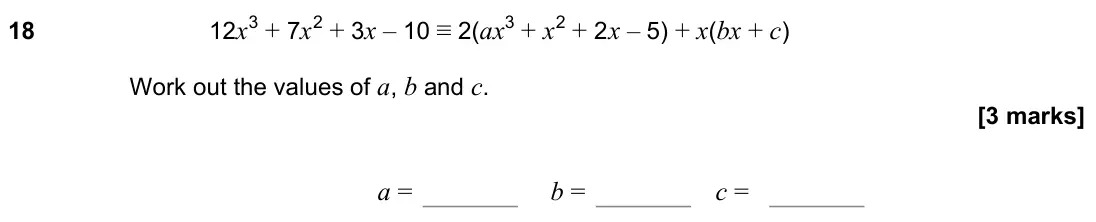
- June 2022, Paper 1H, Q18 (3 marks): 12x3 + 7x2 + 3x – 10 ≡ 2(ax3 + x2 + 2x – 5) + x(bx + c) Work out the values of a, b and c. a = b = c =
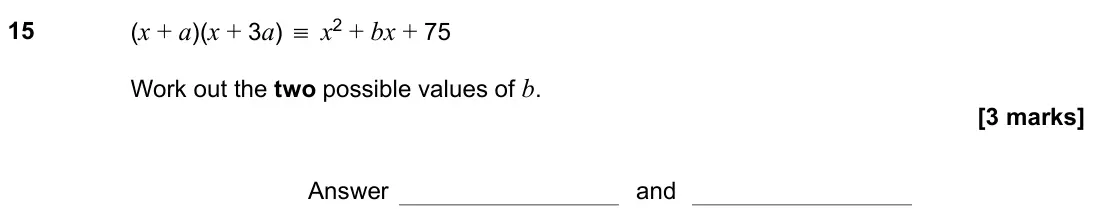
- November 2021, Paper 1H, Q15 (3 marks): (x + a)(x + 3a) ≡ x2 + bx + 75 Work out the two possible values of b. Answer and
- November 2021, Paper 2H, Q21 (4 marks): x is an integer. Prove that 35 + (3x + 1)2 – 2x(4x – 3) is a square number.
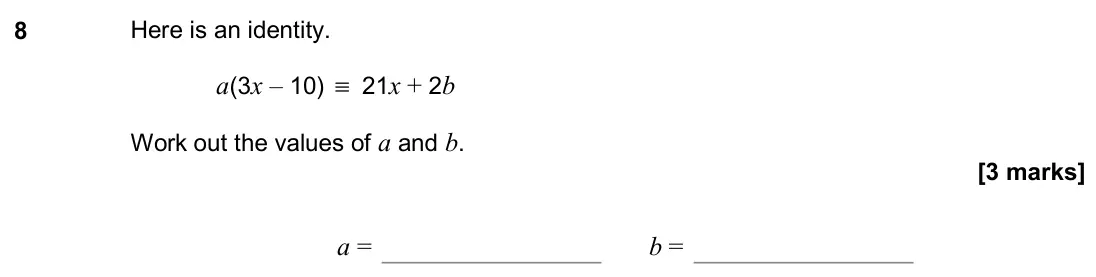
- November 2019, Paper 2H, Q8 (3 marks): Here is an identity. a(3x – 10) ≡ 21x + 2b Work out the values of a and b. a = b =
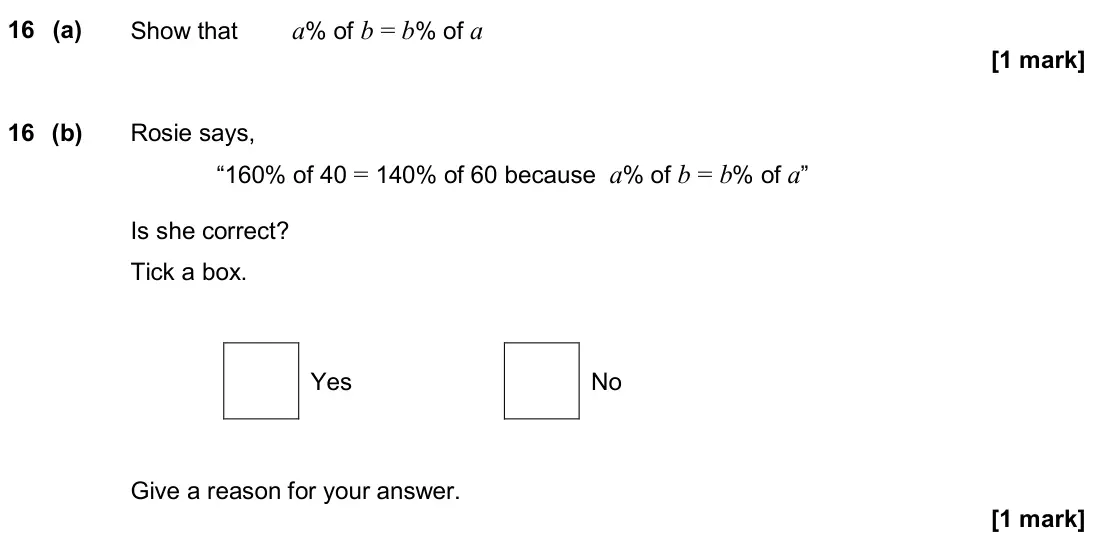
- November 2019, Paper 2H, Q16 (2 marks): (a) Show that a% of b = b% of a 16 (b) Rosie says, “160% of 40 = 140% of 60 because a% of b = b% of a” Is she correct? Tick a box. Yes No Give a reason for your
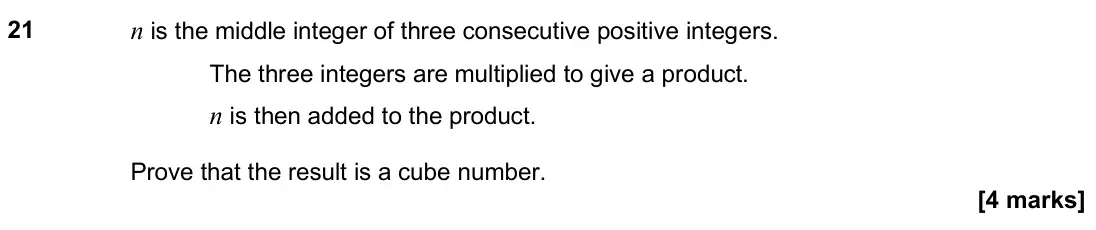
- November 2019, Paper 2H, Q21 (4 marks): n is the middle integer of three consecutive positive integers. The three integers are multiplied to give a product. n is then added to the product. Prove that
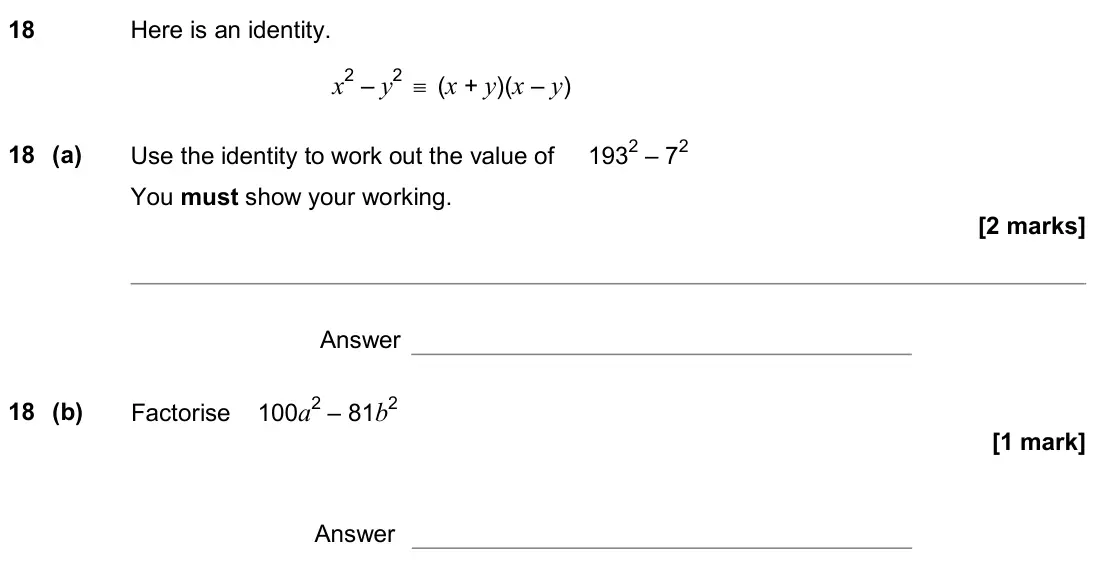
- June 2019, Paper 1H, Q18 (3 marks): Here is an identity. x2 – y2 ≡ (x + y)(x – y) 18 (a) Use the identity to work out the value of 1932 – 72 You must show your working. Answer 18 (b) Factorise 100
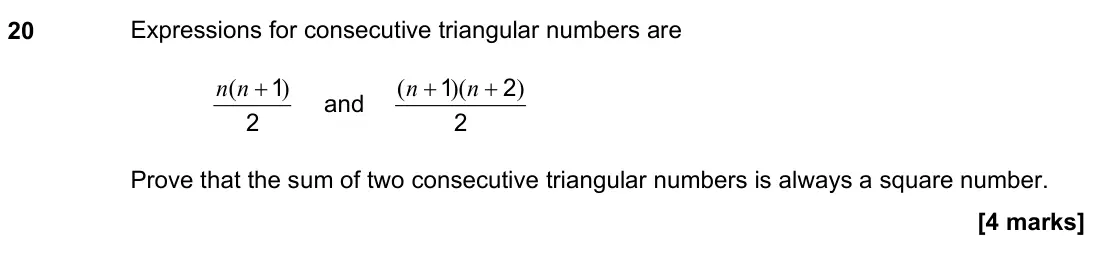
- June 2019, Paper 2H, Q20 (4 marks): Expressions for consecutive triangular numbers are 2 1) ( + n n and 2 2 1 ) )( ( + + n n Prove that the sum of two consecutive triangular numbers is always a sq
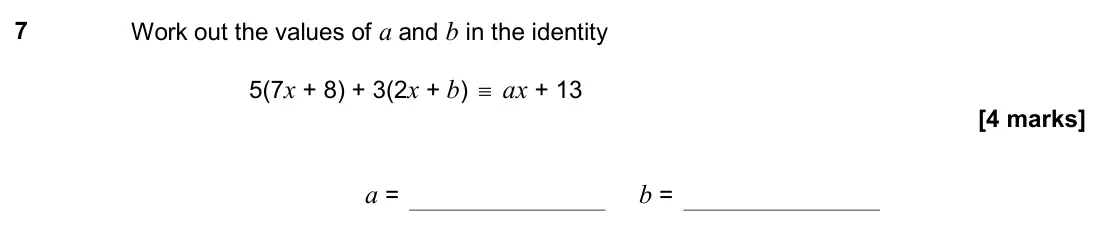
- November 2018, Paper 2H, Q7 (4 marks): Work out the values of a and b in the identity 5(7x + 8) + 3(2x + b) ≡ ax + 13 a = b =
- November 2018, Paper 2H, Q20 (3 marks): n is a positive integer. Prove algebraically that ( ) 2 2 3 2 6 1 + + − n n n n n is a cube number.
- November 2017, Paper 3H, Q26 (2 marks): a2 – b2 ≡ (a + b)(a – b) a and b are positive whole numbers with a > b a2 – b2 is a prime number. Why are a and b consecutive numbers?
- June 2017, Paper 3H, Q27 (3 marks): Prove that x2 + x + 1 is always positive.
- Specimen, Paper 2H, Q16 (3 marks): c is a positive integer. Prove that 15 3 30 6 2 3 c c c is an even number.
Questions, mark schemes and examiner’s reports are © AQA, from their published past papers. Plumi isn’t affiliated with any exam board. Want whole papers? Every AQA GCSE Maths paper.
Rather write your answers by hand on iPad? Plumi marks them against the same mark schemes.