 plumi
Chemical bonds, ionic, covalent and metallic: AQA GCSE Combined Science questions
Every AQA GCSE Combined Science exam question on 5.2.1 Chemical bonds, ionic, covalent and metallic, 2018–2025, with its mark scheme and examiner’s report.
Find questions3,069
Calculations
Q03.5
The whole paper ↗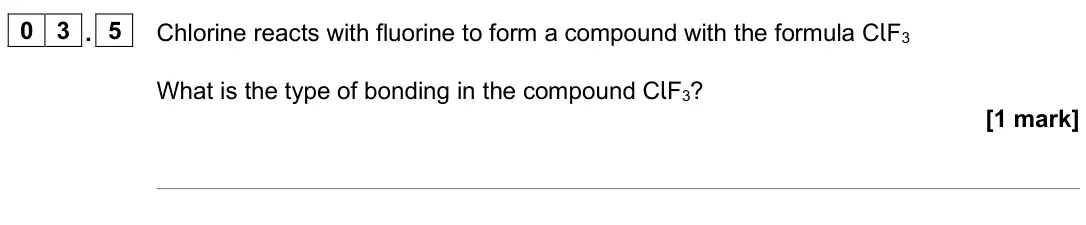
Q05.3
The whole paper ↗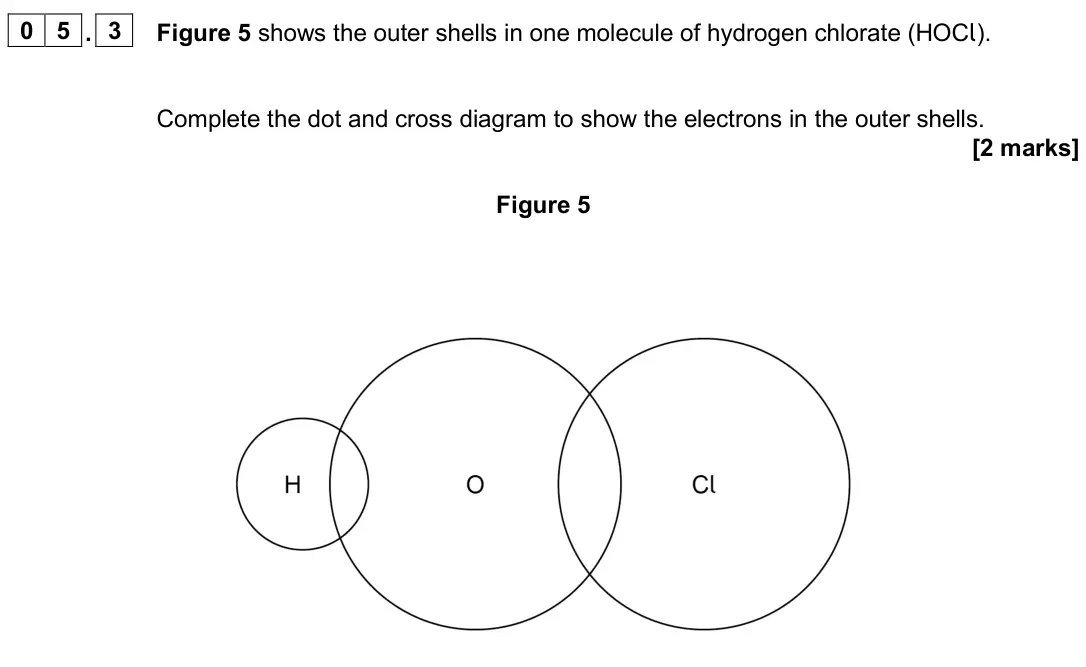
Q07.1
The whole paper ↗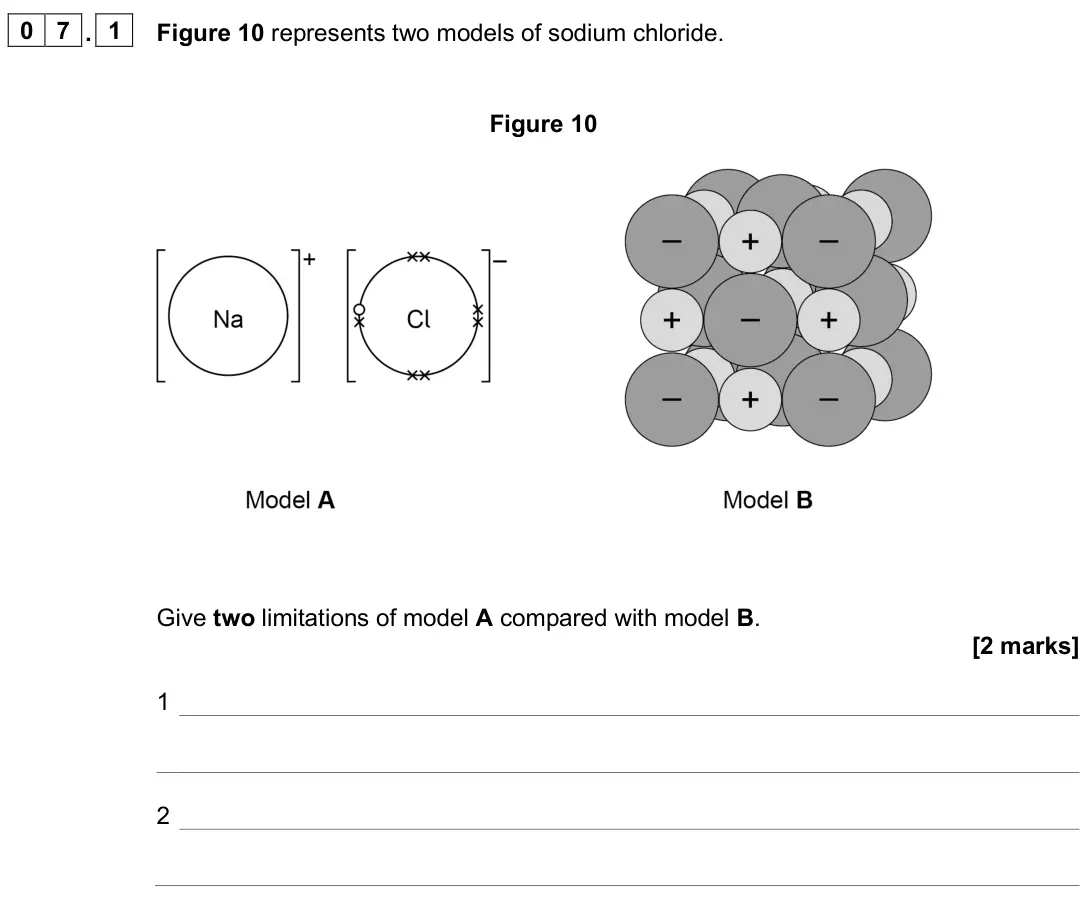
Q07.2
The whole paper ↗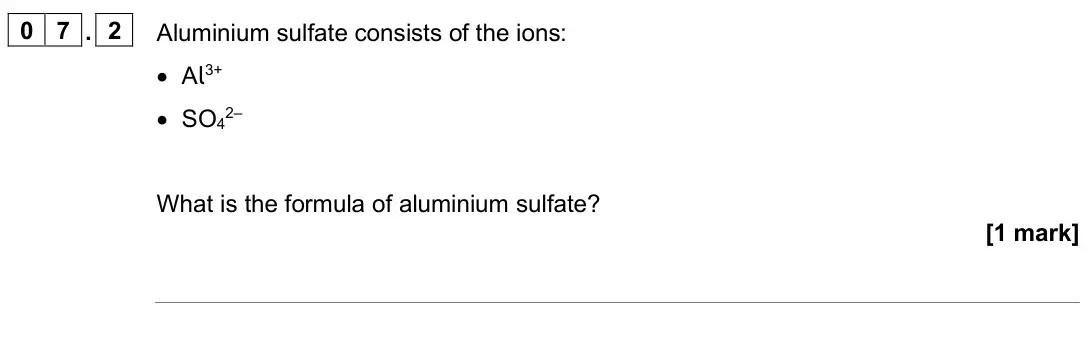
Q07.3
The whole paper ↗
Q07.4
The whole paper ↗
Q01.7
The whole paper ↗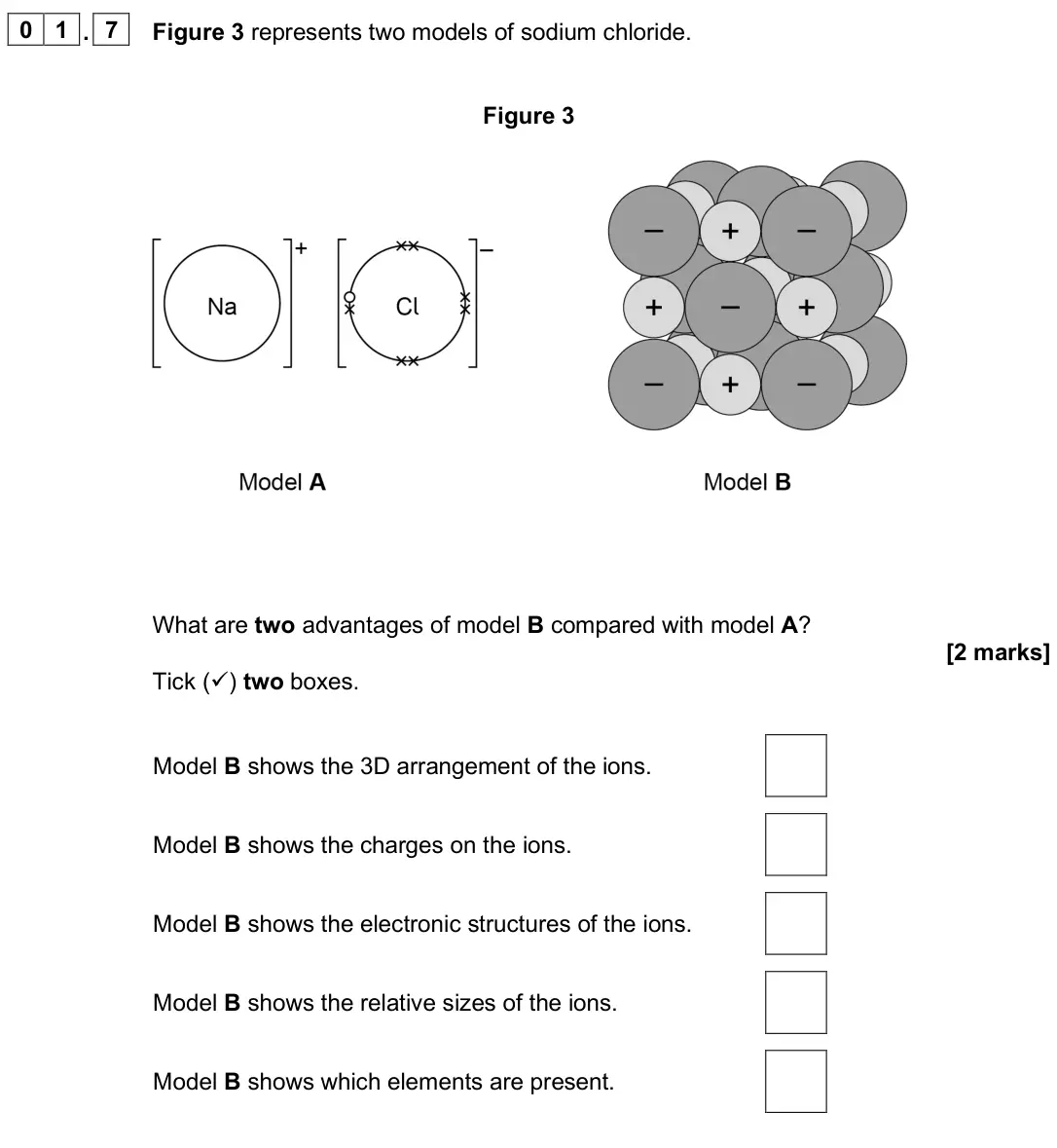
Q02.2
The whole paper ↗
Q05.1
The whole paper ↗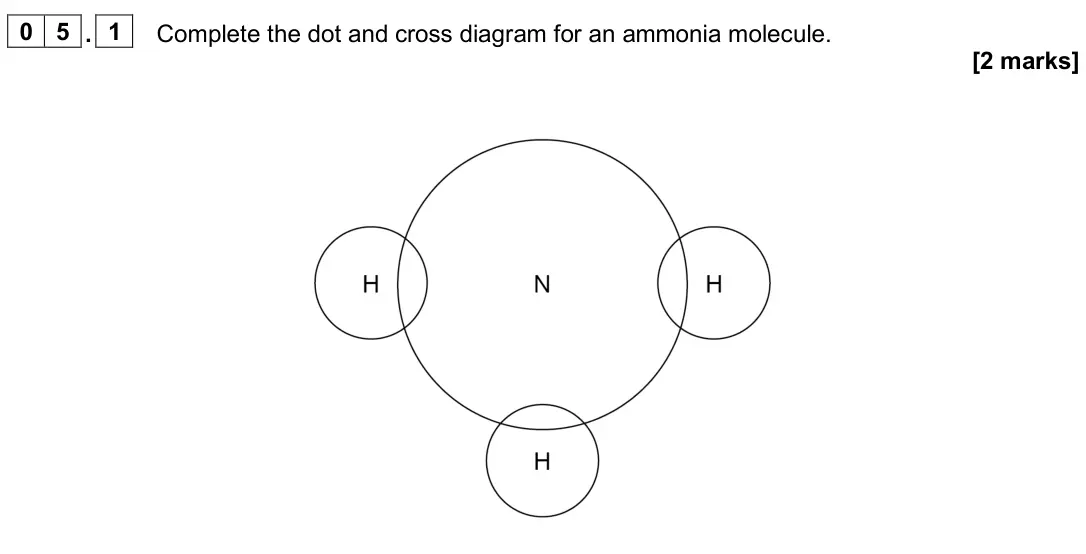
Q07.1
The whole paper ↗
Q02.1
The whole paper ↗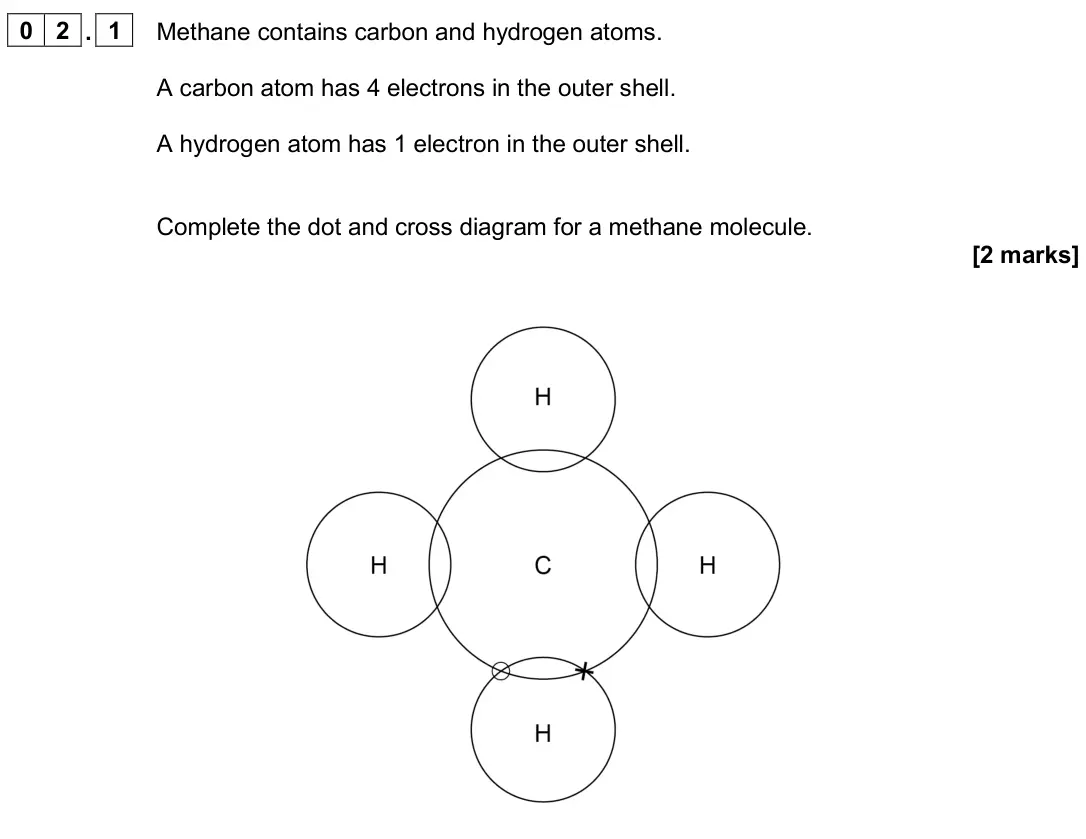
Q02.2
The whole paper ↗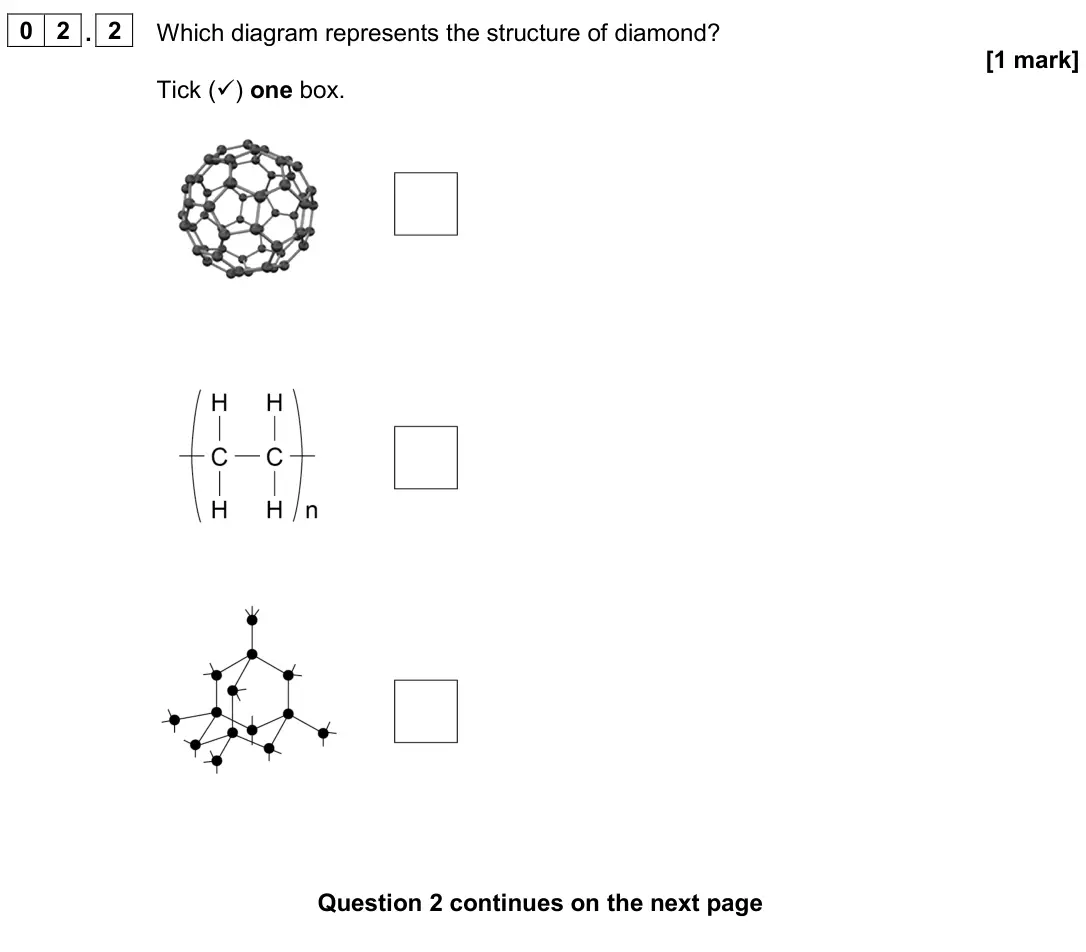
Q01.6
The whole paper ↗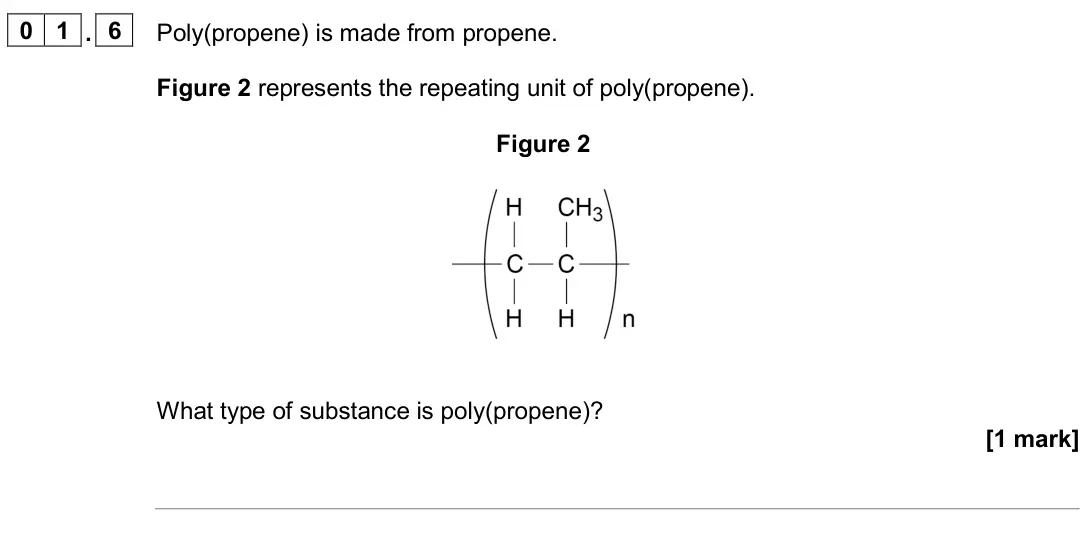
Q06.6
The whole paper ↗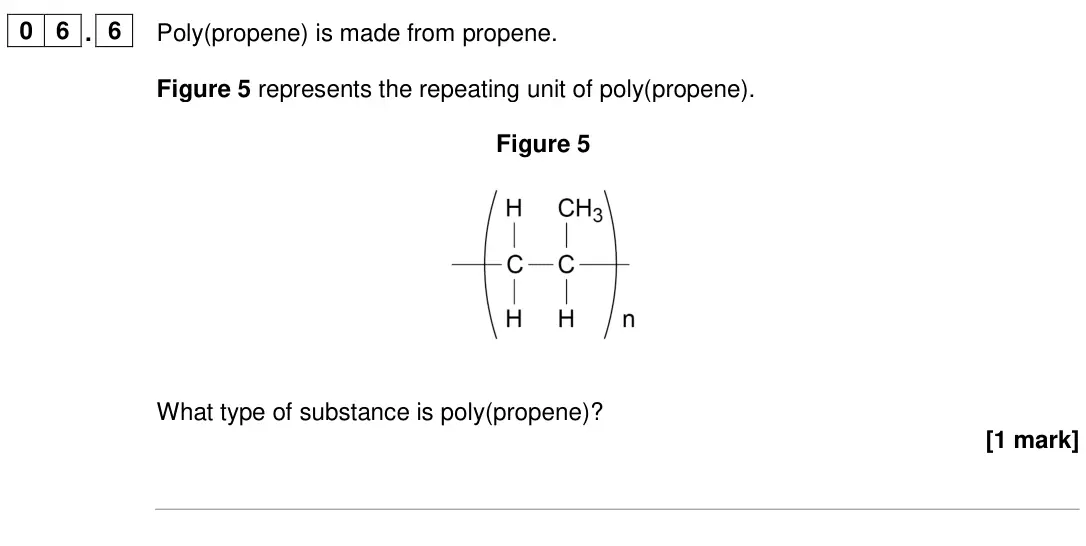
Q04.6
The whole paper ↗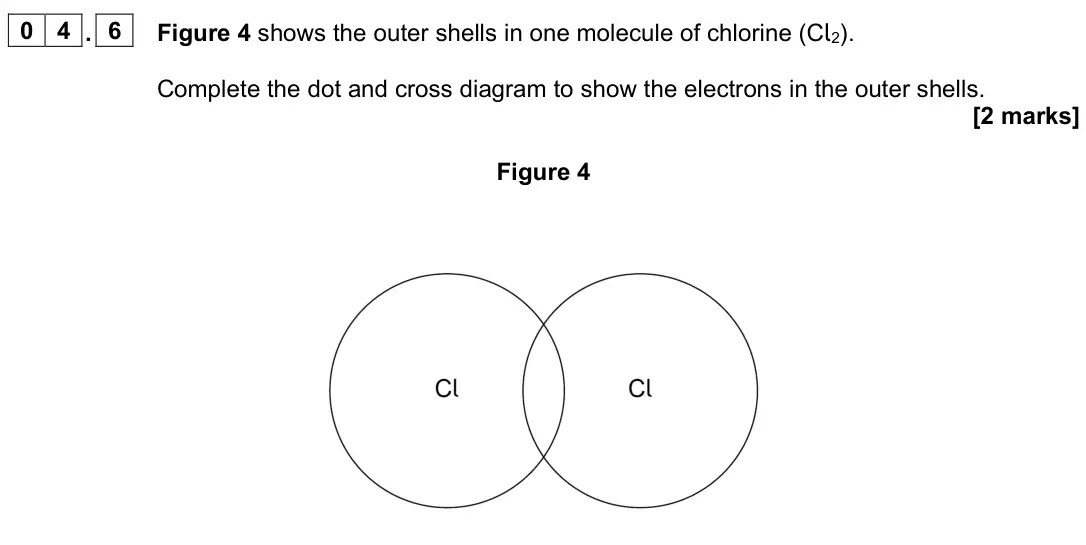
Q07.2
The whole paper ↗
Q07.3
The whole paper ↗
All 50 questions on Chemical bonds, ionic, covalent and metallic, as a list
- June 2025, Chemistry Paper 1 Higher, Q03.5 (1 mark): Chlorine reacts with fluorine to form a compound with the formula ClF3 What is the type of bonding in the compound ClF3? [1 mark]
- June 2025, Chemistry Paper 1 Higher, Q05.3 (2 marks): Figure 5 shows the outer shells in one molecule of hydrogen chlorate (HOCl). Complete the dot and cross diagram to show the electrons in the outer shells. [2 ma
- June 2025, Chemistry Paper 1 Higher, Q07.1 (2 marks): Figure 10 represents two models of sodium chloride. Figure 10 Give two limitations of model A compared with model B. [2 marks] 1 2
- June 2025, Chemistry Paper 1 Higher, Q07.2 (1 mark): Aluminium sulfate consists of the ions: • Al3+ • SO42– What is the formula of aluminium sulfate? [1 mark]
- June 2025, Chemistry Paper 1 Higher, Q07.3 (1 mark): Metals have metallic bonding. Suggest one reason why aluminium metal conducts electricity better than sodium metal. [1 mark]
- June 2025, Chemistry Paper 1 Higher, Q07.4 (4 marks): Silicon dioxide and the polymer poly(ethene) are solid substances. Compare silicon dioxide with the polymer, poly(ethene). Answer in terms of structure and bond
- June 2025, Chemistry Paper 1 Foundation, Q01.7 (2 marks): Figure 3 represents two models of sodium chloride. Figure 3 What are two advantages of model B compared with model A? [2 marks] Tick () two boxes. Model B show
- June 2025, Chemistry Paper 1 Foundation, Q02.2 (1 mark): Lithium has metallic bonding. Which electrons are involved in metallic bonding? [1 mark] Tick () one box. Delocalised electrons from the inner shell Delocalise
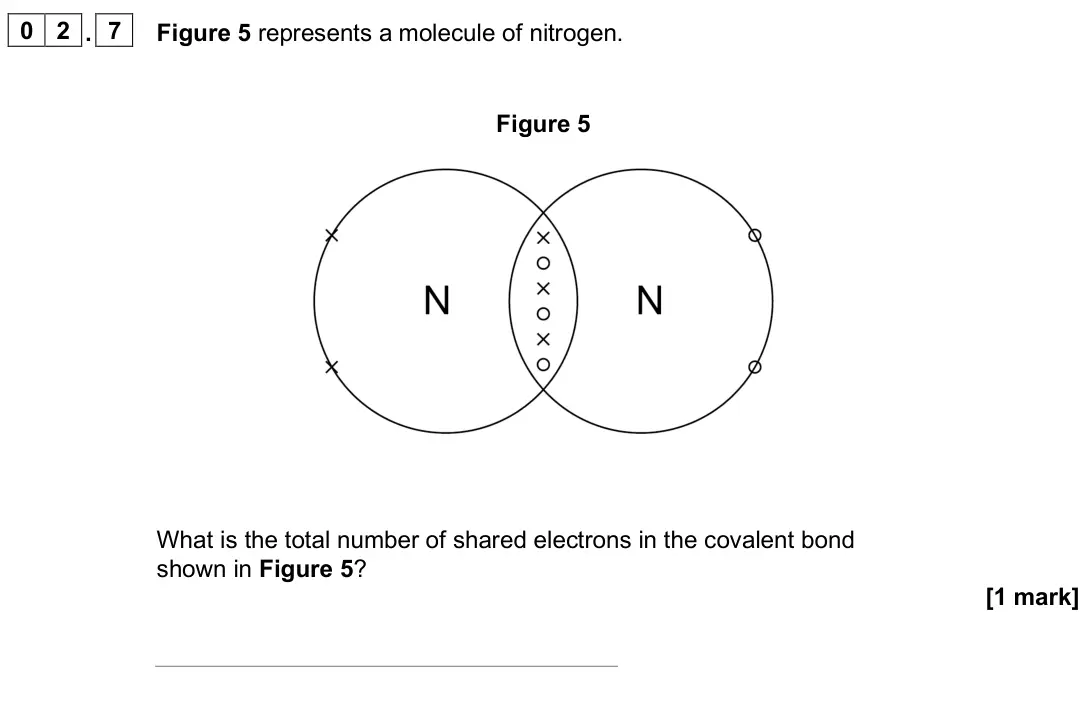
- June 2025, Chemistry Paper 1 Foundation, Q02.7 (1 mark): Figure 5 represents a molecule of nitrogen. Figure 5 What is the total number of shared electrons in the covalent bond shown in Figure 5? [1 mark]
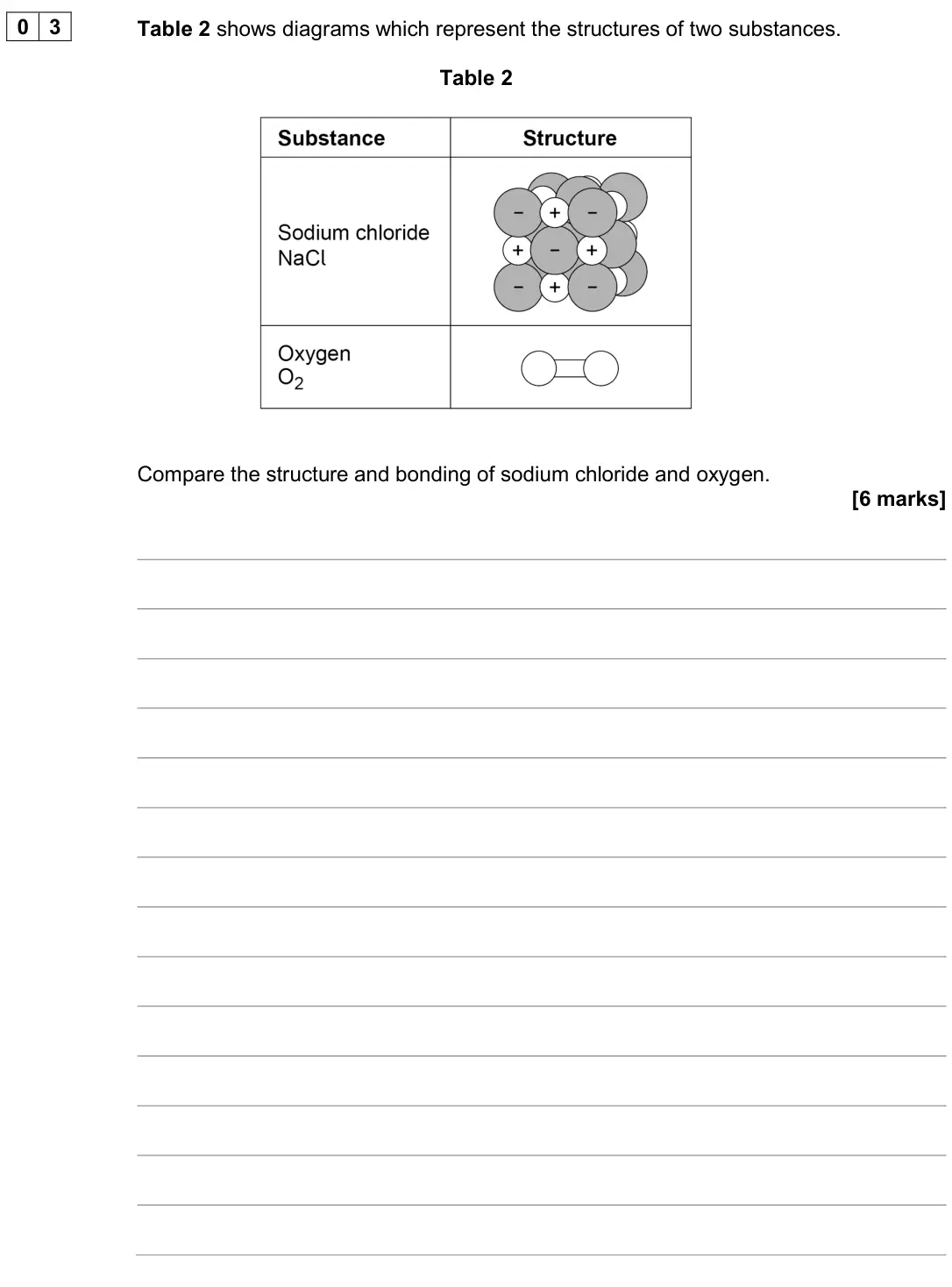
- June 2024, Chemistry Paper 1 Higher, Q03 (6 marks): Table 2 shows diagrams which represent the structures of two substances. Table 2 Compare the structure and bonding of sodium chloride and oxygen. [6 marks]
- June 2024, Chemistry Paper 1 Higher, Q05.1 (2 marks): Complete the dot and cross diagram for an ammonia molecule. [2 marks]
- June 2024, Chemistry Paper 1 Higher, Q07.1 (4 marks): Calcium reacts with chlorine to produce calcium chloride. Explain what happens to calcium atoms and to chlorine atoms when calcium reacts with chlorine to produ
- June 2024, Chemistry Paper 1 Foundation, Q02.1 (2 marks): Methane contains carbon and hydrogen atoms. A carbon atom has 4 electrons in the outer shell. A hydrogen atom has 1 electron in the outer shell. Complete the do
- June 2024, Chemistry Paper 1 Foundation, Q02.2 (1 mark): Which diagram represents the structure of diamond? [1 mark] Tick () one box.
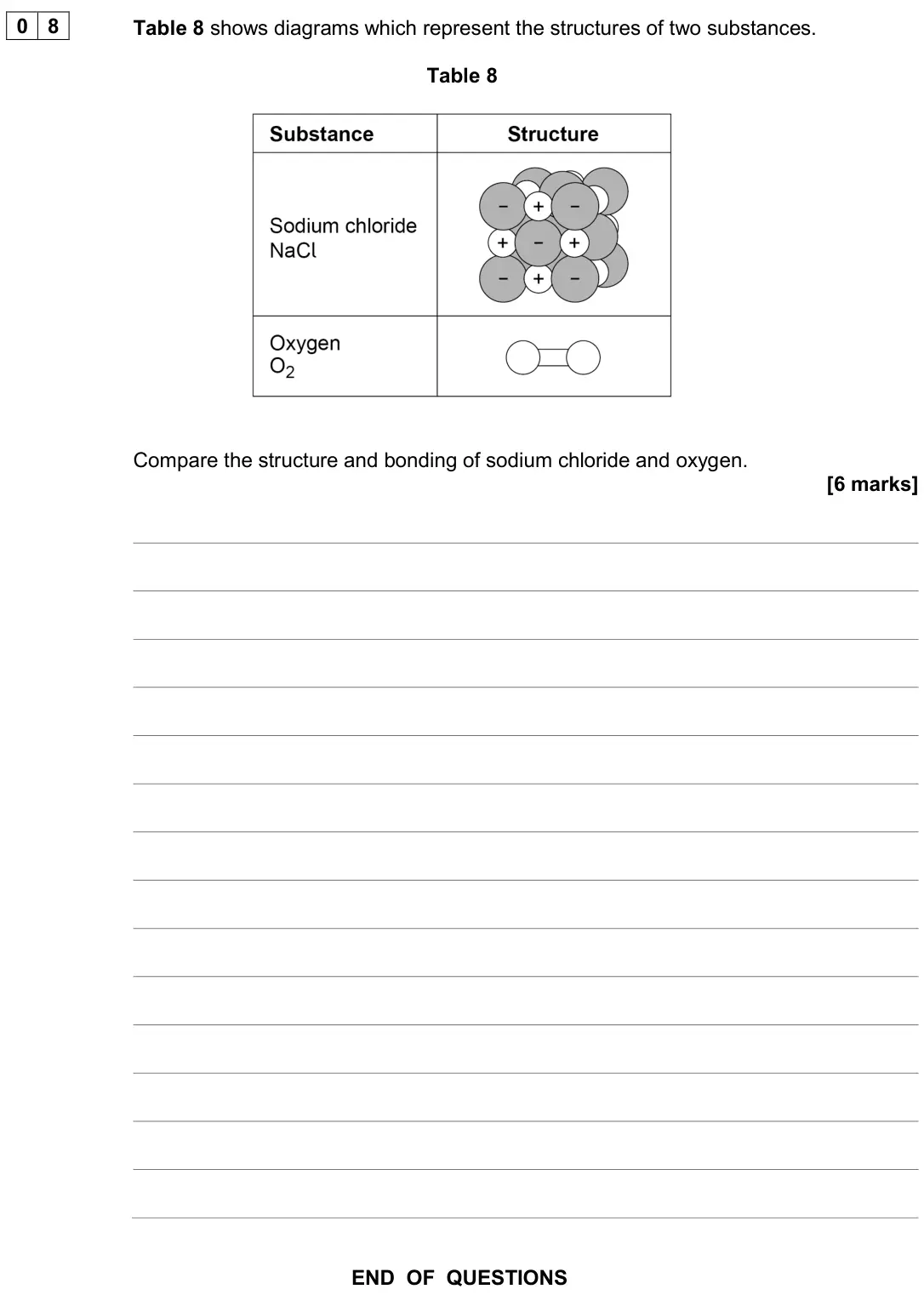
- June 2024, Chemistry Paper 1 Foundation, Q08 (6 marks): Table 8 shows diagrams which represent the structures of two substances. Table 8 Compare the structure and bonding of sodium chloride and oxygen. [6 marks]
- June 2024, Chemistry Paper 2 Higher, Q01.6 (1 mark): Poly(propene) is made from propene. Figure 2 represents the repeating unit of poly(propene). Figure 2 What type of substance is poly(propene)? [1 mark]
- June 2024, Chemistry Paper 2 Foundation, Q06.6 (1 mark): Poly(propene) is made from propene. Figure 5 represents the repeating unit of poly(propene). Figure 5 What type of substance is poly(propene)? [1 mark]
- June 2023, Chemistry Paper 1 Higher, Q04.6 (2 marks): Figure 4 shows the outer shells in one molecule of chlorine (Cl2). Complete the dot and cross diagram to show the electrons in the outer shells. [2 marks] Figur
- June 2023, Chemistry Paper 1 Higher, Q07.2 (3 marks): Explain why the structure of copper allows the conduction of thermal energy. [3 marks]
- June 2023, Chemistry Paper 1 Higher, Q07.3 (3 marks): Explain why copper oxide (CuO) has a high melting point. [3 marks]
- June 2023, Chemistry Paper 1 Higher, Q07.4 (3 marks): Explain why water (H2O) has a low melting point. [3 marks]
- June 2023, Chemistry Paper 1 Foundation, Q01.2 (1 mark): Figure 2 represents a beryllium ion. Figure 2 What is the relative charge on a beryllium ion? [1 mark] Tick () one box. 0 +1 +2
- June 2023, Chemistry Paper 1 Foundation, Q03.1 (1 mark): Which group of elements does not form ions? [1 mark] Tick () one box. Alkali metals Halogens Noble gases
- June 2023, Chemistry Paper 1 Foundation, Q03.2 (4 marks): Potassium reacts with chlorine to produce potassium chloride (KCl). Figure 6 shows what happens to the electrons in the outer shells when a potassium atom react
- June 2023, Chemistry Paper 1 Foundation, Q03.3 (1 mark): In solid ionic compounds, oppositely charged ions attract to form a giant structure. Which structure represents the arrangement of ions in solid potassium chlor
- June 2023, Chemistry Paper 1 Foundation, Q03.4 (2 marks): Water (H2O) is a covalent molecule. Table 2 shows the number of electrons in the outer shells of hydrogen atoms and of oxygen atoms. Table 2 Element Number of e
- June 2023, Chemistry Paper 1 Foundation, Q03.5 (1 mark): Silica has a giant covalent structure. Figure 8 represents the structure of silica. Figure 8 Determine the ratio of silicon (Si) atoms to oxygen (O) atoms in si
- June 2022, Chemistry Paper 1 Higher, Q04.3 (1 mark): Figure 3 shows the structure of a molecule of chlorine oxide. Figure 3 What is the molecular formula of the chlorine oxide molecule in Figure 3? [1 mark]
- June 2022, Chemistry Paper 1 Higher, Q06.1 (2 marks): Complete the dot and cross diagram to represent the bonding in hydrogen chloride on Figure 7. Use dots (o) and crosses (x) to represent electrons. You should sh
- June 2022, Chemistry Paper 1 Foundation, Q02.1 (2 marks): A chlorine atom has 7 electrons in the outer shell. A hydrogen atom has 1 electron in the outer shell. Figure 4 represents part of a dot and cross diagram for a
- June 2022, Chemistry Paper 1 Foundation, Q03.9 (3 marks): Explain why the magnesium alloy is harder than magnesium metal. Use Figure 9. [3 marks]
- November 2020, Chemistry Paper 1 Higher, Q02.1 (1 mark): Figure 2 shows a ball and stick model of a water molecule (H2O). Figure 2 Suggest one limitation of using a ball and stick model for a water molecule. [1 mark]
- November 2020, Chemistry Paper 1 Higher, Q02.3 (1 mark): Figure 3 shows the structure of a molecule. Figure 3 What is the molecular formula of the molecule in Figure 3? [1 mark]
- November 2020, Chemistry Paper 1 Higher, Q07.1 (4 marks): Explain what happens to caesium atoms and to oxygen atoms when caesium reacts with oxygen to produce caesium oxide. You should answer in terms of electrons. [4
- November 2020, Chemistry Paper 1 Foundation, Q04.4 (1 mark): What holds the particles together in sodium chloride? Use Figure 6. [1 mark] Tick () one box. Electrostatic attractions Intermolecular forces Metallic bonds
- November 2020, Chemistry Paper 1 Foundation, Q05.5 (3 marks): Lithium reacts with chlorine to produce lithium chloride. Figure 9 shows what happens to the electrons in the outer shells when a lithium atom reacts with a chl
- November 2020, Chemistry Paper 1 Foundation, Q07.1 (1 mark): Figure 12 shows a ball and stick model of a water molecule (H2O). Figure 12 Suggest one limitation of using a ball and stick model for a water molecule. [1 mark
- November 2020, Chemistry Paper 1 Foundation, Q07.3 (1 mark): Figure 13 shows the structure of a molecule. Figure 13 What is the molecular formula of the molecule in Figure 13? [1 mark]
- November 2020, Chemistry Paper 2 Foundation, Q01.5 (1 mark): What does X represent in Figure 1? [1 mark] Tick () one box. Covalent bond Ionic bond Metallic bond
- June 2019, Chemistry Paper 1 Higher, Q03.3 (2 marks): Oxygen is in Group 6 of the periodic table. Figure 3 shows the outer energy levels in one molecule of oxygen (O2). Draw the electrons in the outer energy levels
- June 2019, Chemistry Paper 1 Higher, Q06.4 (6 marks): Chlorine reacts with sodium and with hydrogen. Compare the structure and bonding in sodium chloride and hydrogen chloride. [6 marks] Copyright © 2019 AQA and it
- June 2019, Chemistry Paper 1 Foundation, Q04.4 (2 marks): Sodium chloride (NaCl) is an ionic compound. Write the formulae of the ions in sodium chloride. [2 marks] Sodium ion Chloride ion
- June 2019, Chemistry Paper 1 Foundation, Q05.4 (2 marks): Table 3 shows the electronic structure of hydrogen and oxygen. Table 3 Element Electronic structure Hydrogen 1 Oxygen 2,6 Figure 5 shows part of a dot and cross
- June 2018, Chemistry Paper 1 Higher, Q02.2 (4 marks): Sodium atoms react with chlorine atoms to produce sodium chloride (NaCl). Describe what happens when a sodium atom reacts with a chlorine atom. Write about elec
- June 2018, Chemistry Paper 1 Higher, Q04.2 (2 marks): Figure 4 represents one molecule of fluorine. Complete the dot and cross diagram on Figure 4 You should show only the electrons in the outer shells. [2 marks] F
- June 2018, Chemistry Paper 1 Higher, Q05.3 (3 marks): Figure 7 shows the structure of sodium. Figure 7 Describe how sodium conducts thermal energy. [3 marks]
- June 2018, Chemistry Paper 1 Foundation, Q01.1 (1 mark): Figure 1 shows part of the structure of calcium oxide (CaO). Figure 1 What type of bonding is present in calcium oxide? [1 mark] Tick one box. Covalent Ionic Ma
- June 2018, Chemistry Paper 1 Foundation, Q01.2 (1 mark): Figure 2 shows a particle of methane (CH4). Figure 2 What type of particle is present in Figure 2? [1 mark] Tick one box. An ion A lattice A molecule A polymer
- June 2018, Chemistry Paper 1 Foundation, Q02.2 (2 marks): A fluorine atom has 7 electrons in the outer shell. Figure 8 shows part of a dot and cross diagram to represent a molecule of fluorine (F2). Complete the dot an
- June 2018, Chemistry Paper 1 Foundation, Q06.2 (4 marks): Sodium atoms react with chlorine atoms to produce sodium chloride (NaCl). Describe what happens when a sodium atom reacts with a chlorine atom. Write about elec
Questions, mark schemes and examiner’s reports are © AQA, from their published past papers. Plumi isn’t affiliated with any exam board. Want whole papers? Full past papers.
Rather write your answers by hand on iPad? Plumi marks them against the same mark schemes.