 plumi
The periodic table: AQA GCSE Combined Science questions
Every AQA GCSE Combined Science exam question on 5.1.2 The periodic table, 2018–2025, with its mark scheme and examiner’s report.
Find questions3,069
Calculations
Q03.4
The whole paper ↗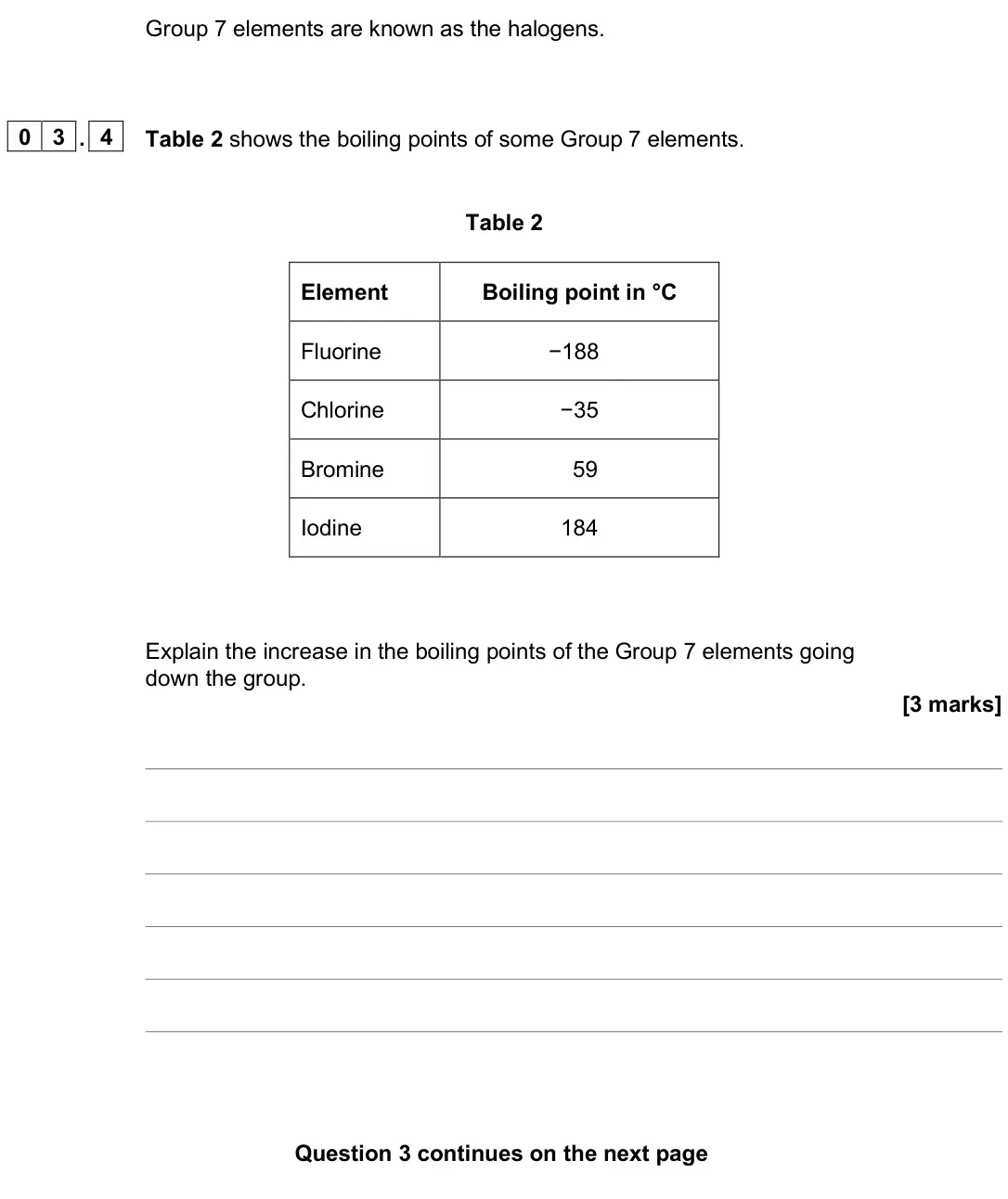
Q03.5
The whole paper ↗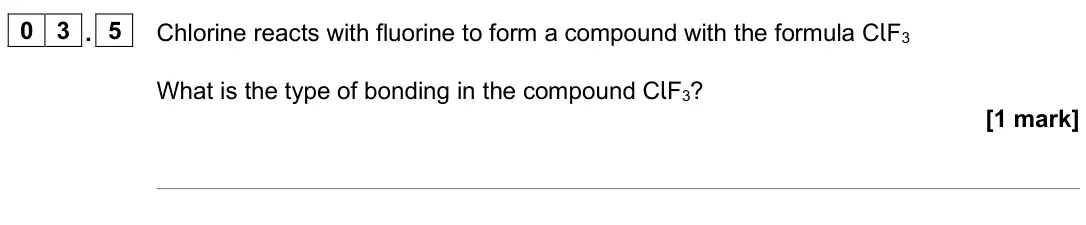
Q03.6
The whole paper ↗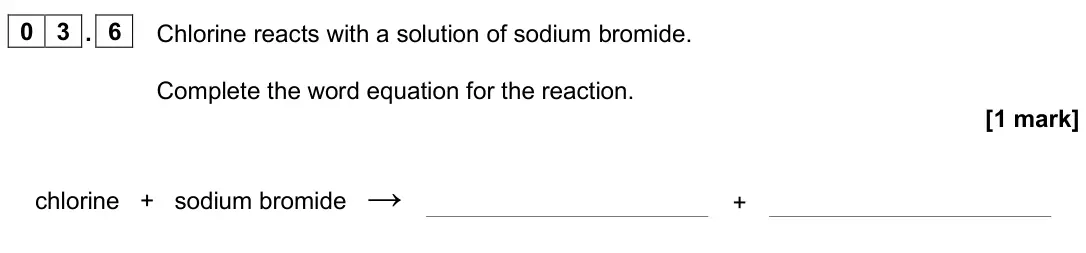
Q03.7
The whole paper ↗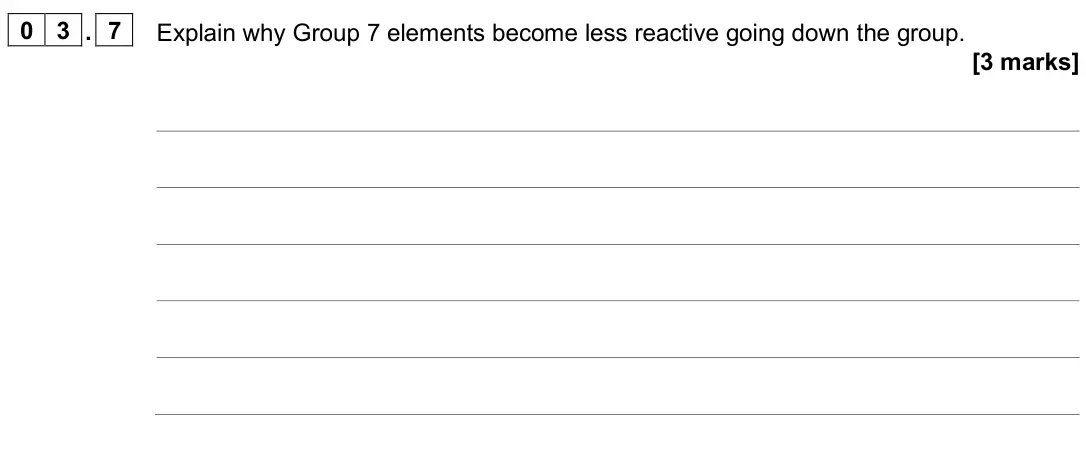
Q02.9
The whole paper ↗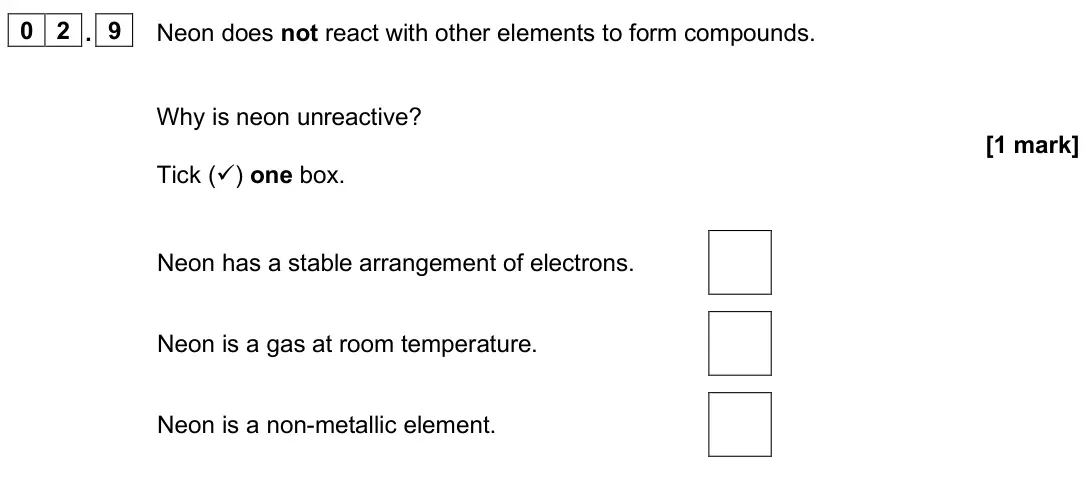
Q07.1
The whole paper ↗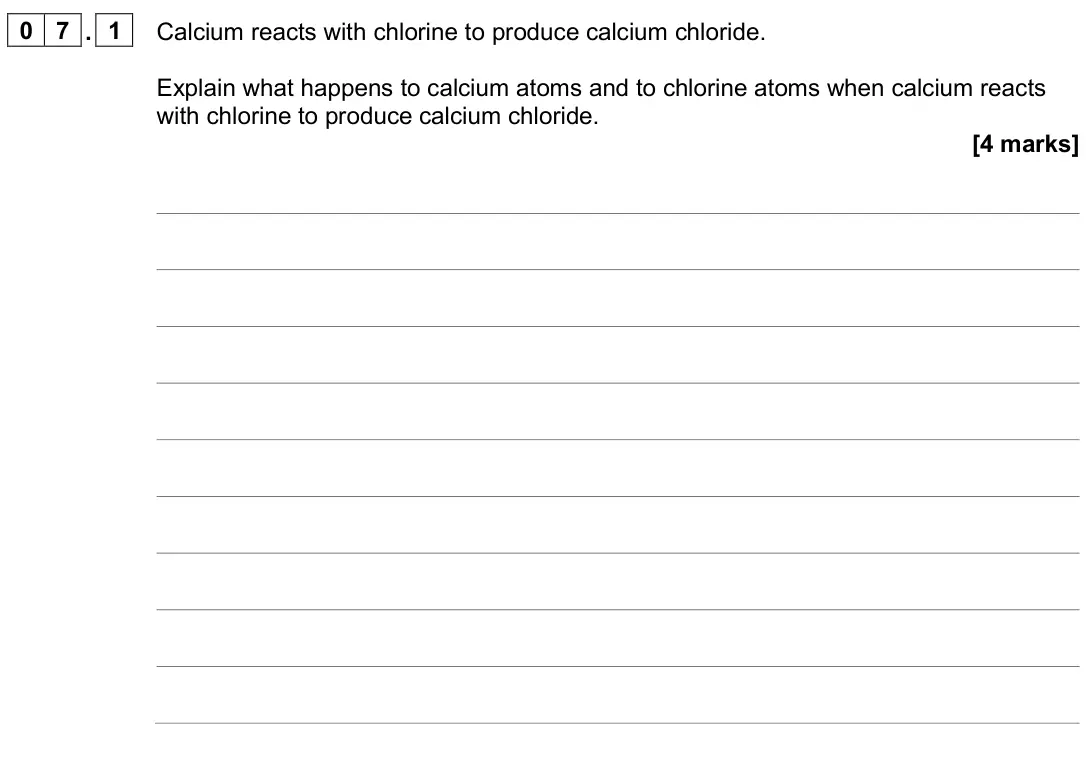
Q07.2
The whole paper ↗
Q07.3
The whole paper ↗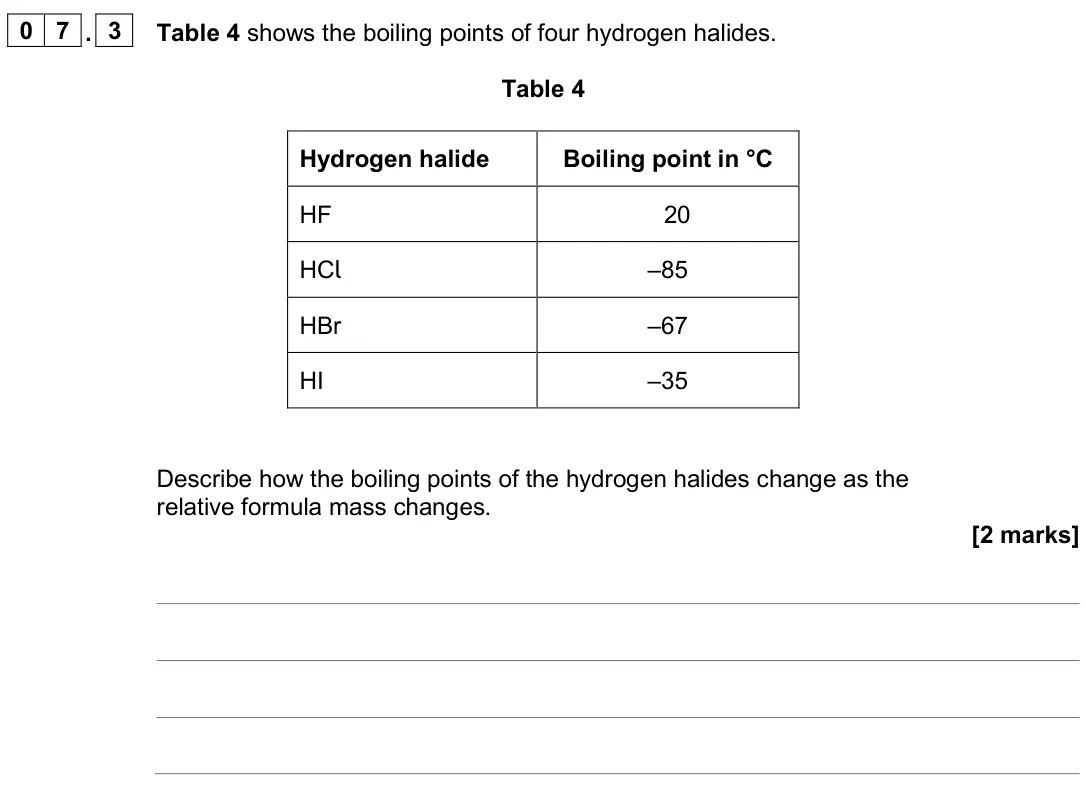
Q01.1
The whole paper ↗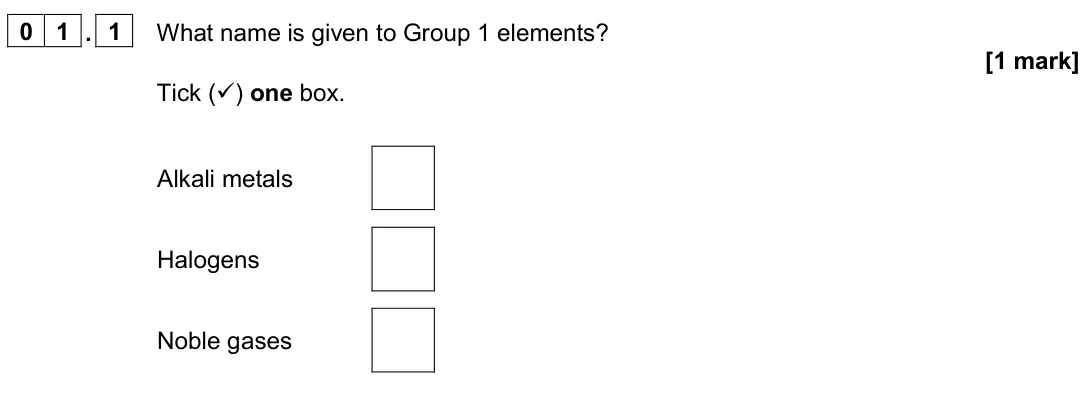
Q01.5
The whole paper ↗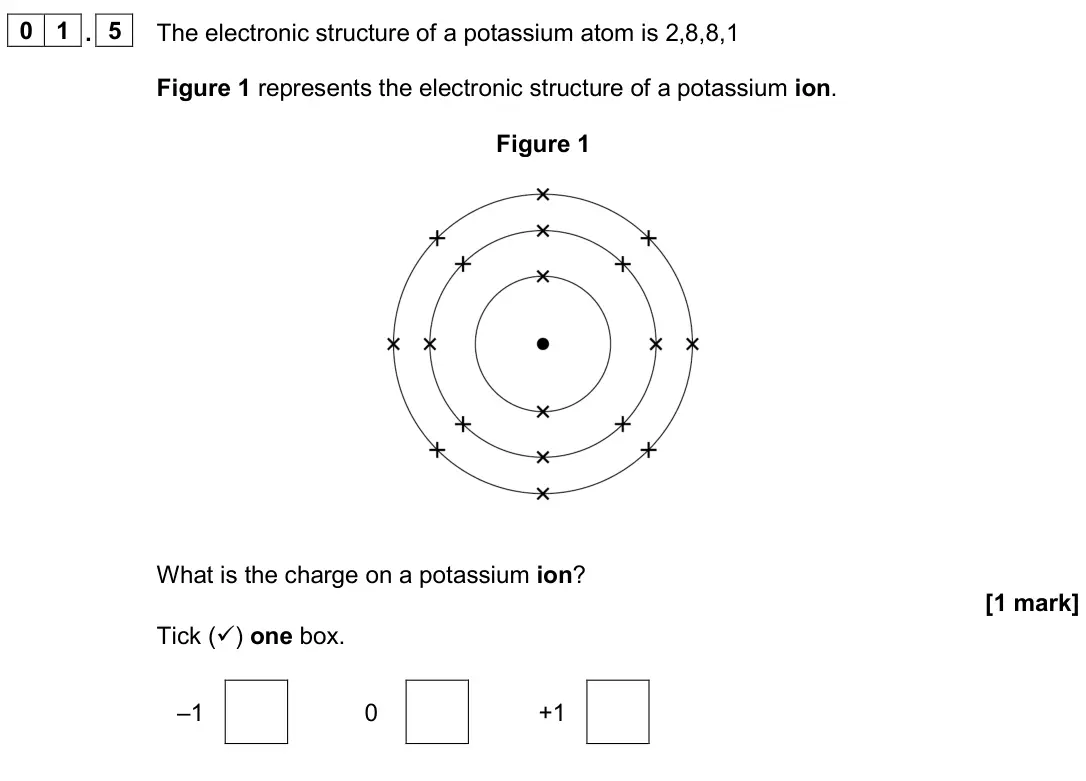
Q01.6
The whole paper ↗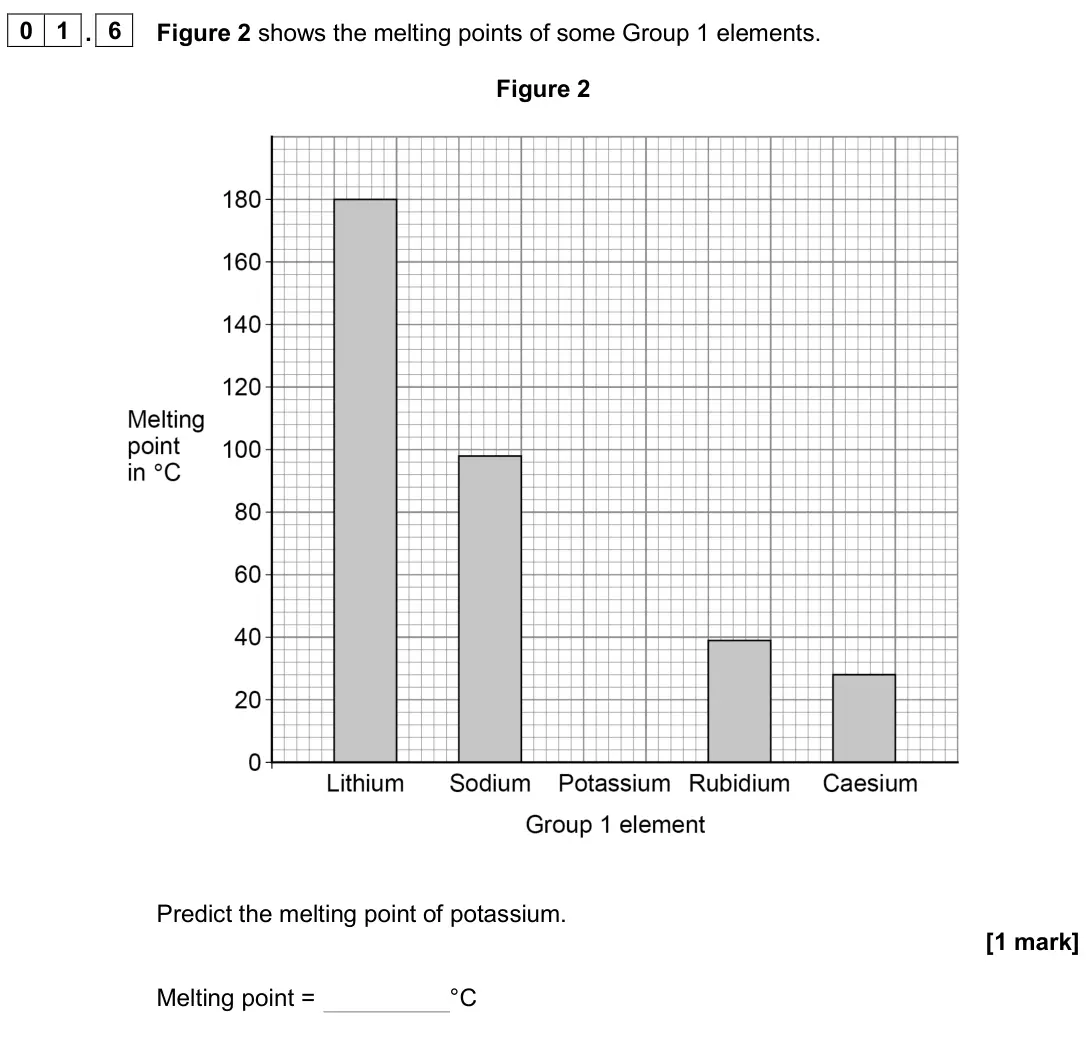
Q03.2
The whole paper ↗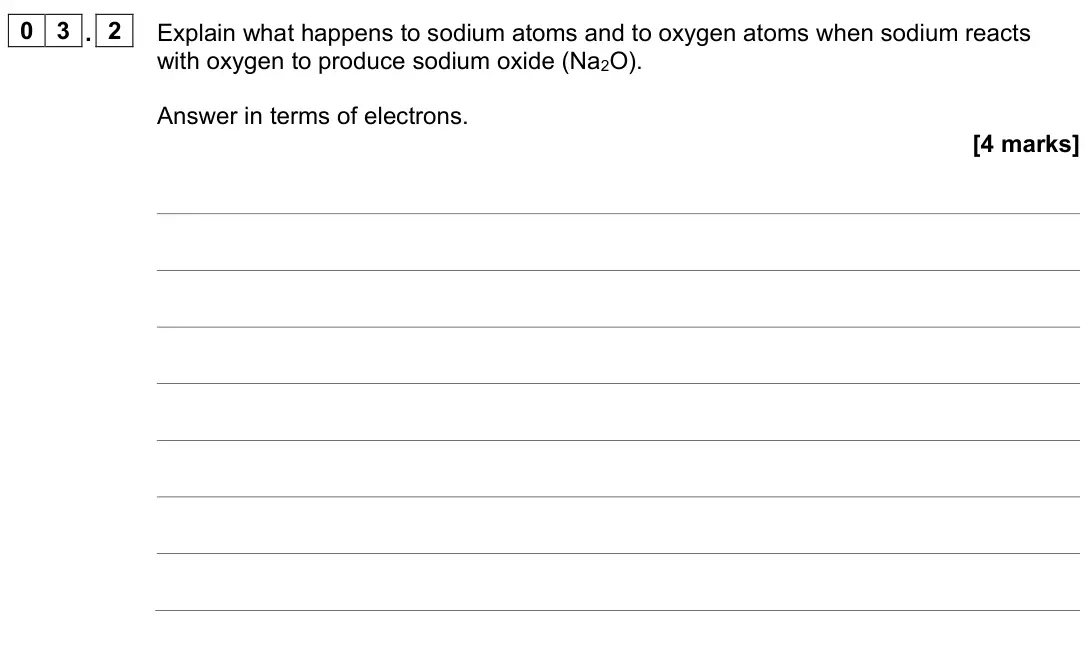
Q03.3
The whole paper ↗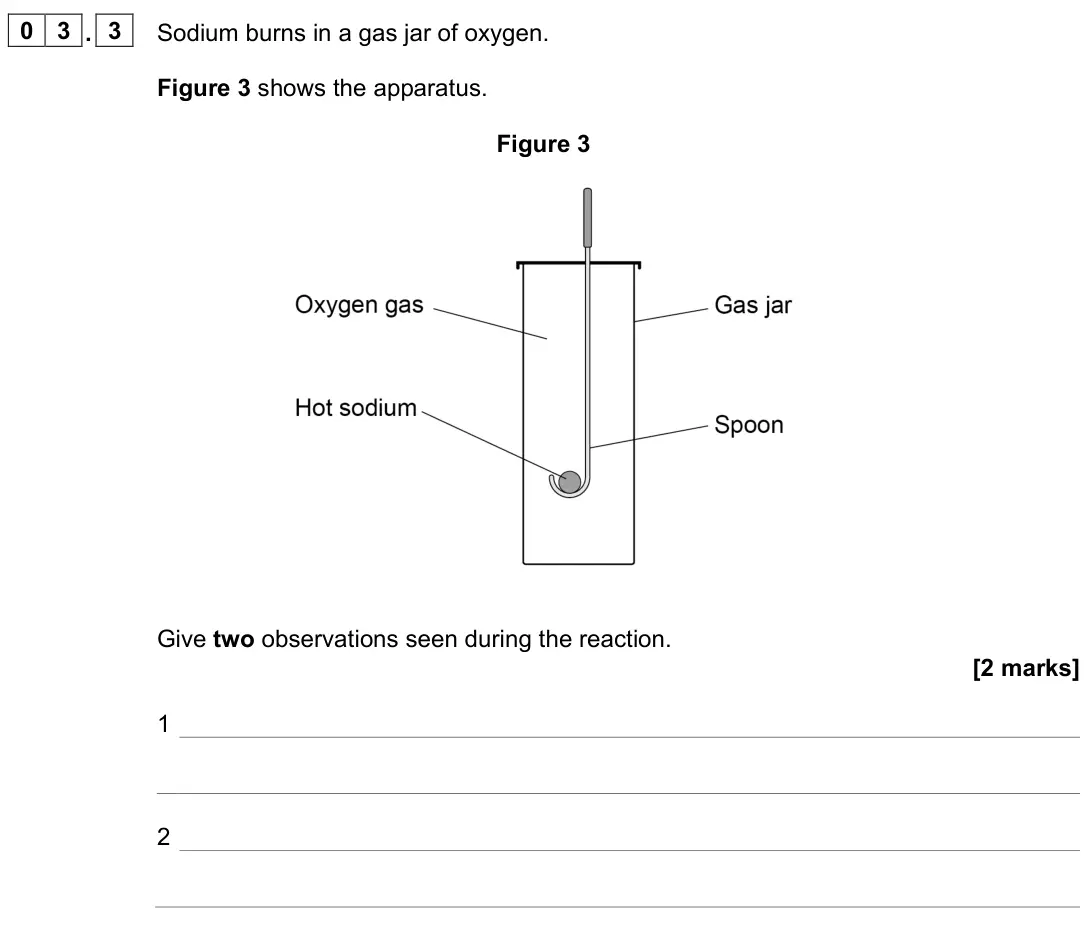
Q03.4
The whole paper ↗
Q04.6
The whole paper ↗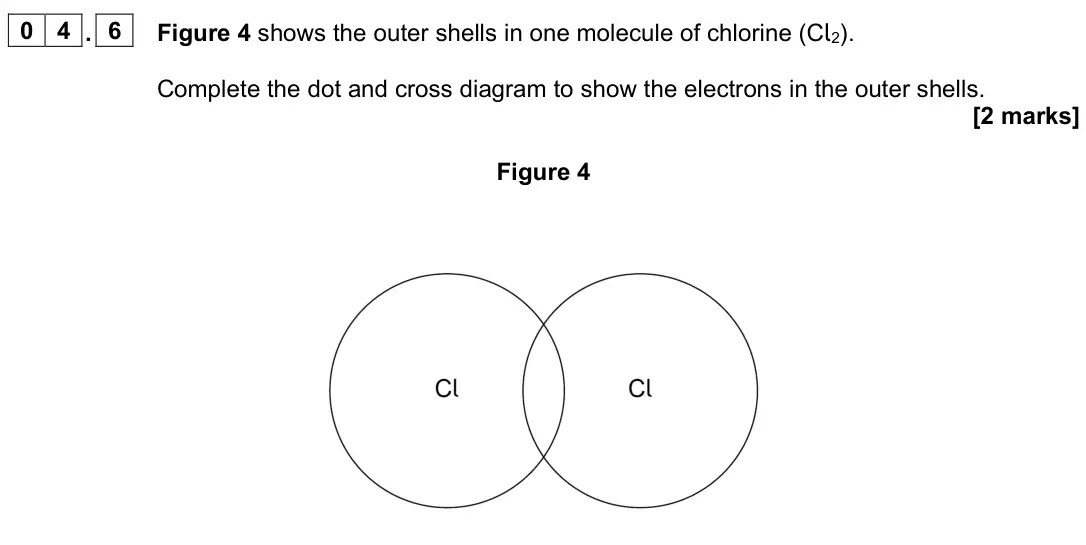
Q05.3
The whole paper ↗
Q05.4
The whole paper ↗
Q04.1
The whole paper ↗
Q04.2
The whole paper ↗
Q04.4
The whole paper ↗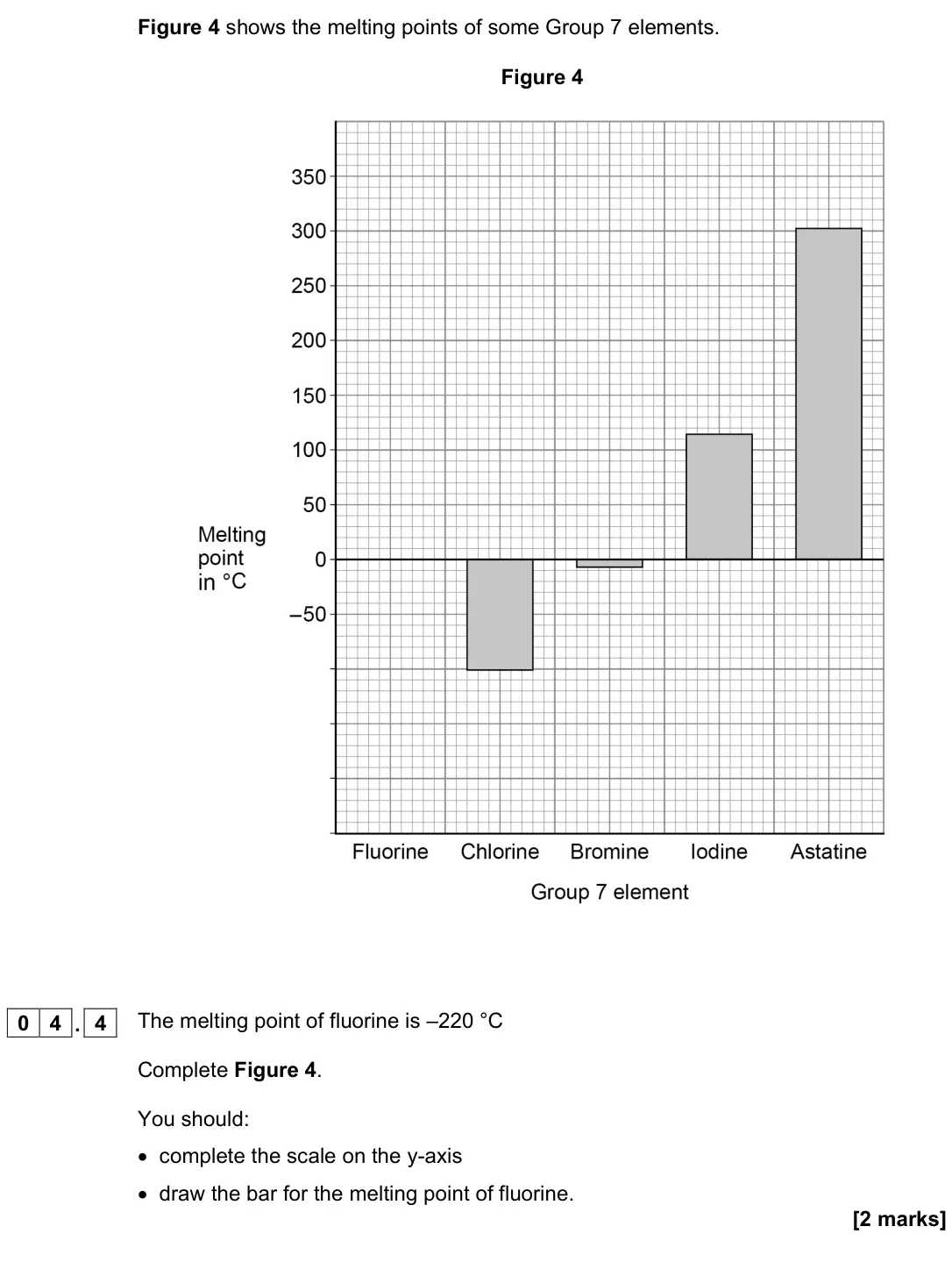
All 89 questions on The periodic table, as a list
- June 2025, Chemistry Paper 1 Higher, Q03.4 (3 marks): Table 2 shows the boiling points of some Group 7 elements. Table 2 Element Boiling point in °C Fluorine −188 Chlorine −35 Bromine 59 Iodine 184 Explain the incr
- June 2025, Chemistry Paper 1 Higher, Q03.5 (1 mark): Chlorine reacts with fluorine to form a compound with the formula ClF3 What is the type of bonding in the compound ClF3? [1 mark]
- June 2025, Chemistry Paper 1 Higher, Q03.6 (1 mark): Chlorine reacts with a solution of sodium bromide. Complete the word equation for the reaction. [1 mark] chlorine + sodium bromide → +
- June 2025, Chemistry Paper 1 Higher, Q03.7 (3 marks): Explain why Group 7 elements become less reactive going down the group. [3 marks]
- June 2025, Chemistry Paper 1 Foundation, Q02.9 (1 mark): Neon does not react with other elements to form compounds. Why is neon unreactive? [1 mark] Tick () one box. Neon has a stable arrangement of electrons. Neon i
- June 2024, Chemistry Paper 1 Higher, Q07.1 (4 marks): Calcium reacts with chlorine to produce calcium chloride. Explain what happens to calcium atoms and to chlorine atoms when calcium reacts with chlorine to produ
- June 2024, Chemistry Paper 1 Higher, Q07.2 (4 marks): Explain why chlorine is more reactive than bromine. [4 marks]
- June 2024, Chemistry Paper 1 Higher, Q07.3 (2 marks): Table 4 shows the boiling points of four hydrogen halides. Table 4 Hydrogen halide Boiling point in °C HF 20 HCl –85 HBr –67 HI –35 Describe how the boiling poi
- June 2024, Chemistry Paper 1 Foundation, Q01.1 (1 mark): What name is given to Group 1 elements? [1 mark] Tick () one box. Alkali metals Halogens Noble gases
- June 2024, Chemistry Paper 1 Foundation, Q01.5 (1 mark): The electronic structure of a potassium atom is 2,8,8,1 Figure 1 represents the electronic structure of a potassium ion. Figure 1 What is the charge on a potass
- June 2024, Chemistry Paper 1 Foundation, Q01.6 (1 mark): Figure 2 shows the melting points of some Group 1 elements. Figure 2 Predict the melting point of potassium. [1 mark] Melting point = °C
- June 2023, Chemistry Paper 1 Higher, Q03.2 (4 marks): Explain what happens to sodium atoms and to oxygen atoms when sodium reacts with oxygen to produce sodium oxide (Na2O). Answer in terms of electrons. [4 marks]
- June 2023, Chemistry Paper 1 Higher, Q03.3 (2 marks): Sodium burns in a gas jar of oxygen. Figure 3 shows the apparatus. Figure 3 Give two observations seen during the reaction. [2 marks] 1 2
- June 2023, Chemistry Paper 1 Higher, Q03.4 (2 marks): Describe two differences in the observations if potassium is used instead of sodium. [2 marks] 1 2
- June 2023, Chemistry Paper 1 Higher, Q04.6 (2 marks): Figure 4 shows the outer shells in one molecule of chlorine (Cl2). Complete the dot and cross diagram to show the electrons in the outer shells. [2 marks] Figur
- June 2023, Chemistry Paper 1 Foundation, Q05.3 (1 mark): Suggest why the reaction is carried out in an inert atmosphere. [1 mark]
- June 2023, Chemistry Paper 1 Foundation, Q05.4 (1 mark): Complete the sentence. Choose the answer from the box. [1 mark] argon chlorine hydrogen The gas used for the inert atmosphere is .
- June 2022, Chemistry Paper 1 Higher, Q04.1 (1 mark): What are the Group 7 elements known as? [1 mark]
- June 2022, Chemistry Paper 1 Higher, Q04.2 (1 mark): Why do Group 7 elements react in similar ways? [1 mark]
- June 2022, Chemistry Paper 1 Higher, Q04.4 (2 marks): The melting point of fluorine is –220 °C Complete Figure 4. You should: • complete the scale on the y-axis • draw the bar for the melting point of fluorine. [2
- June 2022, Chemistry Paper 1 Higher, Q04.5 (3 marks): Explain the trend in the melting points of the Group 7 elements. Use Figure 4. [3 marks]
- June 2022, Chemistry Paper 1 Higher, Q04.6 (1 mark): What is the state symbol for bromine at –50 °C? Use Figure 4. [1 mark] Tick () one box. (aq) (g) (l) (s)
- June 2022, Chemistry Paper 1 Higher, Q06.1 (2 marks): Complete the dot and cross diagram to represent the bonding in hydrogen chloride on Figure 7. Use dots (o) and crosses (x) to represent electrons. You should sh
- June 2022, Chemistry Paper 1 Foundation, Q01.1 (1 mark): What are the Group 1 elements known as? [1 mark] Tick () one box. Alkali metals Halogens Noble gases
- June 2022, Chemistry Paper 1 Foundation, Q01.5 (1 mark): What is the melting point of caesium? Use Figure 2. [1 mark] Melting point = °C
- June 2022, Chemistry Paper 1 Foundation, Q01.6 (1 mark): The melting point of potassium is 63 °C Draw a bar for the melting point of potassium on Figure 2. [1 mark]
- June 2022, Chemistry Paper 1 Foundation, Q01.7 (3 marks): Describe the trend of the melting points of the Group 1 elements in Figure 2. [3 marks]
- June 2022, Chemistry Paper 1 Foundation, Q01.8 (1 mark): The boiling point of sodium is 883 °C What is the state of sodium at 150 °C? Use Figure 2. [1 mark] Tick () one box. Gas Liquid Solid
- June 2022, Chemistry Paper 1 Foundation, Q01.9 (1 mark): Figure 3 represents the electronic structure of a sodium atom and of a potassium atom. Figure 3 Complete the sentence. Choose the answer from the box. [1 mark]
- June 2022, Chemistry Paper 1 Foundation, Q02.1 (2 marks): A chlorine atom has 7 electrons in the outer shell. A hydrogen atom has 1 electron in the outer shell. Figure 4 represents part of a dot and cross diagram for a
- June 2022, Chemistry Paper 1 Foundation, Q04.3 (2 marks): Calculate the relative formula mass (Mr) of magnesium fluoride (MgF2). Relative atomic masses (Ar): F = 19 Mg = 24 [2 marks] Relative formula mass (Mr) =
- June 2022, Chemistry Paper 1 Foundation, Q04.4 (2 marks): Argon is a noble gas. Explain why no product is formed when magnesium and argon are heated together. [2 marks]
- November 2021, Chemistry Paper 1 Higher, Q01.1 (1 mark): Figure 1 shows part of Mendeleev’s version of the periodic table. Figure 1 Which group of elements had not been discovered when Mendeleev’s version of the perio
- November 2021, Chemistry Paper 1 Foundation, Q01.1 (1 mark): Which types of element react when magnesium reacted with chlorine? [1 mark] Tick () one box. A metal and a metal A metal and a non-metal A non-metal and a non-
- November 2021, Chemistry Paper 1 Foundation, Q01.2 (1 mark): Write the word equation for the reaction when magnesium reacts with chlorine. [1 mark] + →
- November 2021, Chemistry Paper 1 Foundation, Q04.1 (1 mark): What is the name of Group 1 elements? [1 mark] Tick () one box. Alkali metals Halogens Noble gases
- November 2021, Chemistry Paper 1 Foundation, Q04.2 (1 mark): Figure 5 represents the melting points of Group 1 elements. Figure 5 What is the melting point of sodium? [1 mark] Melting point of sodium = °C
- November 2021, Chemistry Paper 1 Foundation, Q04.4 (2 marks): Calculate the relative formula mass (Mr) of sodium hydroxide (NaOH). Relative atomic masses (Ar): H = 1 O = 16 Na = 23 [2 marks] Relative formula mass (Mr) =
- November 2021, Chemistry Paper 1 Foundation, Q04.5 (4 marks): Sodium and potassium both react with water. Figure 6 shows sodium reacting with water. Figure 6 Compare what is seen when sodium reacts with water and when pota
- November 2021, Chemistry Paper 1 Foundation, Q06.1 (1 mark): Figure 11 shows part of Mendeleev’s version of the periodic table. Figure 11 Which group of elements had not been discovered when Mendeleev’s version of the per
- November 2020, Chemistry Paper 1 Higher, Q07.1 (4 marks): Explain what happens to caesium atoms and to oxygen atoms when caesium reacts with oxygen to produce caesium oxide. You should answer in terms of electrons. [4
- November 2020, Chemistry Paper 1 Higher, Q07.2 (4 marks): Explain why caesium is more reactive than sodium. You should answer in terms of electrons. [4 marks]
- November 2020, Chemistry Paper 1 Higher, Q07.3 (3 marks): Figure 6 shows part of Mendeleev’s periodic table. Figure 6 Explain why the early periodic tables placed iodine (I) before tellurium (Te), but then Mendeleev pl
- November 2020, Chemistry Paper 1 Foundation, Q02.6 (1 mark): Suggest one reason why the student should not add potassium metal to copper sulfate solution. [1 mark]
- November 2020, Chemistry Paper 1 Foundation, Q03.4 (1 mark): What are Group 7 elements known as? [1 mark] Tick () one box. Alkali metals Halogens Noble gases
- November 2020, Chemistry Paper 1 Foundation, Q03.5 (1 mark): Fluorine, chlorine and bromine react with gold. Which element will be the most reactive with gold? [1 mark] Tick () one box. Fluorine Chlorine Bromine
- November 2020, Chemistry Paper 1 Foundation, Q04.1 (2 marks): Figure 5 shows the proportion of elements in the periodic table that are metals and non-metals. Figure 5 Determine the percentage of the elements in Figure 5 th
- November 2020, Chemistry Paper 1 Foundation, Q04.2 (2 marks): Give two physical properties of metals. [2 marks] 1 2
- November 2020, Chemistry Paper 1 Foundation, Q04.3 (1 mark): Sodium reacts with chlorine to produce sodium chloride. Balance the equation for the reaction. [1 mark] Na + Cl2 → NaCl
- November 2020, Chemistry Paper 1 Foundation, Q05.1 (1 mark): What property was used to arrange elements in early periodic tables? [1 mark] Tick () one box. Atomic number Atomic weight Mass number
- November 2020, Chemistry Paper 1 Foundation, Q05.2 (1 mark): In early periodic tables, iodine (I) was placed before tellurium (Te). Mendeleev placed iodine after tellurium. Figure 7 shows part of Mendeleev’s periodic tabl
- November 2020, Chemistry Paper 1 Foundation, Q05.3 (1 mark): What state is lithium at 100 °C? Use Table 3. [1 mark] Tick () one box. Gas Liquid Solid
- November 2020, Chemistry Paper 1 Foundation, Q05.4 (3 marks): Complete the graph in Figure 8. Use Table 3. You should: • complete the scale on the y-axis • draw bars to show the melting points of sodium and potassium. [3 m
- November 2020, Chemistry Paper 1 Foundation, Q05.5 (3 marks): Lithium reacts with chlorine to produce lithium chloride. Figure 9 shows what happens to the electrons in the outer shells when a lithium atom reacts with a chl
- November 2020, Chemistry Paper 1 Foundation, Q05.6 (2 marks): Lithium and potassium are in the same group of the periodic table. Figure 10 represents the electronic structures of a lithium atom and of a potassium atom. Fig
- June 2019, Chemistry Paper 1 Higher, Q01.4 (2 marks): Predict the reactivity of beryllium compared with magnesium. Give a reason for your answer. Use the periodic table. [2 marks] Reason
- June 2019, Chemistry Paper 1 Higher, Q04.1 (1 mark): What order did scientists use to arrange elements in early periodic tables? [1 mark]
- June 2019, Chemistry Paper 1 Higher, Q04.2 (1 mark): In the early periodic tables some elements were placed in the wrong groups. Mendeleev overcame this in his periodic table. Give one way Mendeleev did this. [1 m
- June 2019, Chemistry Paper 1 Higher, Q04.3 (2 marks): Explain why the boiling points in Table 2 are low. [2 marks]
- June 2019, Chemistry Paper 1 Higher, Q04.4 (3 marks): Explain the trend in the boiling points in Table 2. [3 marks]
- June 2019, Chemistry Paper 1 Higher, Q04.5 (2 marks): Explain why neon is unreactive. Give the electronic structure of neon in your answer. [2 marks]
- June 2019, Chemistry Paper 1 Higher, Q06.1 (1 mark): Sodium reacts with chlorine. What is the balanced equation for the reaction? [1 mark] Tick () one box. Na + Cl → NaCl Na + Cl2 → NaCl2 2 Na + Cl2 → 2 NaCl 2 Na
- June 2019, Chemistry Paper 1 Higher, Q06.2 (3 marks): Hot sodium is put in a gas jar of chlorine. Describe the observations made before, during and after the reaction. [3 marks] Before reaction During reaction Afte
- June 2019, Chemistry Paper 1 Higher, Q06.3 (4 marks): Explain why sodium is less reactive than potassium. [4 marks]
- June 2019, Chemistry Paper 1 Foundation, Q03.1 (1 mark): What order did scientists use to arrange elements in early periodic tables? [1 mark] Tick () one box. Atomic weight of element Number of neutrons in an atom of
- June 2019, Chemistry Paper 1 Foundation, Q03.2 (1 mark): In early periodic tables some elements were placed in the wrong groups. Mendeleev overcame some of these problems in his periodic table. Complete the sentence.
- June 2019, Chemistry Paper 1 Foundation, Q03.3 (1 mark): What is the name of the group that contains argon? [1 mark] Tick () one box. Alkali metals Halogens Noble gases 40
- June 2019, Chemistry Paper 1 Foundation, Q03.7 (1 mark): Why is argon unreactive? [1 mark]
- June 2019, Chemistry Paper 1 Foundation, Q04.1 (1 mark): Sodium reacts with chlorine to produce sodium chloride. Balance the equation for the reaction. [1 mark] Na + Cl2 → NaCl
- June 2019, Chemistry Paper 1 Foundation, Q04.3 (4 marks): A teacher puts hot sodium into a gas jar of chlorine. The changes seen before, during and after this reaction were observed. Complete the sentences. Choose the
- June 2019, Chemistry Paper 1 Foundation, Q04.5 (1 mark): Complete the sentence. Choose the answer from the box. [1 mark] an atom an electron a neutron a proton
- June 2019, Chemistry Paper 1 Foundation, Q04.6 (2 marks): How does the size of a potassium atom compare with the size of a sodium atom? Give a reason for your answer. [2 marks] Reason
- June 2019, Chemistry Paper 1 Foundation, Q06.4 (2 marks): Predict the reactivity of beryllium compared with magnesium. Give a reason for your answer. Use the periodic table. [2 marks] Reason
- June 2018, Chemistry Paper 1 Higher, Q02.1 (2 marks): State one difference and one similarity in the electronic structure of sodium and of chlorine. [2 marks] Difference Similarity
- June 2018, Chemistry Paper 1 Higher, Q04.1 (1 mark): Write the state symbol for chlorine at room temperature. [1 mark] Cl2 ( )
- June 2018, Chemistry Paper 1 Higher, Q04.2 (2 marks): Figure 4 represents one molecule of fluorine. Complete the dot and cross diagram on Figure 4 You should show only the electrons in the outer shells. [2 marks] F
- June 2018, Chemistry Paper 1 Higher, Q04.4 (2 marks): Aluminium reacts with bromine to produce aluminium bromide. Complete the balanced chemical equation for this reaction. [2 marks] Al + Br2 2
- June 2018, Chemistry Paper 1 Higher, Q04.5 (3 marks): When chlorine reacts with potassium bromide, chlorine displaces bromine. Cl2 + 2 KBr Br2 + 2 KCl Explain why chlorine is more reactive than bromine. [3 marks]
- June 2018, Chemistry Paper 1 Foundation, Q02.1 (1 mark): Which group in the periodic table is known as the halogens? [1 mark] Tick one box. Group 1 Group 2 Group 7 Group 0
- June 2018, Chemistry Paper 1 Foundation, Q02.2 (2 marks): A fluorine atom has 7 electrons in the outer shell. Figure 8 shows part of a dot and cross diagram to represent a molecule of fluorine (F2). Complete the dot an
- June 2018, Chemistry Paper 1 Foundation, Q02.3 (2 marks): Chlorine reacts with potassium bromide solution. Complete the word equation. [2 marks] potassium chlorine + bromide +
- June 2018, Chemistry Paper 1 Foundation, Q02.4 (1 mark): What type of reaction happens when chlorine reacts with potassium bromide solution? [1 mark] Tick one box. decomposition displacement neutralisation precipitati
- June 2018, Chemistry Paper 1 Foundation, Q02.5 (1 mark): Complete the sentence. Choose the answer from the box. [1 mark] an atom an electron a neutron a proton
- June 2018, Chemistry Paper 1 Foundation, Q02.6 (1 mark): How does the size of a chlorine atom compare with the size of a bromine atom? Complete the sentence. Choose the answer from the box. [1 mark] bigger than the sa
- June 2018, Chemistry Paper 1 Foundation, Q02.7 (1 mark): Give a reason for your answer to question 02.6 [1 mark] Reason
- June 2018, Chemistry Paper 1 Foundation, Q02.9 (3 marks): Explain why fluorine is a gas at room temperature. Use the following words in your answer: energy forces molecules weak [3 marks]
- June 2018, Chemistry Paper 1 Foundation, Q03.5 (4 marks): Table 2 shows the solubility of three solids in water at room temperature. Table 2 Solid The mass of the solid that dissolves in 100 cm3 of water Phosphorus oxi
- June 2018, Chemistry Paper 1 Foundation, Q04.1 (1 mark): Figure 9 shows the positions of four elements, A, B, C, and D, in the periodic table. Figure 9 Which element is in Group 2? [1 mark] Tick one box. A B C D
- June 2018, Chemistry Paper 1 Foundation, Q06.1 (2 marks): State one difference and one similarity in the electronic structure of sodium and of chlorine. [2 marks] Difference Similarity
Questions, mark schemes and examiner’s reports are © AQA, from their published past papers. Plumi isn’t affiliated with any exam board. Want whole papers? Full past papers.
Rather write your answers by hand on iPad? Plumi marks them against the same mark schemes.