 plumi
Specific charge of the electron: AQA A‑Level Physics questions
AQA A-Level Physics past-paper questions on 3.12.1.3 Specific charge of the electron, 2008–2025, with mark schemes and examiner’s reports where available.
Paper
All papers
Exam
All years
Calculations
Q01.2
The whole paper ↗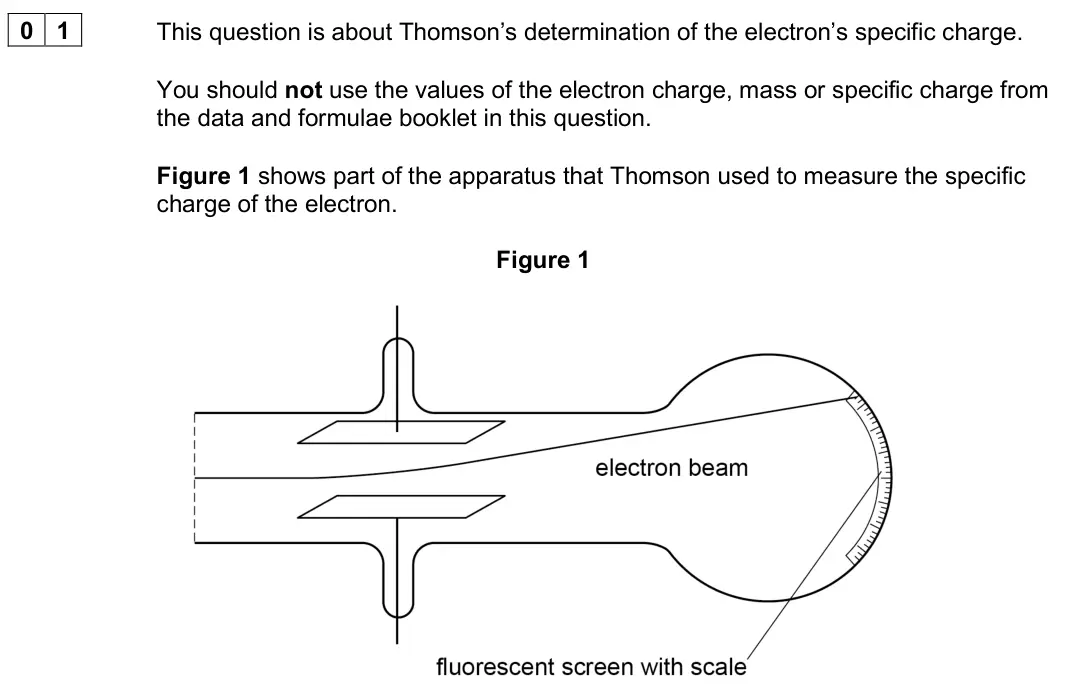
Q01.3
The whole paper ↗Q01.4
The whole paper ↗Q01.5
The whole paper ↗Q01.6
The whole paper ↗Q01.7
The whole paper ↗Q01.1
The whole paper ↗Q01.2
The whole paper ↗Q01.4
The whole paper ↗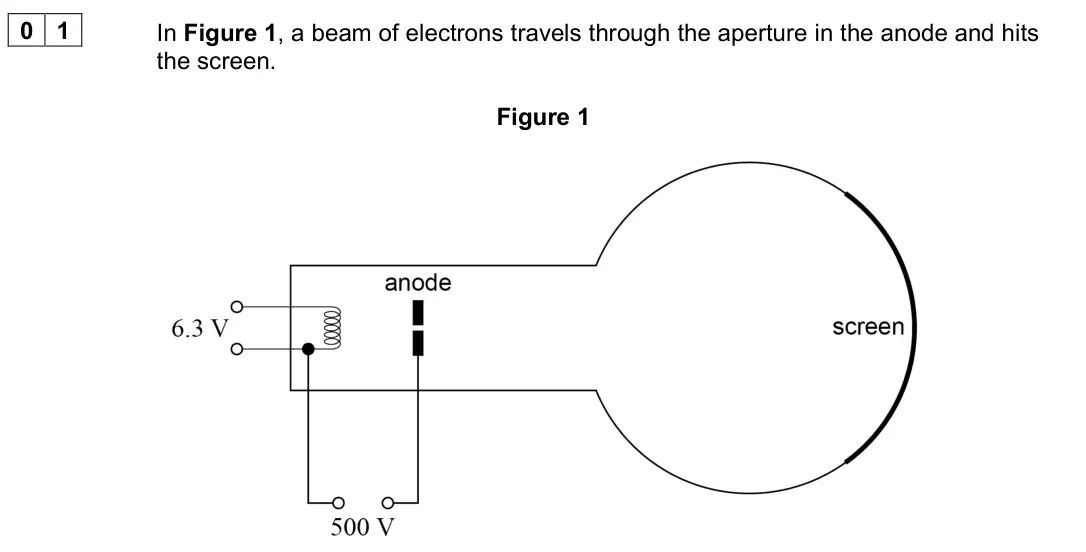
Q01.2
The whole paper ↗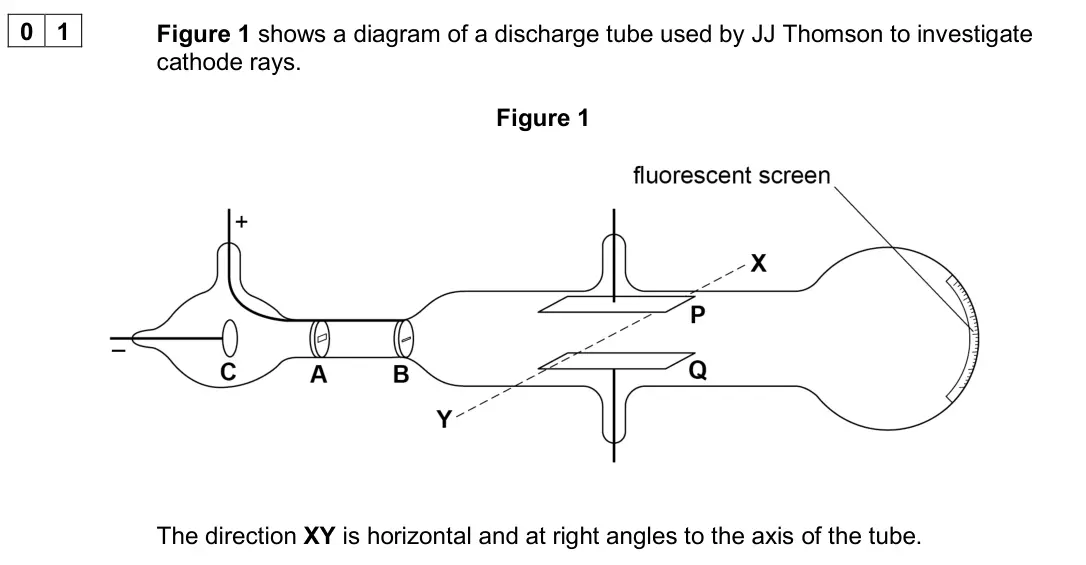
Q01.3
The whole paper ↗Q01.4
The whole paper ↗Q01.2
The whole paper ↗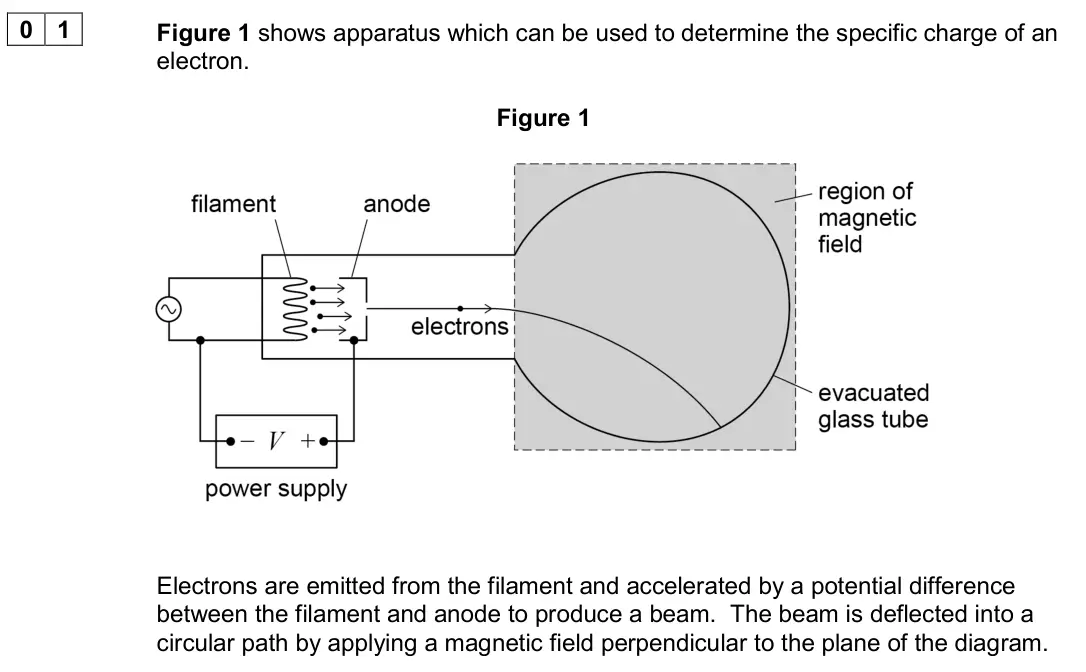
Q01.3
The whole paper ↗Q01.4
The whole paper ↗Q1(a)
The whole paper ↗Q1(b)(ii)
The whole paper ↗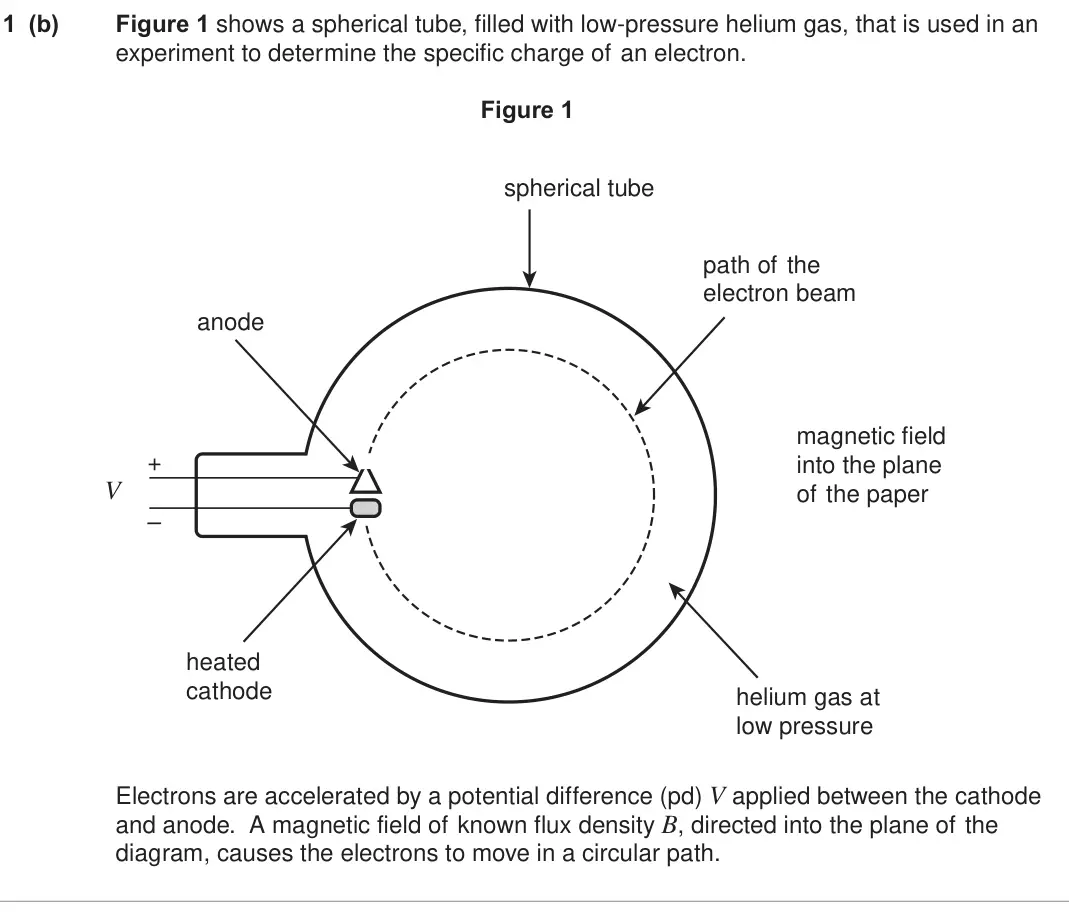
Q1(a)(i)
The whole paper ↗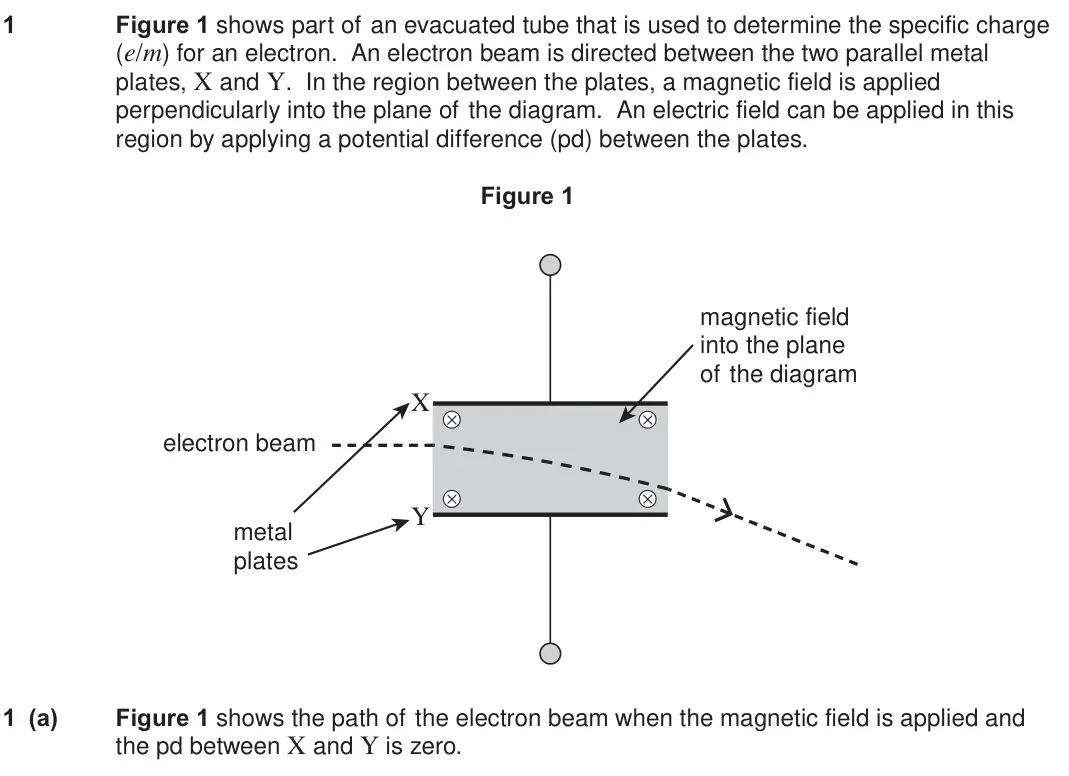
Q1(a)(ii)
The whole paper ↗Q1(a)(iii)
The whole paper ↗
All 29 questions on Specific charge of the electron, as a list
- June 2025, Paper 3 Turning points, Q01.2 (2 marks): A uniform magnetic field of flux density 0.640 mT is now applied between the plates. This returns the electron beam to its undeflected position. Show that the h
- June 2025, Paper 3 Turning points, Q01.3 (1 mark): Show that the vertical component of the velocity of the electrons at T is approximately 1.1 × 10⁷ m s−1. [1 mark]
- June 2025, Paper 3 Turning points, Q01.4 (2 marks): Show that the vertical acceleration of the electrons between the plates is approximately 2.5 × 10¹⁵ m s−2. [2 marks]
- June 2025, Paper 3 Turning points, Q01.5 (3 marks): Determine a value for the specific charge of the electron. [3 marks] specific charge = C kg−1
- June 2025, Paper 3 Turning points, Q01.6 (2 marks): Explain the significance of the result of Thomson’s determination. [2 marks]
- June 2025, Paper 3 Turning points, Q01.7 (3 marks): Some students are given a version of the apparatus to repeat Thomson’s experiment. Figure 3 shows a section of the measuring scale on the fluorescent screen and
- June 2024, Paper 3 Turning points, Q01.1 (2 marks): Figure 1 shows apparatus used in an experiment to measure the specific charge of the electron. Figure 1 Electrons are accelerated by the potential difference VA
- June 2024, Paper 3 Turning points, Q01.2 (4 marks): Determine, using the following data, a value for the specific charge of the electron. B = 1.59 mT VP = 1.51 kV d = 5.0 cm VA = 1.00 kV [4 marks] specific charge
- June 2023, Paper 3 Turning points, Q01.4 (6 marks): In 1897, J J Thomson determined a value for the specific charge of an unknown particle. The unknown particle is now known to be the electron. Describe one metho
- November 2020, Paper 3 Turning points, Q01.2 (1 mark): P and Q are metal plates that can be attached to a second power supply. In an experiment, a potential difference (pd) is applied across P and Q so that P is pos
- November 2020, Paper 3 Turning points, Q01.3 (3 marks): Changes are made to the apparatus so that the particles in the cathode ray travel with a greater speed as they pass between plates P and Q. Explain how the cath
- November 2020, Paper 3 Turning points, Q01.4 (2 marks): Using the apparatus in Figure 1, Thomson determined the specific charge of the particles in the cathode rays. Thomson compared this result with the specific cha
- June 2018, Paper 3 Turning points, Q01.2 (2 marks): Table 1 shows the data collected when determining the specific charge of the electron by the method shown in Figure 1. Table 1 potential difference V that accel
- June 2018, Paper 3 Turning points, Q01.3 (2 marks): Using data from Table 1, calculate a value for the specific charge of the electron. Give your answer to an appropriate number of significant figures. [2 marks]
- June 2018, Paper 3 Turning points, Q01.4 (2 marks): At the time when Thomson measured the specific charge of the particles in cathode rays, the largest specific charge known was that of the hydrogen ion. State ho
- June 2016, PHYA5 Turning points (old spec), Q1(a) (2 marks): J J Thomson devised the first experiments to determine the specific charge for cathode rays produced in discharge tubes. He found that the value did not depend
- June 2016, PHYA5 Turning points (old spec), Q1(b)(ii) (4 marks): In one experiment using the apparatus in Figure 1, the accelerating pd is 1.6 kV and the flux density of the magnetic field is 2.2 mT. The path of the electron
- June 2015, PHYA5 Turning points (old spec), Q1(a)(i) (2 marks): Explain why the path followed by the electron beam in the magnetic field is a circular arc. [2 marks]
- June 2015, PHYA5 Turning points (old spec), Q1(a)(ii) (1 mark): Show that the speed v of the electrons is given by v = ––– where r is the radius of the path of an electron in the magnetic field and B is the flux density of t
- June 2015, PHYA5 Turning points (old spec), Q1(a)(iii) (1 mark): A pd V is now applied between X and Y without changing the flux density of the magnetic field. V is adjusted until the electron beam is not deflected as it trav
- June 2015, PHYA5 Turning points (old spec), Q1(b) (1 mark): Use the equation given in part (a)(ii) and your answer to part (a)(iii) to show that the specific charge for the electron = ––––– . [1 mark] V B2r d
- June 2014, PHYA5 Turning points (old spec), Q1(b) (2 marks): The charged particles moving towards the negative electrode were initially referred to as positive rays. Explain why their specific charge depends on the choice
- June 2012, PHYA5 Turning points (old spec), Q1(a) (3 marks): Explain why the beam curves downwards at an increasing angle to its initial direction.
- June 2012, PHYA5 Turning points (old spec), Q1(b)(i) (1 mark): The arrangement is to be used to determine the speed of the electrons in the beam. Describe what adjustments to the flux density B of the magnetic field should
- June 2012, PHYA5 Turning points (old spec), Q1(b)(ii) (2 marks): Explain why the electrons pass undeflected through the fields when their speed v is given by v = ––– where V is the potential difference between plates P and Q
- June 2012, PHYA5 Turning points (old spec), Q1(c) (3 marks): The beam of electrons was produced by thermionic emission from a heated filament. When the potential difference between the anode and the filament was 4200V, th
- June 2010, PHYA5 Turning points (old spec), Q1(b)(i) (3 marks): Explain why the electrons move in a circular path at a constant speed in the magnetic field.
- June 2010, PHYA5 Turning points (old spec), Q1(b)(ii) (4 marks): When the speed of the electrons in the beam is 7.4 × 10⁶ms–1 and the magnetic flux density is 0.60mT, the radius of curvature of the beam is 68mm. Use these dat
- June 2010, PHYA5 Turning points (old spec), Q1(b)(iii) (2 marks): Discuss the historical relevance of the value of the specific charge of the electron compared with the specific charge of the H+ ion. (2 marks)
Questions, mark schemes and examiner’s reports are © AQA, from their published past papers. Plumi isn’t affiliated with any exam board. Want whole papers? AQA A-Level Physics past papers.
The Plumi iPad app also offers exam-style questions with AI feedback on your handwritten working.