 plumi
Principle of Millikan’s determination of the electronic charge, e: AQA A‑Level Physics questions
AQA A-Level Physics past-paper questions on 3.12.1.4 Principle of Millikan’s determination of the electronic charge, e, 2008–2025, with mark schemes and examiner’s reports where available.
Paper
All papers
Exam
All years
Calculations
Q02.1
The whole paper ↗Q02.2
The whole paper ↗Q02.3
The whole paper ↗Q02.1
The whole paper ↗
Q02.2
The whole paper ↗Q02.1
The whole paper ↗
Q02.2
The whole paper ↗Q02.3
The whole paper ↗Q02.4
The whole paper ↗Q02.5
The whole paper ↗Q01.1
The whole paper ↗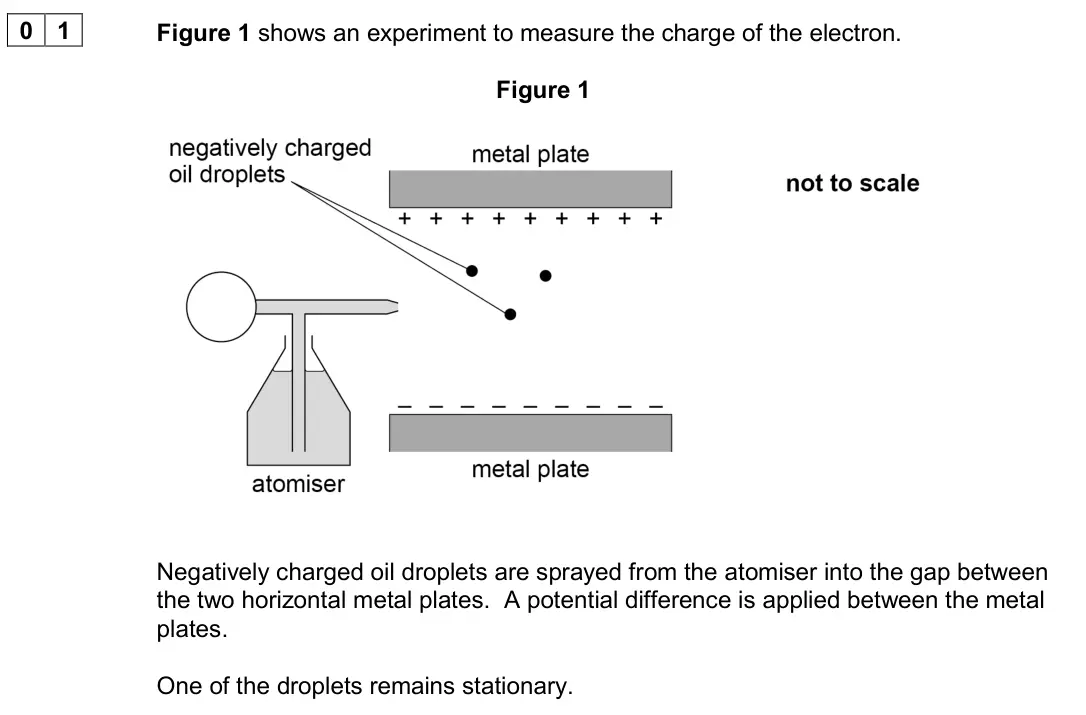
Q01.2
The whole paper ↗Q01.3
The whole paper ↗Q1(c)
The whole paper ↗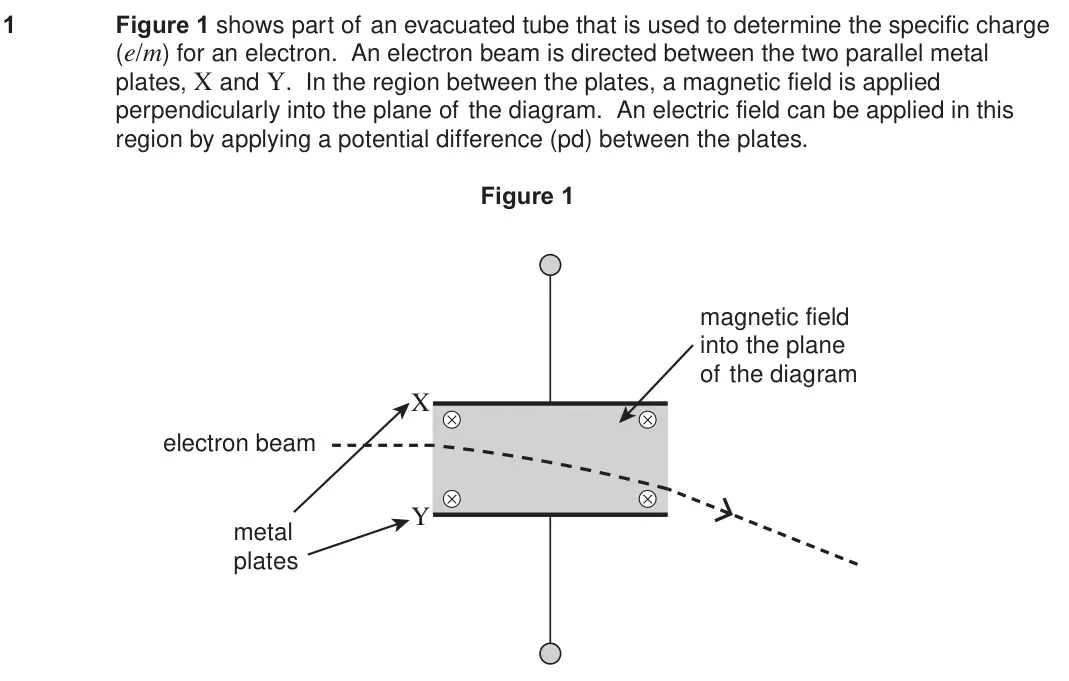
Q1(a)(i)
The whole paper ↗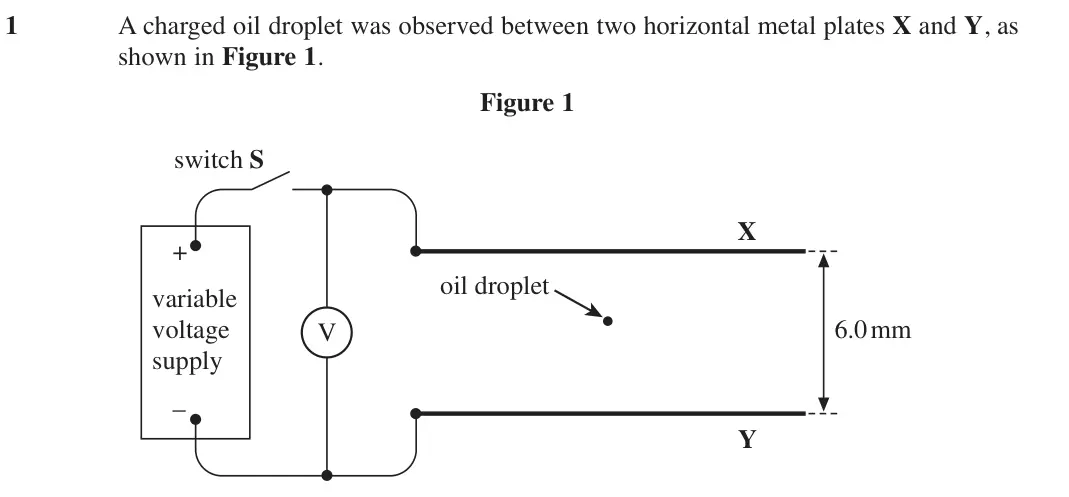
Q1(a)(ii)
The whole paper ↗Q1(a)(iii)
The whole paper ↗Q1(b)
The whole paper ↗Q2(a)(i)
The whole paper ↗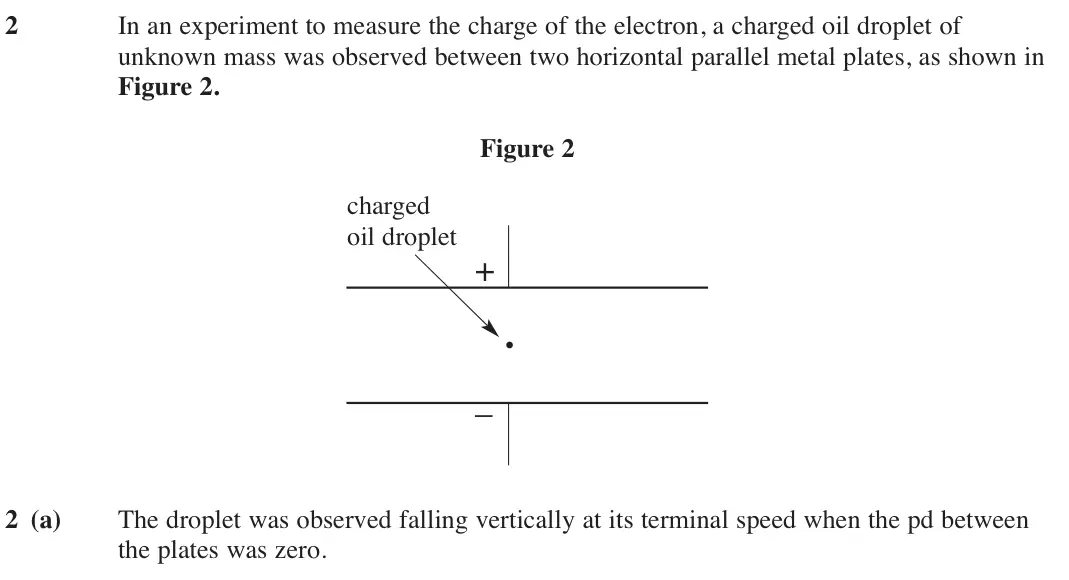
Q2(a)(ii)
The whole paper ↗
All 24 questions on Principle of Millikan’s determination of the electronic charge, e, as a list
- June 2024, Paper 3 Turning points, Q02.1 (6 marks): Figure 2 shows a cross-sectional view of the arrangement that Millikan used to determine the charge on the electron. Figure 2 Millikan’s initial step was to det
- June 2024, Paper 3 Turning points, Q02.2 (3 marks): On one occasion, the radius of a droplet was determined to be 1.20 × 10⁻⁶ m. When the droplet was stationary, the voltmeter reading was 467 V. Show that the cha
- June 2024, Paper 3 Turning points, Q02.3 (3 marks): Table 1 shows the percentage uncertainty in each quantity. Table 1 Quantity Percentage uncertainty radius of oil droplet 4% density of oil 1% gravitational fiel
- June 2023, Paper 3 Turning points, Q02.1 (3 marks): Calculate the viscosity of the air between the plates. [3 marks] viscosity = N s m−2
- June 2023, Paper 3 Turning points, Q02.2 (3 marks): During the experiment, an electric field is produced between the plates and is adjusted until the oil drop is stationary. The electric field strength is 18.8 kV
- June 2022, Paper 3 Turning points, Q02.1 (1 mark): State and explain the sign of the charge on the oil droplet. [1 mark] The variable voltage supply is set to zero volts. The oil drop falls. The constant speed v
- June 2022, Paper 3 Turning points, Q02.2 (3 marks): Show that the mass m of the oil droplet is about 8 × 10⁻¹⁶ kg. [3 marks]
- June 2022, Paper 3 Turning points, Q02.3 (2 marks): The variable voltage supply is adjusted so that the oil droplet rises at a constant speed v2. The potential difference (pd) across the plates is V and the dista
- June 2022, Paper 3 Turning points, Q02.4 (3 marks): The following measurements are made for the droplet in Question 02.2 when it is rising at constant speed. V = 715 V v2 = 1.1 × 10⁻⁴ m s−1 The separation of the
- June 2022, Paper 3 Turning points, Q02.5 (3 marks): After Millikan published his results, it was found that he had used a value for the viscosity of air that was smaller than the actual value. Discuss the effect
- June 2019, Paper 3 Turning points, Q01.1 (2 marks): Identify the forces acting on the stationary droplet. In your answer you should state the relationship between the forces. The upthrust on the droplet due to th
- June 2019, Paper 3 Turning points, Q01.2 (3 marks): The potential difference between the plates is changed to zero and the droplet falls at a terminal velocity of 1.0 × 10⁻⁴ m s−1. The density of the oil is 880 k
- June 2019, Paper 3 Turning points, Q01.3 (3 marks): The potential difference between the plates is restored to its initial value and the droplet becomes stationary. The charge on the droplet is −4.8 × 10⁻¹⁹ C. A
- June 2015, PHYA5 Turning points (old spec), Q1(c) (6 marks): If the charge on an electron is known then its mass can be determined from the specific charge. Describe how Millikan’s experiment with charged oil droplets ena
- June 2013, PHYA5 Turning points (old spec), Q1(a)(i) (4 marks): With the switch S open, the droplet fell vertically at a constant velocity of 1.1 × 10⁻⁴ ms–1. Show that the radius of the droplet is about 1.0 × 10⁻⁶ m. Assume
- June 2013, PHYA5 Turning points (old spec), Q1(a)(ii) (1 mark): Calculate the mass of the droplet. mass kg (1 mark)
- June 2013, PHYA5 Turning points (old spec), Q1(a)(iii) (3 marks): The switch S was closed and the potential difference from the voltage supply was adjusted gradually to reduce the downward motion of the droplet. The droplet st
- June 2013, PHYA5 Turning points (old spec), Q1(b) (4 marks): The mass of another charged droplet was found to be 4.3 × 10⁻¹⁵ kg. With switch S closed and the voltage supply at its maximum value of 1000V, this droplet fell
- June 2011, PHYA5 Turning points (old spec), Q2(a)(i) (2 marks): By considering the forces acting on the droplet as it falls at its terminal velocity, v, show that the radius, r, of the droplet is given by r = where η is the
- June 2011, PHYA5 Turning points (old spec), Q2(a)(ii) (1 mark): Explain how the mass of the oil droplet can be determined from its radius, r. (1 mark)
- June 2011, PHYA5 Turning points (old spec), Q2(b)(i) (3 marks): The two horizontal parallel metal plates were 5.0mm apart. The mass of the droplet was 6.8 × 10 –15kg. The droplet was held stationary when the plate pd was 690
- June 2011, PHYA5 Turning points (old spec), Q2(b)(ii) (2 marks): Millikan made the first accurate measurements of the charge carried by charged oil droplets. Outline what Millikan concluded from these measurements. (2 marks)
- June 2008, PHA8W (2008 spec), Q2(a) (6 marks): 2 (a) When the potential difference between the two plates is zero, the droplet falls vertically at a steady speed of 7.8 × 10 –5m s –1. density of oil droplet
- June 2008, PHA8W (2008 spec), Q2(b) (5 marks): 2 (b) The potential difference between X and Y is adjusted until the droplet becomes stationary. 2 (b) (i) Explain why the droplet becomes stationary. 2 (b) (ii
Questions, mark schemes and examiner’s reports are © AQA, from their published past papers. Plumi isn’t affiliated with any exam board. Want whole papers? AQA A-Level Physics past papers.
The Plumi iPad app also offers exam-style questions with AI feedback on your handwritten working.