 plumi
Progressive waves: AQA A‑Level Physics questions
AQA A-Level Physics past-paper questions on 3.3.1.1 Progressive waves, 2008–2025, with mark schemes and examiner’s reports where available.
Paper
All papers
Exam
All years
Calculations
- Your answer
Q07.2
The whole paper ↗
Q03.1
The whole paper ↗
Q01.1
The whole paper ↗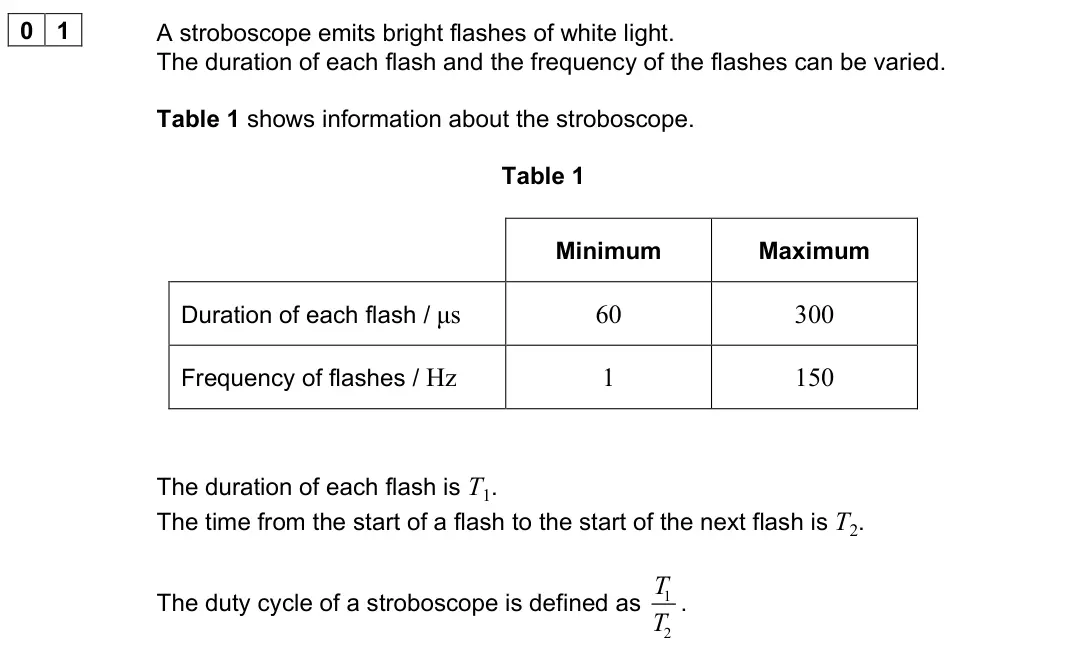
Q02.3
The whole paper ↗
Q01.1
The whole paper ↗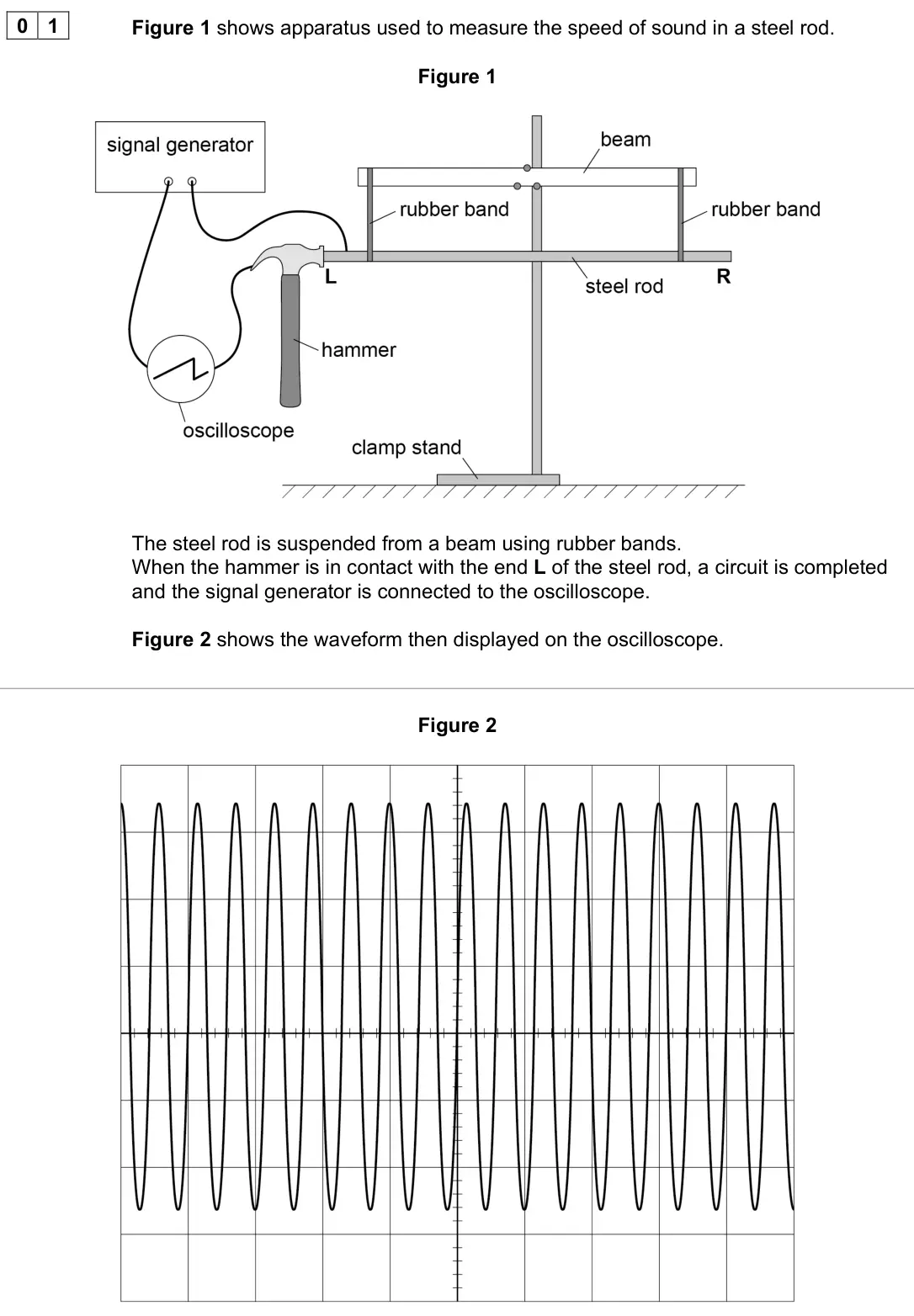
Q01.2
The whole paper ↗Q01.3
The whole paper ↗Q03.1
The whole paper ↗
Q03.2
The whole paper ↗
All 63 questions on Progressive waves, as a list
- June 2025, AS Paper 2, Q09 (1 mark): The minimum distance between two points on a progressive wave with a phase difference of π 2 is 0.040 m. The frequency of the wave is 400 Hz. What is the speed
- June 2025, AS Paper 2, Q15 (1 mark): A cylindrical beaker contains water. The diameter of the water surface is 200 mm. A pencil is dipped into the centre of the surface at time t = 0 A circular wav
- June 2024, Paper 1, Q07.2 (2 marks): Determine, in m s−1, the speed of one of the progressive waves. [2 marks] speed = m s−1
- June 2024, Paper 1, Q13 (1 mark): A laser emits light of wavelength 600 nm for 10 ns. What is the number of complete waves emitted by the laser? [1 mark] A 5 × 10¹⁷ B 5 × 10¹² C 5 × 10⁸ D 5 × 10
- June 2024, AS Paper 1, Q03.1 (2 marks): The frequency of the first harmonic is 147 Hz. Calculate the speed of the wave travelling in the string. [2 marks] speed of wave = m s−1
- June 2023, Paper 3A, Q01.1 (1 mark): What is the maximum duty cycle of the stroboscope? Tick () one box. [1 mark] 6.0 × 10⁻⁵ 3.0 × 10⁻⁴ 9.0 × 10⁻³ 4.5 × 10⁻²
- June 2023, AS Paper 1, Q02.3 (3 marks): The phase difference between A and B shown in Figure 3 is 137°. Show that the time interval labelled t in Figure 3 is approximately 8 × 10⁻¹⁶ s. [3 marks]
- June 2023, AS Paper 2, Q17 (1 mark): Two aerials A1 and A2 receive radio waves from the same distant transmitter T. The waves have a frequency of 88 MHz. The phase difference between the waves rece
- June 2022, Paper 1, Q18 (1 mark): A longitudinal wave of frequency 660 Hz travels through a medium. The wave speed is 330 m s−1. Which statement describes the motion of a particle in the wave? [
- June 2022, Paper 3A, Q01.1 (1 mark): Which control on the oscilloscope should be used to centre the trace vertically on the screen? Tick () one box. [1 mark] X-shift Y-gain Y-shift
- June 2022, Paper 3A, Q01.2 (3 marks): The distance between L and R in Figure 1 is 0.870 m. Deduce the speed of sound in the steel rod. [3 marks] speed of sound = m s−1
- June 2022, Paper 3A, Q01.3 (4 marks): A student repeats the experiment using a steel rod of twice the length. Explain: • how using the longer rod affects the waveform displayed • any changes needed
- June 2022, AS Paper 1, Q03.1 (2 marks): The frequency of the infrared radiation is 3.8 × 10¹⁴ Hz. Each pulse has a duration of 6.0 ns. Calculate the number of cycles in each pulse. [2 marks] number of
- June 2022, AS Paper 1, Q03.2 (2 marks): A and B reflect and return to the satellite. The travel time is the time between the emission of a pulse and its return to the satellite. The difference in the
- June 2022, AS Paper 2, Q15 (1 mark): Two points P and Q on a progressive wave are separated by distance d. The phase difference between P and Q is θ rad. What is the wavelength? [1 mark] A 2 d π B
- June 2022, AS Paper 2, Q16 (1 mark): A long spring is used to demonstrate wave motion. The spring lies horizontally on a table. One end of the spring is attached to a wall. The free end of the spri
- November 2021, Paper 1, Q17 (1 mark): The diagrams show the displacement–distance graph for a wave and the displacement–time graph for a point in the wave. Which is correct for this wave? [1 mark] A
- November 2021, AS Paper 2, Q15 (1 mark): A progressive wave travels along a rope in the direction M to N. X marks a point on the rope. The wave has a frequency of 5.0 Hz, a wavelength of 1.0 m and an a
- November 2020, Paper 1, Q15 (1 mark): A wave travels across the surface of water. The diagram shows how the displacement of water particles at the surface varies with distance. Which row correctly d
- November 2020, Paper 1, Q16 (1 mark): The diagram shows the cross-section of a progressive transverse wave travelling at 24 cm s−1 on water. The amplitude of the wave is 2.0 cm and the frequency is
- November 2020, AS Paper 2, Q12 (1 mark): A wave travels along a water surface. The variation with time of the displacement of a water particle at the surface is shown. What properties of the wave are r
- November 2020, AS Paper 2, Q13 (1 mark): Two points on a progressive wave are out of phase by 0.41 rad. What is this phase difference? [1 mark] A 23° B 47° C 74° D 148°
- June 2019, Paper 3A, Q03.1 (2 marks): The output potential difference (pd) of the signal generator is displayed on the oscilloscope, as shown in Figure 16. Figure 16 The time-base setting of the osc
- June 2019, AS Paper 2, Q15 (1 mark): A sonar transmitter on a ship produces pulses of sound waves. Each pulse of sound waves contains 12 complete oscillations. The frequency of these waves is 8.0 k
- June 2018, AS Paper 2, Q19 (1 mark): Two points on a progressive wave have a phase difference of rad The speed of the wave is 340 m s−1 What is the frequency of the wave when the minimum distance b
- June 2017, Paper 1, Q13 (1 mark): The graph shows how the vertical height of a travelling wave varies with distance along the path of the wave. The speed of the wave is 20 cm s–1. What is the pe
- June 2017, AS Paper 2, Q03.1 (3 marks): Show that the wavelength of the light is 600 nm. [3 marks]
- June 2017, AS Paper 2, Q03.2 (2 marks): Determine the phase difference, in rad, between the incident and reflected waves shown in Figure 9. [2 marks] phase difference = rad
- June 2016, AS Paper 2, Q12 (1 mark): What is the phase difference between two points 0.16 m apart on a progressive sound wave of frequency 256 Hz? [1 mark] speed of sound = 330 m s–1 A π 8 B π 6 C
- Specimen, Paper 1, Q06.2 (1 mark): Read through the following passage and answer the questions that follow it. Measuring the speed of sound in air 5 10 After the wave nature of sound had been ide
- Specimen, Paper 1, Q06.3 (1 mark): Read through the following passage and answer the questions that follow it. Measuring the speed of sound in air 5 10 After the wave nature of sound had been ide
- Specimen, Paper 1, Q06.4 (2 marks): Read through the following passage and answer the questions that follow it. Measuring the speed of sound in air 5 10 After the wave nature of sound had been ide
- Specimen, Paper 1, Q06.6 (2 marks): Read through the following passage and answer the questions that follow it. Measuring the speed of sound in air 5 10 After the wave nature of sound had been ide
- Specimen, Paper 1, Q06.7 (2 marks): END OF SECTION A Section B Each of Questions 7 to 31 is followed by four responses, A, B, C, and D. For each question select the best response.
- Specimen, Paper 2, Q06.5 (4 marks): Section B Each of Questions 7 to 31 is followed by four responses, A, B, C, and D
- June 2016, PHYA2 (old spec), Q6(a) (2 marks): Explain what is meant by a progressive wave. [2 marks] ______________________________________________________________________________ __________________________
- June 2016, PHYA2 (old spec), Q6(b)(i) (1 mark): the amplitude of the wave [1 mark] amplitude = _________________________ mm
- June 2016, PHYA2 (old spec), Q6(b)(ii) (1 mark): the wavelength of the wave [1 mark] wavelength = ___________________________ m
- June 2016, PHYA2 (old spec), Q6(b)(iii) (1 mark): the frequency of the wave [1 mark] frequency = __________________________ Hz
- June 2016, PHYA2 (old spec), Q6(b)(iv) (1 mark): the speed of the wave. [1 mark] speed = ________________________ m s–1
- June 2014, PHYA2 (old spec), Q7(a) (1 mark): Explain what is meant by the frequency of a wave. [1 mark]
- June 2014, PHYA2 (old spec), Q7(c) (2 marks): In order to produce an image with sufficient detail, the wavelength of the ultrasound must be 0.50mm. The speed of the ultrasound in body tissue is 1540ms–1. Ca
- June 2013, PHYA2 (old spec), Q6(a)(i): points A and B on the wave
- June 2013, PHYA2 (old spec), Q6(a)(ii) (2 marks): points A and C on the wave. (2 marks)
- June 2013, PHYA2 (old spec), Q6(d)(i) (1 mark): Define the frequency of a progressive wave. (1 mark)
- June 2013, PHYA2 (old spec), Q6(d)(ii) (2 marks): Calculate the wavelength of the wave if its speed is 4.5 × 10³ms–1. wavelength m (2 marks)
- January 2013, PHYA2 (old spec), Q7(b)(i) (2 marks): The frequency of the microwaves is 9.4GHz. Calculate the wavelength of the waves. wavelength = m (2 marks)
- June 2012, PHYA2 (old spec), Q6(a)(ii) (2 marks): State the phase relationship between X and Y X and Z (2 marks)
- June 2012, PHYA2 (old spec), Q6(b)(i) (2 marks): Show that the speed of a progressive wave on this string is about 125ms–1 (2 marks)
- June 2012, PHYA2 (old spec), Q6(b)(ii) (3 marks): Calculate the time taken for the string at point Z to move from maximum displacement back to zero displacement. answer = s (3 marks)
- June 2012, PHYA2 (old spec), Q7(b)(i) (1 mark): clearly indicate and label the wavelength of wave B (1 mark)
- January 2012, PHYA2 (old spec), Q7(a) (2 marks): Define the amplitude of a wave. (2 marks)
- January 2012, PHYA2 (old spec), Q7(b) (3 marks): The wave travels to the right. Describe how the vertical displacement of the knot varies over the next complete cycle. (3 marks)
- June 2010, PHYA2 (old spec), Q3(a) (1 mark): Define the amplitude of a wave. (1 mark)
- January 2010, PHYA2 (old spec), Q4(a)(iii) (2 marks): Calculate the speed of a progressive wave on this string. answer = ms–1 (2 marks)
- June 2009, PHYA2 (old spec), Q5(a)(i) (1 mark): Calculate the wavelength of the wave. answer m (1 mark)
- June 2009, PHYA2 (old spec), Q5(a)(ii) (2 marks): The frequency of the wave is 22 Hz. Calculate the speed of the wave. answer m s –1 (2 marks)
- June 2009, PHYA2 (old spec), Q5(a)(iii) (2 marks): State the phase difference between points X and Y on the string, giving an appropriate unit. answer (2 marks)
- June 2009, PHYA2 (old spec), Q5(b) (2 marks): Describe how the displacement of point Y on the string varies in the next half-period.
- January 2009, PHYA2 (old spec), Q5(b)(i) (2 marks): The stationary wave in Figure 4 has a frequency of 150 Hz. The string PQ has a length of 1.2 m. Calculate the wave speed of the waves forming the stationary wav
- June 2008, PA04A (2008 spec), Q3 (2 marks): 3 The graph shows, at a particular instant, the variation of the displacement of the particles in a transverse progressive water wave, of wavelength 4 cm, trave
- January 2008, PA04A (2008 spec), Q4 (2 marks): 4 A wave of frequency 5 Hz travels at 8 km s –1 through a medium. What is the phase difference between two points 2 km apart? A zero B π rad 2 C π rad D 3π rad
- January 2008, PA04B (2008 spec), Q1(b) (4 marks): (b) Figure 1 shows the undisturbed position of a string stretched between the two points, P and Q, which are 3.6 m apart. The string is vibrated transversely at
Questions, mark schemes and examiner’s reports are © AQA, from their published past papers. Plumi isn’t affiliated with any exam board. Want whole papers? AQA A-Level Physics past papers.
The Plumi iPad app also offers exam-style questions with AI feedback on your handwritten working.