 plumi
Longitudinal and transverse waves: AQA A‑Level Physics questions
AQA A-Level Physics past-paper questions on 3.3.1.2 Longitudinal and transverse waves, 2008–2025, with mark schemes and examiner’s reports where available.
Paper
All papers
Exam
All years
Calculations
Q02.1
The whole paper ↗Q03.2
The whole paper ↗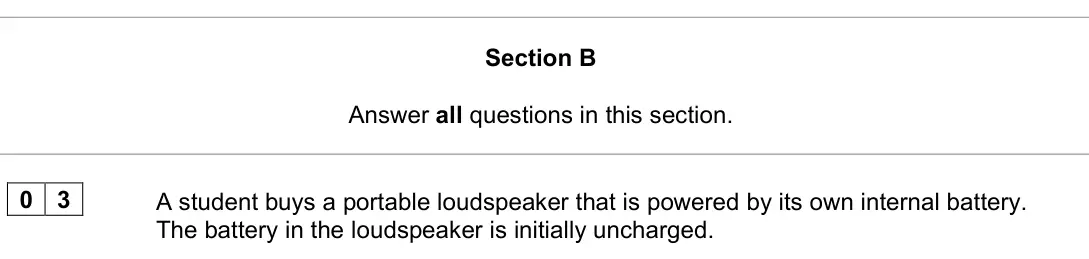
Q02.1
The whole paper ↗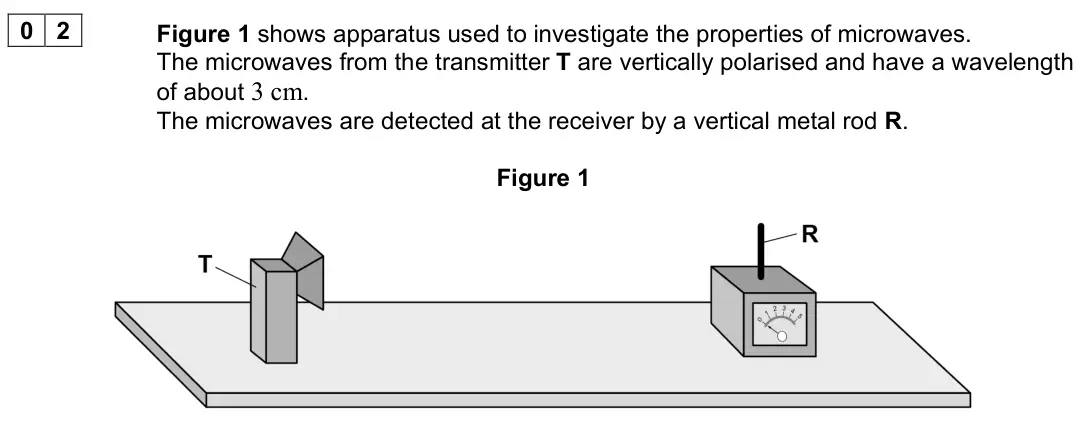
Q01.5
The whole paper ↗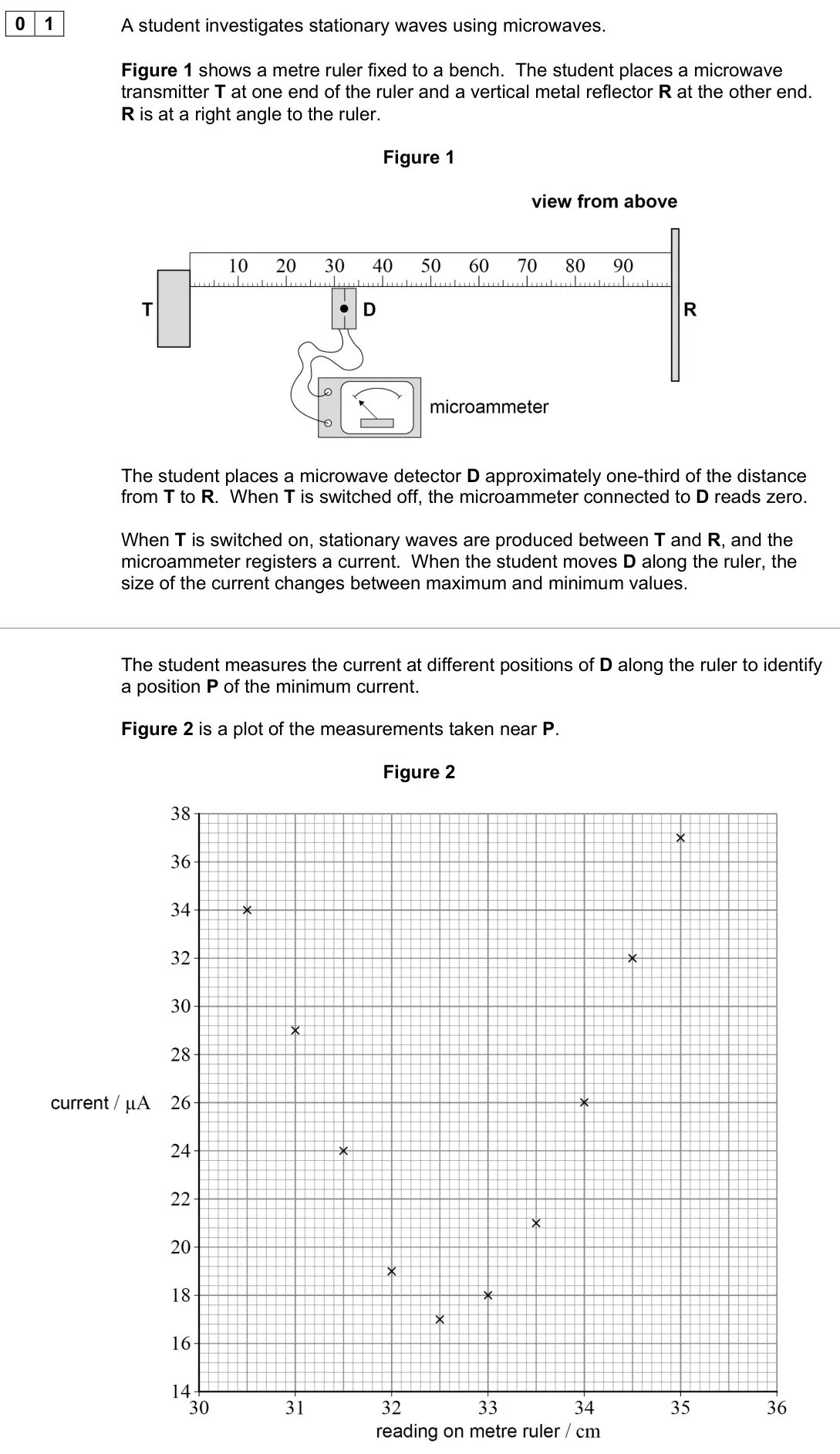
Q06.3
The whole paper ↗
Q04.6
The whole paper ↗
- Your answer
Q04.4
The whole paper ↗
- Your answer
- Your answer
- Your answer
- Your answer
Q6(c)
The whole paper ↗
All 32 questions on Longitudinal and transverse waves, as a list
- June 2025, Paper 1, Q02.1 (2 marks): State what is meant by a transverse wave. [2 marks]
- June 2025, AS Paper 2, Q12 (1 mark): Radio waves are transmitted from a vertical aerial and detected by a receiving aerial. The alignment of the receiving aerial can be varied. Which row shows the
- June 2025, AS Paper 2, Q22 (1 mark): Which is not true for longitudinal waves? [1 mark] A They can be polarised. B They produce interference patterns. C They can be diffracted. D They form stationa
- June 2024, Paper 1, Q14 (1 mark): A detector measures the intensity of light from a source S1. Polaroid material is placed between source S1 and the detector. When the material is rotated throug
- June 2023, AS Paper 1, Q03 (6 marks): A student sits near a lake on a sunny day. Some sunlight is reflected from the surface of the lake. Sunlight is also reflected from objects submerged beneath th
- June 2022, AS Paper 2, Q03.2 (2 marks): A mobile phone transmits data to the loudspeaker using microwaves. The data are processed at the loudspeaker to produce sound waves. Microwaves and sound waves
- June 2022, AS Paper 2, Q11 (1 mark): A narrow beam of light is incident on a sheet of Polaroid material. The intensity of the transmitted beam is a maximum. The Polaroid sheet is rotated about the
- November 2021, Paper 1, Q02.1 (3 marks): Explain how the apparatus can be used to demonstrate that the waves from T are vertically polarised. [3 marks]
- November 2021, AS Paper 2, Q01.5 (1 mark): Figure 4 shows D placed at a position where the current is a maximum. Figure 4 The student rotates D by 90°, without changing its distance from T, to the positi
- November 2020, Paper 1, Q17 (1 mark): Unpolarised light travels through two polarising filters X and Y and is then incident on a screen. When X and Y are arranged as shown, there is a maximum intens
- June 2019, Paper 1, Q06.3 (1 mark): The loudspeaker creates variations in pressure and produces a sound wave in the air around it. State the type of wave produced and describe the motion of the pa
- June 2019, AS Paper 1, Q04.6 (2 marks): The waves caused by earthquakes can be longitudinal or transverse. Describe the difference between longitudinal waves and transverse waves. [2 marks]
- June 2019, AS Paper 2, Q16 (1 mark): Which gives the regions of the electromagnetic spectrum in order of increasing wavelength? [1 mark] A X-rays, ultraviolet, infrared, radio waves B X-rays, micro
- June 2017, Paper 1, Q14 (1 mark): Which statement is not correct for ultrasound and X-rays? [1 mark] A Both can be refracted B Both can be diffracted C Both can be polarised D Both can be reflec
- June 2017, AS Paper 1, Q04.4 (3 marks): The vertical aerial is placed at position B and is rotated slowly through 90° until it lies along the direction AE. State and explain the effect on the signal s
- June 2017, AS Paper 2, Q10 (1 mark): Which row correctly shows electromagnetic radiations in order of decreasing wavelength? [1 mark] A gamma > ultraviolet > microwave B ultraviolet > gamma > micro
- June 2017, AS Paper 2, Q11 (1 mark): Which statement is correct about the properties of an unpolarised electromagnetic wave as it passes through a polariser? [1 mark] A The wave remains unchanged.
- Specimen, Paper 1, Q08 (1 mark): When comparing X-rays with UV radiation, which statement is correct? [1 mark] A X-rays have a lower frequency. B X-rays travel faster in a vacuum. C X-rays do n
- Specimen, Paper 1, Q28 (1 mark): Which one of the following provides direct experimental evidence that light is a transverse wave motion rather than a longitudinal wave motion? [1 mark] A Two l
- June 2016, PHYA2 (old spec), Q6(c) (1 mark): Which of the following statements apply? Place a tick () in the right-hand column for each correct statement. [1 mark] if correct sound waves are transverse s
- June 2014, PHYA2 (old spec), Q7(b) (2 marks): Ultrasound is a longitudinal wave. Describe the nature of a longitudinal wave. [2 marks]
- June 2013, PHYA2 (old spec), Q6(b) (2 marks): Describe the motion of the rock particle at point B during the passage of the next complete cycle. (2 marks)
- June 2013, PHYA2 (old spec), Q6(c) (2 marks): A scientist detects a seismic wave that is polarised. State and explain what the scientist can deduce from this information. (2 marks)
- June 2012, PHYA2 (old spec), Q7(a) (2 marks): State and explain which wave is longitudinal. (2 marks)
- June 2012, PHYA2 (old spec), Q7(b)(ii) (2 marks): use arrows to show the direction in which the points P and Q are about to move as each wave moves to the right. (2 marks)
- June 2012, PHYA2 (old spec), Q7(c) (2 marks): Electromagnetic waves are similar in nature to wave A. Explain why it is important to correctly align the aerial of a TV in order to receive the strongest signa
- June 2010, PHYA2 (old spec), Q3(b)(i) (1 mark): Other than electromagnetic radiation, give one example of a wave that is transverse. (1 mark)
- June 2010, PHYA2 (old spec), Q3(b)(ii) (1 mark): State one difference between a transverse wave and a longitudinal wave. (1 mark)
- June 2010, PHYA2 (old spec), Q3(c)(i) (1 mark): If polarised light is reaching the observer, draw the direction of the transmission axis on filter B in Figure 3. Figure 3 (1 mark) transmission axis observer p
- June 2010, PHYA2 (old spec), Q3(c)(ii) (2 marks): The polarising filter B is rotated clockwise through 360º about line XY from the position shown in Figure 3. On the axes below, sketch how the light intensity r
- June 2010, PHYA2 (old spec), Q3(d) (2 marks): State one application, other than in education, of a polarising filter and give a reason for its use. (2 marks)
- June 2008, PA04A (2008 spec), Q4 (2 marks): 4 Which one of the following statements is not correct? Progressive longitudinal waves can A show interference effects. B be diffracted. C superpose to form a s
Questions, mark schemes and examiner’s reports are © AQA, from their published past papers. Plumi isn’t affiliated with any exam board. Want whole papers? AQA A-Level Physics past papers.
The Plumi iPad app also offers exam-style questions with AI feedback on your handwritten working.