 plumi
Alternating currents: AQA A‑Level Physics questions
AQA A-Level Physics past-paper questions on 3.7.5.5 Alternating currents, 2008–2025, with mark schemes and examiner’s reports where available.
Paper
All papers
Exam
All years
Calculations
Q01.3
The whole paper ↗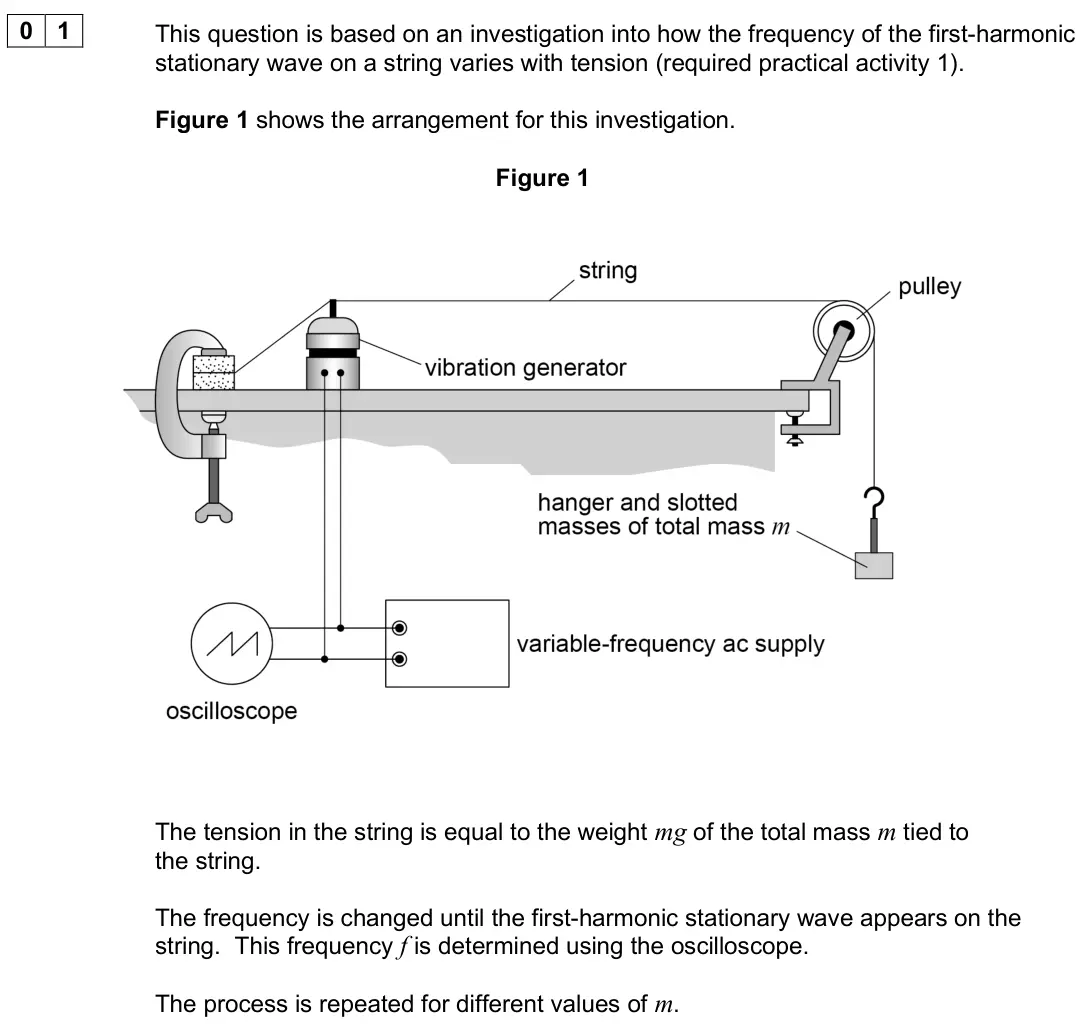
Q01.4
The whole paper ↗Q04.1
The whole paper ↗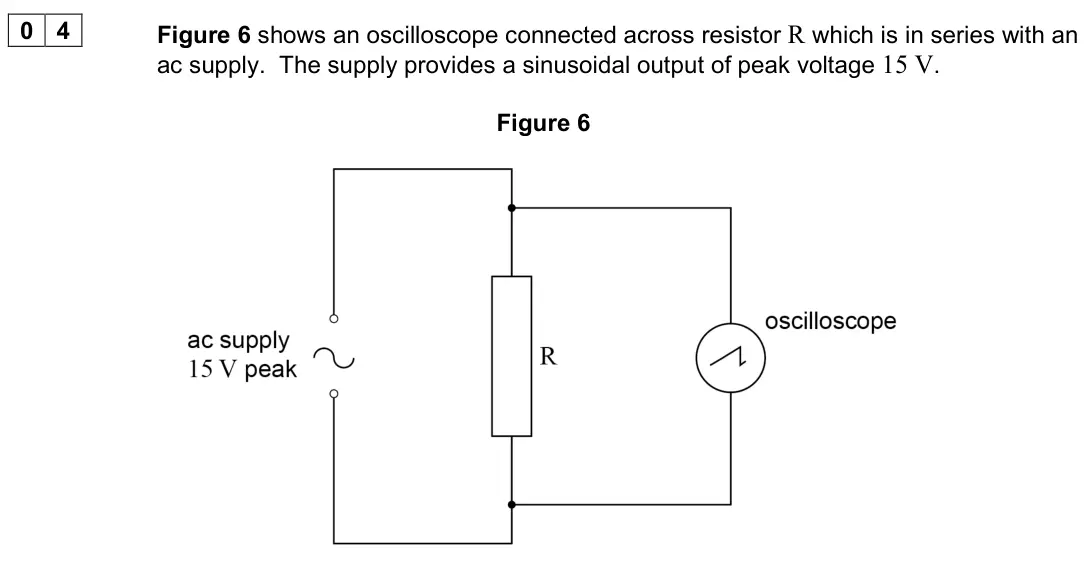
Q04.2
The whole paper ↗Q04.3
The whole paper ↗Q04.4
The whole paper ↗- Your answer
- Your answer
- Your answer
Q02.1
The whole paper ↗
Q02.2
The whole paper ↗Q02.7
The whole paper ↗Q6(a)(i)
The whole paper ↗
All 57 questions on Alternating currents, as a list
- June 2025, Paper 2, Q23 (1 mark): A transformer is used to connect an ac power supply to a 100 W filament lamp. When the lamp is operating at its rated power, the power supply has a peak potenti
- June 2025, Paper 2, Q24 (1 mark): The diagram shows an ac signal displayed on an oscilloscope screen. The time base is set to 5 μs div−1. What is the frequency of the signal? [1 mark] A 34 kHz B
- June 2025, Paper 3A, Q01.3 (2 marks): Determine Vrms, the root mean square voltage of the ac supply. [2 marks] Vrms = V
- June 2025, Paper 3A, Q01.4 (1 mark): Determine the period of the waveform on Figure 2 when m = 100 g. [1 mark] period = ms
- June 2024, Paper 2, Q13 (1 mark): A signal generator supplies a sinusoidal root mean square voltage of 7.0 V. The sinusoidal voltage is displayed on an oscilloscope screen. The screen has eight
- June 2024, Paper 2, Q14 (1 mark): Two signals that have the same frequency are displayed simultaneously on an oscilloscope. The display is shown with the time-base set to 5 ms div−1. Which row s
- June 2022, Paper 2, Q24 (1 mark): Power P is dissipated in a resistor of resistance R carrying a direct current I. A second resistor of resistance 2R carries an alternating current with peak val
- November 2021, Paper 2, Q23 (1 mark): Mains electricity is rated 230 V in the UK. Which is correct? [1 mark] A The mean voltage is 163 V. B The peak voltage is 230 V. C The root mean square voltage
- November 2021, Paper 2, Q24 (1 mark): In a resistor of resistance R, a steady current I dissipates a power P. In a resistor of resistance 2 R there is an alternating current of root mean square valu
- November 2020, Paper 2, Q04.1 (1 mark): Calculate the rms voltage of the supply. [1 mark] rms voltage = V
- November 2020, Paper 2, Q04.2 (1 mark): Determine the y-voltage gain of the oscilloscope used for Figure 7. [1 mark] y-voltage gain = V div−1
- November 2020, Paper 2, Q04.3 (1 mark): A dc supply gives the same rate of energy dissipation in R as the ac supply in Figure 6. Draw the trace of the output of the dc supply on Figure 7. The oscillos
- November 2020, Paper 2, Q04.4 (1 mark): The ac supply shown in Figure 6 is replaced with a square-wave generator operating between 0 and +15 V. Figure 8 shows the trace of the new waveform displayed o
- June 2019, Paper 2, Q28 (1 mark): A steady current I dissipates power P in a resistor of resistance R. An alternating current through a resistor of resistance 2R has a peak value of I. What is t
- June 2019, Paper 2, Q29 (1 mark): The figure shows an oscilloscope trace of a sinusoidal ac voltage. The time base setting is 5 ms cm–1 and the Y-voltage gain is 10 V cm–1. Which row describes t
- June 2017, Paper 2, Q23 (1 mark): The mean power dissipated in a resistor is 47.5 µW when the root mean square (rms) voltage across the resistor is 150 mV. What is the peak current in the resist
- June 2017, Paper 3A, Q02.1 (1 mark): Determine the peak-to-peak voltage V of the waveform shown in Figure 8. [1 mark] V = V
- June 2017, Paper 3A, Q02.2 (2 marks): Determine the frequency f of the waveform shown in Figure 8. [2 marks] f = Hz Figure 7 Figure 8
- June 2017, Paper 3A, Q02.7 (2 marks): State and explain what changes, if any, the student needs to make to the settings of the oscilloscope so the waveform across R is fully displayed. [2 marks]
- June 2016, PHYA1 (old spec), Q6(a)(i) (2 marks): Calculate the peak-to-peak voltage of the mains supply. [2 marks] peak-to-peak voltage = ___________________________ V
- June 2016, PHYA1 (old spec), Q6(a)(ii) (3 marks): The resistance of the heating element in the oven at its working temperature is 12 Ω. Calculate the power dissipated by the heating element in the oven. Give yo
- June 2016, PHYA1 (old spec), Q7(a) (1 mark): Explain why the oscilloscope shows a bright spot rather than a horizontal line. [1 mark] _______________________________________________________________________
- June 2013, PHYA1 (old spec), Q5(a)(i) (1 mark): State the peak-to-peak voltage. peak-to-peak voltage V (1 mark)
- June 2013, PHYA1 (old spec), Q5(a)(ii) (1 mark): State the peak voltage. peak voltage V (1 mark)
- June 2013, PHYA1 (old spec), Q5(a)(iii) (2 marks): Calculate the root mean square (rms) value of the alternating voltage. rms voltage V (2 marks)
- June 2013, PHYA1 (old spec), Q5(a)(iv) (3 marks): Calculate the frequency of the alternating voltage. State an appropriate unit. frequency unit (3 marks)
- June 2013, PHYA1 (old spec), Q5(b) (2 marks): On Figure 2 draw a line to show the dc voltage that gives the same rate of energy dissipation in R as produced by the alternating waveform. (2 marks)
- June 2013, PHYA1 (old spec), Q5(c) (3 marks): An oscilloscope has a screen of eight vertical and ten horizontal divisions. Describe how you would use the oscilloscope to display the alternating waveform in
- June 2012, PHYA1 (old spec), Q5(a) (6 marks): An alternating current supply provides an output voltage of 12V rms at a frequency of 50 Hz. Describe how you would use an oscilloscope to check the accuracy of
- June 2012, PHYA1 (old spec), Q5(b)(i) (1 mark): Calculate the rms current in the lamp. answer = A (1 mark)
- June 2012, PHYA1 (old spec), Q5(b)(ii) (1 mark): Calculate the peak current in the lamp. answer = A (1 mark)
- June 2012, PHYA1 (old spec), Q5(b)(iii) (2 marks): Calculate the peak power of the lamp. answer = W (2 marks)
- June 2011, PHYA1 (old spec), Q5(a) (1 mark): On the grid below show the appearance of the screen if the y-input is connected to a 2.5V dc supply. (1 mark)
- June 2011, PHYA1 (old spec), Q5(b)(i) (2 marks): Explain why a vertical line is now seen on the screen.
- June 2011, PHYA1 (old spec), Q5(b)(ii) (2 marks): Calculate the peak-to-peak voltage of the ac supply. answer = V (2 marks)
- June 2011, PHYA1 (old spec), Q5(b)(iii) (2 marks): Calculate the root mean square voltage of the supply. answer = V (2 marks)
- January 2011, PHYA4 Section B (old spec), Q5(b) (3 marks): The permanent magnet produces a uniform magnetic field of flux density 220mT over a 55mm length of the wire. Show that the maximum force on the wire is about 40
- January 2011, PHYA1 (old spec), Q5(a) (1 mark): State what is meant by root mean square voltage. (1 mark)
- January 2011, PHYA1 (old spec), Q5(b)(i) (2 marks): Calculate the peak value of the supply voltage. answer = V (2 marks)
- January 2011, PHYA1 (old spec), Q5(b)(ii) (1 mark): Calculate the average power dissipated in a lamp connected to the mains supply when the rms current is 0.26A. answer = W (1 mark)
- January 2011, PHYA1 (old spec), Q5(c) (4 marks): The frequency of the voltage supply is 50Hz. On the axes below draw the waveform of the supplied voltage labelling the axes with appropriate values. (4 marks) v
- January 2010, PHYA1 (old spec), Q7(a)(i) (1 mark): Calculate the peak voltage of the ac source. answer = V (1 mark)
- January 2010, PHYA1 (old spec), Q7(a)(ii) (1 mark): Calculate the rms voltage. answer = V (1 mark)
- January 2010, PHYA1 (old spec), Q7(a)(iii) (1 mark): Calculate the time period of the ac signal. answer = ms (1 mark)
- January 2010, PHYA1 (old spec), Q7(a)(iv) (2 marks): Calculate the frequency of the ac signal. answer = Hz (2 marks)
- June 2009, PHYA1 (old spec), Q6(a)(i) (3 marks): Calculate the frequency answer Hz (3 marks)
- June 2009, PHYA1 (old spec), Q6(a)(ii) (2 marks): Calculate the peak voltage answer V (2 marks)
- June 2009, PHYA1 (old spec), Q6(a)(iii) (2 marks): the rms voltage answer V (2 marks)
- June 2009, PHYA1 (old spec), Q6(b) (2 marks): State and explain the effect on the oscilloscope trace if the time base is switched off.
- January 2009, PHA3W (2008 spec), Q3(a) (3 marks): 3 (a) (i) Calculate the peak voltage of the mains supply. 3 (a) (ii) Calculate the rms current supplied to the cooker when it is operating at full power. (3 mar
- June 2008, PHA3W (2008 spec), Q2(b) (3 marks): 2 (b) An electric heater is required to produce 1.2 kW when connected to the 230 V rms ac mains. The heating element consists of a single uniform wire of an all
- June 2008, PHA3W (2008 spec), Q3(a) (3 marks): 3 (a) Calculate, for the ac source, 3 (a) (i) the frequency, 3 (a) (ii) the rms voltage. (3 marks)
- June 2008, PHA3W (2008 spec), Q3(b) (3 marks): 3 (b) The two resistors have the following values R1 = 400 Ω, R2 = 80 Ω. Draw on Figure 4 the waveform which would be seen on the screen of oscilloscope 2 if th
- June 2008, PHA9W (2008 spec), Q2(b) (2 marks): 2 (b) The oscilloscope was set to a voltage sensitivity of 1 V cm –1 and a time base of 5 ms cm –1. Draw on the grid the trace that would be seen on the oscillo
- June 2008, PHA9W (2008 spec), Q3(a) (2 marks): 3 (a) Explain why this capacitor should not be connected to a 24 V rms ac supply. (2 marks)
- January 2008, PHA3W (2008 spec), Q4(a) (3 marks): (a) At a certain frequency the ac signal has an rms output of 21.2 V. Figure 4 shows the trace obtained on the screen of the oscilloscope when one horizontal di
- January 2008, PHA3W (2008 spec), Q4(b) (5 marks): (b) The voltage output and frequency of the ac signal are now changed so that the peak voltage is 60V and the frequency is 100 Hz. State which two controls on t
Questions, mark schemes and examiner’s reports are © AQA, from their published past papers. Plumi isn’t affiliated with any exam board. Want whole papers? AQA A-Level Physics past papers.
The Plumi iPad app also offers exam-style questions with AI feedback on your handwritten working.