 plumi
Interference: AQA A‑Level Physics questions
AQA A-Level Physics past-paper questions on 3.3.2.1 Interference, 2008–2025, with mark schemes and examiner’s reports where available.
Paper
All papers
Exam
All years
Calculations
Q01.1
The whole paper ↗
Q04.1
The whole paper ↗
Q04.2
The whole paper ↗Q04.3
The whole paper ↗Q02.1
The whole paper ↗
Q03.3
The whole paper ↗
Q03.4
The whole paper ↗Q03.5
The whole paper ↗Q02.2
The whole paper ↗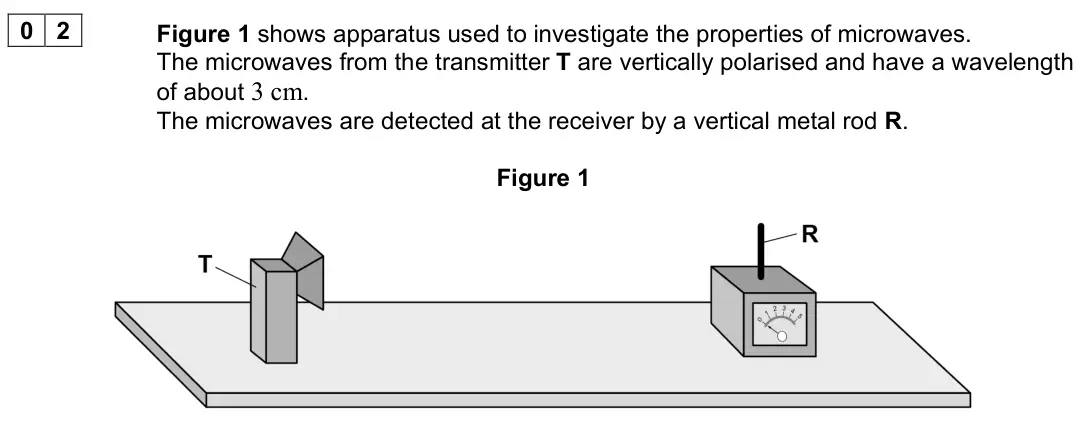
Q02.3
The whole paper ↗Q02.4
The whole paper ↗Q02.2
The whole paper ↗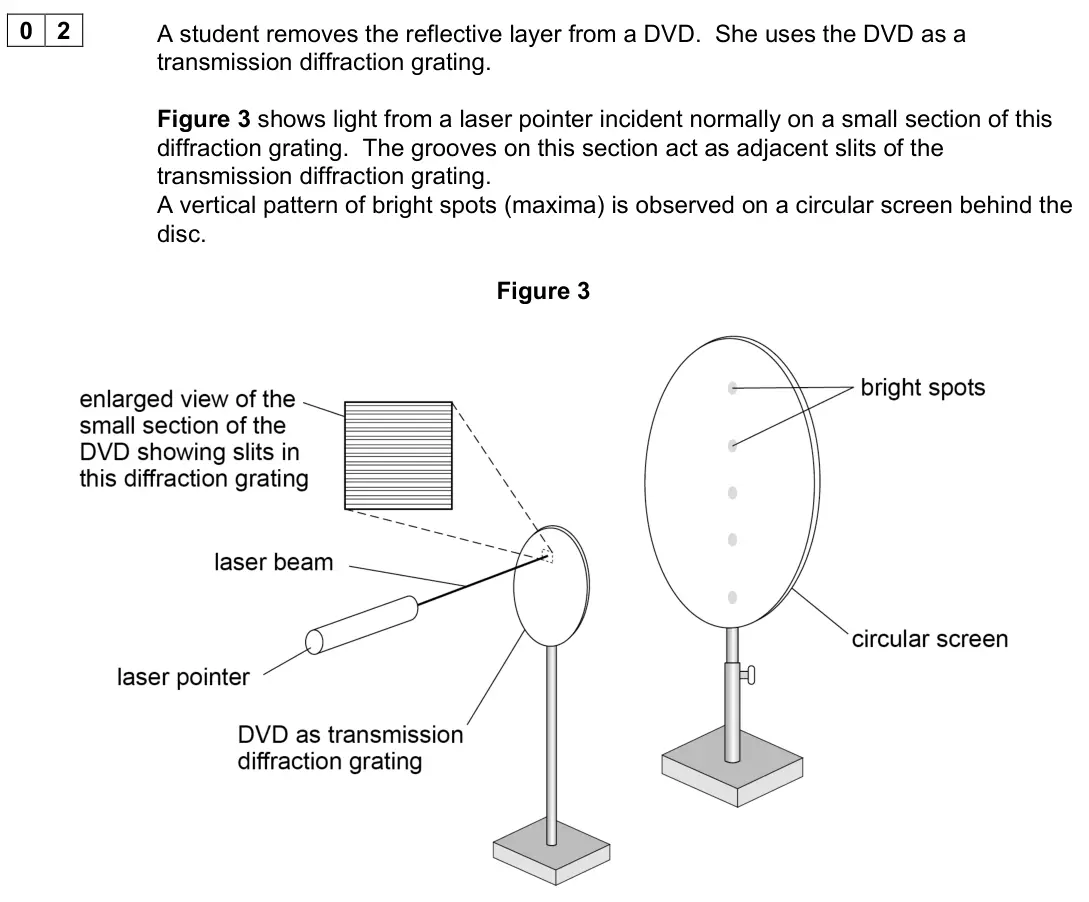
All 76 questions on Interference, as a list
- June 2025, Paper 1, Q17 (1 mark): Monochromatic light of wavelength λ is used in a double-slit experiment. The slits are vertical and have a separation s. A narrow screen of width Y is placed a
- June 2025, AS Paper 2, Q01.1 (1 mark): State one safety precaution when using a laser in a school laboratory. [1 mark] A piece of squared paper is positioned parallel to the diffraction grating. Figu
- June 2025, AS Paper 2, Q11 (1 mark): Two coherent sources generate sound waves of wavelength 0.40 m. The waves are in phase when they leave the sources. The path difference between a detector and e
- June 2024, Paper 1, Q16 (1 mark): Point sources of sound of the same frequency are placed at S1 and S2. A sound detector is moved slowly along the line PQ. Consecutive maxima of sound intensity
- June 2024, Paper 1, Q17 (1 mark): Monochromatic light is used in a Young’s double-slit interference experiment after passing through a single slit. The resulting fringe pattern is observed on a
- June 2024, AS Paper 2, Q04.1 (3 marks): Deduce the relationship between d and the wavelength λ of light that produces a bright fringe. [3 marks]
- June 2024, AS Paper 2, Q04.2 (2 marks): 0 4 Figure 13 shows an arrangement used to determine the thickness of metal foil using interference of light. Figure 13 Two thin glass plates are separated by t
- June 2024, AS Paper 2, Q04.3 (3 marks): The space between the plates is now filled with water. The same light source is used, and t and l remain the same as before. Deduce how the distance s will chan
- June 2024, AS Paper 2, Q15 (1 mark): Sources M1 and M2 emit coherent microwaves of wavelength 5.0 cm. When M1 and M2 are very close, a maximum of intensity occurs at a point D that is 1.0 m away. M
- June 2023, Paper 1, Q16 (1 mark): A double slit with a separation s is illuminated by light of wavelength λ. Fringes with spacing w are produced on a screen placed a distance D from the slits. T
- June 2023, AS Paper 1, Q02.1 (3 marks): Figure 2 shows how A and B vary with time at the upper surface. Figure 2 In the layer, the light has a wavelength of 356 nm. The thickness of the layer is 89 nm
- June 2023, AS Paper 2, Q06 (1 mark): S1 and S2 are coherent sources of microwaves that produce waves of the same amplitude. A microwave detector gives a zero reading when placed at a point that is
- June 2022, Paper 1, Q20 (1 mark): Light of wavelength 5.2 × 10⁻⁷ m is used in a Young’s double-slit experiment. The distance from the slits to the screen is 1.5 m. The width of ten fringes is 3.
- June 2022, AS Paper 2, Q03.3 (2 marks): A second loudspeaker receives the same data from the mobile phone. The two loudspeakers act as coherent sources of sound waves. State the two conditions require
- June 2022, AS Paper 2, Q03.4 (2 marks): Show that the difference between the path lengths AM and BM is approximately 0.3 m. [2 marks]
- June 2022, AS Paper 2, Q03.5 (2 marks): The speed of sound is 340 m s−1. Determine the frequency of the sound waves. [2 marks] frequency = Hz
- November 2021, Paper 1, Q02.2 (4 marks): Explain what happens to the signal detected by R as M is moved slowly towards X. [4 marks]
- November 2021, Paper 1, Q02.3 (1 mark): Suggest why Young’s double-slit equation should not be used to determine the wavelength. [1 mark]
- November 2021, Paper 1, Q02.4 (3 marks): The wavelength is known to be about 3 cm. Deduce whether this practical arrangement is suitable for a determination of a value for the wavelength. [3 marks]
- November 2021, AS Paper 1, Q02.2 (3 marks): Explain how light from the diffraction grating forms a maximum on the screen. [3 marks]
- November 2021, AS Paper 2, Q19 (1 mark): In a Young’s double-slit experiment, monochromatic light is incident on two narrow slits and the resulting interference pattern is observed on a screen. Which c
- November 2020, Paper 1, Q03.1 (2 marks): Explain why the two loudspeakers are coherent sources of sound waves. [2 marks]
- November 2020, Paper 1, Q03.2 (3 marks): The student faces the two loudspeakers at point A. Point A is at equal distances from P and Q. He then moves to point B, at right angles to the line OA, still f
- November 2020, Paper 1, Q03.3 (3 marks): The student records the following data: separation of the two loudspeakers = 0.30 m distance OA = 2.25 m distance from A to B = 0.95 m Show that the path differ
- November 2020, Paper 1, Q03.4 (1 mark): The frequency of the sound wave is 2960 Hz. Calculate the speed of sound from the student’s data. [1 mark] speed of sound = m s−1
- November 2020, Paper 1, Q03.5 (3 marks): The student moves his head to point C as shown in Figure 4. The emitted frequency of the sound from the loudspeakers is then gradually decreased. Figure 4 Discu
- November 2020, AS Paper 2, Q14 (1 mark): Light of wavelength is incident normally on two parallel slits of separation s. Fringes of spacing w are seen on a screen at a distance D from the slits. Which
- June 2019, AS Paper 2, Q01.4 (1 mark): Eye protection should be used to prevent eye damage when using a laser. Describe one other safety measure to minimise the risk of eye damage when using a laser
- June 2019, AS Paper 2, Q18 (1 mark): In a Young’s double-slit experiment, the spacing of the double slits is s and the distance between the slits and the screen on which fringes are formed is D. Wh
- June 2018, Paper 1, Q15 (1 mark): In the diagram, P is the source of a wave of frequency 50 Hz The wave travels to R by two routes, P → Q → R and P → R. The speed of the wave is 30 m s−1 What is
- June 2018, Paper 1, Q16 (1 mark): Light from a point source passes through a single slit and is then incident on a double-slit arrangement. An interference pattern is observed on the screen. Wha
- June 2018, AS Paper 1, Q07.1 (2 marks): Describe the interference pattern that is seen on the white screen. [2 marks]
- June 2018, AS Paper 1, Q07.2 (4 marks): A filter transmits only green light of wavelength and red light of wavelength 1.2 This filter is placed between the light source and the single slit. Describe t
- June 2018, AS Paper 1, Q07.3 (6 marks): A student decides to use the apparatus shown in Figure 8 to determine the wavelength of red light using a filter that transmits only red light. The student sugg
- June 2017, Paper 1, Q16 (1 mark): When a monochromatic light source is incident on two slits of the same width an interference pattern is produced. One slit is then covered with opaque black pap
- June 2017, Paper 3A, Q01.1 (1 mark): The ammeter reading depends on the superposition of waves travelling directly to R and other waves that reach R after reflection from M. State the phase differe
- June 2017, Paper 3A, Q01.2 (1 mark): Explain why the minimum reading is not zero when the distance x is measured. [1 mark]
- June 2017, Paper 3A, Q01.3 (2 marks): When M is moved further away the reading increases to a maximum then decreases to a minimum. At the first minimum position, a student labels the minimum n = 1 a
- June 2017, Paper 3A, Q01.5 (2 marks): Determine using your results for Gmax and Gmin. [2 marks] = m Figure 4
- June 2017, Paper 3A, Q01.7 (2 marks): Explain how the graph in Figure 4 can be used to obtain the value of y. You are not required to determine y. [2 marks]
- June 2017, AS Paper 1, Q04.1 (3 marks): Explain why the signal strength falls to a minimum between B and C, and between C and D. [3 marks]
- June 2017, AS Paper 1, Q04.2 (3 marks): Determine the frequency of the microwaves that are transmitted. [3 marks] frequency = Hz
- June 2017, AS Paper 1, Q04.3 (2 marks): The intensity of the waves passing through each slit is the same. Explain why the minimum intensity between C and D is not zero. [2 marks]
- June 2015, PHYA2 (old spec), Q7(a) (2 marks): On the axes in Figure 7, sketch a graph to show how the intensity varies with position for a monochromatic light source. [2 marks]
- June 2015, PHYA2 (old spec), Q7(b)(i) (1 mark): For an interference pattern to be observed the light has to be emitted by two coherent sources. Explain what is meant by coherent sources. [1 mark]
- June 2015, PHYA2 (old spec), Q7(b)(ii) (1 mark): Explain how the use of the single slit in the arrangement in Figure 7 makes the light from the two slits sufficiently coherent for fringes to be observed. [1 ma
- June 2015, PHYA2 (old spec), Q7(b)(iii) (3 marks): In this experiment light behaves as a wave. Explain how the bright fringes are formed. [3 marks]
- June 2015, PHYA2 (old spec), Q7(c)(i) (2 marks): A scientist carries out the Young double-slit experiment using a laser that emits violet light of wavelength 405 nm. The separation of the slits is 5.00 × 10⁻⁵
- June 2015, PHYA2 (old spec), Q7(c)(ii) (1 mark): Describe the change to the pattern seen on the screen when the violet laser is replaced by a green laser. Assume the brightness of the central maximum is the sa
- June 2015, PHYA2 (old spec), Q7(c)(iii) (3 marks): The scientist uses the same apparatus to measure the wavelength of visible electromagnetic radiation emitted by another laser. Describe how he should change the
- June 2013, PHYA2 (old spec), Q7(a) (1 mark): A laser emits monochromatic light. Explain the meaning of the term monochromatic light. (1 mark)
- June 2013, PHYA2 (old spec), Q7(c) (2 marks): State and explain one precaution that should be taken when using laser light. (2 marks)
- January 2013, PHYA2 (old spec), Q7(a) (2 marks): Explain what is meant by coherent sources. (2 marks)
- January 2013, PHYA2 (old spec), Q7(b)(ii) (1 mark): Using Figure 5 and your answer to part (b)(i), calculate the path difference between the two waves arriving at the detector. path difference = m (1 mark)
- January 2013, PHYA2 (old spec), Q7(c) (3 marks): State and explain whether a maximum or minimum is detected at the position shown in Figure 5. (3 marks)
- January 2013, PHYA2 (old spec), Q7(d) (3 marks): The experiment is now rearranged so that the perpendicular distance from the slits to the detector is 0.42m. The interference fringe spacing changes to 0.11m. C
- January 2013, PHYA2 (old spec), Q7(e) (3 marks): With the detector at the position of a maximum, the frequency of the microwaves is now doubled. State and explain what would now be detected by the detector in
- June 2011, PHYA2 (old spec), Q7(a) (6 marks): The scientist has a double slit of known separation. Describe the measurements that need to be taken and explain how they are used to find the wavelength of the
- June 2011, PHYA2 (old spec), Q7(b) (2 marks): In 1802 Thomas Young used candle light to observe the interference pattern from two narrow slits acting as coherent light sources. Explain what is meant by cohe
- June 2011, PHYA2 (old spec), Q7(c) (2 marks): Sketch and label on the diagram below the arrangement that Young would have used to obtain his interference pattern. (2 marks) candle screen
- June 2011, PHYA2 (old spec), Q7(d) (2 marks): State two differences in the appearance of the pattern obtained with a laser and that produced by a white light source such as a candle. Difference 1 Difference
- June 2011, PHYA2 (old spec), Q7(e) (2 marks): Explain how the wave theory of light accounts for the areas on the screen where the intensity is a minimum. (2 marks)
- January 2011, PHYA2 (old spec), Q3(b) (2 marks): A laser is a source of monochromatic, coherent light. State what is meant by monochromatic light coherent light (2 marks)
- January 2010, PHYA2 (old spec), Q5(a) (1 mark): What did this suggest to Young about the nature of light? (1 mark)
- January 2010, PHYA2 (old spec), Q5(b)(i): State what is meant by monochromatic.
- January 2010, PHYA2 (old spec), Q5(b)(ii) (2 marks): State what is meant by coherent. (2 marks)
- January 2010, PHYA2 (old spec), Q5(b)(iii) (1 mark): State one safety precaution that should be taken while using a laser. (1 mark)
- January 2010, PHYA2 (old spec), Q5(c) (3 marks): Figure 6 shows the maxima of a two slit interference pattern produced on a screen when a laser was used as a monochromatic light source. Figure 6 The slit spaci
- January 2010, PHYA2 (old spec), Q5(d) (2 marks): The laser is replaced by another laser emitting visible light with a shorter wavelength. State and explain how this will affect the spacing of the maxima on the
- January 2009, PHYA2 (old spec), Q7(a)(ii) (4 marks): Explain the formation of the fringes seen on the screen.
- January 2009, PHYA2 (old spec), Q7(a)(iii) (4 marks): The slit spacing was 0.56 mm. The distance across 4 fringe spacings was 3.6 mm when the screen was at a distance of 0.80 m from the slits. Calculate the wavelen
- January 2009, PHYA2 (old spec), Q7(b) (3 marks): Describe how the appearance of the fringes would differ if white light had been used instead of red light.
- June 2008, PA04B (2008 spec), Q2(a) (4 marks): 2 (a) You may be awarded additional marks to those shown in brackets for the in your answer. Describe, with the aid of a diagram, the appearance of 2 (a) (i) th
- June 2008, PA04B (2008 spec), Q2(b) (5 marks): 2 (b) Young’s fringes, produced by monochromatic laser light passing through slits 0.60 mm apart, are viewed on a screen. The distance across 20 fringe spacings
- January 2008, PA04A (2008 spec), Q5 (2 marks): 5 Interference fringes are produced on a screen by illuminating a double slit with monochromatic light. Which one of the following changes would reduce the sepa
- January 2008, PA04A (2008 spec), Q6 (2 marks): 6 Two coherent sources produce waves which are 180° out of phase. What is a possible value for the path difference of the two waves when they meet at a point of
Questions, mark schemes and examiner’s reports are © AQA, from their published past papers. Plumi isn’t affiliated with any exam board. Want whole papers? AQA A-Level Physics past papers.
The Plumi iPad app also offers exam-style questions with AI feedback on your handwritten working.