 plumi
Refraction at a plane surface: AQA A‑Level Physics questions
AQA A-Level Physics past-paper questions on 3.3.2.3 Refraction at a plane surface, 2008–2025, with mark schemes and examiner’s reports where available.
Paper
All papers
Exam
All years
Calculations
Q02.1
The whole paper ↗
Q02.2
The whole paper ↗Q02.3
The whole paper ↗Q02.4
The whole paper ↗Q03.1
The whole paper ↗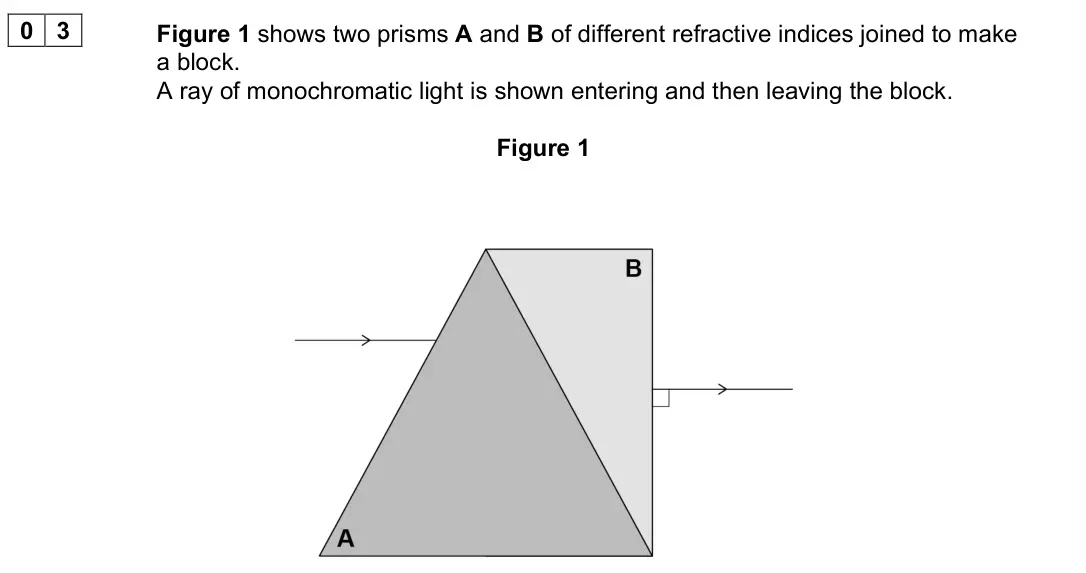
Q03.2
The whole paper ↗Q04.3
The whole paper ↗
Q04.1
The whole paper ↗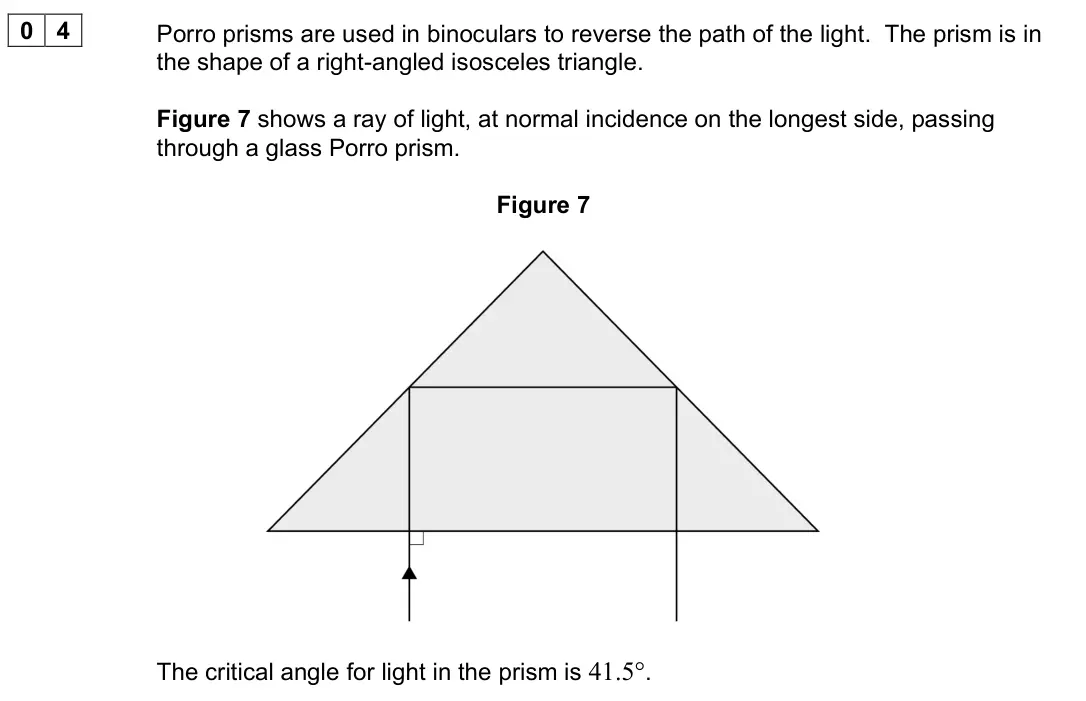
Q04.2
The whole paper ↗Q04.3
The whole paper ↗Q04.4
The whole paper ↗Q04.5
The whole paper ↗Q02.4
The whole paper ↗
Q04.1
The whole paper ↗
Q04.2
The whole paper ↗Q04.3
The whole paper ↗
All 152 questions on Refraction at a plane surface, as a list
- June 2025, Paper 1, Q18 (1 mark): A light ray passes from medium X to medium Y. The refractive index of X is 1.33 What is the refractive index of Y? [1 mark] A 0.86 B 1.22 C 1.74 D 2.32
- June 2025, Paper 1, Q19 (1 mark): The critical angle at a boundary between two media is 53°. The speed of light in one medium is 2.6 × 10⁸ m s−1. What is the speed of light in the other medium?
- June 2025, AS Paper 1, Q02.1 (1 mark): What happens to the frequency of the light as it enters the glass core? Tick () one box. [1 mark] It decreases. It is unchanged. It increases. The refractive i
- June 2025, AS Paper 1, Q02.2 (2 marks): The critical angle at the core–cladding boundary is 80.7° Calculate the refractive index of the cladding. [2 marks] refractive index of cladding = Figure 1 show
- June 2025, AS Paper 1, Q02.3 (2 marks): Calculate the maximum value of θA for the ray to be transmitted through the optical fibre. [2 marks] maximum value of θA = °
- June 2025, AS Paper 1, Q02.4 (3 marks): Figure 2 shows the path of a ray of light that enters at the centre of the straight optical fibre at a smaller value of θA. Only the first two total internal re
- June 2025, AS Paper 2, Q14 (1 mark): Monochromatic light passes from air to glass. The light has a wavelength of 632 nm in air. The refractive index of the glass is 1.50 What is the wavelength of t
- June 2024, Paper 1, Q03.1 (1 mark): Complete, on Figure 1, the path of the ray of light inside the block. [1 mark]
- June 2024, Paper 1, Q03.2 (2 marks): Deduce which prism, A or B, has the greater refractive index. [2 marks]
- June 2024, AS Paper 2, Q04.3 (3 marks): The space between the plates is now filled with water. The same light source is used, and t and l remain the same as before. Deduce how the distance s will chan
- June 2024, AS Paper 2, Q21 (1 mark): The cladding of a step-index optical fibre [1 mark] A must not be transparent. B must have a higher refractive index than the core. C reduces signal loss. D red
- June 2023, Paper 1, Q04.1 (1 mark): Show that the glass used to make the prism has a refractive index of about 1.5 [1 mark]
- June 2023, Paper 1, Q04.2 (2 marks): Explain why the ray emerges parallel to the incident ray. [2 marks]
- June 2023, Paper 1, Q04.3 (3 marks): Draw on Figure 8 the path of the ray of light as it continues inside the prism and emerges from the longest side. [3 marks]
- June 2023, Paper 1, Q04.4 (4 marks): When the angle of incidence is greater than θ, some of the light escapes the prism through one of the shorter sides. Assume that the refractive index is 1.5 and
- June 2023, Paper 1, Q04.5 (4 marks): A manufacturer wants to make a prism with a larger value of θ. Two alternative changes to the original design of the prism are suggested: 1. use a prism of the
- June 2023, AS Paper 1, Q02.4 (4 marks): 89 nm is the minimum thickness that will produce a phase difference of 137° between A and B. Calculate the refractive index of the material of the layer. [4 mar
- June 2023, AS Paper 2, Q04.1 (1 mark): Explain why the light ray in Figure 12 does not change direction as it enters the block. [1 mark]
- June 2023, AS Paper 2, Q04.2 (2 marks): The refractometer is calibrated using a drop of liquid. When θ = 15°, light is partially refracted at the glass–liquid boundary. Calculate the angle of refracti
- June 2023, AS Paper 2, Q04.3 (2 marks): Explain why the intensity of the light ray on the screen increases at T. [2 marks]
- June 2023, AS Paper 2, Q04.4 (2 marks): The liquid is replaced with a drop of sugar solution. The refractive index of the sugar solution is greater than 1.33 Deduce how this change affects the positio
- June 2023, AS Paper 2, Q04.5 (3 marks): The refractometer in Figure 13 is used to determine the concentration of a sugar solution. Figure 14 shows the variation of refractive index with concentration
- June 2022, Paper 1, Q06.1 (1 mark): Explain how the path of the ray shows that the refractive index of A is greater than the refractive index of B. [1 mark]
- June 2022, Paper 1, Q06.2 (2 marks): Show that the angle of refraction of the ray in B is about 60°. [2 marks]
- June 2022, Paper 1, Q06.3 (3 marks): Draw, on Figure 12, the path of the ray immediately after it reaches P. Justify your answer with calculations. [3 marks] END OF SECTION A Section B
- June 2022, AS Paper 1, Q03.3 (2 marks): Calculate the refractive index of the ice. [2 marks] refractive index =
- June 2022, AS Paper 1, Q03.4 (2 marks): Calculate the wavelength of the infrared radiation when it is inside the ice sheet. [2 marks] wavelength = m
- June 2022, AS Paper 2, Q20 (1 mark): Which combination produces the smallest modal dispersion in an optical fibre? [1 mark] Refractive index of core Refractive index of cladding A 1.5 1.4 B 1.4 1.5
- November 2021, Paper 1, Q03.1 (1 mark): Calculate the speed of the light ray in the optical fibre. [1 mark] speed = m s−1
- November 2021, Paper 1, Q03.2 (3 marks): Calculate A, in degrees, for the optical fibre shown in Figure 4. [3 marks] A = degrees
- November 2021, Paper 1, Q03.3 (3 marks): A ray is incident on the optical fibre at angle A. The optical fibre is now bent, as shown in Figure 5. Figure 5 Draw, on Figure 5, what happens to the ray with
- November 2021, AS Paper 1, Q07.1 (2 marks): Explain what is meant by modal dispersion in an optical fibre. [2 marks] Figure 15 shows a ray of light incident on the central axis of an optical fibre at an a
- November 2021, AS Paper 1, Q07.2 (1 mark): Show that the horizontal component of the velocity of the pulse is approximately 1.9 × 10⁸ m s−1. [1 mark]
- November 2021, AS Paper 1, Q07.3 (3 marks): The frequency of the blue light in the pulse is 720 THz. Calculate the speed of the blue light in the core of the optical fibre. [3 marks] speed = m s−1
- November 2021, AS Paper 1, Q07.4 (2 marks): Two pulses of monochromatic light are incident normally on the air−core boundary. They then travel along the central axis of the core. One pulse consists of blu
- November 2021, AS Paper 1, Q07.5 (1 mark): Another two pulses, identical to the pulses in Question 07.4, are incident on the central axis of the optical fibre and travel along its length. However, the pu
- November 2021, AS Paper 2, Q18 (1 mark): A ray of light is incident on the internal boundary of a rectangular glass block in air. Part of the light refracts out of the block at an angle of 30°. Some of
- November 2020, Paper 1, Q14 (1 mark): A monochromatic light wave travels from glass into air. Which row shows what happens to the wavelength, speed and photon energy? [1 mark] Wavelength Speed Photo
- November 2020, AS Paper 2, Q01.1 (1 mark): State why the emergent ray does not change direction as it leaves the block. [1 mark]
- November 2020, AS Paper 2, Q01.2 (4 marks): The student draws an arrow on the paper to mark the incident ray. She marks the path of the emergent ray with crosses A, B and C. She removes the block from the
- November 2020, AS Paper 2, Q01.3 (1 mark): The refractive index n of the block is given by 2 0 2 1 R R n R R − = − Determine n. [1 mark] n =
- November 2020, AS Paper 2, Q03.4 (3 marks): The camera’s signal is transmitted as a series of pulses through an optical fibre. Table 2 shows data for two optical fibres X and Y. Both optical fibres are id
- November 2020, AS Paper 2, Q16 (1 mark): The speed of light decreases by 40% when it travels from air into a transparent medium. What is the refractive index of the medium? [1 mark] A 0.6 B 1.4 C 1.7 D
- June 2019, Paper 1, Q02.1 (1 mark): Suggest how the design ensures that there is no deviation of the ray as it enters the first prism. [1 mark]
- June 2019, Paper 1, Q02.2 (2 marks): Suggest two features of the design that ensure that there is no deviation of the ray as it leaves the first prism and enters the windscreen glass. [2 marks] 1 2
- June 2019, Paper 1, Q02.3 (2 marks): The refractive index of the windscreen glass is 1.52 Explain why the ray follows the path shown inside the windscreen glass in Figure 1. Support your answer wit
- June 2019, Paper 1, Q02.4 (2 marks): When it starts to rain, water droplets form on the outside of the windscreen as shown in Figure 2. Figure 2 The refractive index of water is 1.33 Explain why th
- June 2019, Paper 1, Q02.5 (2 marks): The refractive index of the windscreen glass can vary by a few per cent across the thickness of the glass. Discuss how this variation may affect the path of the
- June 2019, Paper 1, Q02.6 (2 marks): A different design has the LED and the detector further apart. The ray undergoes more reflections inside the windscreen glass before reaching the detector. Disc
- June 2019, AS Paper 1, Q04.1 (2 marks): Explain why the laser beam stays inside the stream of water. [2 marks]
- June 2019, AS Paper 1, Q04.2 (3 marks): Calculate the speed of the laser light in the water. Give your answer to an appropriate number of significant figures. [3 marks] speed = m s–1
- June 2019, AS Paper 1, Q04.3 (1 mark): Calculate the critical angle for the water−air boundary. [1 mark] critical angle = degrees
- June 2019, AS Paper 1, Q04.4 (6 marks): Tyndall’s experiment led to the development of optical fibres. Figure 5 shows a step-index optical fibre. Figure 5 Discuss the properties of a step-index optica
- June 2019, AS Paper 1, Q04.5 (2 marks): Scientists use optical fibres to monitor earthquakes. Light travelling through an optical fibre can be reflected by impurities in the fibre, as shown in Figure
- June 2019, AS Paper 2, Q20 (1 mark): Which characteristics of monochromatic light change when the light passes from air into glass? [1 mark] A Speed, wavelength and frequency. B Speed and frequency
- June 2018, Paper 1, Q18 (1 mark): An electromagnetic wave enters a fibre-optic cable from air. On entering the cable, the wave slows down to three-fifths of its original speed. What is the refra
- June 2018, Paper 1, Q19 (1 mark): The diagram shows part of the path of a ray of light through a right-angled prism. The prism is made of glass of refractive index 1.5 The incident light ray is
- June 2018, AS Paper 2, Q04.1 (3 marks): Figure 9 shows an incident ray of light being partially reflected at the boundary between glass A and glass B. The refractive index nA of glass A is 1.461 The s
- June 2018, AS Paper 2, Q04.2 (3 marks): Figure 10 shows a cross-sectional view of an optical fibre strain gauge. Figure 10 A maximum intensity of the reflected light is produced due to superposition o
- June 2018, AS Paper 2, Q04.3 (2 marks): Figure 12 shows the relationship between λR and the strain in two optical fibre strain gauges P and Q. The engineer wishes to measure small accelerations in ano
- June 2018, AS Paper 2, Q15 (1 mark): A ray of light is incident on a glass–air boundary of a rectangular block as shown. The refractive index of this glass is 1.5 The refractive index of air is 1.0
- June 2018, AS Paper 2, Q16 (1 mark): Rays of light are incident at the same angle θ on the core–cladding boundary of optical fibres P and Q. The cores of P and Q have the same refractive index n. P
- June 2017, Paper 1, Q03.1 (1 mark): The angle of refraction of the ray at the plane surface is 90°. Refractive index of the glass used = 1.6 Calculate the angle of incidence of the ray on the flat
- June 2017, Paper 1, Q03.2 (2 marks): A thin film of liquid is placed on the flat surface of the glass block as shown in Figure 3. Figure 3 The angle of incidence is changed so that the angle of ref
- June 2017, Paper 1, Q03.3 (3 marks): The source of green light is changed for one that contains only red and blue light. For any material red light has a lower refractive index than green light, an
- June 2017, AS Paper 2, Q23 (1 mark): Which row shows the change in velocity, frequency and wavelength of an electromagnetic wave as it travels from an optically less dense to an optically more dens
- June 2017, AS Paper 2, Q24 (1 mark): The diagram shows a ray of light travelling in air and incident on a glass block of refractive index 1.5 What is the angle of refraction in the glass? [1 mark]
- June 2016, AS Paper 2, Q16 (1 mark): Which of the following is correct when total internal reflection occurs? [1 mark] A The angle of incidence is less than the critical angle. B The light meets an
- June 2016, AS Paper 2, Q17 (1 mark): What is the speed of light in glass of refractive index 1.42? [1 mark] A 4.26 × 10⁷ m s–1 B 2.11 × 10⁸ m s–1 C 3.00 × 10⁸ m s–1 D 4.73 × 10⁸ m s–1
- Specimen, Paper 1, Q05.1 (3 marks): Describe the structure of a step-index optical fibre outlining the purpose of the core and the cladding. [3 marks] 0 5 . 1
- Specimen, Paper 1, Q05.2 (2 marks): A signal is to be transmitted along an optical fibre of length 1200 m. The signal consists of a square pulse of white light and this is transmitted along the ce
- Specimen, Paper 1, Q05.3 (2 marks): Discuss two changes that could be made to reduce the effect described in part 5.2. [2 marks] 0 5 . 3
- Specimen, Paper 1, Q13 (1 mark): Monochromatic light may be characterised by its speed, frequency and wavelength. Which of the following quantities change when monochromatic light passes from a
- Specimen, Paper 3A, Q03.1 (1 mark): A student says that Figure 4 resembles that of the decay of radioactive atomic nuclei with time and that it shows half-life behaviour. Comment on whether the st
- Specimen, Paper 3A, Q03.2 (3 marks): Figure 4 shows how the refractive index n of a type of glass varies with the wavelength of light λ passing through the glass. The data for plotting the graph we
- Specimen, Paper 3A, Q03.3 (3 marks): Figure 4 shows how the refractive index n of a type of glass varies with the wavelength of light λ passing through the glass. The data for plotting the graph we
- Specimen, Paper 3A, Q03.4 (3 marks): Figure 4 shows how the refractive index n of a type of glass varies with the wavelength of light λ passing through the glass. The data for plotting the graph we
- Specimen, Paper 3A, Q03.5 (1 mark): Use your graph to determine a. [1 mark] 0 3 . 5
- Specimen, Paper 3A, Q03.6 (1 mark): State the significance of a. [1 mark] 0 3 . 6
- Specimen, Paper 3A, Q03.7 (3 marks): Figure 4 shows how the refractive index n of a type of glass varies with the wavelength of light λ passing through the glass. The data for plotting the graph we
- June 2016, PHYA2 (old spec), Q8(a)(i) (2 marks): Calculate the critical angle for diamond. [2 marks] Refractive index of diamond = 2.42 critical angle = _______________________ degree
- June 2016, PHYA2 (old spec), Q8(a)(ii) (2 marks): The ray shown in Figure 13 enters at an angle of incidence of 50.2º. Calculate the angle of refraction θ. [2 marks] θ = _______________________ degree
- June 2016, PHYA2 (old spec), Q8(a)(iii) (2 marks): The angles of a diamond are chosen to maximise the amount of light reflected. Figure 14 shows a diamond with different angles to that of a normally shaped diamo
- June 2016, PHYA2 (old spec), Q8(a)(iv) (2 marks): Moissanite is a transparent material with a refractive index of 2.67. Discuss whether this material, if made to the diamond shape shown in Figure 13, would refl
- June 2016, PHYA2 (old spec), Q8(b)(i) (1 mark): Calculate the speed at which infrared radiation travels in the core. [1 mark] speed = ________________________ m s–1
- June 2016, PHYA2 (old spec), Q8(b)(ii) (2 marks): The wavelength of this infrared radiation is 1300 nm in air. Calculate the wavelength of infrared in the core. [2 marks] wavelength = __________________________
- June 2016, PHYA2 (old spec), Q8(b)(iii) (1 mark): State one reason for surrounding the core with cladding. [1 mark] ______________________________________________________________________________ _______________
- June 2015, PHYA5 Medical physics (old spec), Q4(b) (1 mark): Each fibre has a core surrounded by cladding. Calculate the critical angle at the core–cladding interface. refractive index of core = 1.52 refractive index of c
- June 2015, PHYA2 (old spec), Q5(a) (2 marks): Tick () the appropriate boxes in Table 3 to indicate how the wavelength, frequency and speed of light are affected when a ray of light travels from air into gl
- June 2015, PHYA2 (old spec), Q5(b)(i) (2 marks): A ray A enters perpendicularly to one face of the prism. It is partially refracted and partially reflected at the interface between the glass and the transparen
- June 2015, PHYA2 (old spec), Q5(b)(ii) (2 marks): Determine the angle θ in Figure 5. [2 marks] angle θ = degree
- June 2015, PHYA2 (old spec), Q5(c)(i) (1 mark): Identify the effect that takes place at X in Figure 6. [1 mark]
- June 2015, PHYA2 (old spec), Q5(c)(ii) (3 marks): Explain, with a diagram, how the effect that occurs at X is used to transmit information along an optic fibre. [3 marks]
- June 2014, PHYA2 (old spec), Q5(a)(i) (2 marks): Calculate the angle of refraction θ in Figure 4. [2 marks] angle degrees
- June 2014, PHYA2 (old spec), Q5(a)(ii) (2 marks): Calculate the critical angle for a ray of light travelling from oil to water. [2 marks] angle degrees
- June 2014, PHYA2 (old spec), Q5(a)(iii) (2 marks): On Figure 4 continue the path of the ray of light A immediately after it strikes the boundary between the oil and the water. [2 marks]
- June 2014, PHYA2 (old spec), Q5(b) (4 marks): In Figure 5 a student has incorrectly drawn a ray of light B entering the glass and then entering the water before totally internally reflecting from the water–
- June 2013, PHYA2 (old spec), Q5(a) (2 marks): State the two conditions necessary for a light ray to undergo total internal reflection at the boundary between two transparent media. condition 1 condition 2 (
- June 2013, PHYA2 (old spec), Q5(b) (2 marks): Calculate the speed of light in glass A. refractive index of glass A = 1.80 speed of light ms–1 (2 marks)
- June 2013, PHYA2 (old spec), Q5(c) (2 marks): Show that angle θ is about 30º. (2 marks)
- June 2013, PHYA2 (old spec), Q5(d) (2 marks): The refractive index of glass C is 1.40. Calculate the critical angle between glass A and glass C. critical angle degrees (2 marks)
- June 2013, PHYA2 (old spec), Q5(e)(i) (2 marks): State and explain what happens to the light ray when it reaches the boundary between glass A and glass C. (2 marks)
- June 2013, PHYA2 (old spec), Q5(e)(ii) (1 mark): On Figure 7 continue the path of the light ray after it strikes the boundary between glass A and glass C. (1 mark)
- January 2013, PHYA2 (old spec), Q5(a) (1 mark): Show that the refractive index of the core is 1.47. (1 mark)
- January 2013, PHYA2 (old spec), Q5(b)(i) (2 marks): Complete Figure 4 to show what happens to the ray after it strikes the boundary at X. (2 marks)
- January 2013, PHYA2 (old spec), Q5(b)(ii) (1 mark): Calculate the critical angle. critical angle = degrees (1 mark)
- January 2013, PHYA2 (old spec), Q5(b)(iii) (2 marks): Calculate the refractive index of the cladding. refractive index = (2 marks)
- January 2013, PHYA2 (old spec), Q5(c) (2 marks): Give two reasons why optical fibres used for communications have a cladding. reason 1 reason 2 (2 marks)
- June 2012, PHYA2 (old spec), Q4(a)(i) (1 mark): Name the part of the fibre labelled X. (1 mark)
- June 2012, PHYA2 (old spec), Q4(a)(ii) (2 marks): Calculate the critical angle for the boundary between the core and X. answer = degrees (2 marks)
- June 2012, PHYA2 (old spec), Q4(b)(i) (1 mark): The ray leaves the core at Y. At this point the fibre has been bent through an angle of 30o as shown in Figure 5. Calculate the value of the angle i. answer = d
- June 2012, PHYA2 (old spec), Q4(b)(ii) (2 marks): Calculate the angle r. answer = degrees (2 marks)
- June 2012, PHYA2 (old spec), Q4(c) (2 marks): The core of another fibre is made with a smaller diameter than the first, as shown in Figure 6. The curvature is the same and the path of a ray of light is show
- January 2012, PHYA2 (old spec), Q6(a)(i) (2 marks): Calculate the refractive index of the glass. answer = (2 marks)
- January 2012, PHYA2 (old spec), Q6(a)(ii) (2 marks): Calculate the critical angle for the glass-air boundary. answer = degrees (2 marks)
- January 2012, PHYA2 (old spec), Q6(b) (2 marks): On Figure 6, continue the path of the ray of light until it emerges from the prism. (2 marks)
- June 2011, PHYA2 (old spec), Q5(a) (3 marks): The speed of light is given by c = f λ State how each of these quantities will change, if at all, when light travels from air to glass. c f λ (3 marks) Figure 6
- June 2011, PHYA2 (old spec), Q5(b) (2 marks): Ray A enters the end of the fibre and then undergoes total internal reflection. On Figure 6 complete the path of this ray along the fibre. (2 marks)
- June 2011, PHYA2 (old spec), Q5(c)(i) (2 marks): The speed of light in the core is 2.04 × 10⁸ ms–1. Show that the refractive index of the core is 1.47. (2 marks)
- June 2011, PHYA2 (old spec), Q5(c)(ii) (2 marks): Show that the critical angle at the boundary between the core and the cladding is about 80°. refractive index of the cladding = 1.45 (2 marks)
- June 2011, PHYA2 (old spec), Q5(d) (3 marks): Ray B enters the end of the fibre and refracts along the core-cladding boundary. Calculate the angle of incidence, θ, of this ray at the point of entry to the f
- June 2011, PHYA2 (old spec), Q5(e) (2 marks): Figure 7 shows a pulse of monochromatic light (labelled X) that is transmitted a significant distance along the fibre. The shape of the pulse after travelling a
- January 2011, PHYA2 (old spec), Q7(a) (2 marks): Show that the angle of refraction θ in Figure 8 is about 50°. (2 marks)
- January 2011, PHYA2 (old spec), Q7(b) (2 marks): The oil and the glass have the same refractive index. On Figure 8, draw the path of the light ray after it strikes the boundary between the water and the glass
- January 2011, PHYA2 (old spec), Q7(c) (1 mark): Explain why the total internal reflection will not occur when the ray travels from water to glass. (1 mark)
- January 2011, PHYA2 (old spec), Q7(d) (2 marks): Calculate the critical angle for the boundary between the glass and air. answer = degrees (2 marks)
- January 2011, PHYA2 (old spec), Q7(e) (2 marks): On Figure 8, complete the path of the ray after it strikes the boundary between the glass and air. (2 marks)
- June 2010, PHYA2 (old spec), Q7(a) (3 marks): Complete Figure 8 to show the path of the ray beyond P until it returns to air. (3 marks)
- June 2010, PHYA2 (old spec), Q7(b) (2 marks): Show that the refractive index of the glass is about 1.5. (2 marks)
- June 2010, PHYA2 (old spec), Q7(c) (1 mark): Calculate the critical angle for the glass-liquid boundary. answer = degrees (1 mark)
- June 2010, PHYA2 (old spec), Q7(d) (2 marks): Calculate the refractive index of the liquid. answer = (2 marks)
- January 2010, PHYA2 (old spec), Q3(a)(i) (1 mark): Name the parts A and B of the fibre. (1 mark) A B
- January 2010, PHYA2 (old spec), Q3(a)(ii) (2 marks): On Figure 3, draw the path of the ray of light through the fibre. Assume the light ray undergoes total internal reflection at the boundary between A and B. (2 m
- January 2010, PHYA2 (old spec), Q3(b) (2 marks): Calculate the critical angle for the boundary between A and B. Give your answer to an appropriate number of significant figures. The refractive index of part A
- January 2010, PHYA2 (old spec), Q3(c) (2 marks): State and explain one reason why part B of the optical fibre is made as narrow as possible. (2 marks)
- January 2010, PHYA2 (old spec), Q3(d) (2 marks): State one application of optical fibres and explain how this has benefited society. Application Benefit (2 marks)
- June 2009, PHYA2 (old spec), Q6(a)(i) (3 marks): Calculate the critical angle of the core-cladding boundary. answer degrees (3 marks)
- June 2009, PHYA2 (old spec), Q6(a)(ii) (1 mark): State why the light ray enters the cladding at Q. (1 mark)
- June 2009, PHYA2 (old spec), Q6(a)(iii) (3 marks): Calculate the angle of refraction, θ, at Q. answer degrees (3 marks)
- June 2009, PHYA2 (old spec), Q6(b) (2 marks): Explain why optical fibres used for communications need to have cladding.
- January 2009, PHYA2 (old spec), Q6(a)(i) (1 mark): Light ray Q is refracted along the water-air surface. The angle of incidence of light ray Q at the water surface is 49.0°. Calculate the refractive index of the
- January 2009, PHYA2 (old spec), Q6(a)(ii) (3 marks): Draw on Figure 6 the path of light ray P from the water-air surface. (3 marks)
- January 2009, PHYA2 (old spec), Q6(b)(i) (2 marks): Explain why this light ray is totally internally reflected at the water surface. (2 marks)
- January 2009, PHYA2 (old spec), Q6(b)(ii) (4 marks): Draw the path of light ray R from the water surface and explain whether or not R enters the glass at the right-hand side of the tank. the refractive index of th
- January 2009, PA01 (2008 spec), Q4(a) (5 marks): 4 (a) (i) Calculate the angle of incidence θ. 4 (a) (ii) Calculate the critical angle at the glass-air boundary. 4 (a) (iii) On Figure 1 continue the path of th
- January 2009, PA01 (2008 spec), Q4(b) (6 marks): 4 (b) The rectangular glass block now acts as a barrier to a pool of water as in Figure 2. refractive index of water = 1.33 Figure 2 glass base glass block 54.0
- June 2008, PA01 (2008 spec), Q5(a) (5 marks): 5 (a) Calculate the refractive index of 5 (a) (i) the glass, 5 (a) (ii) the gel. (5 marks)
- June 2008, PA01 (2008 spec), Q5(b) (4 marks): 5 (b) On Figure 3 draw, using a ruler, the path of the ray of light with the gel removed. Mark the values of all relevant angles. Figure 3 (4 marks) air air gla
- June 2008, PA01 (2008 spec), Q5(c) (2 marks): 5 (c) A ray of light passes through a straight, 5.00 m long, optical fibre of refractive index 1.59. Calculate the time taken for a ray of light to travel along
- January 2008, PA01 (2008 spec), Q4(a) (4 marks): (a) (i) Explain what is meant by critical angle. (ii) Calculate the critical angle for a boundary between the glass and air. refractive index of the glass = 1.5
- January 2008, PA01 (2008 spec), Q4(b) (3 marks): (b) Draw, using a ruler, on Figure 1 the path taken by rays P, Q and R on striking the internal surface. (3 marks)
- January 2008, PA01 (2008 spec), Q4(c) (6 marks): (c) (i) Describe what would happen to ray Q if the glass shown in Figure 1 had been surrounded during manufacture with a glass cladding of lower refractive inde
Questions, mark schemes and examiner’s reports are © AQA, from their published past papers. Plumi isn’t affiliated with any exam board. Want whole papers? AQA A-Level Physics past papers.
The Plumi iPad app also offers exam-style questions with AI feedback on your handwritten working.