 plumi
Diffraction: AQA A‑Level Physics questions
AQA A-Level Physics past-paper questions on 3.3.2.2 Diffraction, 2008–2025, with mark schemes and examiner’s reports where available.
Paper
All papers
Exam
All years
Calculations
Q01.2
The whole paper ↗
Q01.3
The whole paper ↗Q01.4
The whole paper ↗Q03.3
The whole paper ↗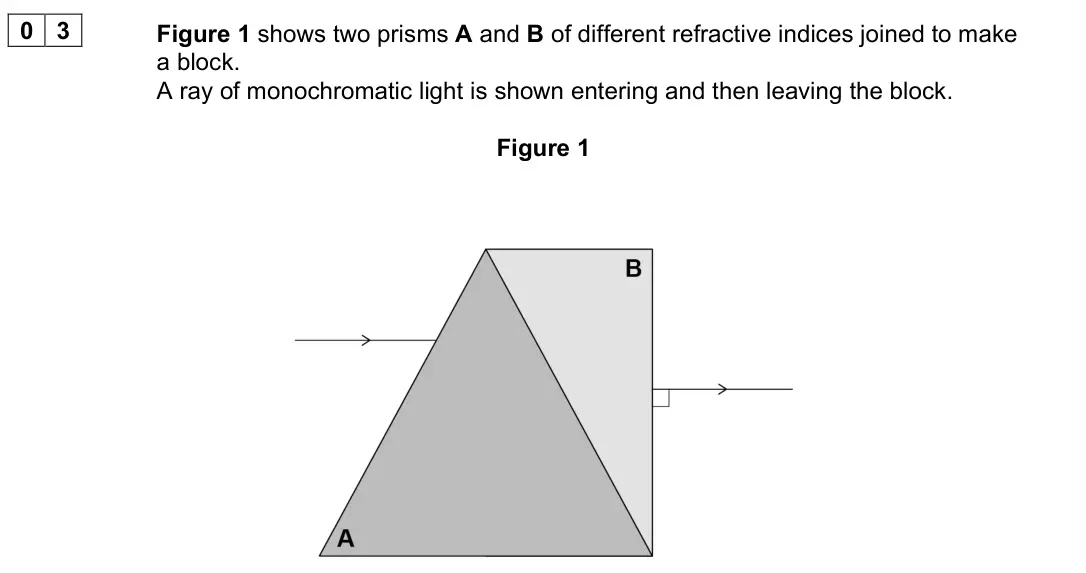
Q03.4
The whole paper ↗Q03.5
The whole paper ↗Q02.1
The whole paper ↗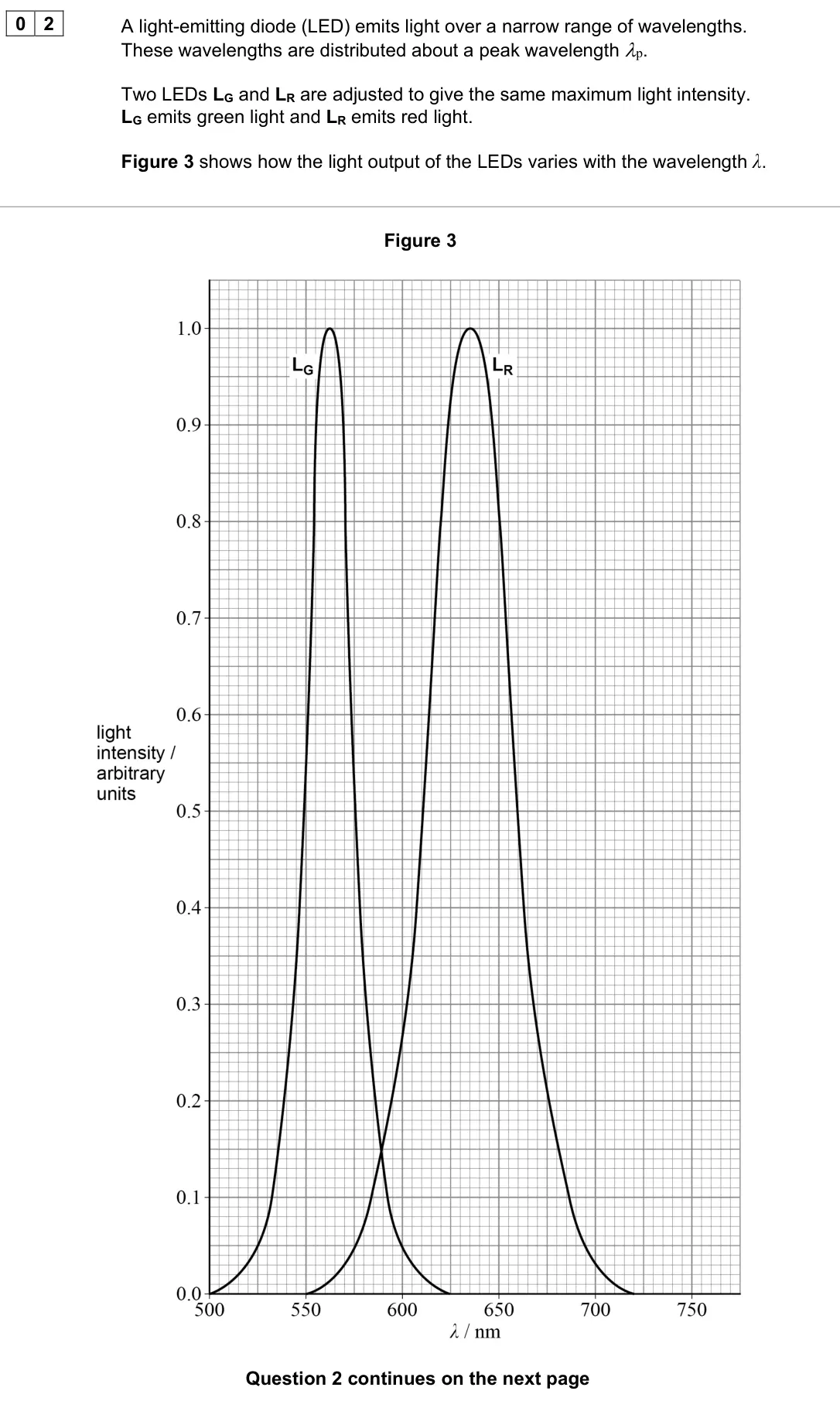
Q02.2
The whole paper ↗Q02.1
The whole paper ↗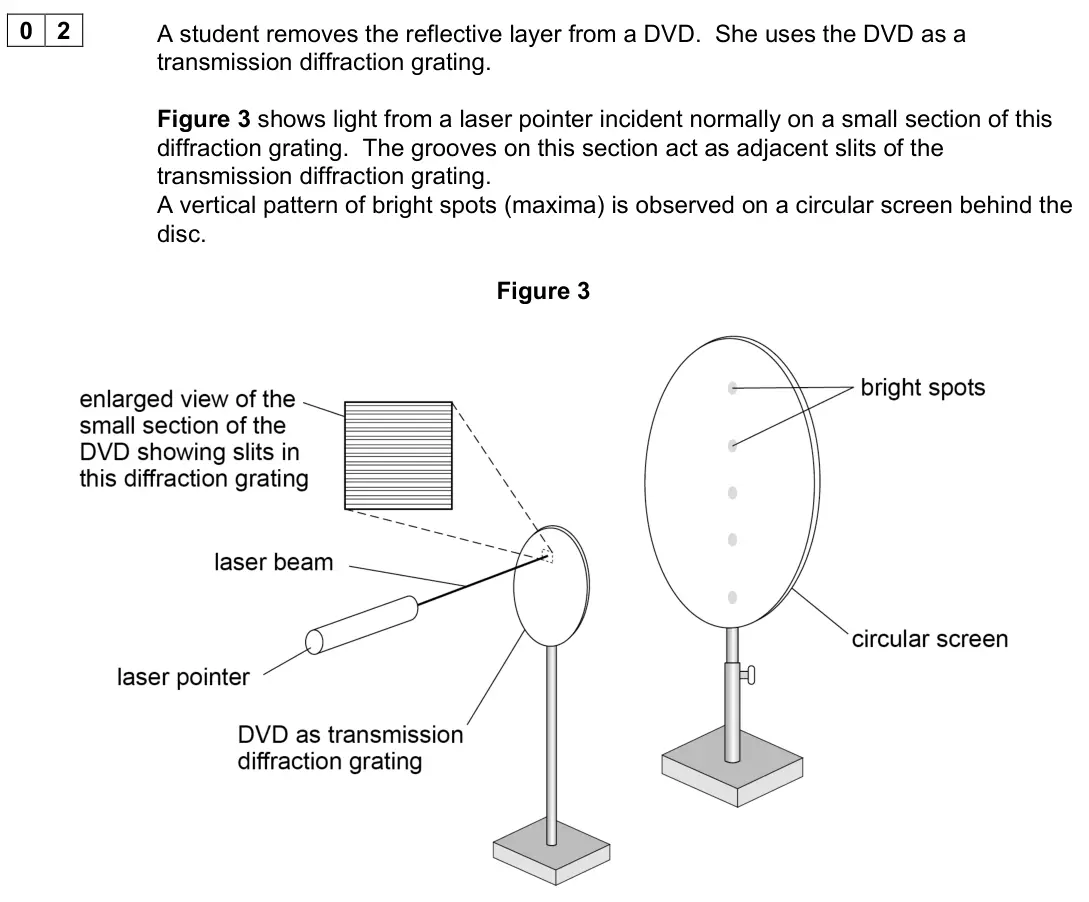
Q02.2
The whole paper ↗Q02.3
The whole paper ↗
All 75 questions on Diffraction, as a list
- June 2025, Paper 1, Q15 (1 mark): A student derives the equation nλ = dsinθ for the production of a diffraction pattern on a screen. This derivation requires that: [1 mark] A the diffraction ang
- June 2025, Paper 1, Q20 (1 mark): Monochromatic light of wavelength 420 nm is incident normally on a plane transmission diffraction grating that has a slit separation of 3.6 μm. What is the tota
- June 2025, AS Paper 2, Q01.2 (2 marks): C is the central maximum. Determine ∆x, the distance between C and the spot at the second-order maximum. Go on to determine the percentage uncertainty in ∆x. [2
- June 2025, AS Paper 2, Q01.3 (3 marks): When the readings in Table 1 were taken, the distance between the grating and the paper was 1.20 m. The grating has 300 lines per mm. Determine an accurate valu
- June 2025, AS Paper 2, Q01.4 (2 marks): The student changes the distance between the grating and the paper so that B and D are at the edges of the paper as shown in Figure 2. The paper and diffraction
- June 2024, Paper 1, Q03.3 (1 mark): Describe one non-astronomical application of a diffraction grating. [1 mark]
- June 2024, Paper 1, Q03.4 (3 marks): Figure 2 shows a spectrum of light. Two lines in the spectrum are labelled X and Y. Figure 2 The light passes at normal incidence through a diffraction grating.
- June 2024, Paper 1, Q03.5 (3 marks): A scientist wants to obtain an accurate value for the difference in wavelength between line X and line Y. She has two options: • option 1: to analyse the second
- June 2024, AS Paper 2, Q07 (1 mark): Monochromatic light of wavelength 520 nm is incident normally on a diffraction grating. The third-order maximum occurs at a diffraction angle θ. Light of wavele
- June 2023, Paper 1, Q17 (1 mark): A single narrow slit is illuminated with monochromatic light and a diffraction pattern is produced. The slit width is increased. What happens to the width and b
- June 2023, AS Paper 2, Q05 (1 mark): [multiple choice] Light of wavelength λ is incident normally on a diffraction grating. The separation between adjacent slits is equal to 5λ. What is the smalles
- June 2023, AS Paper 2, Q25 (1 mark): A central diffraction maximum is observed when monochromatic light of wavelength λ passes through a single slit of width s. Which combination of changes to λ an
- June 2022, Paper 1, Q21 (1 mark): Monochromatic light of wavelength 5.8 × 10⁻⁷ m is incident normally on a plane transmission diffraction grating that has a slit separation of 2.5 × 10⁻⁶ m. How
- June 2022, AS Paper 2, Q19 (1 mark): Monochromatic visible light is incident normally on a plane transmission diffraction grating that has 4.8 × 10⁵ lines m−1. First-order maxima are observed at an
- November 2021, Paper 1, Q19 (1 mark): A diffraction grating is illuminated normally. The second-order maximum for light of wavelength 650 nm occurs at the same angle as the third-order maximum for l
- November 2021, Paper 3A, Q02.1 (3 marks): Light from LR is incident normally on a plane diffraction grating. The fifth-order maximum for light of wavelength p occurs at a diffraction angle of 76.3°. Det
- November 2021, Paper 3A, Q02.2 (1 mark): Suggest one possible disadvantage of using the fifth-order maximum to determine N. [1 mark]
- November 2021, AS Paper 1, Q02.1 (1 mark): Light of wavelength λ travels from each illuminated slit, producing maxima on the screen. State the path difference between light from adjacent slits when this
- November 2021, AS Paper 1, Q02.2 (3 marks): Explain how light from the diffraction grating forms a maximum on the screen. [3 marks]
- November 2021, AS Paper 1, Q02.3 (2 marks): Deduce the combination of disc and laser pointer that will produce the greatest possible number of interference maxima. [2 marks]
- November 2021, AS Paper 1, Q02.4 (3 marks): The student uses the CD and laser pointer B as shown in Figure 4. A diffraction pattern is produced on the screen. Laser pointer B and the CD are in fixed posit
- November 2020, Paper 1, Q19 (1 mark): Monochromatic light is incident normally on a diffraction grating that has 4.50 × 10⁵ lines m−1. The angle between the second-order diffraction maxima is 44°. W
- November 2020, AS Paper 2, Q15 (1 mark): A narrow beam of monochromatic light is incident normally to a diffraction grating. The first-order diffracted beam makes an angle of 20° with the normal to the
- June 2019, Paper 1, Q03.1 (2 marks): Describe the pattern produced on the screen. [2 marks]
- June 2019, Paper 1, Q03.2 (2 marks): The green filter is replaced with a red filter. Describe the change in the pattern produced on the screen. [2 marks]
- June 2019, Paper 1, Q03.3 (2 marks): A diffraction grating is placed between the red filter and the screen. The diffraction grating has 500 lines per millimetre. Light is incident normally on the g
- June 2019, Paper 1, Q03.4 (2 marks): In practice, the filter transmits red light with wavelengths in the range 600 nm to 700 nm. Suggest how this affects the appearance of the maxima. [2 marks]
- June 2019, AS Paper 2, Q01.5 (1 mark): Figure 2 shows the experimental arrangement with y, the perpendicular distance between the diffraction grating and the screen, equal to 1.280 m. Table 2 shows s
- June 2019, AS Paper 2, Q01.6 (2 marks): Spot E is the second-order maximum. The diffraction grating has 3.00 × 10⁵ lines per metre. Calculate the wavelength of the laser light. [2 marks] wavelength =
- June 2019, AS Paper 2, Q01.7 (2 marks): The student plans to repeat the experiment using the same diffraction grating and laser. State and explain one way the student can change the experimental arran
- June 2019, AS Paper 2, Q19 (1 mark): Monochromatic electromagnetic radiation of wavelength 5.8 × 10⁻⁷ m is incident normally on a diffraction grating with 3.0 × 10⁵ lines per metre. What is the hig
- June 2019, AS Paper 2, Q21 (1 mark): Which is a description of the pattern produced when monochromatic light passes through a very narrow slit? [1 mark] A A series of equally-spaced light and dark
- June 2018, Paper 1, Q17 (1 mark): A diffraction grating has 500 lines per mm. When monochromatic light is incident normally on the grating the third-order spectral line is formed at an angle of
- June 2018, AS Paper 2, Q18 (1 mark): A diffraction grating is illuminated normally with light of wavelength 6.5 × 10⁻⁷ m When a screen is 1.5 m from the grating, the distance between the zero and f
- June 2017, Paper 1, Q16 (1 mark): When a monochromatic light source is incident on two slits of the same width an interference pattern is produced. One slit is then covered with opaque black pap
- June 2017, Paper 1, Q17 (1 mark): When light of wavelength 5.0 × 10⁻⁷ m is incident normally on a diffraction grating the fourth-order maximum is observed at an angle of 30°. What is the number
- June 2017, AS Paper 2, Q25 (1 mark): Intensity maxima are produced on a screen when a parallel beam of monochromatic light is incident on a diffraction grating. Light of a longer wavelength can be
- June 2017, AS Paper 2, Q27 (1 mark): Light of wavelength 500 nm is passed through a diffraction grating which has 400 lines per mm. What is the angular separation between the two second-order maxim
- June 2016, AS Paper 2, Q14 (1 mark): In a diffraction-grating experiment the maxima are produced on a screen. What causes the separation of the maxima of the diffraction pattern to decrease? [1 mar
- June 2016, AS Paper 2, Q15 (1 mark): White light passes through a single narrow slit and illuminates a screen. What is observed on the screen? [1 mark] A a set of equally spaced white fringes B a c
- Specimen, Paper 1, Q06.1 (1 mark): Read through the following passage and answer the questions that follow it. Measuring the speed of sound in air 5 10 After the wave nature of sound had been ide
- Specimen, Paper 1, Q17 (1 mark): Monochromatic light of wavelength 490 nm falls normally on a diffraction grating that has 6 x 10⁵ lines per metre. Which one of the following is correct? [1 mar
- Specimen, Paper 2, Q06.3 (3 marks): Read the following passage and answer the questions that follow Satellites used for telecommunications are usually in geostationary orbits. Using suitable dishe
- June 2016, PHYA2 (old spec), Q6(d) (3 marks): narrow gap microphone wall signal generator oscilloscope not to scale A B 6 (d) In an investigation, a single loudspeaker is positioned behind a wall with a nar
- June 2016, PHYA2 (old spec), Q7(a) (1 mark): Which colour would be observed first as the telescope is rotated from the straight-through position? Place a tick () in the right-hand column to show the corre
- June 2016, PHYA2 (old spec), Q7(b) (3 marks): Explain how a bright line is formed by the diffraction grating at the first-order diffraction angle. [3 marks] _________________________________________________
- June 2016, PHYA2 (old spec), Q7(c)(i) (2 marks): The wavelength of the green light is 5.3 × 10⁻⁷ m. Calculate the first-order diffraction angle for this colour. [2 marks] angle = _______________________ degree
- June 2016, PHYA2 (old spec), Q7(c)(ii) (3 marks): As the telescope is rotated further, higher-order diffraction maxima are observed. Calculate the highest order observed for the green light. [3 marks] highest o
- June 2014, PHYA2 (old spec), Q6(a) (1 mark): Give one possible application of the spectrometer and diffraction grating used in this way. [1 mark] Figure 6 diffracted beam telescope diffraction grating sour
- June 2014, PHYA2 (old spec), Q6(b)(i) (1 mark): When the spectrometer telescope is rotated from an initial angle of zero degrees, a spectrum is not observed until the angle of diffraction θ is about 50º. Stat
- June 2014, PHYA2 (old spec), Q6(b)(ii) (1 mark): White light is directed into the spectrometer. Light emerges at A and B. State one difference between the light emerging at B compared to that emerging at A. [1
- June 2014, PHYA2 (old spec), Q6(c) (3 marks): The angle of diffraction θ at the centre of the observed beam B in Figure 6 is 51.0º and the grating has 1480 lines per mm. Calculate the wavelength of the ligh
- June 2014, PHYA2 (old spec), Q6(d) (2 marks): Determine by calculation whether any more orders could be observed at the wavelength calculated in part (c). [2 marks]
- June 2013, PHYA2 (old spec), Q7(b) (2 marks): Figure 9 shows a laser emitting blue light directed at a single slit, where the slit width is greater than the wavelength of the light. The intensity graph for
- June 2013, PHYA2 (old spec), Q7(d) (3 marks): Copyright © 2013 AQA and its licensors. All rights reserved. 7 (d) The red laser light is replaced by a non-laser source emitting white light. Describe how the
- January 2012, PHYA2 (old spec), Q5(a) (3 marks): In an experiment, a narrow beam of white light from a filament lamp is directed at normal incidence at a diffraction grating. Complete the diagram in Figure 5 t
- January 2012, PHYA2 (old spec), Q5(b) (2 marks): Light from a star is passed through the grating. Explain how the appearance of the first-order beam can be used to deduce one piece of information about the gas
- January 2012, PHYA2 (old spec), Q5(c)(i) (2 marks): Draw a labelled diagram of a suitable arrangement to carry out this experiment. (2 marks)
- January 2012, PHYA2 (old spec), Q5(c)(ii) (6 marks): Describe the necessary procedure in order to obtain an accurate and reliable value for the wavelength of the laser light. Your answer should include details of
- January 2011, PHYA2 (old spec), Q3(a) (2 marks): On Figure 3, sketch how the intensity varies across the screen to the right of the central maximum. (2 marks)
- January 2011, PHYA2 (old spec), Q3(c) (1 mark): Describe how the pattern would change if light of a longer wavelength was used. (1 mark)
- January 2011, PHYA2 (old spec), Q3(d) (2 marks): State two ways in which the appearance of the fringes would change if the slit was made narrower. (2 marks)
- January 2011, PHYA2 (old spec), Q3(e) (3 marks): The laser is replaced with a lamp that produces a narrow beam of white light. Sketch and label the appearance of the fringes as you would see them on a screen.
- June 2010, PHYA2 (old spec), Q6(a) (2 marks): Figure 6 shows two of the slits in the grating. Label Figure 6 with the distances d and λ. (2 marks) Figure 6 e e monochromatic light direction of first order b
- June 2010, PHYA2 (old spec), Q6(b) (2 marks): State and explain what happens to the value of angle θ for the first order beam if the wavelength of the monochromatic light decreases. (2 marks)
- June 2010, PHYA2 (old spec), Q6(d)(i) (1 mark): Calculate the distance between the centres of two adjacent slits on this grating. answer = m (1 mark)
- June 2010, PHYA2 (old spec), Q6(d)(ii) (2 marks): Calculate the first order angle of diffraction of line P in Figure 7. answer = degrees (2 marks)
- June 2009, PHYA2 (old spec), Q7(a)(i) (4 marks): Calculate the angle of diffraction of the second order diffracted beam. answer degrees (4 marks)
- June 2009, PHYA2 (old spec), Q7(a)(ii) (3 marks): Show that no beams higher than the second order can be observed at this wavelength. (3 marks)
- June 2009, PHYA2 (old spec), Q7(b) (2 marks): The light source is replaced by a monochromatic light source of unknown wavelength. A narrow beam of light from this light source is directed normally at the gr
- January 2009, PHYA2 (old spec), Q7(a)(i) (1 mark): Light passing through each slit spreads out. What is the name for this effect? (1 mark)
- June 2008, PA04A (2008 spec), Q5 (2 marks): 5 Light of wavelength 590 nm is incident normally on a diffraction grating with 500 lines per mm. What is the maximum number of orders that will be observed in
- June 2008, PA04B (2008 spec), Q2(a) (4 marks): 2 (a) You may be awarded additional marks to those shown in brackets for the in your answer. Describe, with the aid of a diagram, the appearance of 2 (a) (i) th
- June 2008, PA10 (2008 spec), Q5(b) (6 marks): 5 (b) A transmission diffraction grating has 600 lines per millimetre. A narrow beam of light from a sodium vapour lamp is passed through the diffraction gratin
- January 2008, PA04A (2008 spec), Q7 (2 marks): 7 Light of wavelength λ is incident normally on a diffraction grating of slit separation 4 λ. What is the angle between the second order maximum and third order
Questions, mark schemes and examiner’s reports are © AQA, from their published past papers. Plumi isn’t affiliated with any exam board. Want whole papers? AQA A-Level Physics past papers.
The Plumi iPad app also offers exam-style questions with AI feedback on your handwritten working.