 plumi
Data communication systems: AQA A‑Level Physics questions
Every AQA A-Level Physics exam question on 3.13.6 Data communication systems, 2016–2025, with its mark scheme and examiner’s report.
Find questions2,714
Calculations
Q04.1
The whole paper ↗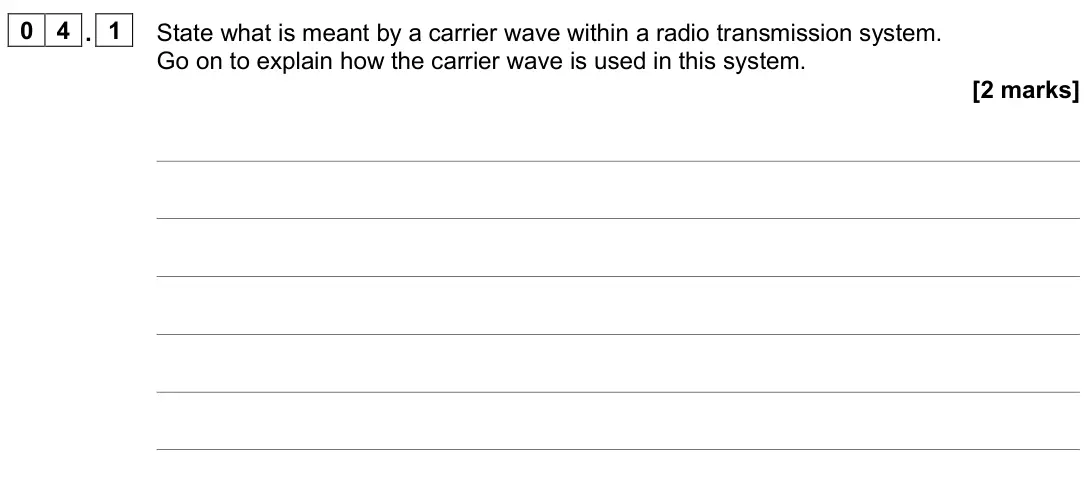
Q02.2
The whole paper ↗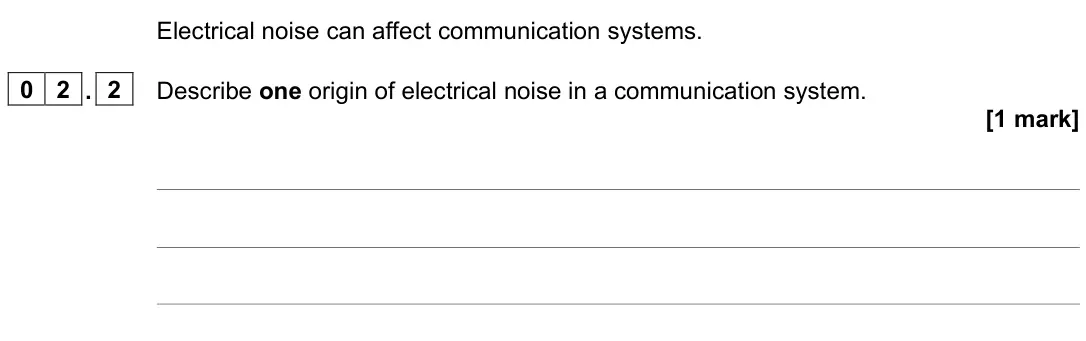
Q02.3
The whole paper ↗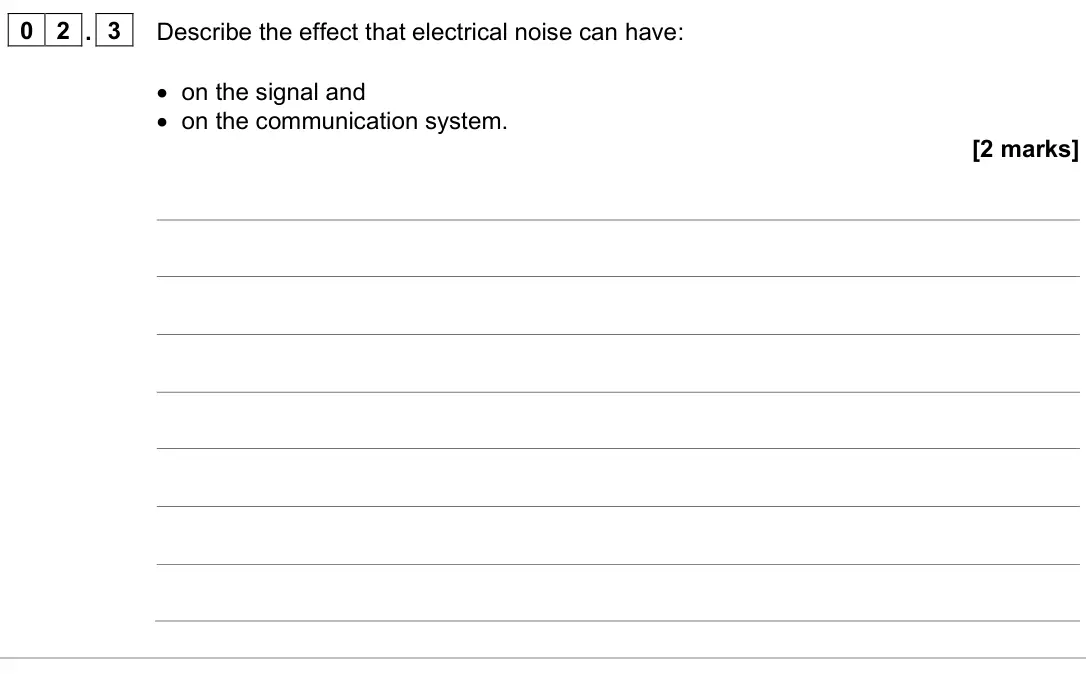
Q03.3
The whole paper ↗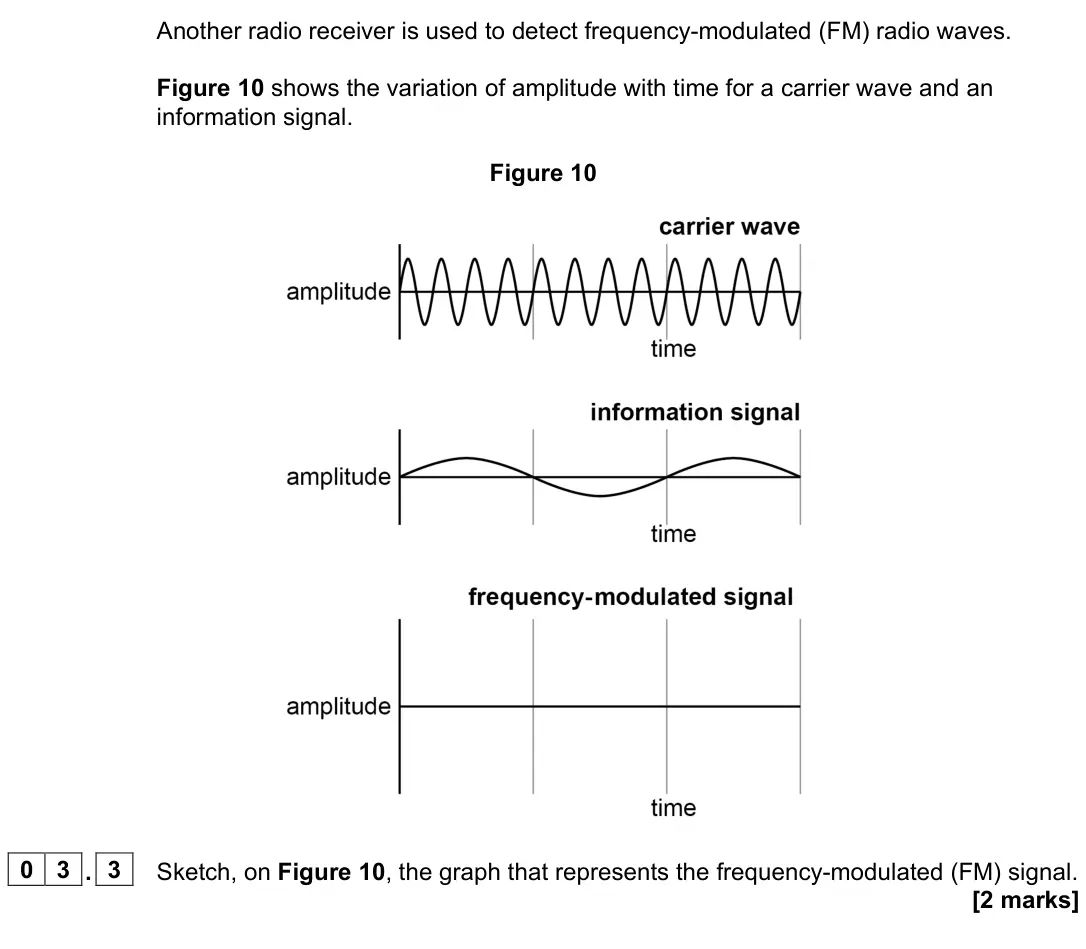
Q03.4
The whole paper ↗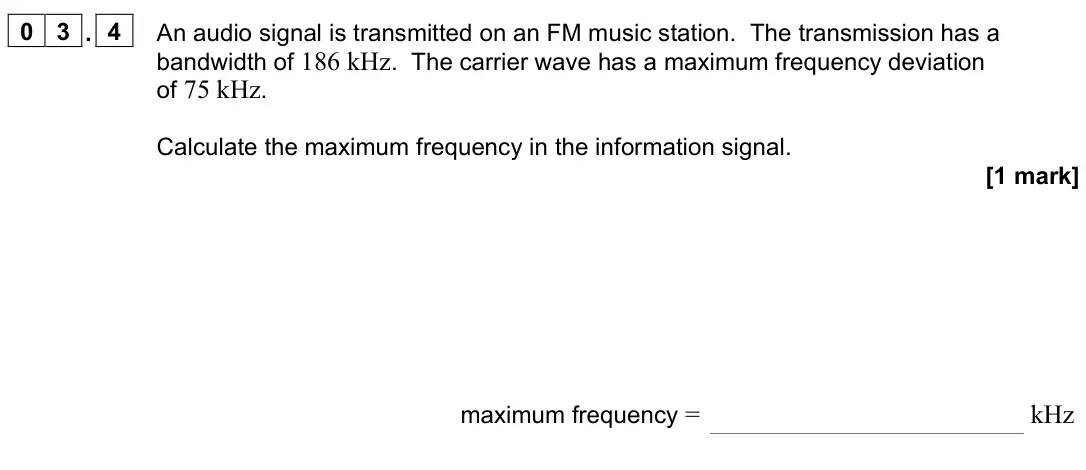
Q03.1
The whole paper ↗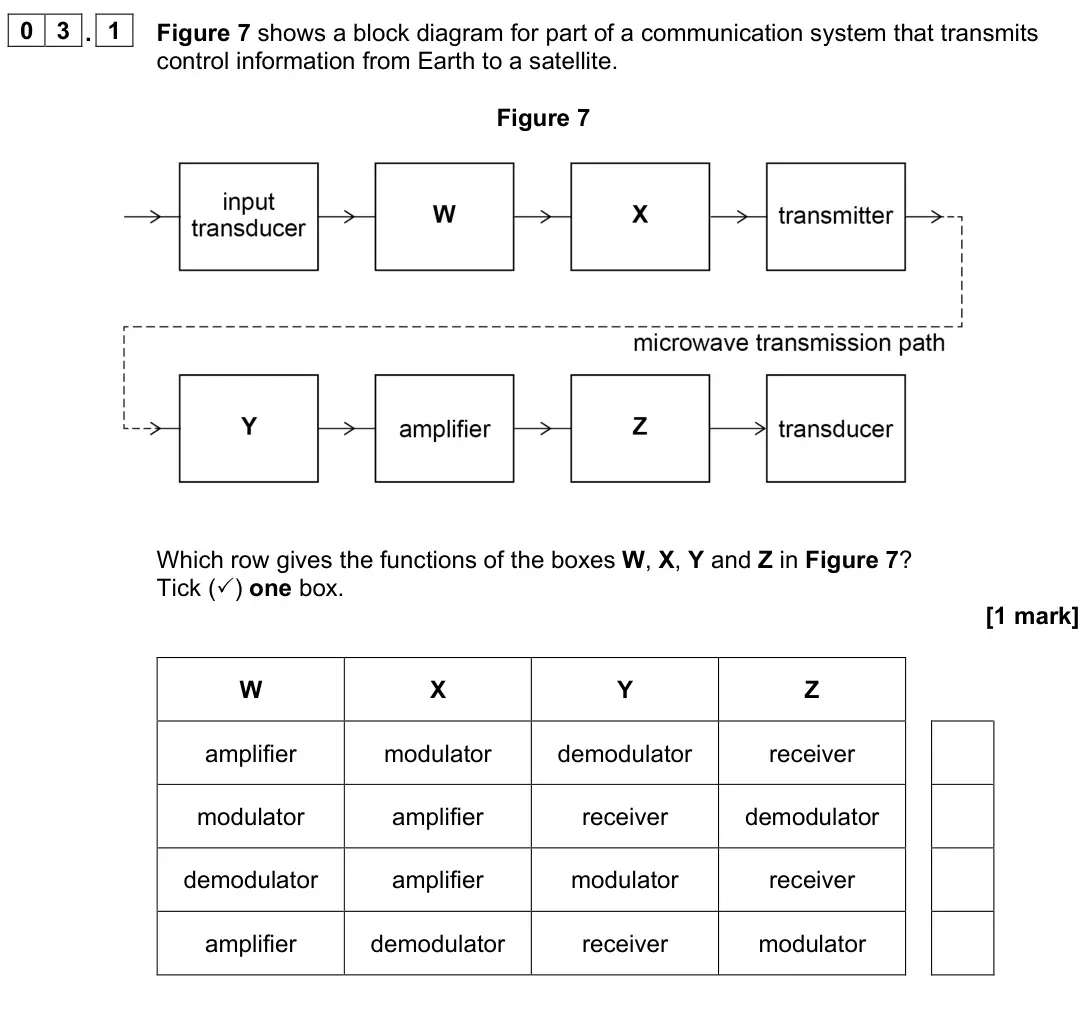
Q03.2
The whole paper ↗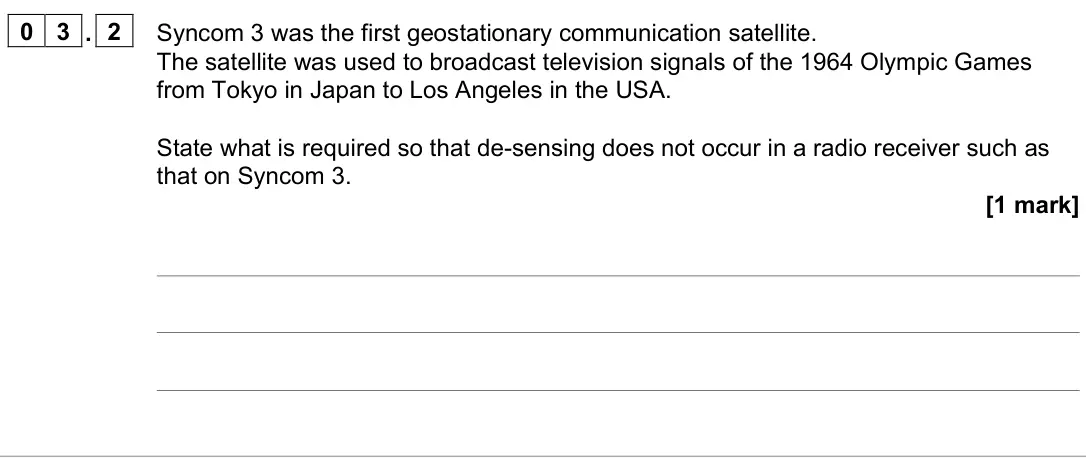
Q03.3
The whole paper ↗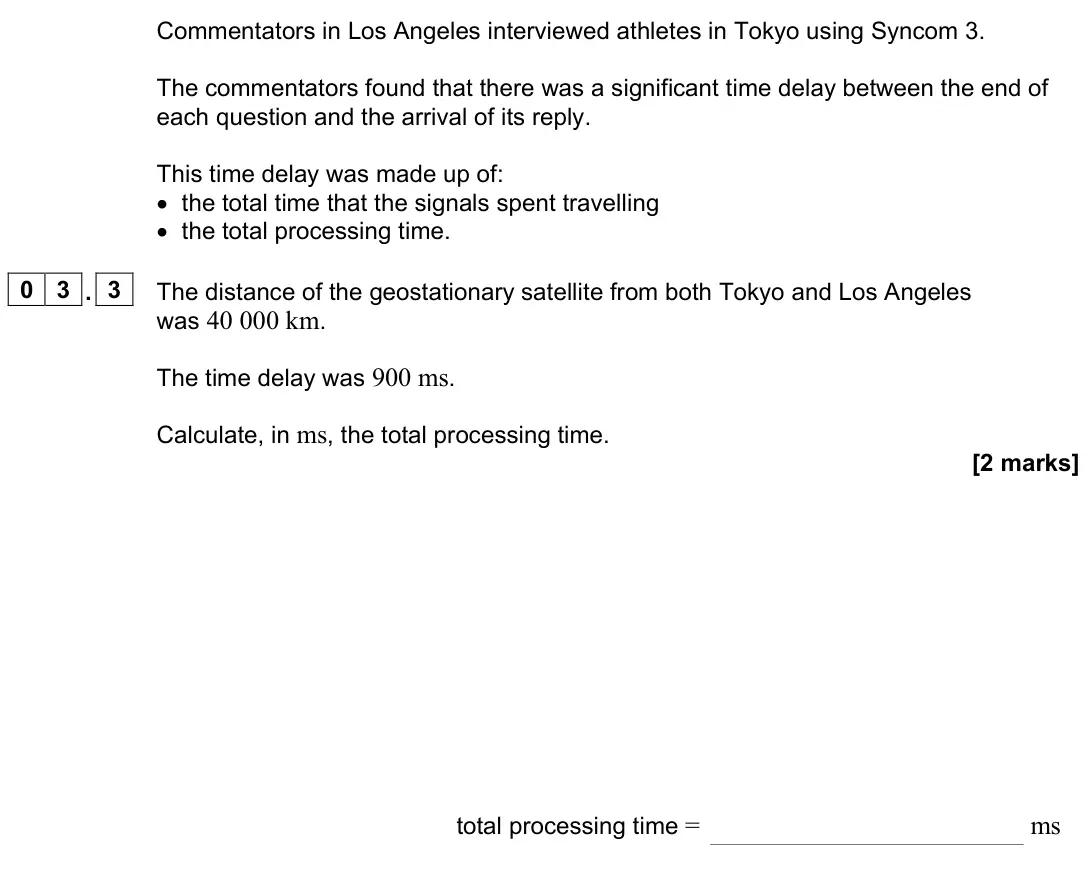
Q03.4
The whole paper ↗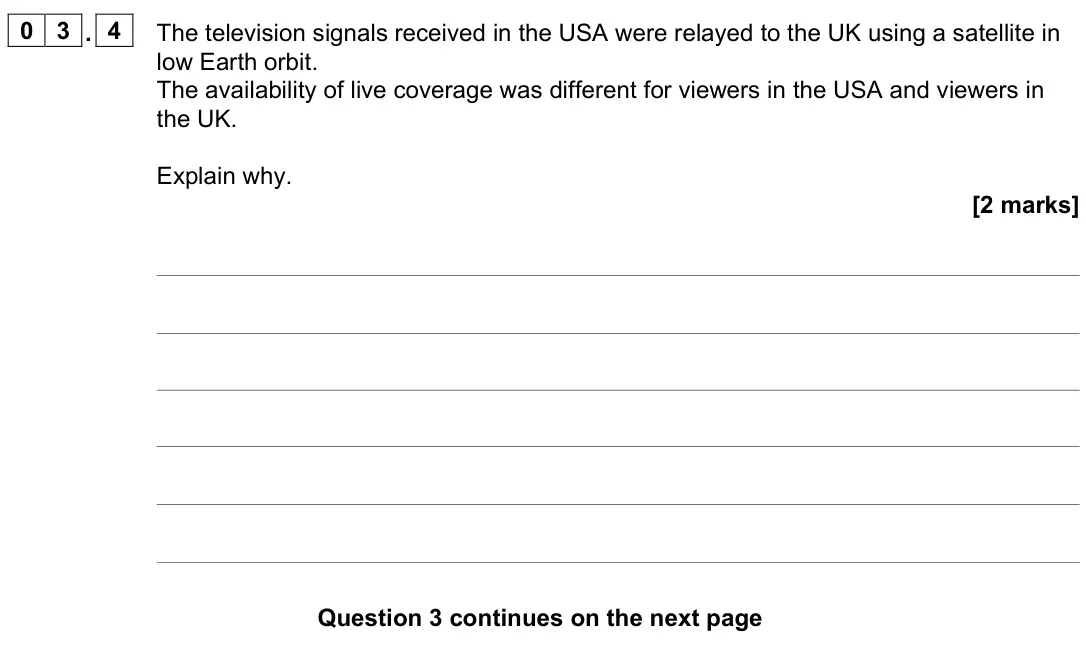
Q03.5
The whole paper ↗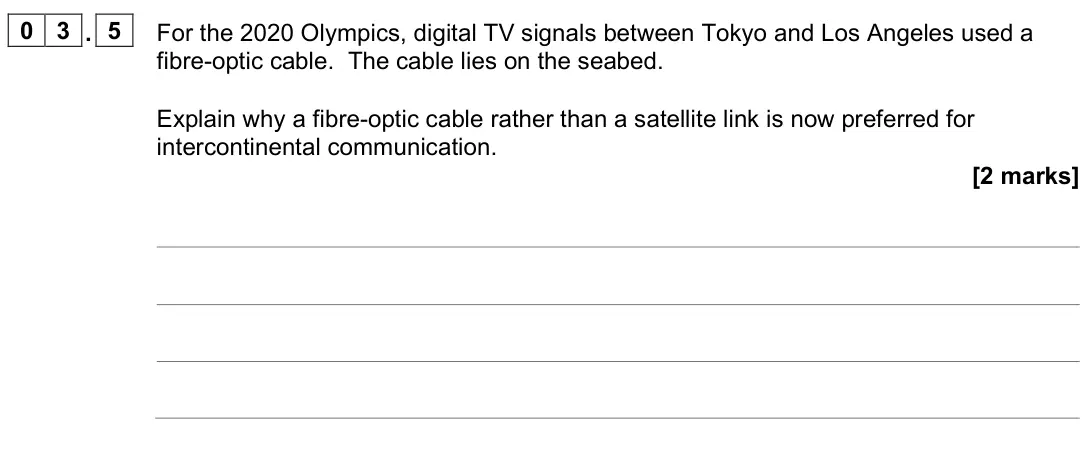
Q03.1
The whole paper ↗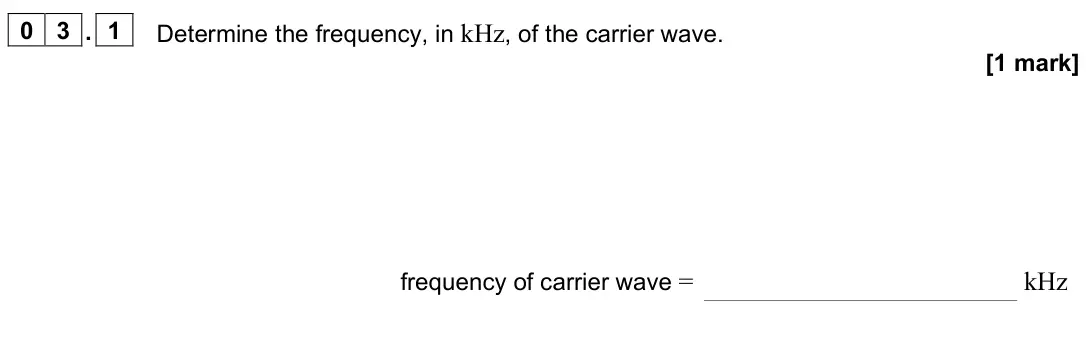
Q03.2
The whole paper ↗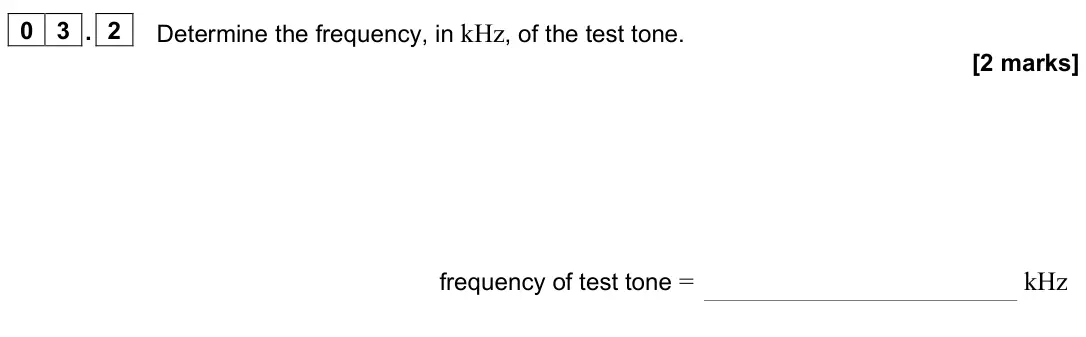
Q03.3
The whole paper ↗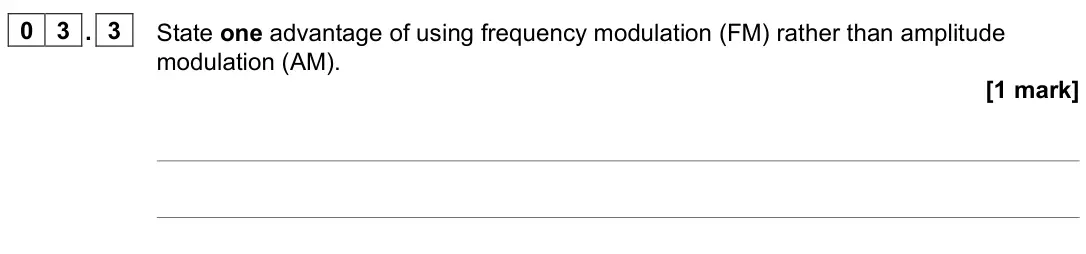
Q03.4
The whole paper ↗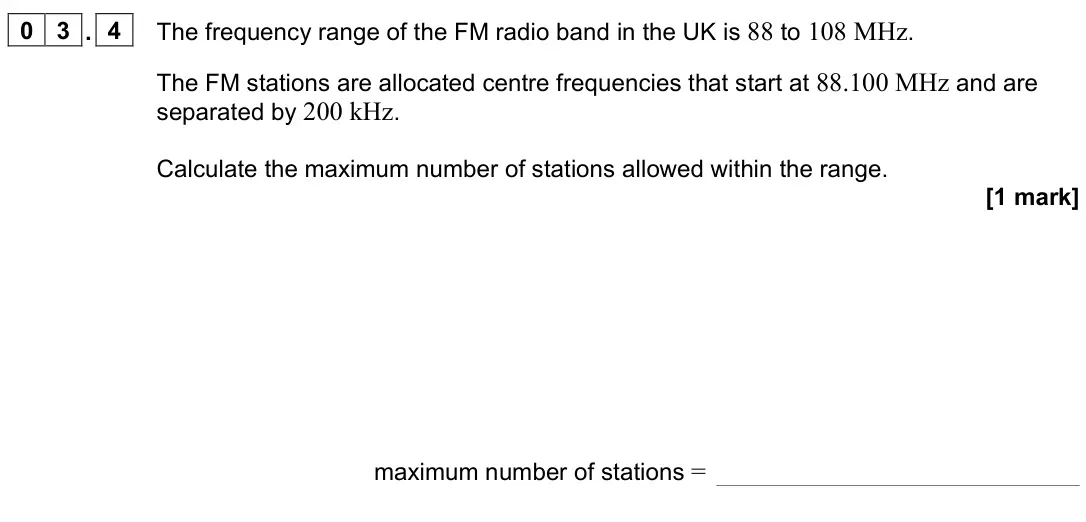
Q03.5
The whole paper ↗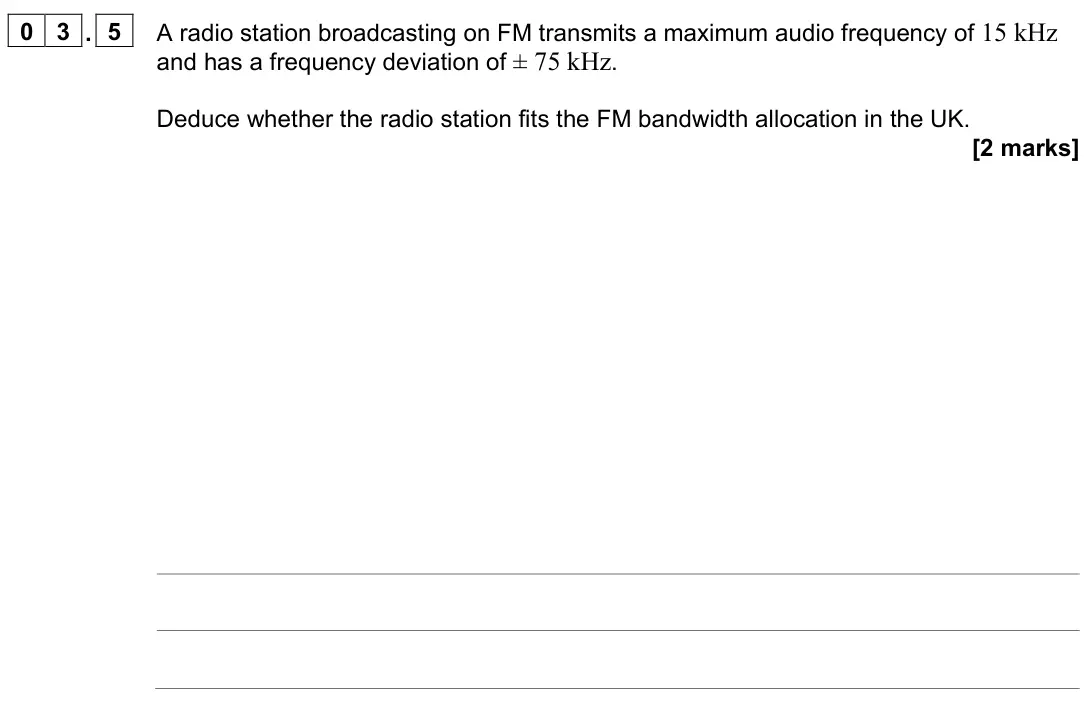
All 33 questions on Data communication systems, as a list
- June 2025, Paper 3 Electronics, Q04.1 (2 marks): State what is meant by a carrier wave within a radio transmission system. Go on to explain how the carrier wave is used in this system. [2 marks]
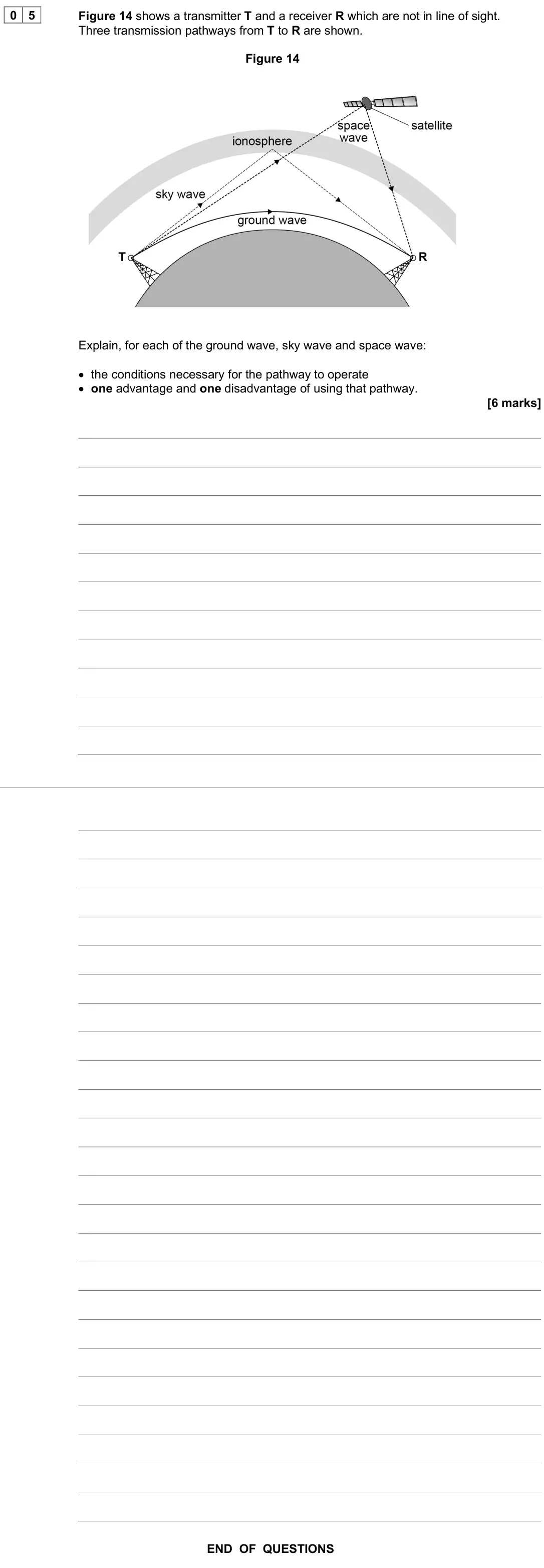
- June 2025, Paper 3 Electronics, Q05 (6 marks): Figure 14 shows a transmitter T and a receiver R which are not in line of sight. Three transmission pathways from T to R are shown. Figure 14 Explain, for each
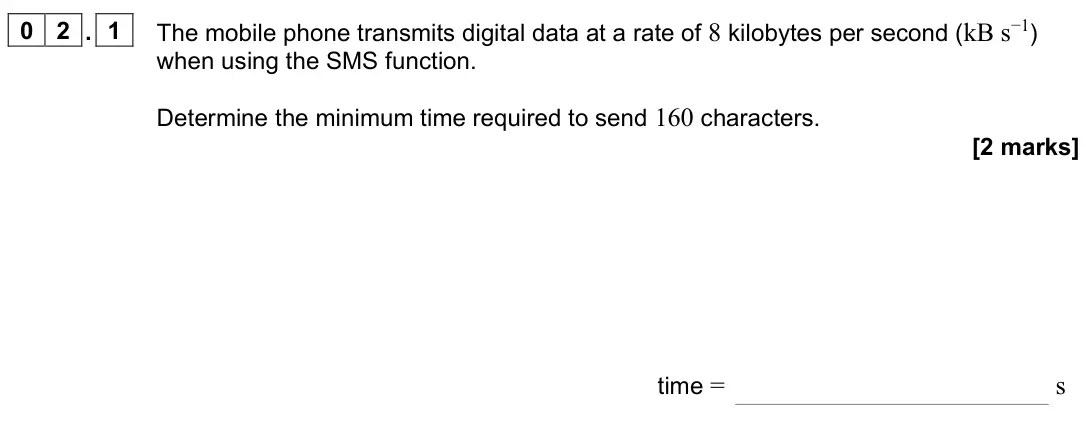
- June 2024, Paper 3 Electronics, Q02.1 (2 marks): The mobile phone transmits digital data at a rate of 8 kilobytes per second (kB s−1) when using the SMS function. Determine the minimum time required to send 16
- June 2024, Paper 3 Electronics, Q02.2 (1 mark): Describe one origin of electrical noise in a communication system. [1 mark]
- June 2024, Paper 3 Electronics, Q02.3 (2 marks): Describe the effect that electrical noise can have: • on the signal and • on the communication system. [2 marks]
- June 2024, Paper 3 Electronics, Q03.3 (2 marks): Sketch, on Figure 10, the graph that represents the frequency-modulated (FM) signal. [2 marks]
- June 2024, Paper 3 Electronics, Q03.4 (1 mark): An audio signal is transmitted on an FM music station. The transmission has a bandwidth of 186 kHz. The carrier wave has a maximum frequency deviation of 75 kHz
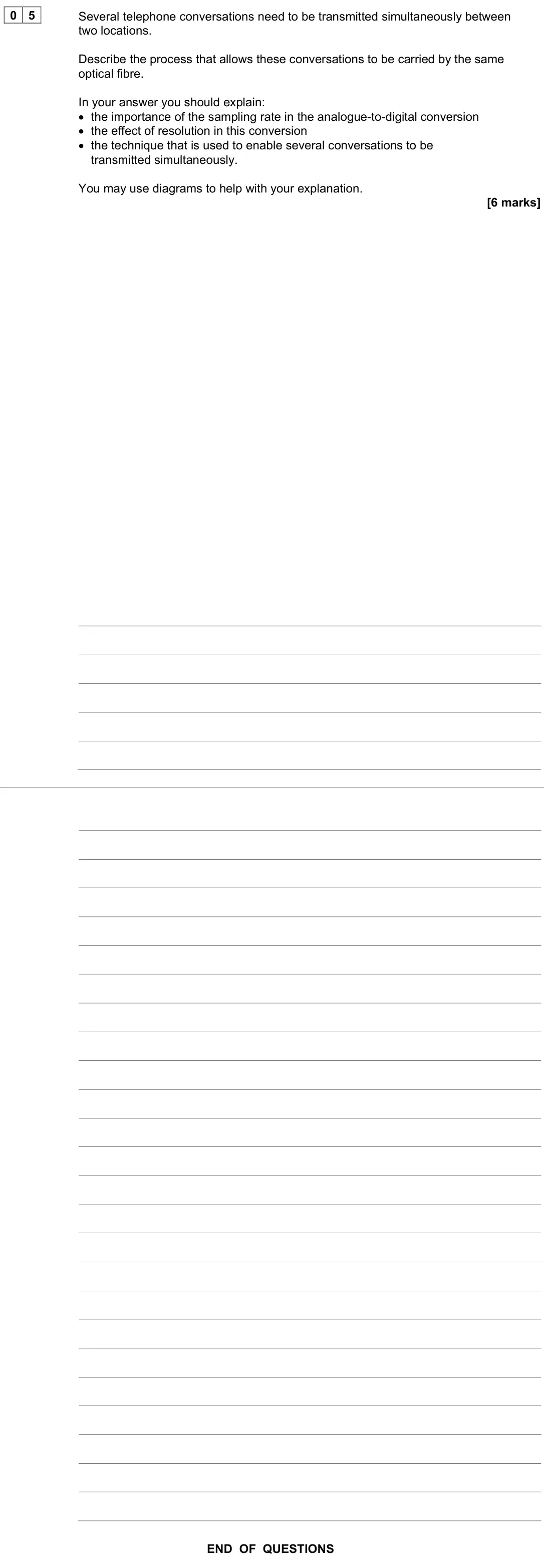
- June 2024, Paper 3 Electronics, Q05 (6 marks): Several telephone conversations need to be transmitted simultaneously between two locations. Describe the process that allows these conversations to be carried
- June 2023, Paper 3 Electronics, Q03.1 (1 mark): Figure 7 shows a block diagram for part of a communication system that transmits control information from Earth to a satellite. Figure 7 Which row gives the fun
- June 2023, Paper 3 Electronics, Q03.2 (1 mark): Syncom 3 was the first geostationary communication satellite. The satellite was used to broadcast television signals of the 1964 Olympic Games from Tokyo in Jap
- June 2023, Paper 3 Electronics, Q03.3 (2 marks): The distance of the geostationary satellite from both Tokyo and Los Angeles was 40 000 km. The time delay was 900 ms. Calculate, in ms, the total processing tim
- June 2023, Paper 3 Electronics, Q03.4 (2 marks): The television signals received in the USA were relayed to the UK using a satellite in low Earth orbit. The availability of live coverage was different for view
- June 2023, Paper 3 Electronics, Q03.5 (2 marks): For the 2020 Olympics, digital TV signals between Tokyo and Los Angeles used a fibre-optic cable. The cable lies on the seabed. Explain why a fibre-optic cable
- June 2022, Paper 3 Electronics, Q03.1 (1 mark): Determine the frequency, in kHz, of the carrier wave. [1 mark] frequency of carrier wave = kHz
- June 2022, Paper 3 Electronics, Q03.2 (2 marks): Determine the frequency, in kHz, of the test tone. [2 marks] frequency of test tone = kHz
- June 2022, Paper 3 Electronics, Q03.3 (1 mark): State one advantage of using frequency modulation (FM) rather than amplitude modulation (AM). [1 mark]
- June 2022, Paper 3 Electronics, Q03.4 (1 mark): The frequency range of the FM radio band in the UK is 88 to 108 MHz. The FM stations are allocated centre frequencies that start at 88.100 MHz and are separated
- June 2022, Paper 3 Electronics, Q03.5 (2 marks): A radio station broadcasting on FM transmits a maximum audio frequency of 15 kHz and has a frequency deviation of ± 75 kHz. Deduce whether the radio station fit
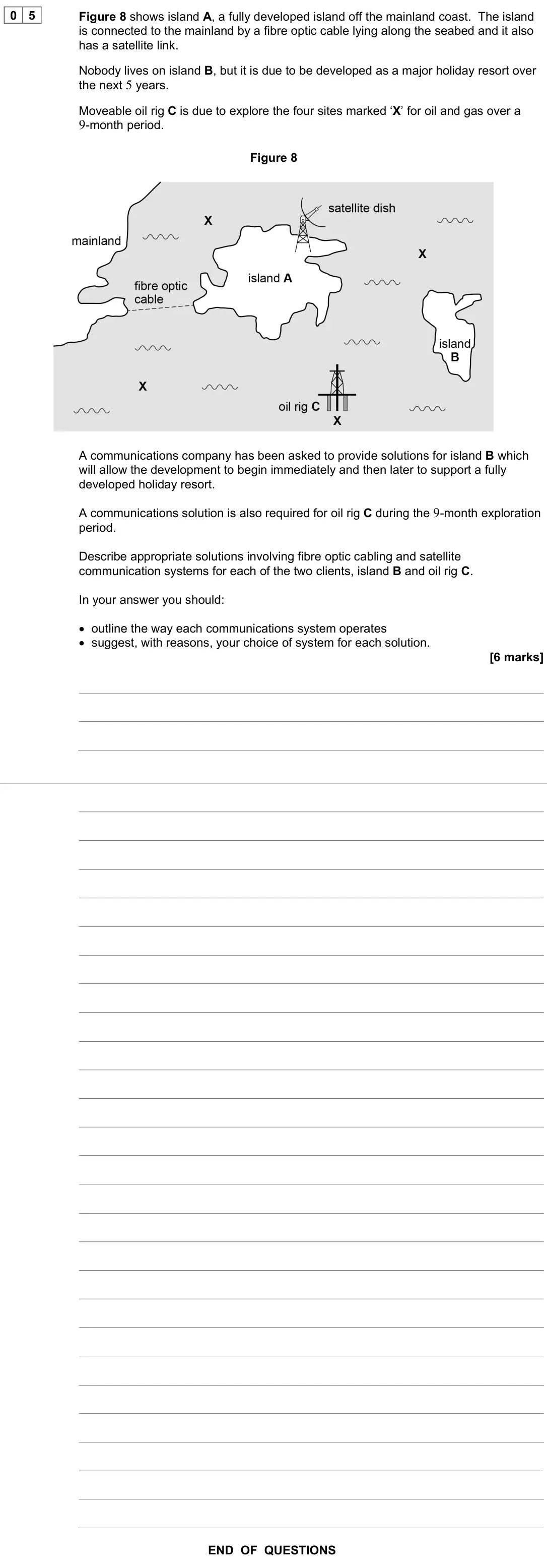
- June 2022, Paper 3 Electronics, Q05 (6 marks): Figure 8 shows island A, a fully developed island off the mainland coast. The island is connected to the mainland by a fibre optic cable lying along the seabed
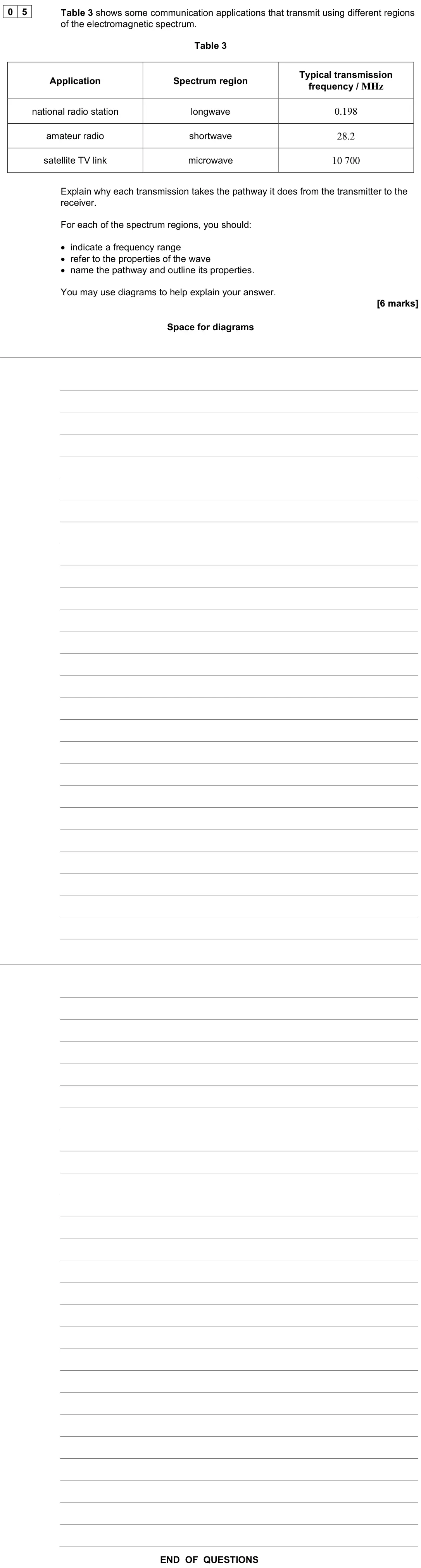
- November 2021, Paper 3 Electronics, Q05 (6 marks): Table 3 shows some communication applications that transmit using different regions of the electromagnetic spectrum. Table 3 Application Spectrum region Typical
- November 2020, Paper 3 Electronics, Q05 (6 marks): British embassies in Europe are to be connected to a new long-distance communication link. The link, in the form of a land-based cable, will support multiple si
- June 2019, Paper 3 Electronics, Q05 (6 marks): A telephone company transmits 15 speech channels across a single transmission link. The analogue information is first subjected to pulse code modulation (PCM) b
- June 2018, Paper 3 Electronics, Q03.1 (1 mark): State the letter representing the subsystem in which you might find an induced emf being generated. [1 mark]
- June 2018, Paper 3 Electronics, Q03.2 (1 mark): State the letter representing the subsystem where the audio and radio waves are combined. [1 mark]
- June 2018, Paper 3 Electronics, Q03.3 (1 mark): The signal strength at stage D must be amplified. Explain why the signal strength at stage D is weak. [1 mark]
- June 2018, Paper 3 Electronics, Q03.4 (1 mark): Figure 5 shows graphs of a radio carrier signal and a modulating sine wave. Figure 5 Complete the graph in Figure 5 to represent the combined amplitude modulate
- June 2018, Paper 3 Electronics, Q03.5 (3 marks): Approximately 20 radio stations use amplitude modulation (AM) to broadcast to people living in the London area. Another 35 AM stations broadcast to people outsi
- June 2017, Paper 3 Electronics, Q05 (6 marks): Discuss how longwave (LW), shortwave (SW) and microwave links can be used to communicate beyond the visible horizon. For each link, you should give: • a typical
- Specimen, Paper 3 Electronics, Q02.1 (1 mark): Describe what is meant by amplitude modulation (am). [1 mark] 0 2 . 1
- Specimen, Paper 3 Electronics, Q02.2 (1 mark): A radio wave has an unmodulated frequency of 120 kHz. It is amplitude modulated by a signal from an audio transducer of frequency 2.2 kHz. Calculate the bandwid
- Specimen, Paper 3 Electronics, Q02.3 (1 mark): Explain why frequency modulation (fm) is not used for commercial radio transmissions in the medium and long wave bands. [1 mark] 0 2 . 3
- Specimen, Paper 3 Electronics, Q02.4 (2 marks): State and explain one advantage of transmitting digital signals using frequency modulation (fm) rather than amplitude modulation (am). [2 marks] 0 2 . 4
- Specimen, Paper 3 Electronics, Q05 (6 marks): Compare the advantages and disadvantages of optic fibre and copper wire for transmitting information. [6 marks] 0 5
Questions, mark schemes and examiner’s reports are © AQA, from their published past papers. Plumi isn’t affiliated with any exam board. Want whole papers? Every AQA A-Level Physics paper.
Rather write your answers by hand on iPad? Plumi marks them against the same mark schemes.