 plumi
Wave-particle duality: AQA A‑Level Physics questions
Every AQA A-Level Physics exam question on 3.12.2 Wave-particle duality, 2016–2025, with its mark scheme and examiner’s report.
Find questions2,714
Calculations
Q02.1
The whole paper ↗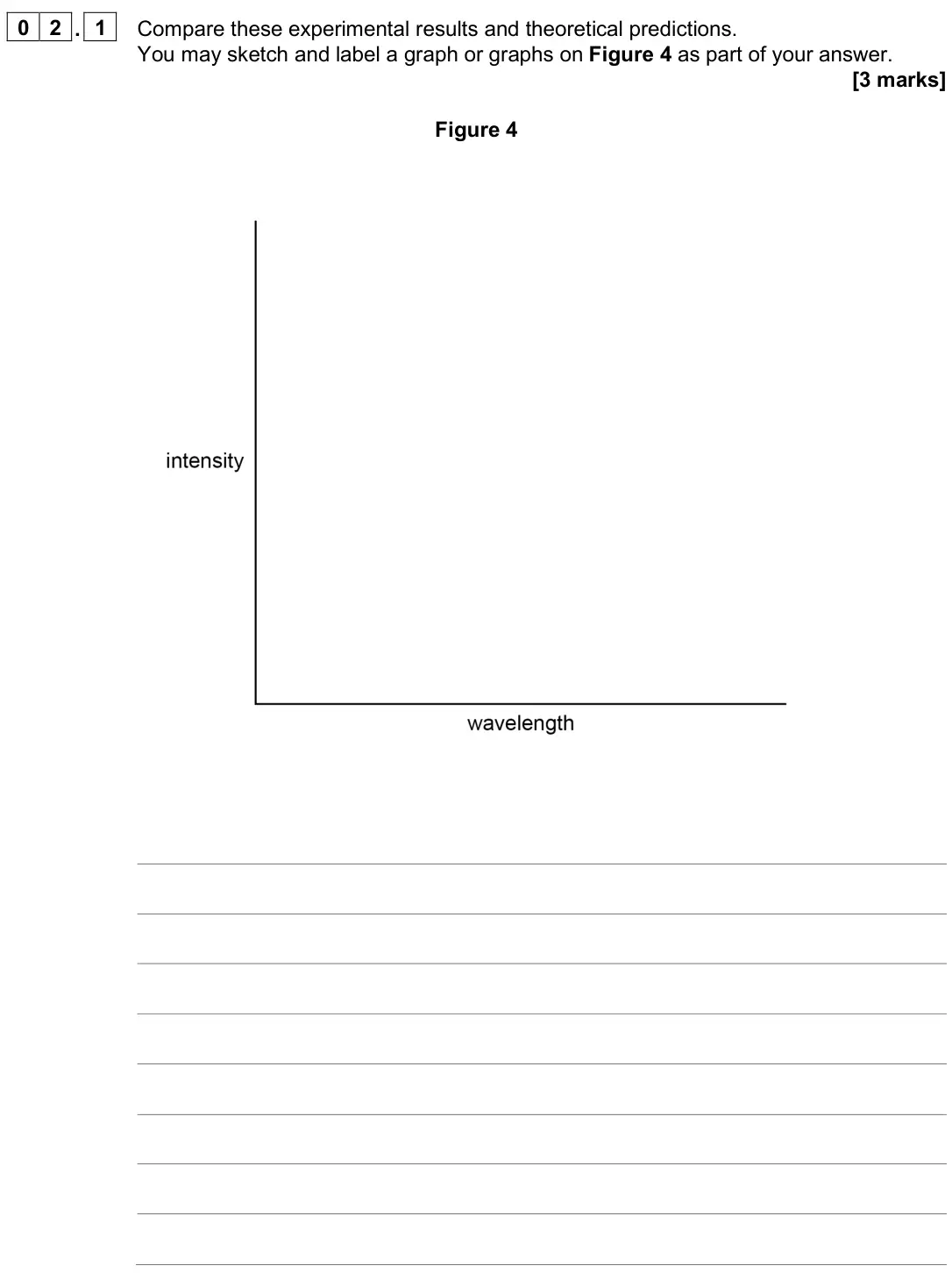
Q02.2
The whole paper ↗
Q01.3
The whole paper ↗
Q03.1
The whole paper ↗
Q03.2
The whole paper ↗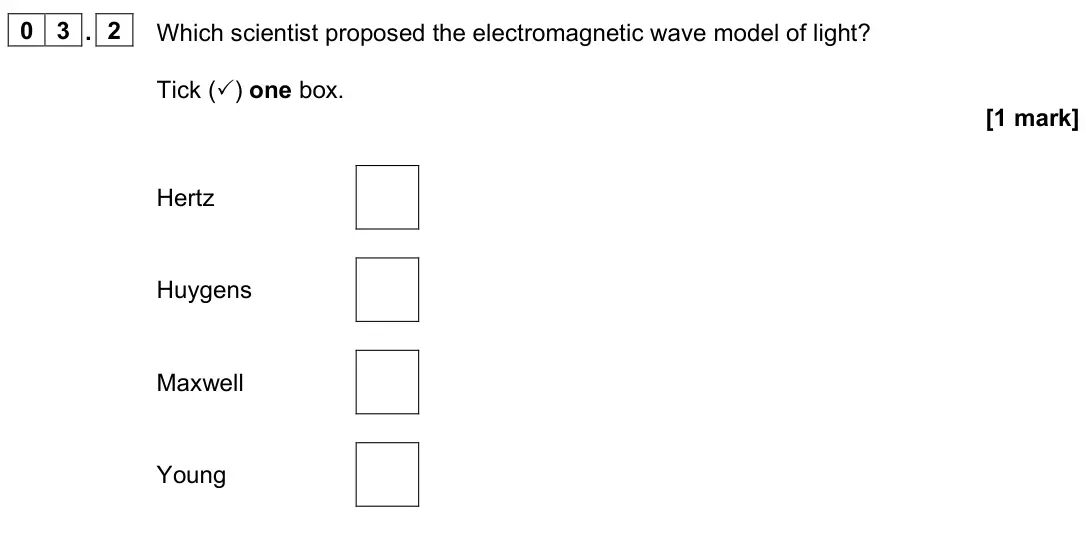
Q03.3
The whole paper ↗
Q03.4
The whole paper ↗
Q01.1
The whole paper ↗
Q01.2
The whole paper ↗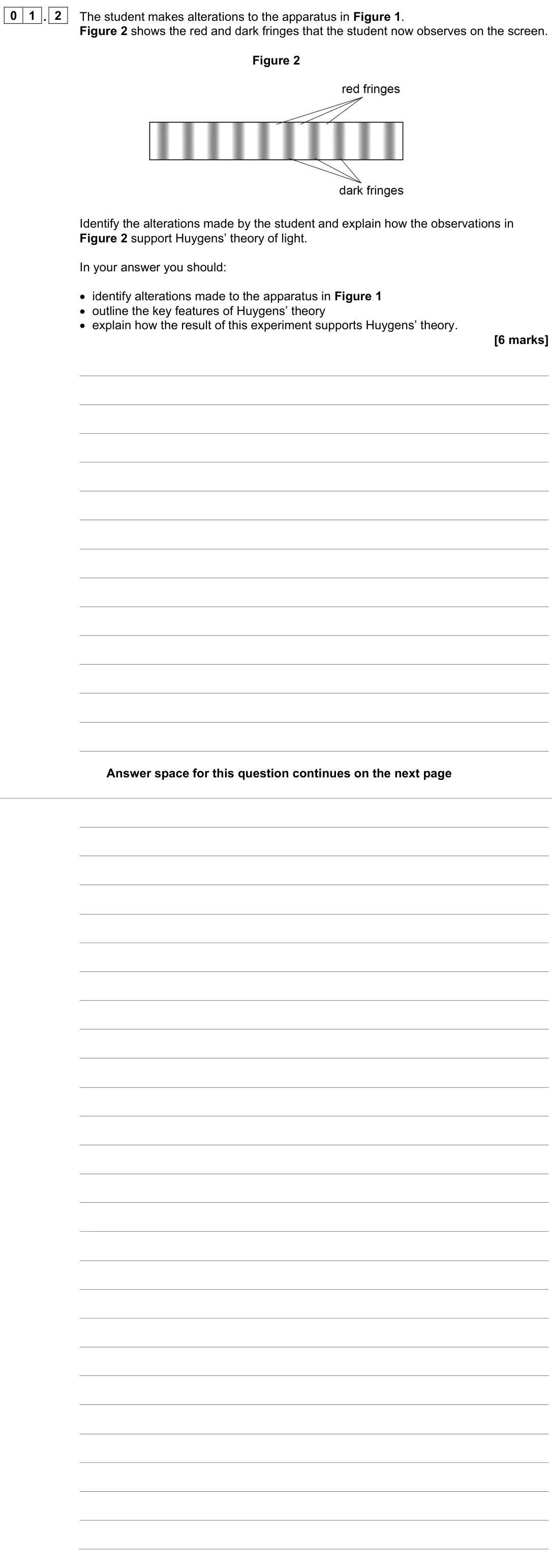
Q01.3
The whole paper ↗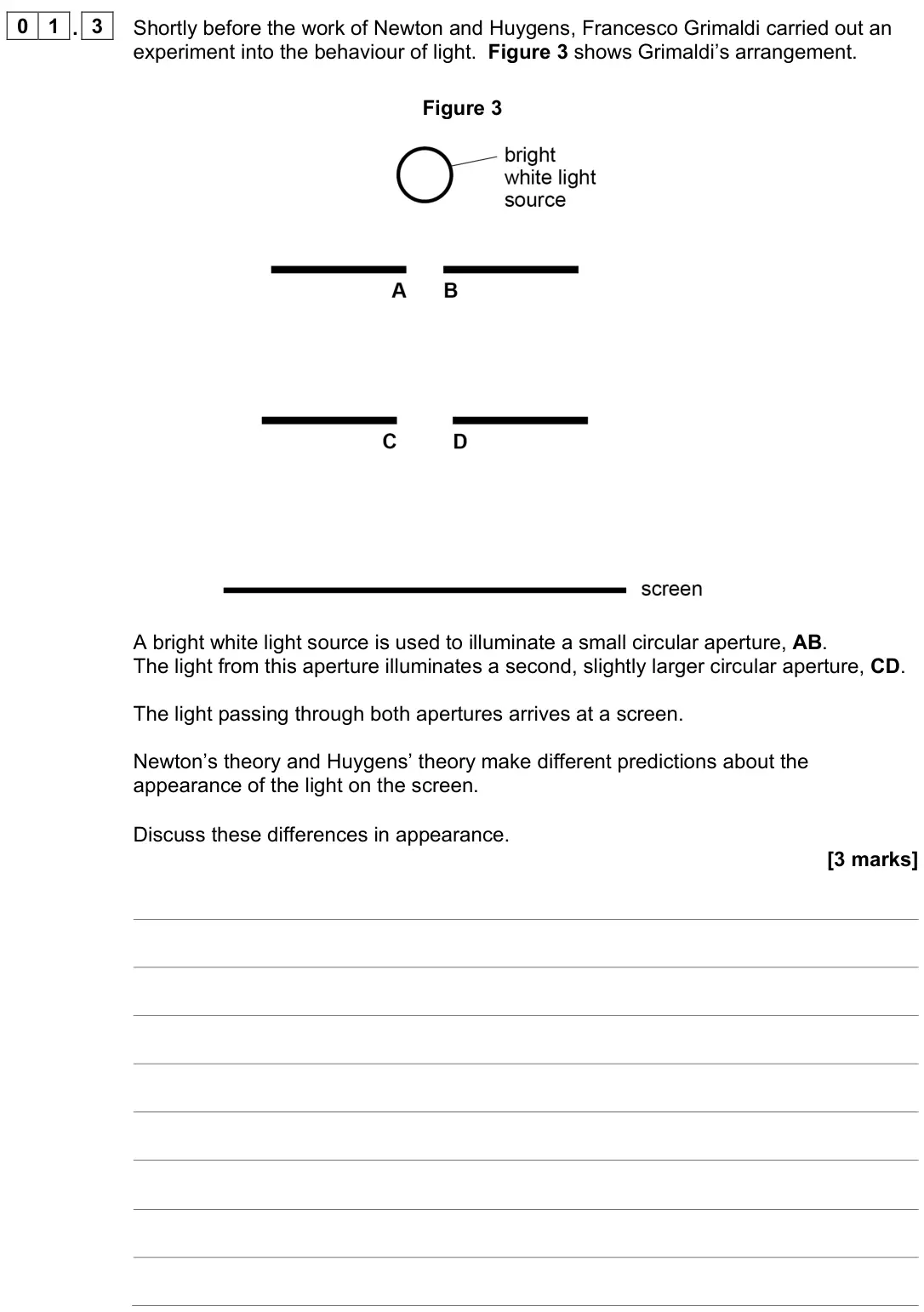
Q03.1
The whole paper ↗
Q03.2
The whole paper ↗
Q03.3
The whole paper ↗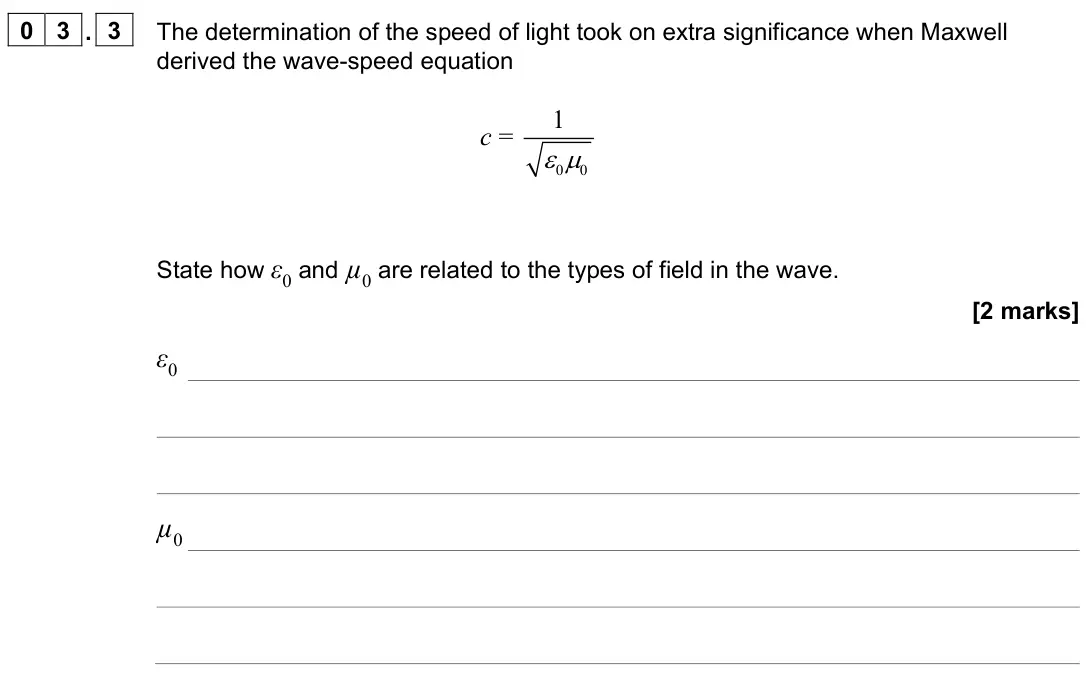
Q01.2
The whole paper ↗
Q01.3
The whole paper ↗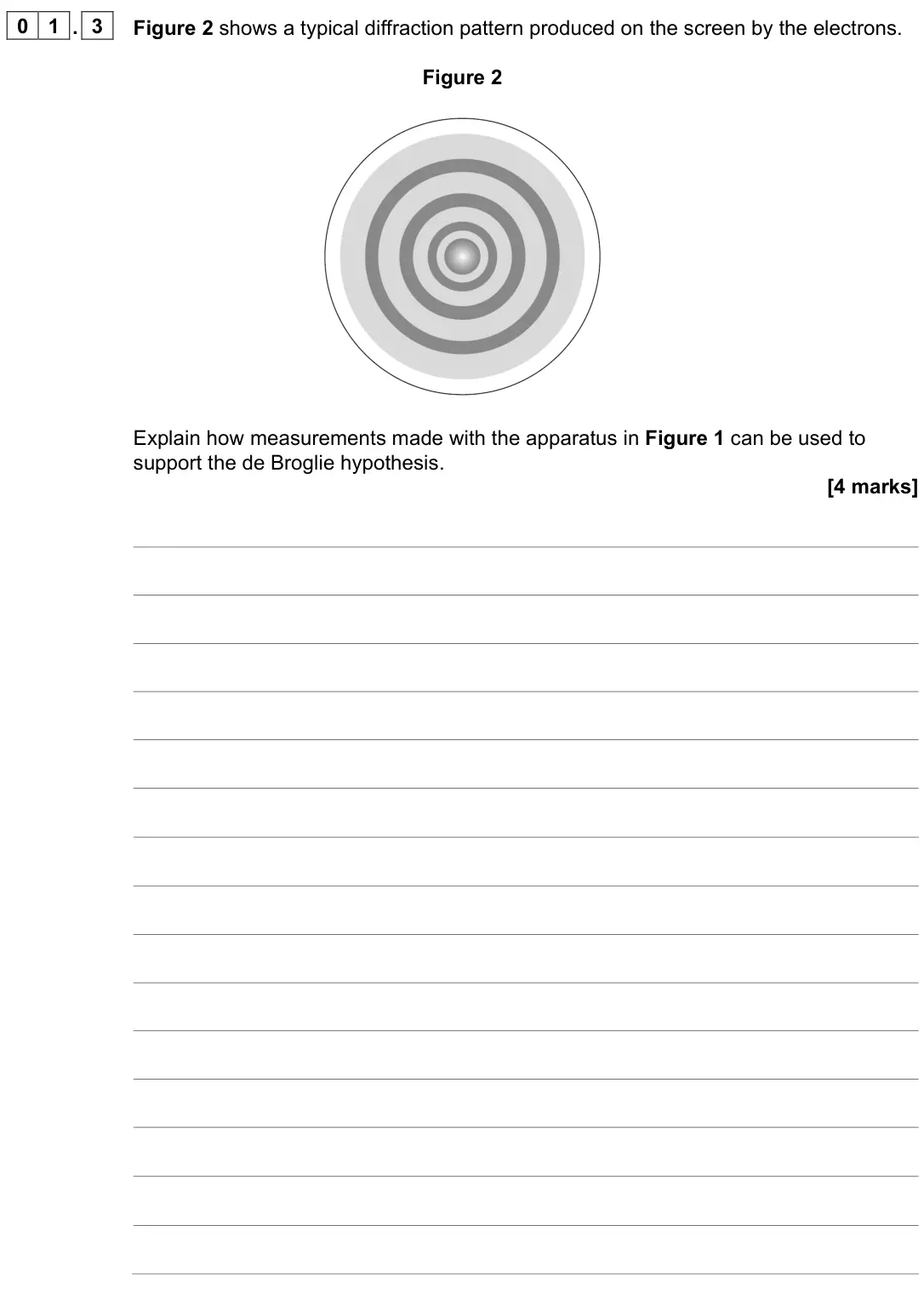
Q01.4
The whole paper ↗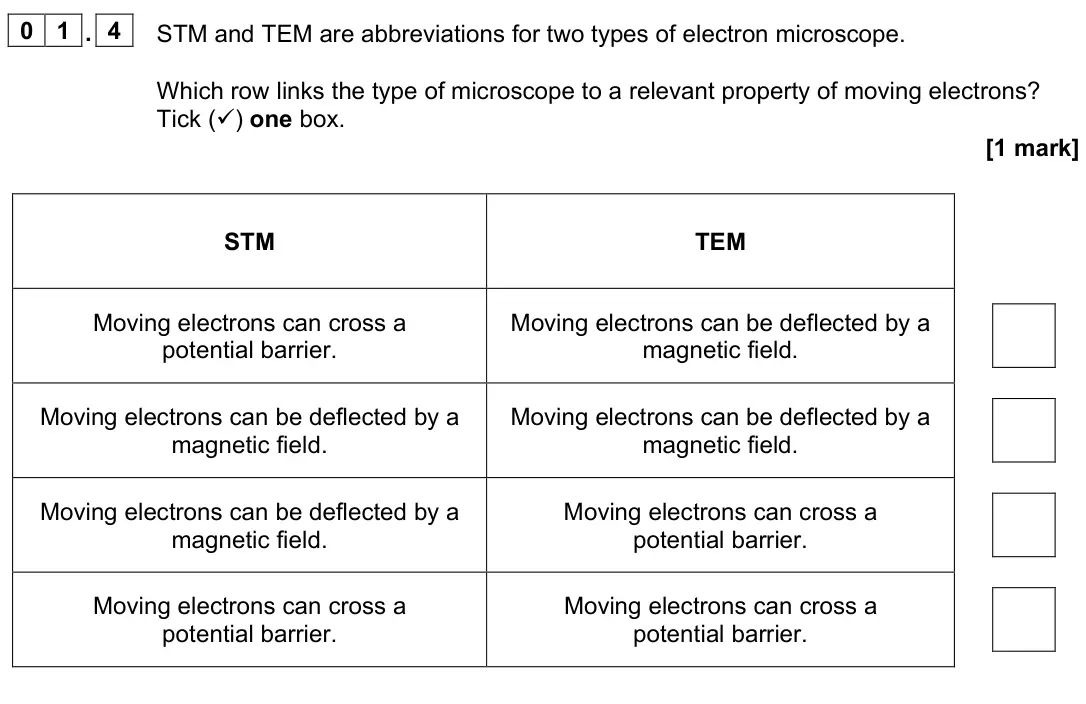
Q02.1
The whole paper ↗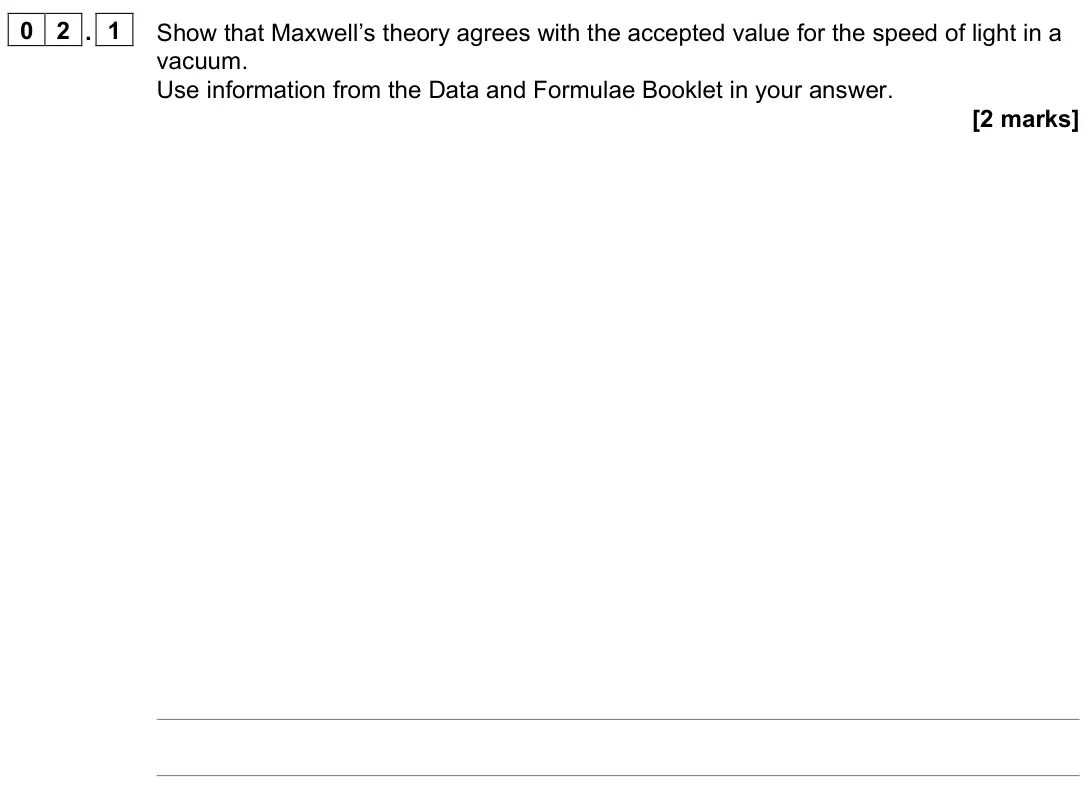
Q02.2
The whole paper ↗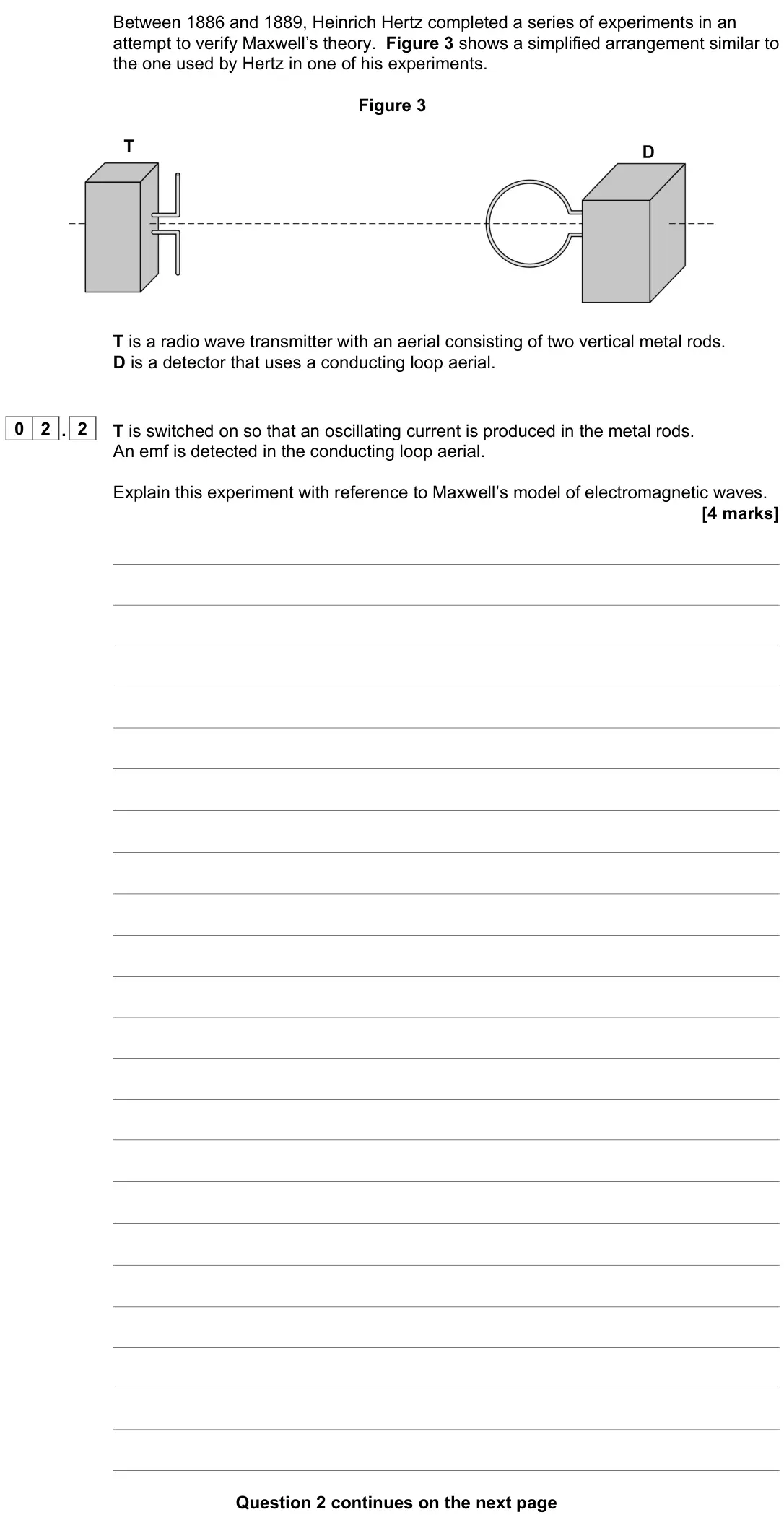
All 46 questions on Wave-particle duality, as a list
- June 2025, Paper 3 Turning points, Q02.1 (3 marks): Compare these experimental results and theoretical predictions. You may sketch and label a graph or graphs on Figure 4 as part of your answer. [3 marks] Figure
- June 2025, Paper 3 Turning points, Q02.2 (1 mark): A proposal was made that allowed a resolution of the contradiction. Outline this proposal. [1 mark]
- June 2025, Paper 3 Turning points, Q03 (6 marks): The work of Fizeau, Foucault, Hertz and Maxwell contributed to our understanding of the nature of light. Fizeau measured the speed of light in air. Foucault con
- June 2024, Paper 3 Turning points, Q03 (5 marks): Hertz did an experiment to determine the speed of radio waves. Describe this experiment. In your answer you should: • include a labelled diagram • state the mea
- June 2023, Paper 3 Turning points, Q01.3 (3 marks): A student suggests that the apparatus can be used to demonstrate the wave properties of electrons in the beam, provided that the aperture in the anode has a sui
- June 2023, Paper 3 Turning points, Q03.1 (1 mark): Draw and label on Figure 3: • the corresponding electric field • the direction of propagation of the wave. [1 mark]
- June 2023, Paper 3 Turning points, Q03.2 (1 mark): Which scientist proposed the electromagnetic wave model of light? Tick () one box. [1 mark] Hertz Huygens Maxwell Young
- June 2023, Paper 3 Turning points, Q03.3 (3 marks): Another theory of the nature of light was proposed by Isaac Newton. Describe how Newton’s theory was used to explain the refraction of light as it moves from ai
- June 2023, Paper 3 Turning points, Q03.4 (3 marks): Describe a demonstration using visible light that can be performed in a school laboratory to show that Newton’s theory is not correct. [3 marks]
- June 2022, Paper 3 Turning points, Q01.1 (2 marks): The student observes two bright white lines on the screen. Explain how this observation supports Newton’s theory of light. [2 marks]
- June 2022, Paper 3 Turning points, Q01.2 (6 marks): The student makes alterations to the apparatus in Figure 1. Figure 2 shows the red and dark fringes that the student now observes on the screen. Figure 2 Identi
- June 2022, Paper 3 Turning points, Q01.3 (3 marks): Shortly before the work of Newton and Huygens, Francesco Grimaldi carried out an experiment into the behaviour of light. Figure 3 shows Grimaldi’s arrangement.
- June 2022, Paper 3 Turning points, Q03.1 (2 marks): State what f0 represents in the equation. [2 marks]
- June 2022, Paper 3 Turning points, Q03.2 (2 marks): The experiment is attempted using a rotating wheel with 720 teeth that can be rotated at up to 620 revolutions per minute. The distance between W and M is 8.5 k
- June 2022, Paper 3 Turning points, Q03.3 (2 marks): The determination of the speed of light took on extra significance when Maxwell derived the wave-speed equation c = 0 0 1 State how ε0 and µ0 are related to the
- November 2021, Paper 3 Turning points, Q01.2 (4 marks): In the experiment, electrons are incident on a target made of a crystalline material. The electron wavelengths need to be about 50% the size of an atom to produ
- November 2021, Paper 3 Turning points, Q01.3 (4 marks): Figure 2 shows a typical diffraction pattern produced on the screen by the electrons. Figure 2 Explain how measurements made with the apparatus in Figure 1 can
- November 2021, Paper 3 Turning points, Q01.4 (1 mark): STM and TEM are abbreviations for two types of electron microscope. Which row links the type of microscope to a relevant property of moving electrons? Tick ()
- November 2021, Paper 3 Turning points, Q02.1 (2 marks): Show that Maxwell’s theory agrees with the accepted value for the speed of light in a vacuum. Use information from the Data and Formulae Booklet in your answer.
- November 2021, Paper 3 Turning points, Q02.2 (4 marks): T is switched on so that an oscillating current is produced in the metal rods. An emf is detected in the conducting loop aerial. Explain this experiment with re
- November 2021, Paper 3 Turning points, Q02.3 (4 marks): In a different experiment Hertz used stationary waves to determine the speed of radio waves. Figure 4 shows an experimental arrangement similar to the arrangeme
- November 2020, Paper 3 Turning points, Q02.1 (2 marks): State what is meant by black-body radiation. [2 marks]
- November 2020, Paper 3 Turning points, Q02.2 (2 marks): Describe how the predictions of classical theory compare with Wien and Lummer’s experimental results. Annotate Figure 2 as part of your answer. [2 marks]
- November 2020, Paper 3 Turning points, Q02.3 (2 marks): In 1900 Max Planck suggested a solution to the problems of the classical theory. Outline the main aspects of his suggestion. [2 marks]
- November 2020, Paper 3 Turning points, Q02.4 (6 marks): Planck’s suggestion was developed by Albert Einstein to explain the results of photoelectric effect experiments. Discuss Einstein’s explanation of photoelectric
- November 2020, Paper 3 Turning points, Q03.1 (2 marks): The scanning tunnelling microscope (STM) uses a process called quantum tunnelling. Explain what is meant by quantum tunnelling of an electron in an STM. You may
- November 2020, Paper 3 Turning points, Q03.2 (3 marks): An STM is used to map the positions of the atoms between points A and B on the surface of a sample. Figure 3 shows some of the features of the operation of an S
- November 2020, Paper 3 Turning points, Q03.3 (3 marks): The smallest size of objects that the STM can resolve is similar to the de Broglie wavelength of the tunnelling electrons. Deduce whether electrons with kinetic
- June 2019, Paper 3 Turning points, Q02.1 (1 mark): What happens to the horizontal and vertical components of the velocity of the corpuscles, according to the theory, when they are reflected? Tick () one box. [1
- June 2019, Paper 3 Turning points, Q02.2 (6 marks): Newton used the corpuscular theory to explain the refraction of light at an interface between air and water. Huygens used the wave theory to explain the refract
- June 2019, Paper 3 Turning points, Q02.3 (3 marks): Light is now known to behave as an electromagnetic wave. Describe a plane-polarised electromagnetic wave travelling through a vacuum. You may wish to draw a lab
- June 2019, Paper 3 Turning points, Q03.1 (2 marks): State de Broglie’s hypothesis. [2 marks]
- June 2019, Paper 3 Turning points, Q03.2 (2 marks): The voltmeter in Figure 3 shows a reading of 3.5 kV. Determine whether this voltmeter reading is consistent with a de Broglie wavelength for the electrons in th
- June 2019, Paper 3 Turning points, Q03.3 (4 marks): The experiment is repeated using a similar arrangement to that shown in Figure 3. Figure 4 shows the diffraction patterns from the two experiments. Figure 4 fir
- June 2018, Paper 3 Turning points, Q02.1 (3 marks): Sketch a graph on Figure 4 to show how the amplitude detected by the dipole receiver varies with angle of rotation as the receiver is turned through 360° Start
- June 2018, Paper 3 Turning points, Q02.2 (2 marks): Maxwell derived the equation for the speed c of electromagnetic waves, where 0 is the permeability of free space and 𝜀𝜀0 is the permittivity of free space. Expl
- June 2018, Paper 3 Turning points, Q03.1 (3 marks): Calculate the wavelength, in nm, of the electromagnetic radiation incident on the metal surface. [3 marks] wavelength = nm
- June 2018, Paper 3 Turning points, Q03.2 (3 marks): The intensity of the electromagnetic radiation is increased. No adjustment is made to the potential divider. The classical wave model and the photon model make
- June 2018, Paper 3 Turning points, Q03.3 (2 marks): The potential divider in Figure 5 is returned to its original position so that a photocurrent is detected by the microammeter. The potential divider is then adj
- June 2018, Paper 3 Turning points, Q03.4 (1 mark): The apparatus shown in Figure 5 is used to investigate three different metal surfaces A, B and C. Table 2 shows, for each of the three surfaces, a voltmeter rea
- June 2017, Paper 3 Turning points, Q02.1 (2 marks): Explain these observations. [2 marks] Observation A Observation B
- June 2017, Paper 3 Turning points, Q02.2 (2 marks): Table 1 shows data from Fizeau’s experiment at the instant when observation B is made. Table 1 d, distance from M to W 8.6 km f, number of wheel revolutions per
- June 2017, Paper 3 Turning points, Q02.3 (2 marks): The speed of the wheel is further increased. Deduce the value of f when the observer would next be unable to see light returning from the mirror. [2 marks]
- June 2017, Paper 3 Turning points, Q02.4 (3 marks): Explain how the nature of light is implied by Maxwell’s theory of electromagnetic waves and Fizeau’s result. [3 marks]
- June 2017, Paper 3 Turning points, Q03.2 (3 marks): The electrons in a particular TEM have a kinetic energy of 4.1 × 10⁻¹⁶ J. Relativistic effects are negligible for this electron energy. Suggest, with a calculat
- June 2017, Paper 3 Turning points, Q03.3 (6 marks): A typical TEM can accelerate electrons to very high speeds and form high resolution images. Explain: • the process of image formation, and • the factors that af
Questions, mark schemes and examiner’s reports are © AQA, from their published past papers. Plumi isn’t affiliated with any exam board. Want whole papers? Every AQA A-Level Physics paper.
Rather write your answers by hand on iPad? Plumi marks them against the same mark schemes.