 plumi
Basics of electricity: AQA A‑Level Physics questions
AQA A-Level Physics past-paper questions on 3.5.1.1 Basics of electricity, 2008–2025, with mark schemes and examiner’s reports where available.
Paper
All papers
Exam
All years
Calculations
Q01.4
The whole paper ↗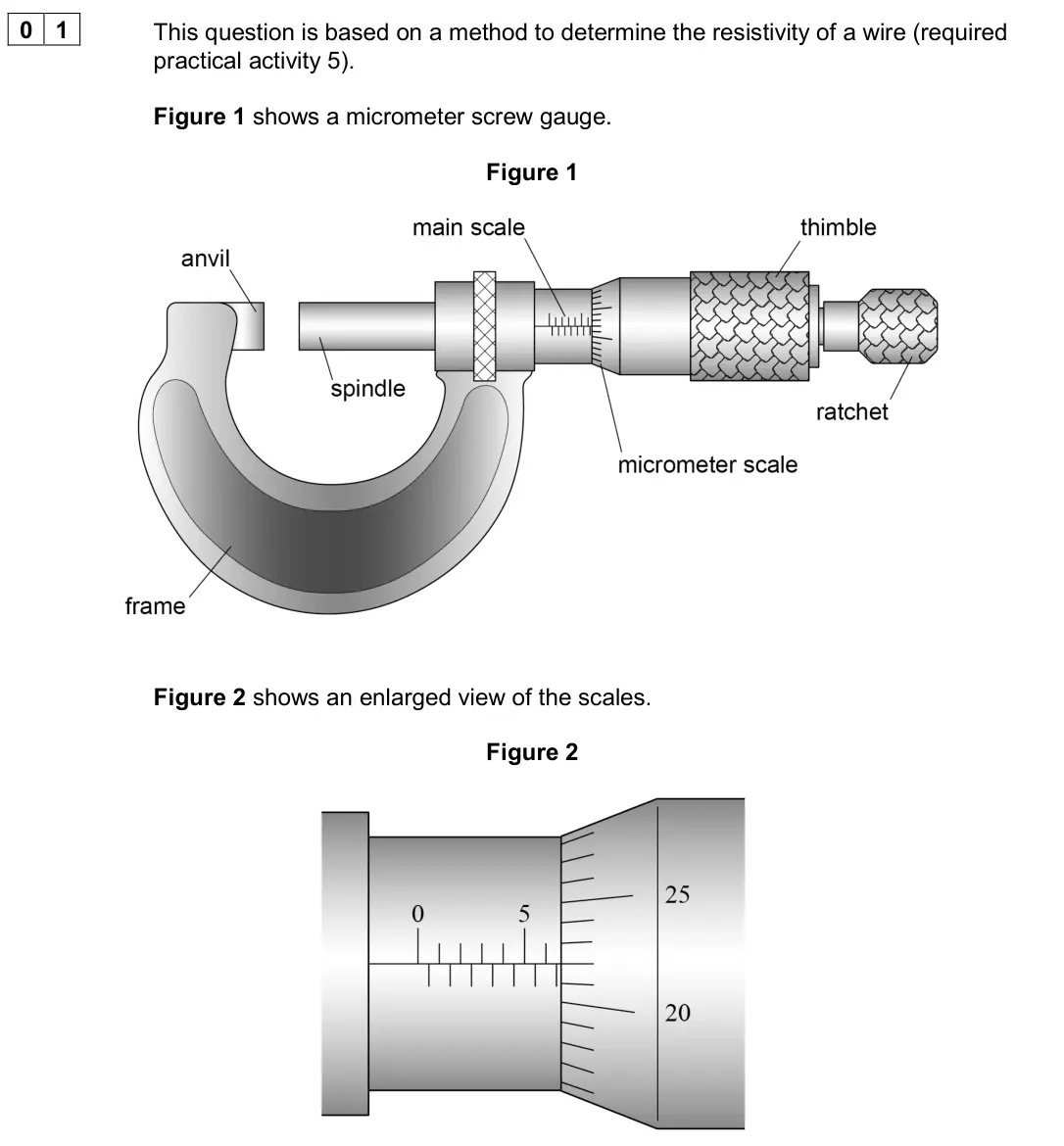
Q02.2
The whole paper ↗
Q02.4
The whole paper ↗Q06.2
The whole paper ↗Q03.1
The whole paper ↗
Q04.4
The whole paper ↗
- Your answer
Q02.1
The whole paper ↗
Q04.1
The whole paper ↗
Q04.2
The whole paper ↗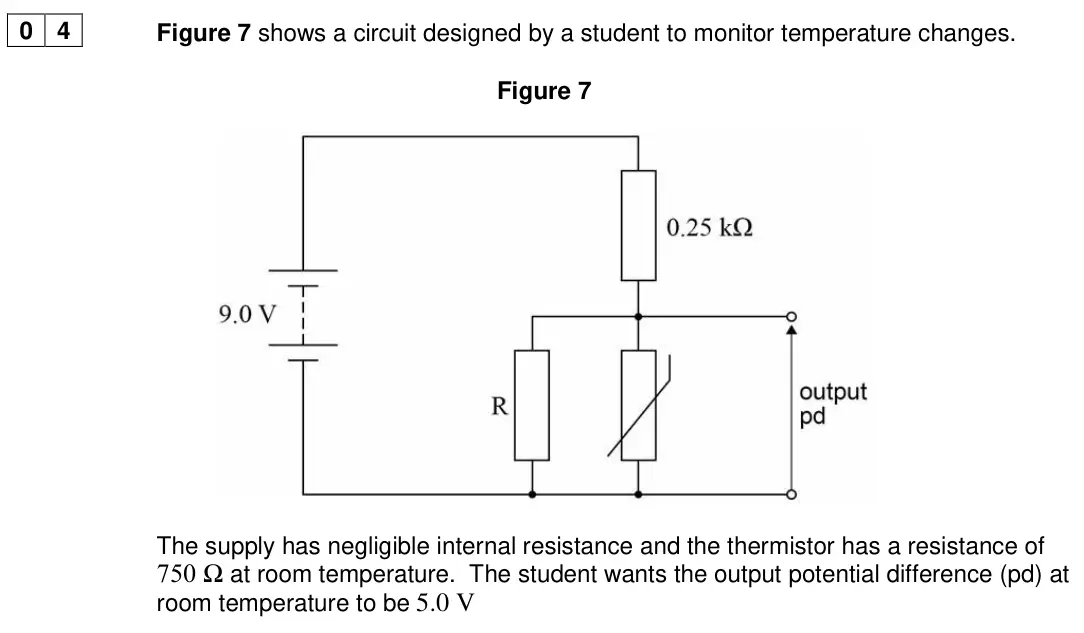
- Your answer
- Your answer
Q06.1
The whole paper ↗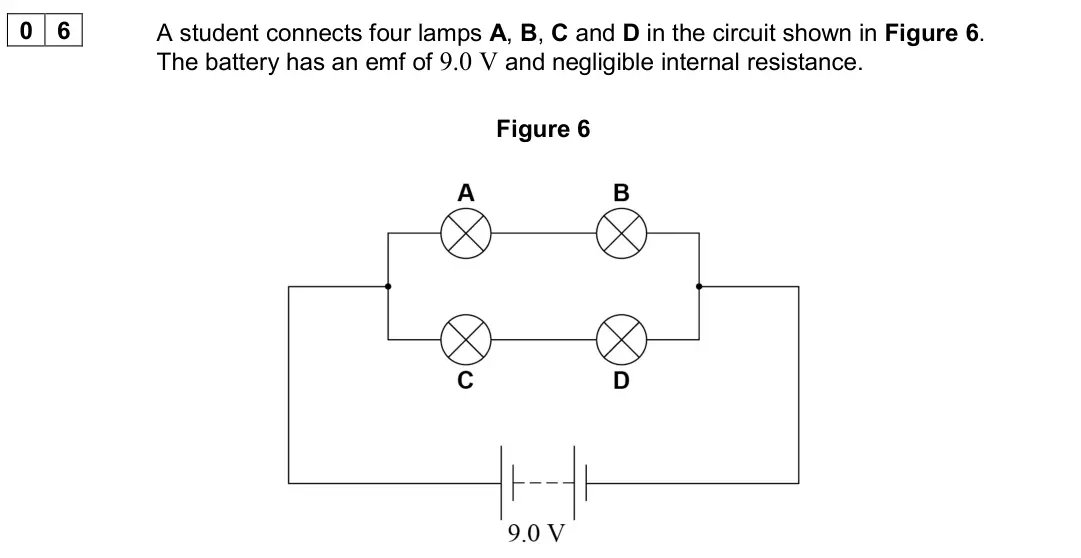
All 55 questions on Basics of electricity, as a list
- June 2025, Paper 1, Q29 (1 mark): The diagram shows part of a circuit. The graph shows how the two currents I1 and I2 vary with time. What is the total charge that flows through point P in 60 s?
- June 2024, Paper 3A, Q01.4 (2 marks): When the switch is closed, the voltmeter reading is 397 mV. Show that, for the arrangement in Figure 4, the resistance R of the wire between the clips is about
- June 2024, Paper 3A, Q02.2 (2 marks): The quantity EV is a measure of the intensity of the light incident on the LDR. The SI unit of EV is the lux (lx). The resistance R of the LDR is given by log(R
- June 2024, Paper 3A, Q02.4 (2 marks): Deduce the value of x when EV = 130 lx. [2 marks] x = mm
- June 2024, AS Paper 2, Q06 (1 mark): The current in a circuit is 0.33 A. How many electrons pass a point in the circuit in 7.0 minutes? [1 mark] A 1.4 × 10¹⁹ B 1.2 × 10²⁰ C 8.7 × 10²⁰ D 8.0 × 10²¹
- June 2023, AS Paper 1, Q06.2 (2 marks): Calculate the number of electrons that pass a point in the circuit in 37 minutes. [2 marks] number of electrons =
- June 2023, AS Paper 2, Q29 (1 mark): The current in a resistor is 15 mA. How many electrons pass through the resistor in 3 minutes? [1 mark] A 2.8 × 10¹⁷ B 1.7 × 10¹⁹ C 2.8 × 10²⁰ D 1.7 × 10²²
- June 2022, Paper 1, Q29 (1 mark): The current in a metallic conductor is 1.5 mA. How many electrons pass a point in the conductor in two minutes? [1 mark] A 1.1 × 10¹⁸ B 1.9 × 10¹⁹ C 1.4 × 10²⁰
- June 2022, AS Paper 2, Q03.1 (2 marks): The battery is connected to a charger that maintains a constant potential difference of 5.0 V across the battery. It takes 2.6 hours for the battery to become f
- November 2020, AS Paper 2, Q04.4 (4 marks): The electron hits the first electrode and causes the release of several electrons. Figure 9 shows how a series of accelerations and collisions produces a large
- November 2020, AS Paper 2, Q30 (1 mark): The capacity of a portable charger is rated in ampere hours (A h). A charger of capacity 1 A h can provide 1 A for 1 hour at its working voltage. One charger ha
- November 2020, AS Paper 2, Q31 (1 mark): A filament lamp with resistance 12 Ω is operated at a power of 36 W. How much charge flows through the filament lamp during 15 minutes? [1 mark] A 26 C B 1.6 kC
- June 2019, Paper 1, Q21 (1 mark): A rubber belt in an electrostatic machine has a width of 0.1 m and moves with speed 0.4 m s–1. Each square metre of the belt carries a charge Q coulomb. The cha
- June 2019, AS Paper 1, Q02.1 (3 marks): The designers state that the battery can produce a current of 2.0 A in the heating element for 240 minutes. Calculate the energy dissipated in the heating eleme
- June 2019, AS Paper 2, Q04.1 (3 marks): Determine the total energy input by the 24 V battery to the motor in the first 200 ms. [3 marks] total energy input = J
- June 2019, AS Paper 2, Q31 (1 mark): A power of 100 kW at a potential difference of 10 kV is transmitted to a load resistor through cables of total resistance 5.0 Ω. What is the power loss in the c
- June 2018, Paper 1, Q04.2 (2 marks): The student selects a resistor rated at 0.36 W for the 0.25 kΩ resistor in Figure 7. Determine whether this resistor is suitable. [2 marks]
- June 2018, Paper 1, Q25 (1 mark): A gas containing doubly-charged ions flows to give an electric current of 0.64 A How many ions pass a point in 1.0 minute? [1 mark] A 2.0 × 10¹⁸ B 4.0 × 10¹⁸ C
- June 2018, Paper 1, Q26 (1 mark): A mobile phone operates at a constant power of 200 mW It has a 3.7 V lithium-ion battery that has a charge capacity of 9400 C What is the time taken for the bat
- June 2018, AS Paper 1, Q06.1 (4 marks): Table 1 shows the operating conditions for the lamps when they are at normal brightness. Table 1 Lamps Operating voltage / V Power / W A and C 6.0 6.0 B and D 3
- June 2018, AS Paper 2, Q03.4 (2 marks): A spark counter consists of a wire gauze separated from a metal wire by a small air gap. A power supply with an output of 4500 V is connected in series with a 5
- June 2018, AS Paper 2, Q28 (1 mark): Which graph shows how power dissipated P varies with current I in a component that obeys Ohm’s law? [1 mark] A B C D
- June 2018, AS Paper 2, Q29 (1 mark): 1.0 kilowatt-hour (kW h) is equivalent to [1 mark] A 6.3 × 10¹⁸ eV B 6.3 × 10²¹ eV C 2.3 × 10²² eV D 2.3 × 1025 eV
- June 2017, Paper 1, Q04.3 (3 marks): Solar cells convert solar energy to useful electrical energy in the road sign with an efficiency of 4.0%. The solar-cell supply used by the engineer has a total
- June 2017, AS Paper 2, Q18 (1 mark): A battery of negligible internal resistance and an emf of 12 V is connected in series with a heating element. The heating element has a resistance of 6.5 Ω when
- June 2016, AS Paper 2, Q02.6 (1 mark): A student decides to carry out a similar experiment. The student thinks the meter in Figure 7 could be used as the microvoltmeter to measure ε. Figure 7 When th
- June 2016, AS Paper 2, Q04.3 (1 mark): The RTG has a constant output voltage of 32 V. Calculate the current when the output power is 100 W. [1 mark] current = ____________________ A
- June 2016, AS Paper 2, Q04.4 (2 marks): Calculate the maximum number of components, each of resistance 45 Ω, that can be connected in parallel across the RTG before the maximum output power is reached
- June 2016, AS Paper 2, Q28 (1 mark): The current in a wire is 20 mA. How many electrons pass a point in the wire in 2 minutes? [1 mark] A 2.5 × 10¹⁷ B 1.5 × 10¹⁹ C 2.5 × 10²⁰ D 1.5 × 10²²
- June 2016, AS Paper 2, Q31 (1 mark): The National Grid uses high-voltage transmission lines to carry electrical power around the UK. A particular transmission line delivers 800 MW of power at 132 k
- June 2016, PHYA1 (old spec), Q6(a)(ii) (3 marks): The resistance of the heating element in the oven at its working temperature is 12 Ω. Calculate the power dissipated by the heating element in the oven. Give yo
- June 2016, PHYA1 (old spec), Q6(b)(iii) (2 marks): Calculate the average power wasted in the cable due to the heating effect of the electric current. [2 marks] average power = ___________________________ W
- June 2016, PHYA1 (old spec), Q6(b)(iv) (2 marks): State two reasons why it is important that the cable has a low resistance. [2 marks] 1 _________________________________________________________________________
- June 2015, PHYA1 (old spec), Q5(d)(i) (2 marks): Calculate the electrical energy converted by each lamp if both are on for 4 hours a day for a period of 30 days. [2 marks] electrical energy converted by X = J
- June 2015, PHYA1 (old spec), Q5(d)(ii) (2 marks): Suggest why the two lamps can have different power ratings but have the same light intensity output. [2 marks]
- June 2015, PHYA1 (old spec), Q7(c) (3 marks): The potential difference across a length of 1.0 km of the cable is 75 V. Calculate the total power loss for a 1.0 km length of cable. [3 marks] Total power loss
- June 2014, PHYA4 Section B (old spec), Q2(b)(ii) (1 mark): Copper contains 8.4 × 1028 free electrons per cubic metre. The section of wire in Figure 2 is 95mm long and its cross-sectional area is 5.1 × 10⁻⁶m2. Show that
- June 2013, PHYA1 (old spec), Q6(b)(i) (3 marks): Using appropriate data values that you have calculated, complete the following table by calculating the rate of energy dissipation in each resistor. (3 marks) r
- June 2013, PHYA1 (old spec), Q6(b)(ii) (2 marks): Hence show that energy is conserved in the circuit. (2 marks)
- January 2013, PHYA1 (old spec), Q7(b)(i) (1 mark): Calculate the current flowing in the lamp. current = A (1 mark)
- June 2012, PHYA1 (old spec), Q6(a)(ii) (1 mark): Calculate the resistance of P. answer = Ω (1 mark)
- June 2012, PHYA1 (old spec), Q6(a)(iii) (1 mark): Calculate the resistance of Q. answer = Ω (1 mark)
- June 2012, PHYA1 (old spec), Q7(a)(iii) (2 marks): Calculate the charge passing through the battery in 2.0 minutes. Give an appropriate unit for your answer. answer = unit = (2 marks)
- January 2012, PHYA1 (old spec), Q6(a) (2 marks): Calculate the current in each lamp when it is operated at its correct working voltage. X A Y A (2 marks)
- June 2011, PHYA4 Section B (old spec), Q3(a)(ii) (2 marks): A rechargeable 1.2V cell used in a cordless telephone can supply a steady current of 55mA for 10 hours. Show that this cell, when fully charged, stores almost 5
- June 2011, PHYA4 Section B (old spec), Q5(a)(i) (1 mark): Calculate the current in the cables. answer = A (1 mark)
- June 2011, PHYA4 Section B (old spec), Q5(a)(ii) (2 marks): The total resistance of the cables is 30Ω. Calculate the power supplied to the factory by the cables. answer = kW (2 marks)
- June 2011, PHYA4 Section B (old spec), Q5(a)(iii) (1 mark): Calculate the efficiency with which power is transmitted by the cables from the input at the supply point to the factory. answer = % (1 mark)
- June 2011, PHYA1 (old spec), Q6(d)(i) (2 marks): Calculate the charge flowing through the cell in 15s, stating an appropriate unit. answer = (2 marks)
- January 2011, PHYA1 (old spec), Q6(b)(i) (1 mark): Calculate the resistance of the lamp when it has reached its normal operating temperature, answer = Ω (1 mark)
- January 2011, PHYA1 (old spec), Q6(b)(ii) (1 mark): Calculate the power of the lamp when it has reached its normal operating temperature. answer = W (1 mark)
- June 2010, PHYA1 (old spec), Q6(c)(i) (2 marks): Calculate the resistance of the filament when the pd across its terminals is 12V. answer = Ω (2 marks)
- January 2010, PHYA1 (old spec), Q6(a)(iv) (2 marks): Calculate the charge passing through cell A in five minutes, stating an appropriate unit. answer = (2 marks)
- June 2008, PHA3W (2008 spec), Q1(c) (3 marks): 1 (c) When the lamps are at their correct working voltage, 1 (c) (i) calculate the time taken for a charge of 20 C to pass through one of the lamps, 1 (c) (ii)
- June 2008, PHA3W (2008 spec), Q2(a) (7 marks): 2 (a) A student is required to carry out an experiment and to draw a suitable graph in order to obtain a value for the resistance of a resistor. You may be awar
Questions, mark schemes and examiner’s reports are © AQA, from their published past papers. Plumi isn’t affiliated with any exam board. Want whole papers? AQA A-Level Physics past papers.
The Plumi iPad app also offers exam-style questions with AI feedback on your handwritten working.