Skip to content

AQA A‑Level Computer Science questions by topic

Every question from every AQA A-Level Computer Science paper, 2020–2025, part by part. Filter by topic, paper or year, open the mark scheme under any question, and download a set as a PDF. Paper 1 is sat on screen around a Skeleton Program AQA gives schools before the exam: its written questions and its programming task are here; the questions on the Skeleton Program, which can’t be answered without it, are left out.

Find questions561
Topics Pick as many as you like. Open one to choose its sub-topics.

Year 1 · AS

Year 2 · A‑Level only

Calculations

561 questions

  1. Q01.1

    June 2025 · Paper 1

    1 mark
    The whole paper ↗
    June 2025 Paper 1, question 01.1: Explain why a record in a hash table can normally be found more quickly than a record in a sorted list. [1 mark]
  2. Q01.2

    June 2025 · Paper 1

    4 marks
    The whole paper ↗
    June 2025 Paper 1, question 01.2: Describe the steps involved in adding a new record to a hash table. [4 marks]
  3. Q01.3

    June 2025 · Paper 1

    1 mark
    The whole paper ↗
    June 2025 Paper 1, question 01.3: Explain why the time taken to find a specific record in a hash table can increase when lots of records are stored in the table. [1 mark]
  4. Q01.4

    June 2025 · Paper 1

    1 mark
    The whole paper ↗
    June 2025 Paper 1, question 01.4: Explain why the linear search algorithm has time complexity of O(n). [1 mark]
  5. Q01.5

    June 2025 · Paper 1

    1 mark
    The whole paper ↗
    June 2025 Paper 1, question 01.5: Explain why the binary search algorithm has time complexity of O(log n). [1 mark]
  6. Q01.6

    June 2025 · Paper 1

    1 mark
    The whole paper ↗
    June 2025 Paper 1, question 01.6: State one advantage of a linear search compared to a binary search. [1 mark]
  7. Q01.7

    June 2025 · Paper 1

    1 mark
    The whole paper ↗
    June 2025 Paper 1, question 01.7: Explain why both these sorting algorithms are tractable. [1 mark]
  8. Q01.8

    June 2025 · Paper 1

    1 mark
    The whole paper ↗
    June 2025 Paper 1, question 01.8: After how many passes is bubble sort guaranteed to have sorted any list of 100 items? [1 mark]
  9. Q02

    June 2025 · Paper 1

    2 marks
    The whole paper ↗
    June 2025 Paper 1, question 02: Define the term decomposition. [2 marks] Dijkstra’s algorithm is an example of a breadth-first traversal algorithm.
  10. Q03.1

    June 2025 · Paper 1

    1 mark
    The whole paper ↗
    June 2025 Paper 1, question 03.1: State the purpose of Dijkstra’s algorithm. [1 mark]
  11. Q03.2

    June 2025 · Paper 1

    2 marks
    The whole paper ↗
    June 2025 Paper 1, question 03.2: State both the reasons why the graph in Figure 1 is not a tree. [2 marks]
  12. Q03.3

    June 2025 · Paper 1

    2 marks
    The whole paper ↗
    June 2025 Paper 1, question 03.3: Complete the unshaded cells in Table 1 to show how the graph in Figure 1 could be represented as an adjacency matrix. Table 1 1 2 3 4 5 6 7 1 2 3 4 5 6 7 Copy t
  13. Q03.4

    June 2025 · Paper 1

    1 mark
    The whole paper ↗
    June 2025 Paper 1, question 03.4: Describe one of the base cases for the recursive subroutine Traverse. [1 mark] Figure 4 shows a trace table for the subroutine call Traverse(1, 6) The subroutin
  14. Q03.5

    June 2025 · Paper 1

    6 marks
    The whole paper ↗
    June 2025 Paper 1, question 03.5: Complete the unshaded cells in Table 2 to show the result of tracing the algorithm shown in Figure 3 using the adjacency list AL in Figure 2 for the subroutine
  15. Q04.1

    June 2025 · Paper 1

    12 marks
    The whole paper ↗
    June 2025 Paper 1, question 04.1: Your PROGRAM SOURCE CODE. [12 marks]
  16. Q04.2

    June 2025 · Paper 1

    1 mark
    The whole paper ↗
    June 2025 Paper 1, question 04.2: SCREEN CAPTURE(S) showing the results of testing the program by entering the string: Hello t
  17. Q01.1

    June 2025 · Paper 2

    2 marks
    The whole paper ↗
    June 2025 Paper 2, question 01.1: Figure 1 shows the classification of various types of software and some examples of these types. Figure 1 Complete Table 1 by naming the correct types of softwa
  18. Q01.2

    June 2025 · Paper 2

    2 marks
    The whole paper ↗
    June 2025 Paper 2, question 01.2: One function of the operating system is to allocate I/O devices to competing processes. Describe two other functions of an operating system. [2 marks] Function
  19. Q01.3

    June 2025 · Paper 2

    4 marks
    The whole paper ↗
    June 2025 Paper 2, question 01.3: Software can be developed using a low-level language or a high-level language. Describe the advantages of writing programs using a high-level language. [4 marks
  20. Q02.1

    June 2025 · Paper 2

    2 marks
    The whole paper ↗
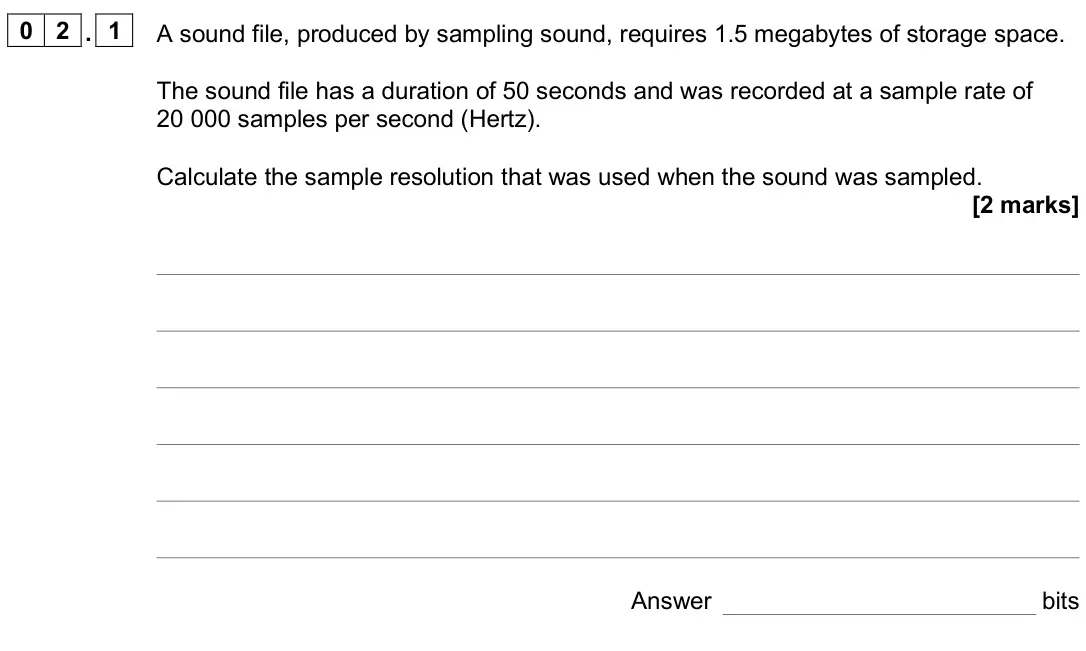
    June 2025 Paper 2, question 02.1: A sound file, produced by sampling sound, requires 1.5 megabytes of storage space. The sound file has a duration of 50 seconds and was recorded at a sample rate

Questions, mark schemes and examiner’s reports are © AQA, from their published past papers. Plumi isn’t affiliated with any exam board. Want whole papers? Full past papers.

Rather write your answers by hand on iPad? Plumi marks them against the same mark schemes.