 plumi
Binary number system: AQA A‑Level Computer Science questions
Every AQA A-Level Computer Science exam question on 4.5.4 Binary number system, 2020–2025, with its mark scheme and examiner’s report.
Find questions561
Calculations
Q07.4
The whole paper ↗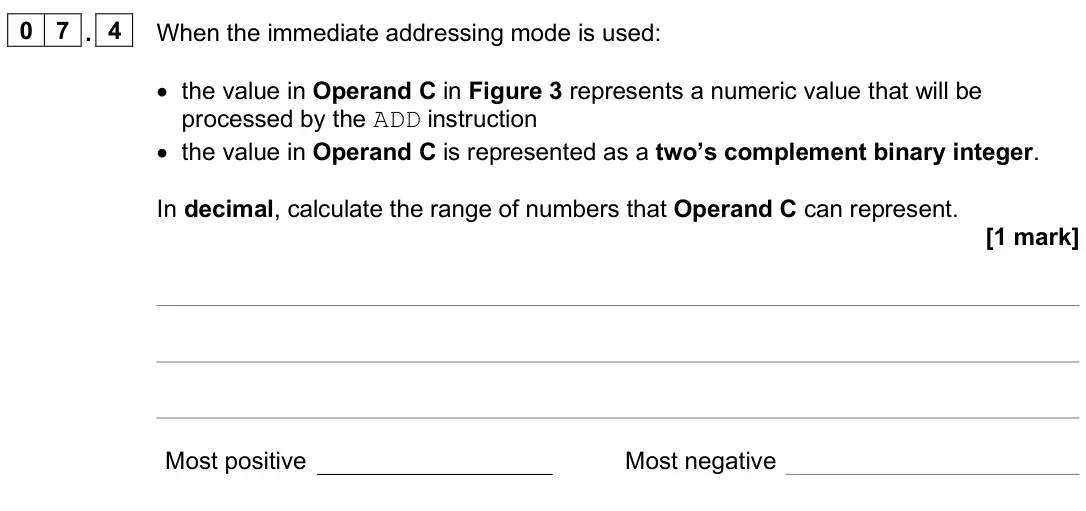
Q12.1
The whole paper ↗
Q12.2
The whole paper ↗
Q12.3
The whole paper ↗
Q12.4
The whole paper ↗
Q12.5
The whole paper ↗
Q12.6
The whole paper ↗
Q02.3
The whole paper ↗
Q02.4
The whole paper ↗
Q02.5
The whole paper ↗
Q02.6
The whole paper ↗
Q04.1
The whole paper ↗
Q04.2
The whole paper ↗
Q04.3
The whole paper ↗
Q04.4
The whole paper ↗
Q04.5
The whole paper ↗
Q02.3
The whole paper ↗
Q02.4
The whole paper ↗
Q02.5
The whole paper ↗
Q06.1
The whole paper ↗
All 47 questions on Binary number system, as a list
- June 2025, Paper 2, Q07.4 (1 mark): When the immediate addressing mode is used: • the value in Operand C in Figure 3 represents a numeric value that will be processed by the ADD instruction • the
- June 2025, Paper 2, Q12.1 (1 mark): Shade one lozenge to indicate which bit pattern (A–E) in Figure 7 does not represent a normalised value. [1 mark] A B C D E
- June 2025, Paper 2, Q12.2 (1 mark): Shade one lozenge to indicate which bit pattern (A–E) in Figure 7 shows the most negative normalised value that can be represented. [1 mark] A B C D E
- June 2025, Paper 2, Q12.3 (1 mark): State one reason why values stored using a floating point representation are usually normalised. [1 mark]
- June 2025, Paper 2, Q12.4 (2 marks): and 12.5 use a normalised floating point representation with an 8-bit mantissa and a 6-bit exponent, both stored using two’s complement. 1 2 . 4 Figure 8 shows
- June 2025, Paper 2, Q12.5 (3 marks): use a normalised floating point representation with an 8-bit mantissa and a 6-bit exponent, both stored using two’s complement. 1 2 . 5 The decimal value 43 057
- June 2025, Paper 2, Q12.6 (1 mark): Calculate the relative error that occurred when you represented 43 057 152 as closely as possible in question part 12.5. You should show your working. Express y
- June 2025, AS Paper 2, Q02.3 (2 marks): Show how the 8-bit unsigned binary number 01001111 can be added to the 8-bit unsigned binary number 00001011 without converting the numbers into decimal. You mu
- June 2025, AS Paper 2, Q02.4 (2 marks): What are the lowest and highest values that can be represented by a 4-bit two’s complement binary integer? Give your answers in decimal. [2 marks] Lowest Highes
- June 2025, AS Paper 2, Q02.5 (3 marks): Using 8-bit two’s complement binary, what is the result of subtracting 00110100 from 01101101? Give your answer in 8-bit two’s complement binary. You must show
- June 2025, AS Paper 2, Q02.6 (2 marks): Represent 5.75 as an 8-bit unsigned fixed point binary number with four bits before and four bits after the binary point. [2 marks]
- June 2024, Paper 2, Q04.1 (2 marks): Shade the lozenges next to all of the true statements about representing numbers using fixed and floating point representations. [2 marks] A A processor can usu
- June 2024, Paper 2, Q04.2 (2 marks): Figure 2 shows a floating point representation of a number: Figure 2 Calculate the decimal equivalent of the number in Figure 2. You should show your working. [
- June 2024, Paper 2, Q04.3 (3 marks): and 04.4 use a normalised floating point representation with an 8-bit mantissa and a 4-bit exponent, both stored using two’s complement. 0 4 . 3 The decimal num
- June 2024, Paper 2, Q04.4 (1 mark): What is the smallest number of bits that would need to be added to the mantissa so that the decimal number 12.765625 could be represented exactly? [1 mark]
- June 2024, Paper 2, Q04.5 (2 marks): A different system uses a normalised floating point representation with a 10-bit mantissa and a 6-bit exponent, both stored using two’s complement. In decimal,
- June 2024, AS Paper 2, Q02.3 (2 marks): Show how the unsigned binary number 00100011 can be added to the unsigned binary number 00101011 without converting the numbers into decimal. You must show all
- June 2024, AS Paper 2, Q02.4 (2 marks): Show how the 8-bit two’s complement binary integer 00011100 can be subtracted from the 8-bit two’s complement binary integer 00111011 without converting the num
- June 2024, AS Paper 2, Q02.5 (2 marks): The bit pattern in Figure 1 represents a 10-bit unsigned fixed point binary number with four bits before and six bits after the binary point. Figure 1 0 1 1 1 0
- June 2023, Paper 2, Q06.1 (2 marks): Figure 7 shows a floating point representation of a number: Figure 7 0 1 1 0 1 0 0 0 1 1 0 1 Mantissa Exponent Calculate the decimal equivalent of the number in
- June 2023, Paper 2, Q06.2 (3 marks): use a normalised floating point representation with an 8-bit mantissa and a 4-bit exponent, both stored using two’s complement. 0 6 . 2 Write the normalised flo
- June 2023, Paper 2, Q06.3 (2 marks): On each row of Table 1, state the name of the Type of error that has occurred in the Situation that is described. [2 marks] Table 1 Situation Type of error A ca
- June 2023, Paper 2, Q06.4 (1 mark): Explain how the floating point representation used in Question parts 06.1 and 06.2 could be modified to represent numbers more precisely, without changing the t
- June 2023, AS Paper 2, Q03.2 (1 mark): Table 1 shows two unsigned binary integers, Number 1 and Number 2. Complete the table to show the result in binary of adding the two numbers. You must complete
- June 2023, AS Paper 2, Q03.3 (2 marks): What is the result of subtracting the two’s complement binary number 00100100 from the two’s complement binary number 00011011? You should give your answer in t
- June 2023, AS Paper 2, Q03.4 (1 mark): In decimal, what are the lowest and highest values that can be represented by an 8-bit two’s complement binary integer? [1 mark] Lowest: Highest:
- June 2023, AS Paper 2, Q03.5 (2 marks): What is the decimal equivalent of the bit pattern shown in Figure 1 if it represents an unsigned fixed-point binary value with two bits before the binary point
- June 2022, Paper 2, Q05.1 (2 marks): Figure 2 shows a number stored using a fixed point representation and two’s complement, with six bits before and four bits after the binary point. Figure 2 1 0
- June 2022, Paper 2, Q05.2 (2 marks): State two reasons why values stored using a floating point representation are usually stored in normalised form. [2 marks] Reason 1 Reason 2
- June 2022, Paper 2, Q05.3 (2 marks): Figure 3 shows a floating point representation of a number. Figure 3 Calculate the decimal equivalent of the number. Express your answer as a fraction or to 4 d
- June 2022, Paper 2, Q05.4 (3 marks): Write the normalised floating point representation of the decimal value –23.25 in the boxes below. You should show your working. [3 marks] Answer
- June 2022, Paper 2, Q05.5 (2 marks): use a normalised floating point representation with an 8-bit mantissa and a 4-bit exponent, both stored using two’s complement. 0 5 . 5 Figure 4 shows the close
- June 2022, AS Paper 2, Q03.1 (2 marks): State, in decimal, the lowest and highest values that could be represented in unsigned binary when using 16 bits. [2 marks] Lowest Highest
- June 2022, AS Paper 2, Q03.2 (2 marks): Figure 1 and Figure 2 show the bit patterns of two unsigned binary integers. Figure 1 0 0 0 1 0 1 0 1 Figure 2 0 0 0 0 0 1 1 1 Calculate the result of multiplyi
- November 2021, Paper 2, Q08 (2 marks): Use binary addition in 8-bit two’s complement to perform the subtraction: 18 – 72 You must show both your working and your final answer in binary. [2 marks]
- November 2021, Paper 2, Q10.1 (3 marks): Four-bit patterns that are stored in this computer’s memory are listed in Figure 5 and are labelled with the letters A to D. Three of the bit patterns are valid
- November 2021, Paper 2, Q10.2 (2 marks): Figure 6 shows a floating point representation of a number: Figure 6 Calculate the decimal equivalent of the number. You should show your working. [2 marks] Ans
- November 2021, Paper 2, Q10.3 (1 mark): Calculate the absolute error that has occurred when representing 104.7 in Figure 7. [1 mark] Answer
- November 2021, Paper 2, Q10.4 (1 mark): Calculate the relative error that has occurred when representing 104.7 in Figure 7. Express your answer as a percentage to two decimal places. [1 mark] Answer
- November 2021, Paper 2, Q10.5 (1 mark): Explain why the relative error is usually considered to be a more important measure of error than the absolute error. [1 mark]
- November 2020, Paper 2, Q02.1 (2 marks): Non-integer values such as -1.65 and 23/1068 can be represented by a computer using a fixed point or a floating point system. State one advantage of using a flo
- November 2020, Paper 2, Q02.2 (2 marks): The following is a floating point representation of a number: Calculate the decimal equivalent of the number. Express your answer to at least four decimal place
- November 2020, Paper 2, Q02.3 (3 marks): Write the normalised floating point representation of the decimal value 1632 in the boxes below. You should show your working. [3 marks] Answer
- November 2020, Paper 2, Q02.4 (3 marks): and 02.5 use a normalised floating point representation with a 7-bit mantissa and a 5-bit exponent, both stored using two’s complement. Questions 02.2, 02.3, 02
- November 2020, Paper 2, Q02.5 (2 marks): use a normalised floating point representation with a 7-bit mantissa and a 5-bit exponent, both stored using two’s complement. 0 2 . 5 When the decimal value 28
- November 2020, AS Paper 2, Q02.1 (2 marks): Figure 2 shows two unsigned binary integers. Figure 2 0 0 1 0 1 1 0 1 0 0 0 0 0 1 0 1 What is the result in binary of multiplying the two numbers shown in Figur
- November 2020, AS Paper 2, Q02.2 (2 marks): Convert the decimal number 6.34375 into an unsigned fixed point binary number using 8 bits with 5 bits after the binary point. You may use the space below for w
Questions, mark schemes and examiner’s reports are © AQA, from their published past papers. Plumi isn’t affiliated with any exam board. Want whole papers? Full past papers.
Rather write your answers by hand on iPad? Plumi marks them against the same mark schemes.