 plumi
Regular languages: AQA A‑Level Computer Science questions
Every AQA A-Level Computer Science exam question on 4.4.2 Regular languages, 2020–2025, with its mark scheme and examiner’s report.
Find questions561
Calculations
Q04.1
The whole paper ↗
Q04.2
The whole paper ↗
Q04.3
The whole paper ↗
Q04.4
The whole paper ↗
Q04.5
The whole paper ↗
Q04.6
The whole paper ↗
Q04.1
The whole paper ↗
Q04.2
The whole paper ↗
Q04.3
The whole paper ↗


Q06.1
The whole paper ↗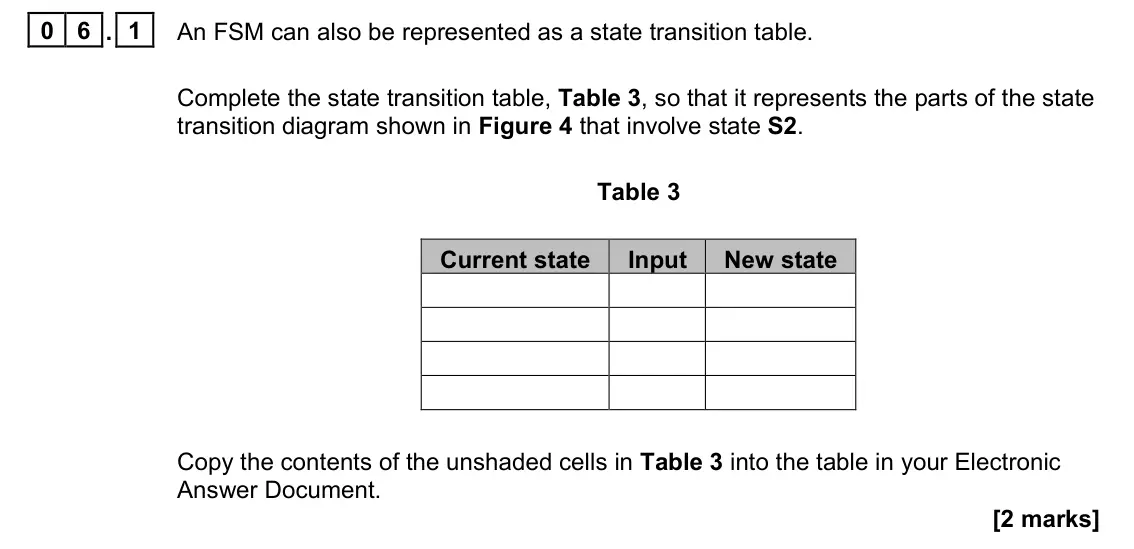
Q06.2
The whole paper ↗
Q02.1
The whole paper ↗
All 14 questions on Regular languages, as a list
- June 2024, Paper 1, Q04.1 (1 mark): What is meant by the cardinality of a set? [1 mark]
- June 2024, Paper 1, Q04.2 (1 mark): Explain what is wrong with the statement: ‘The only subsets of R are the sets {a}, {b} and {a, b}’. [1 mark]
- June 2024, Paper 1, Q04.3 (1 mark): How many members are there in the set formed by the intersection of R and U? [1 mark]
- June 2024, Paper 1, Q04.4 (1 mark): The language defined by a regular expression can be represented as a set. Explain the functionality of the | (vertical bar) metacharacter when it is used in a r
- June 2024, Paper 1, Q04.5 (2 marks): Write a regular expression that would match with all the members of the set W. [2 marks]
- June 2024, Paper 1, Q04.6 (2 marks): Write a regular expression that would match with all the members of the set X. [2 marks]
- June 2023, Paper 1, Q04.1 (3 marks): Complete Table 2 to show which of the languages in Figure 4 are regular languages. Table 2 Language Regular language (Y/N)? Language A Language B Language C Lan
- June 2023, Paper 1, Q04.2 (2 marks): Show that the language defined by the union of the sets {bn | n > 0} and {a, ab} is a regular language by writing a regular expression for the language. [2 mark
- June 2023, Paper 1, Q04.3 (1 mark): Explain what is meant by the cardinality of a set. [1 mark] for the next question
- June 2023, AS Paper 1, Q01 (6 marks): A security system uses a motion sensor, a keypad and an alarm bell. The system operates as follows: • the system is initially off • when the system is switched
- June 2022, AS Paper 1, Q02 (6 marks): A parking meter has an Add hours button (+), an Accept button, a coin slot, a payment card reader, a Cancel button and a number keypad. The system operates in a
- November 2021, Paper 1, Q06.1 (2 marks): An FSM can also be represented as a state transition table. Complete the state transition table, Table 3, so that it represents the parts of the state transitio
- November 2021, Paper 1, Q06.2 (3 marks): Regular expressions can be used to recognise the same strings as FSMs without output. Write a regular expression that will recognise the same set of strings tha
- November 2020, Paper 1, Q02.1 (2 marks): Complete the unshaded cells of Table 1 to show which of the statements about regular languages are true and which are false. Table 1 Statement True or False? Al
Questions, mark schemes and examiner’s reports are © AQA, from their published past papers. Plumi isn’t affiliated with any exam board. Want whole papers? Full past papers.
Rather write your answers by hand on iPad? Plumi marks them against the same mark schemes.