 plumi
Determination of rate equation: AQA A‑Level Chemistry questions
AQA A-Level Chemistry past-paper questions on 3.1.9.2 Determination of rate equation, 2008–2025, with mark schemes and examiner’s reports where available.
Paper
All papers
Exam
All years
Calculations
Q09.5
The whole paper ↗
Q02.1
The whole paper ↗
Q02.2
The whole paper ↗Q02.4
The whole paper ↗Q02.5
The whole paper ↗Q02.6
The whole paper ↗Q02.7
The whole paper ↗Q01.1
The whole paper ↗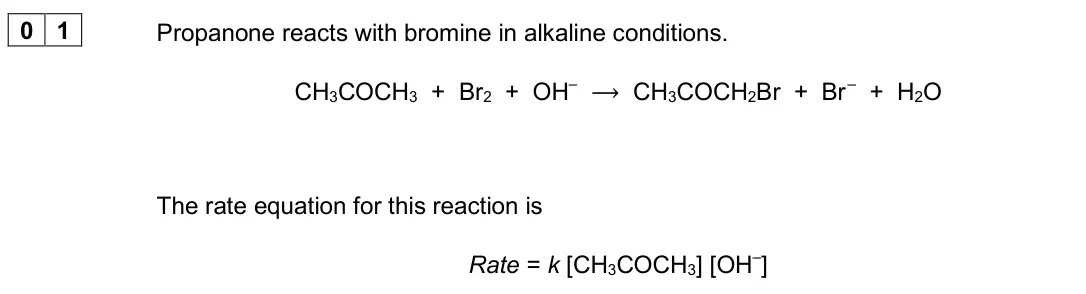
Q01.2
The whole paper ↗Q01.3
The whole paper ↗Q01.4
The whole paper ↗Q02.2
The whole paper ↗
Q02.3
The whole paper ↗Q02.4
The whole paper ↗Q02.5
The whole paper ↗Q02.1
The whole paper ↗
Q02.2
The whole paper ↗Q01.4
The whole paper ↗
Q04.2
The whole paper ↗
Q04.3
The whole paper ↗
All 61 questions on Determination of rate equation, as a list
- June 2025, Paper 2, Q09.5 (1 mark): The rate equation for the reaction between a different bromoalkane (R2CHBr) and an aqueous solution of KOH is rate = k [R2CHBr] Which of these is a correct mech
- June 2025, Paper 3, Q02.1 (3 marks): The amount of thiosulfate is the same in each experiment. To allow the order of reaction with respect to each reactant to be calculated, several other variables
- June 2025, Paper 3, Q02.2 (3 marks): Deduce the order of reaction with respect to each reactant. Explain how you deduced the order of reaction with respect to iodide ions. [3 marks] Order with resp
- June 2025, Paper 3, Q02.4 (3 marks): In each experiment, 1.00 cm3 of 1.00 × 10⁻³ mol dm–3 sodium thiosulfate solution is used to react with the iodine initially produced. I2(aq) + 2 S2O32–(aq) → 2
- June 2025, Paper 3, Q02.5 (1 mark): The total uncertainty in the times recorded for each experiment is ±0.5 s but the stopwatch used has a measurement uncertainty of ±0.01 s Suggest why, in each e
- June 2025, Paper 3, Q02.6 (1 mark): Calculate the percentage uncertainty in the time recorded in experiment 3. [1 mark] Percentage uncertainty
- June 2025, Paper 3, Q02.7 (2 marks): The five experiments are repeated with the same stopwatch and the same concentrations and volumes of H2O2, I– and H+ Suggest and explain how the method can be c
- June 2024, Paper 2, Q01.1 (1 mark): Sketch a graph on the axes provided to show how, at constant temperature, the concentration of bromine changes during this reaction. [1 mark]
- June 2024, Paper 2, Q01.2 (5 marks): Table 1 shows the initial rate of this reaction for experiments using different mixtures containing propanone, bromine and hydroxide ions. Table 1 Experiment [C
- June 2024, Paper 2, Q01.3 (4 marks): Figure 1 shows an incomplete mechanism for this reaction. Figure 1 Complete the mechanism in Figure 1 by adding four curly arrows and any relevant lone pair(s)
- June 2024, Paper 2, Q01.4 (1 mark): Use evidence from the rate equation to explain why Step 1 is the rate determining step. [1 mark]
- June 2024, Paper 3, Q02.2 (1 mark): 20 g of large marble chips is a large excess of calcium carbonate. Suggest why using a large excess of calcium carbonate means that the rate is only affected by
- June 2024, Paper 3, Q02.3 (2 marks): The mass of carbon dioxide produced in time t is equal to mt. The total mass of CO2 produced during the reaction is equal to mtotal. Explain why (mtotal – mt) i
- June 2024, Paper 3, Q02.4 (3 marks): Table 1 shows the rate of reaction, calculated from the gradient of the curve, at five different times. (mtotal – mt) is proportional to the concentration of un
- June 2024, Paper 3, Q02.5 (1 mark): State how the graph in Figure 2 confirms that the rate equation for this reaction is Rate = k[HCl] [1 mark]
- June 2023, Paper 2, Q02.1 (3 marks): Complete Table 1 by calculating the missing values. [3 marks]
- June 2023, Paper 2, Q02.2 (2 marks): A suggested mechanism for the reaction is shown. Step 1 B + H+ → BH+ Step 2 BH+ + B → B2H+ Step 3 B2H+ + A → C + D Deduce the rate-determining step for this rea
- June 2022, Paper 2, Q01.4 (1 mark): An experiment was done to measure the time, t, taken for a solution of iodine to react completely when added to an excess of an acidified solution of butanone.
- June 2022, Paper 3, Q04.2 (2 marks): The graph in Figure 1 shows how the concentration of hydrogen peroxide changes with time in this experiment. Figure 1 Tangents to the curve in Figure 1 can be u
- June 2022, Paper 3, Q04.3 (2 marks): The concentration of hydrogen peroxide solution at time t during the experiment can be calculated using this expression. [ ] [ ] max 2 2 2 2 initial max H O H O
- June 2022, Paper 3, Q04.4 (2 marks): Plot the data from Table 5 on the grid in Figure 2. Draw a line of best fit. [2 marks] Figure 2
- June 2022, Paper 3, Q04.5 (2 marks): Use Figure 2 to determine the order of reaction with respect to H2O2 State how the graph shows this order. [2 marks] Order How the graph shows this order
- November 2021, Paper 2, Q10.1 (2 marks): Suggest why the 1.0 cm3 portions of the reaction mixture are added to an excess of NaHCO3 solution. [2 marks]
- November 2021, Paper 2, Q10.2 (2 marks): Suggest why the order of this reaction with respect to propanone can be ignored in this experiment. [2 marks]
- November 2021, Paper 2, Q10.3 (3 marks): Use the results in Table 5 to draw a graph of volume of sodium thiosulfate solution against time. Draw a line of best fit. [3 marks]
- November 2021, Paper 2, Q10.4 (2 marks): Explain how the graph shows that the reaction is zero-order with respect to iodine in the reaction between propanone and iodine. [2 marks]
- November 2020, Paper 2, Q01.1 (3 marks): Use the graph in Figure 1 to determine the initial rate of reaction for this experiment. State its units. Show your working on the graph. [3 marks] Rate Units
- November 2020, Paper 2, Q01.2 (2 marks): Another student reacted different initial concentrations of phosphinate ions with an excess of hydroxide ions. The student measured the time (t) taken to collec
- November 2020, Paper 2, Q01.3 (1 mark): Complete the diagram in Figure 2 to show how the hydrogen gas could be collected and measured in the experiments in Questions 01.1 and 01.2. [1 mark] Figure 2 T
- November 2020, Paper 3, Q04.4 (3 marks): During the experiment the concentration of cisplatin is measured at one-minute intervals. Explain how graphical methods can be used to process the measured resu
- June 2019, Paper 2, Q04.1 (1 mark): Complete Table 2 to show the initial rate of reaction of P in each experiment. [1 mark] Table 2 Experiment Initial rate / mol dm 3 s 1 1 1.6 × 10⁻⁴ 2 3
- June 2019, Paper 2, Q04.2 (2 marks): Determine the order of reaction with respect to P and the order of reaction with respect to Q. [2 marks] Order with respect to P Order with respect to Q
- June 2018, Paper 3, Q01.1 (2 marks): Explain why the use of a large excess of H2O2 and I– means that the rate of reaction at a fixed temperature depends only on the concentration of H+(aq). [2 mark
- June 2018, Paper 3, Q01.2 (2 marks): Samples of the reaction mixture are removed at timed intervals and titrated with alkali to determine the concentration of H+(aq). State and explain what must be
- June 2018, Paper 3, Q01.3 (2 marks): A graph of the results is shown in Figure 1. Figure 1 Explain how the graph shows that the order with respect to H+(aq) is zero. [2 marks]
- June 2018, Paper 3, Q01.4 (3 marks): Use the graph in Figure 1 to calculate the value of k1 Give the units of k1 [3 marks] k1 Units
- June 2018, Paper 3, Q01.5 (1 mark): A second reaction mixture is made at the same temperature. The initial concentrations of H+(aq) and I–(aq) in this mixture are both 0.500 mol dm–3 There is a la
- June 2018, Paper 3, Q01.6 (1 mark): Draw a line of best fit on the grid in Figure 2. [1 mark]
- June 2018, Paper 3, Q01.7 (2 marks): Calculate the rate of reaction when [H+] = 0.35 mol dm–3 Show your working using a suitable construction on the graph in Figure 2. [2 marks] Rate mol dm–3 s–1
- June 2018, Paper 3, Q01.8 (6 marks): A general equation for a reaction is shown. A(aq) + B(aq) + C(aq) → D(aq) + E(aq) In aqueous solution, A, B, C and D are all colourless but E is dark blue. A re
- June 2018, Paper 3, Q13 (1 mark): A series of experiments was carried out to find the order of reaction with respect to reactant X. In these experiments, only the concentration of X was changed.
- June 2017, Paper 2, Q02.1 (1 mark): Draw a tangent to the curve at t = 0 [1 mark
- June 2017, Paper 2, Q02.2 (1 mark): Use this tangent to deduce the initial rate of the reaction. [1 mark Initial rate mol dm−3s−1
- Specimen, Paper 2, Q01.1 (3 marks): 3
- Specimen, Paper 2, Q02.1 (1 mark): Draw a tangent to the curve when the concentration of butadiene is 0.0120 mol dm–3. [1 mark] 0 2 . 1
- Specimen, Paper 2, Q02.2 (5 marks): 8
- June 2016, CHEM4 (old spec), Q6(a) (2 marks): Deduce the order of reaction with respect to D and the order with respect to E. [2 marks] Order with respect to D Order with respect to E Space for working
- June 2016, CHEM4 (old spec), Q6(b) (1 mark): Suggest why initial rates of reaction are used to determine these orders rather than rates of reaction at other times during the experiments. [1 mark]
- June 2016, CHEM4 (old spec), Q6(c) (2 marks): State how the initial rate is obtained from a graph of the concentration of the product against time. [2 marks]
- June 2016, CHEM4 (old spec), Q7(a) (1 mark): Suggest why the order with respect to iodine is zero. [1 mark]
- June 2015, CHEM4 (old spec), Q1(c) (1 mark): The reaction is zero order with respect to B. State the significance of this zero order for the mechanism of the reaction. [1 mark]
- June 2014, CHEM4 (old spec), Q3(a)(i) (1 mark): Deduce the order of reaction with respect to A. Tick () one box. [1 mark] Order of reaction with respect to A Tick () 0 1 2
- June 2014, CHEM4 (old spec), Q3(a)(ii) (1 mark): Deduce the order of reaction with respect to B. Tick () one box. [1 mark] Order of reaction with respect to B Tick () 0 1 2
- January 2013, CHEM4 (old spec), Q1(c)(i) (1 mark): Deduce the rate-determining step in this two-step process. (1 mark)
- January 2013, CHEM4 (old spec), Q1(c)(ii) (1 mark): Outline a mechanism for this step using a curly arrow. (1 mark)
- June 2011, CHEM4 (old spec), Q6(b) (2 marks): Using the rate equation and the overall equation, the following three-step mechanism for the reaction was suggested. X and Y are intermediate species. Step 1 NO
- January 2011, CHEM4 (old spec), Q1(b) (2 marks): Compound A reacts with compound B as shown by the overall equation A + 3B → AB3 The rate equation for the reaction is rate = k[A][B]2 A suggested mechanism for
- June 2010, CHEM4 (old spec), Q1(d)(i) (2 marks): Using the rate equation, predict which of the three steps is the rate-determining step. Explain your answer. Rate-determining step Explanation (2 marks)
- January 2010, CHEM4 (old spec), Q3(d) (2 marks): The following mechanism for the overall reaction has been proposed. Use the rate equation to suggest which of the four steps could be the rate-determining step.
- June 2008, CHM4 (2008 spec), Q2(a) (2 marks): 2 (a) The table below shows the results of three experiments to investigate the rate of reaction between compounds A and B. All three experiments were carried o
- June 2008, CHM5 (2008 spec), Q5(a) (2 marks): 5 (a) Use these curves and the dotted lines to deduce the order of the reaction with respect to iodide ions. Explain how you deduced the order. Order Explanatio
Questions, mark schemes and examiner’s reports are © AQA, from their published past papers. Plumi isn’t affiliated with any exam board. Want whole papers? AQA A-Level Chemistry past papers.
The Plumi iPad app also offers exam-style questions with AI feedback on your handwritten working.