 plumi
Ionic bonding: AQA A‑Level Chemistry questions
AQA A-Level Chemistry past-paper questions on 3.1.3.1 Ionic bonding, 2008–2025, with mark schemes and examiner’s reports where available.
Paper
All papers
Exam
All years
Calculations
- Your answer
Q03.5
The whole paper ↗
Q02.3
The whole paper ↗
Q01.2
The whole paper ↗
Q08.1
The whole paper ↗
Q01.3
The whole paper ↗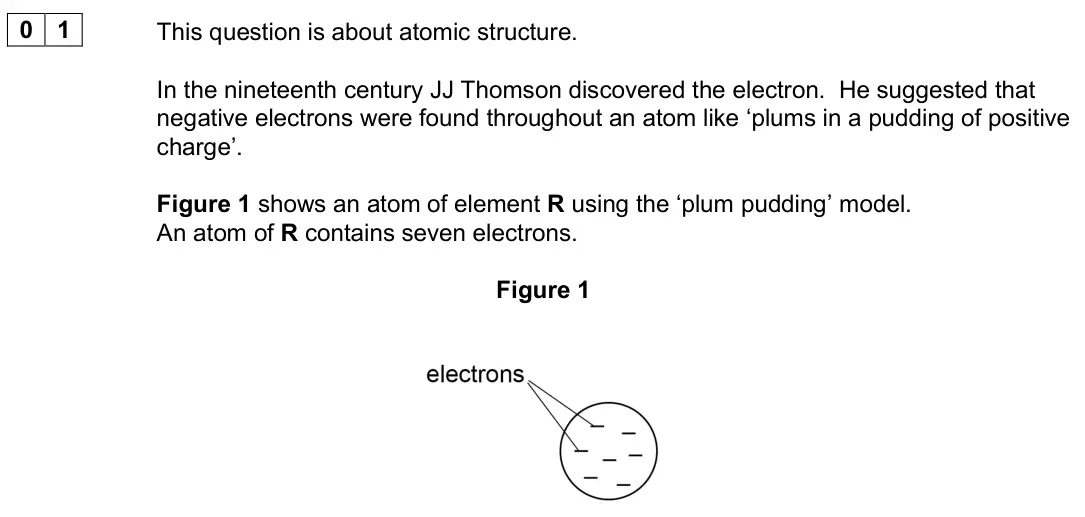
Q01.3
The whole paper ↗Q7(d)
The whole paper ↗
Q7(e)(iii)
The whole paper ↗Q4(c)(ii)
The whole paper ↗Q7(b)
The whole paper ↗
Q4(a)
The whole paper ↗
Q7(d)
The whole paper ↗
Q3(b)
The whole paper ↗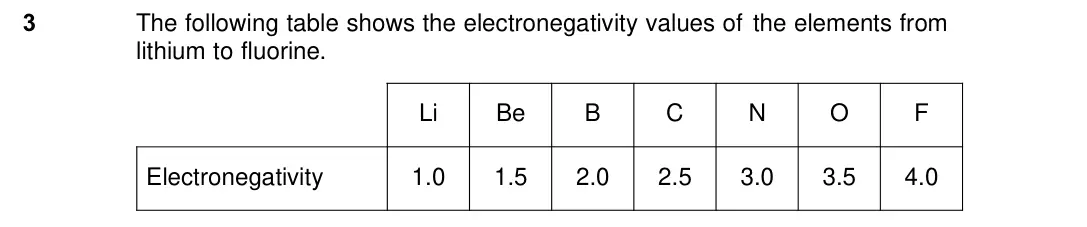
Q4(d)
The whole paper ↗Q1(c)
The whole paper ↗
All 26 questions on Ionic bonding, as a list
- June 2025, AS Paper 1, Q08 (1 mark): What is the formula of gallium sulfate(VI)? [1 mark] A Ga2(SO4)3 B Ga3(SO4)2 C Ga2(SO3)3 D GaSO4
- June 2025, AS Paper 1, Q11 (1 mark): Which diagram best shows the arrangement and the relative sizes of the ions in solid sodium chloride? [1 mark] A B C D
- June 2024, Paper 3, Q09 (1 mark): What is the formula of ammonium ethanedioate? [1 mark] A NH4(C2O4)2 B (NH4)2C2O4 C NH4C2O4 D (NH4)2(C2O4)3
- June 2024, AS Paper 1, Q03.5 (2 marks): Draw a 3D diagram to show how the particles are arranged in a barium oxide lattice. You should draw eight particles. [2 marks]
- November 2021, Paper 3, Q12 (1 mark): Which statement about inorganic ionic compounds is always correct? [1 mark] A They dissolve in water to give neutral solutions. B They release energy when they
- November 2021, AS Paper 1, Q02.3 (3 marks): Explain, in terms of structure and bonding, why magnesium chloride has a high melting point. [3 marks]
- June 2019, AS Paper 1, Q01.2 (2 marks): Explain, in terms of structure and bonding, why the melting point of sodium fluoride is high. [2 marks]
- June 2018, Paper 1, Q08.1 (6 marks): Use your knowledge of structure and bonding to explain why sodium bromide has a melting point that is higher than that of sodium, and higher than that of sodium
- June 2018, AS Paper 1, Q01.3 (1 mark): Identify R and deduce the formula of the compound formed when R reacts with the Group 2 metal in the same period as R. [1 mark]
- June 2018, AS Paper 1, Q10 (1 mark): Which row shows the bonding in ammonium chloride? [1 mark] Covalent Dative covalent Ionic A B C D
- June 2016, AS Paper 1, Q01.3 (1 mark): Deduce the formula of the compound that contains 2+ ions and 3− ions that both have the same electron configuration as argon. [1 mark]
- June 2015, CHEM1 (old spec), Q7(d) (3 marks): Sodium azide has a high melting point. Predict the type of bonding in a crystal of sodium azide. Suggest why its melting point is high. [3 marks] Type of bondin
- June 2015, CHEM1 (old spec), Q7(e)(iii) (1 mark): Which is the correct formula of magnesium azide? [1 mark] Tick () one box. Mg3N MgN MgN6 Mg3N2
- June 2014, CHEM1 (old spec), Q4(c)(ii) (1 mark): Suggest the formula of an ionic compound that is formed by the chemical combination of two different elements from Table 3. [1 mark]
- June 2014, CHEM1 (old spec), Q7(b) (3 marks): Thallium(I) bromide (TlBr) is a crystalline solid with a melting point of 480 ºC. Suggest the type of bonding present in thallium(I) bromide and state why the m
- June 2013, CHEM5 (old spec), Q4(a) (3 marks): State the type of bonding in magnesium oxide. Outline a simple experiment to demonstrate that magnesium oxide has this type of bonding. Type of bonding Experime
- June 2013, CHEM1 (old spec), Q7(d) (3 marks): Predict the type of crystal structure in solid zinc fluoride and explain why its melting point is high.
- January 2013, CHEM1 (old spec), Q3(b) (3 marks): State the type of bonding in lithium fluoride. Explain why a lot of energy is needed to melt a sample of solid lithium fluoride. Bonding Explanation
- June 2012, CHEM1 (old spec), Q4(d) (3 marks): Magnesium oxide (MgO) has a melting point of 3125 K. Predict the type of crystal structure in magnesium oxide and suggest why its melting point is high. Type of
- January 2012, CHEM1 (old spec), Q1(c) (3 marks): BrF4 – ions are also formed when potassium fluoride dissolves in liquid BrF3 to form KBrF4 Explain, in terms of bonding, why KBrF4 has a high melting point.
- January 2012, CHEM1 (old spec), Q5(c) (1 mark): Use the Periodic Table and your knowledge of electron arrangement to write the formula of lithium nitride. (1 mark)
- June 2011, CHEM1 (old spec), Q4(b)(i) (1 mark): Name the type of bonding in sodium chloride. (1 mark)
- January 2010, CHEM1 (old spec), Q3(f) (3 marks): Sodium sulfide (Na2S) has a melting point of 1223K. Predict the type of bonding in sodium sulfide and explain why its melting point is high. Type of bonding Exp
- June 2009, CHEM1 (old spec), Q5(d) (5 marks): 5 (d) Silver reacts with fluorine to form silver fluoride (AgF). Silver fluoride has a high melting point and has a structure similar to that of sodium chloride
- June 2008, CHM1 (2008 spec), Q6 (8 marks): 6 On heating, a mixture of sodium and iodine react to form sodium iodide as shown by the equation below. 2Na + I2 →2NaI The melting points of iodine and sodium
- June 2008, CHM6W (2008 spec), Q1 (1 mark): 1 Which one of the following solids contains covalent bonds but not ionic bonds? A C6H5COOH B CuSO4 C NH4Br D CH3NH3Cl
Questions, mark schemes and examiner’s reports are © AQA, from their published past papers. Plumi isn’t affiliated with any exam board. Want whole papers? AQA A-Level Chemistry past papers.
The Plumi iPad app also offers exam-style questions with AI feedback on your handwritten working.