 plumi
Nature of covalent and dative covalent bonds: AQA A‑Level Chemistry questions
AQA A-Level Chemistry past-paper questions on 3.1.3.2 Nature of covalent and dative covalent bonds, 2008–2025, with mark schemes and examiner’s reports where available.
Paper
All papers
Exam
All years
Calculations
Q01.6
The whole paper ↗
Q01.5
The whole paper ↗
Q02.1
The whole paper ↗
Q01.3
The whole paper ↗
Q07.1
The whole paper ↗
Q07.2
The whole paper ↗Q08.1
The whole paper ↗Q7(e)(i)
The whole paper ↗
Q4(b)
The whole paper ↗Q3(b)
The whole paper ↗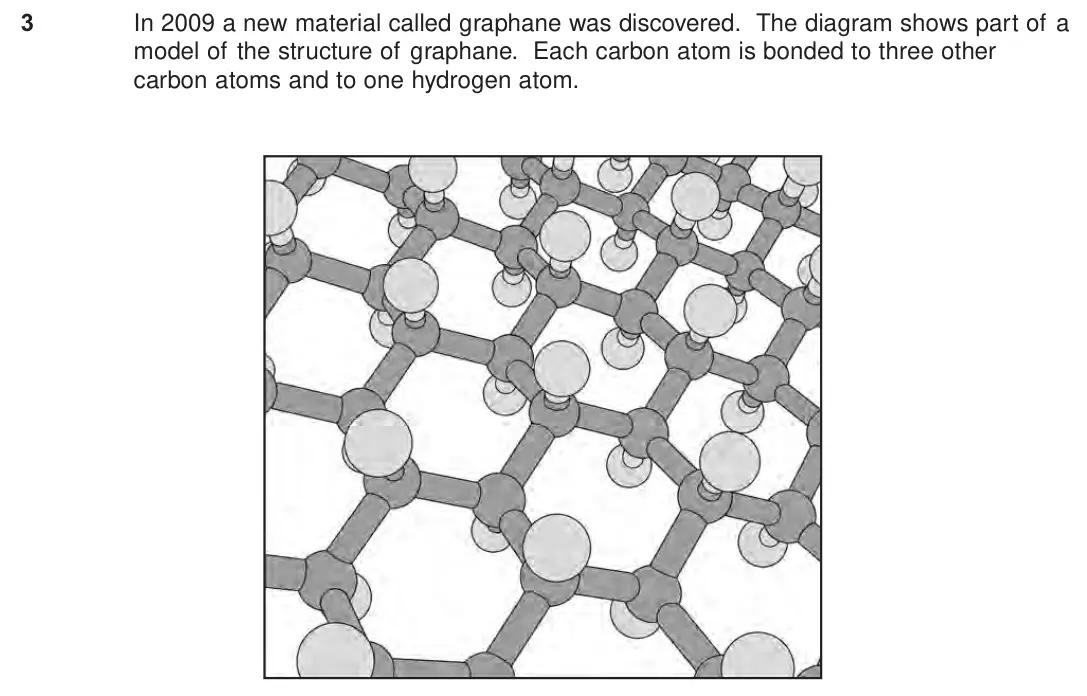
Q5(b)
The whole paper ↗
Q3(b)
The whole paper ↗
All 31 questions on Nature of covalent and dative covalent bonds, as a list
- June 2025, AS Paper 2, Q01.6 (2 marks): A co-ordinate bond is formed when the (CH3)3C+ carbocation reacts with CN– to form a nitrile. Explain how this co-ordinate bond is formed during this reaction.
- June 2024, Paper 3, Q10 (1 mark): Which diagram shows the formation of a dative covalent bond? [1 mark] A B C D
- June 2024, AS Paper 1, Q11 (1 mark): Which involves the formation of a dative covalent bond? [1 mark] A PCl3 + Cl2 → PCl5 B Na+ + H– → NaH C Mg + Cl2 → MgCl2 D BH3 + H– → BH4–
- June 2023, Paper 1, Q01.5 (1 mark): Name the type of bond between N and H in ammonia. [1 mark]
- June 2023, AS Paper 1, Q14 (1 mark): Which molecule can accept an electron pair during the formation of a coordinate bond? [1 mark] A NH3 B AlCl3 C SiH4 D PCl3
- June 2022, AS Paper 1, Q15 (1 mark): The equation for a reaction is AsH3 + H+ → AsH4+ What type of interaction forms in this reaction? [1 mark] A Co-ordinate bond B Dipole–dipole force C Hydrogen b
- November 2021, AS Paper 1, Q13 (1 mark): Which molecule is not able to form a co-ordinate bond with another species? [1 mark] A BH3 B CH4 C NH3 D H2O
- November 2020, AS Paper 1, Q16 (1 mark): Which compound contains a co-ordinate bond? [1 mark] A HF B NH3 C CHCl3 D NH4Cl
- June 2019, Paper 3, Q02.1 (1 mark): Draw the displayed formula of a molecule of H2SO4 [1 mark]
- June 2019, AS Paper 1, Q01.3 (2 marks): The ion H2F+ is formed when hydrogen fluoride gains a proton as shown in the equation HF + H+ → H2F+ Name the type of bond formed when HF reacts with H+ Explain
- June 2018, Paper 3, Q06 (1 mark): Which diagram shows the correct bonding and correct bond polarity in a molecule of oxygen difluoride? [1 mark] A B C D In the early twentieth century the appara
- June 2018, AS Paper 1, Q10 (1 mark): Which row shows the bonding in ammonium chloride? [1 mark] Covalent Dative covalent Ionic A B C D
- June 2017, Paper 1, Q07.1 (1 mark): State the type of bonding between the oxygen and hydrogen in this compound [1 mark
- June 2016, AS Paper 1, Q07.2 (2 marks): Name the type of bond formed between N and Al in H3NAlCl3 and explain how this bond is formed. [2 marks] Type of bond Explanation
- Specimen, Paper 1, Q08.1 (2 marks): A co-ordinate bond is formed when a transition metal ion reacts with a ligand. Explain how this co-ordinate bond is formed. [2 mark 0 8 . 1
- June 2015, CHEM1 (old spec), Q7(e)(i) (1 mark): The azide ion can be represented as N N – N– One of these bonds is a co-ordinate bond. On the following diagram, draw an arrowhead on one of the bonds to repres
- June 2014, CHEM1 (old spec), Q4(b) (1 mark): Ammonia reacts with boron trichloride to form a molecule with the following structure. State how the bond between ammonia and boron trichloride is formed. [1 ma
- June 2013, CHEM1 (old spec), Q3(b) (1 mark): State how two carbon atoms form a carbon–carbon bond in graphane. (1 mark)
- June 2013, CHEM1 (old spec), Q5(b) (2 marks): An aluminium chloride molecule reacts with a chloride ion to form the AlCl4−ion. Name the type of bond formed in this reaction. Explain how this type of bond is
- June 2012, CHEM1 (old spec), Q3(b) (2 marks): State the type of bond that is formed between the PH3 molecule and the H+ ion. Explain how this bond is formed. Name of bond How bond is formed (2 marks)
- January 2012, CHEM1 (old spec), Q1(a) (2 marks): Fluorine reacts with bromine to form liquid bromine trifluoride (BrF3). State the type of bond between Br and F in BrF3 and state how this bond is formed. Type
- June 2011, CHEM1 (old spec), Q3(d) (2 marks): A molecule of NHF2 reacts with a molecule of BF3 as shown in the following equation. NHF2 + BF3 F2HNBF3 State the type of bond formed between the N atom and the
- June 2010, CHEM5 (old spec), Q4(e)(i) (2 marks): In this diagram, bonds between nitrogen and iron are shown as N→Fe and as N–Fe. State the meaning of each of these symbols. Meaning of → Meaning of – (2 marks)
- June 2010, CHEM1 (old spec), Q1(a)(i) (1 mark): State the meaning of the term covalent bond. (1 mark)
- June 2010, CHEM1 (old spec), Q1(d)(i) (3 marks): Name the type of bond formed when a molecule of BF3 reacts with an F – ion. Explain how this bond is formed. Type of bond Explanation
- January 2010, CHEM1 (old spec), Q3(e) (2 marks): When H+ ions react with H2O molecules, H3O+ ions are formed. Name the type of bond formed when H+ ions react with H2O molecules. Explain how this type of bond i
- June 2009, CHEM1 (old spec), Q3(a)(i) (2 marks): 3 (a) (i) State the type of bond present between the C and H atoms in both of these molecules. Explain how this type of bond is formed. Type of bond Explanation
- January 2009, CHEM1 (old spec), Q2(d) (3 marks): 2 (d) Phosphorus is in the same group of the Periodic Table as nitrogen. A molecule of PH3 reacts with an H+ ion to form a PH4+ ion. Name the type of bond forme
- January 2009, CHM1 (2008 spec), Q2(d) (1 mark): 2 (d) Use your knowledge of bonding to draw a diagram showing the bonding in a molecule of C2H2 (1 mark)
- January 2009, CHM1 (2008 spec), Q4(a) (2 marks): 4 (a) The methylene molecule can be represented as :CH2 The equation for the reaction between H+ and :CH2 is shown below. H+ + :CH2 →CH3 + Name the type of bond
- June 2008, CHM6W (2008 spec), Q1 (1 mark): 1 Which one of the following solids contains covalent bonds but not ionic bonds? A C6H5COOH B CuSO4 C NH4Br D CH3NH3Cl
Questions, mark schemes and examiner’s reports are © AQA, from their published past papers. Plumi isn’t affiliated with any exam board. Want whole papers? AQA A-Level Chemistry past papers.
The Plumi iPad app also offers exam-style questions with AI feedback on your handwritten working.