 plumi
Bond polarity: AQA A‑Level Chemistry questions
AQA A-Level Chemistry past-paper questions on 3.1.3.6 Bond polarity, 2008–2025, with mark schemes and examiner’s reports where available.
Paper
All papers
Exam
All years
Calculations
Q03.1
The whole paper ↗
Q03.2
The whole paper ↗Q03.3
The whole paper ↗Q05.2
The whole paper ↗
Q06.1
The whole paper ↗
Q06.2
The whole paper ↗Q04.2
The whole paper ↗
Q04.3
The whole paper ↗Q04.4
The whole paper ↗Q03.4
The whole paper ↗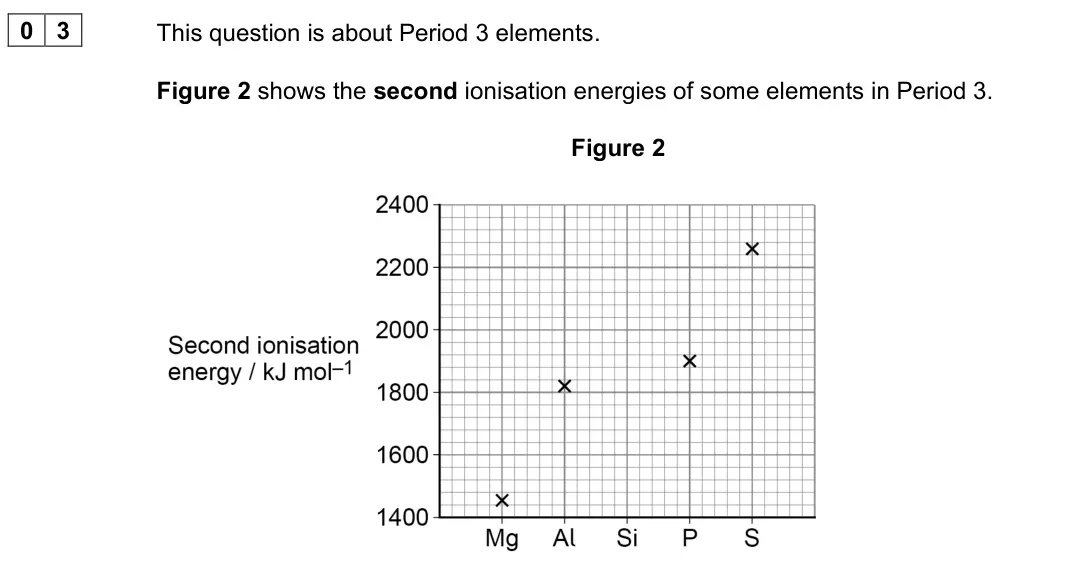
Q05.1
The whole paper ↗
Q01.4
The whole paper ↗
All 43 questions on Bond polarity, as a list
- June 2025, AS Paper 1, Q19 (1 mark): Which of these molecules is polar? [1 mark] A BF3 B CO2 C CCl4 D SCl2
- June 2025, AS Paper 2, Q14 (1 mark): Sulfur dioxide can be found in the flue gases from the combustion of some fuels. Which statement about sulfur dioxide is correct? [1 mark] A Sulfur dioxide mole
- June 2024, Paper 3, Q12 (1 mark): Which molecule does not have a permanent dipole? [1 mark] A NH3 B PCl3 C SCl2 D SiCl4
- June 2024, AS Paper 1, Q03.1 (1 mark): Define electronegativity. [1 mark]
- June 2024, AS Paper 1, Q03.2 (2 marks): Explain why the C–Cl bond is polar. [2 marks]
- June 2024, AS Paper 1, Q03.3 (2 marks): Although the C–Cl bond is polar, CCl4 is a non-polar molecule. Explain why. [2 marks]
- June 2023, Paper 3, Q05.2 (4 marks): All three compounds in Table 2 are polar. Ethanol is the most polar and ethylamine is the least polar. Explain why all three molecules are polar and why ethylam
- June 2023, AS Paper 1, Q13 (1 mark): Which molecule has a permanent dipole? [1 mark] A NCl3 B CCl4 C PF5 D SF6
- June 2023, AS Paper 2, Q06.1 (1 mark): State why the C–Cl bonds in dichloromethane and tetrachloromethane are polar. [1 mark]
- June 2023, AS Paper 2, Q06.2 (1 mark): Suggest why tetrachloromethane molecules are non-polar. [1 mark]
- June 2022, AS Paper 1, Q04.2 (1 mark): Define the term electronegativity. [1 mark]
- June 2022, AS Paper 1, Q04.3 (1 mark): Deduce the two atoms from Table 3 that will form the most polar bond. [1 mark]
- June 2022, AS Paper 1, Q04.4 (2 marks): The C–Br bond is polar. Explain why CBr4 is not a polar molecule. [2 marks]
- November 2021, Paper 3, Q16 (1 mark): Which molecule has a permanent dipole? [1 mark] A BF3 B NH3 C SiCl4 D SO3
- November 2021, AS Paper 1, Q15 (1 mark): Which bond has the most unsymmetrical electron distribution? [1 mark] A H–O B H–S C H–N D H–P
- November 2020, Paper 1, Q03.4 (1 mark): Identify the element in Period 3, from sodium to chlorine, that has the highest electronegativity. [1 mark]
- November 2020, Paper 2, Q05.1 (3 marks): Define the term electronegativity. Explain the polarity of the C–Br bond in 2-bromopropane. [3 marks] Electronegativity Explanation
- November 2020, AS Paper 1, Q10 (1 mark): Which species contains bonds that have different polarities? [1 mark] A NH4+ B CCl4 C CH3Cl D H3O+
- November 2020, AS Paper 1, Q23 (1 mark): Which molecule has a permanent dipole? [1 mark] A CF4 B PCl5 C CO2 D Cl2O
- November 2020, AS Paper 2, Q01.4 (1 mark): The C–Cl bond in 1-chloropropane is polar because carbon and chlorine have different electronegativities. Define the term electronegativity. [1 mark]
- June 2019, Paper 1, Q03.2 (1 mark): Identify the element in Period 4 with the highest electronegativity value. [1 mark]
- June 2018, Paper 3, Q06 (1 mark): Which diagram shows the correct bonding and correct bond polarity in a molecule of oxygen difluoride? [1 mark] A B C D In the early twentieth century the appara
- June 2018, AS Paper 2, Q10 (1 mark): Which molecule does not have a permanent dipole? [1 mark] A CH3Br B CH2Br2 C CHBr3 D CBr4
- June 2017, AS Paper 1, Q05.1 (1 mark): 0 5 . 1 Give the meaning of the term electronegativity. [1 mark]
- June 2017, AS Paper 1, Q05.2 (2 marks): Explain how permanent dipole-dipole forces arise between hydrogen chloride molecules. [2 mark
- June 2017, AS Paper 1, Q05.3 (4 marks): Complete Table 4 by naming the shape of each molecule. Place a tick () in the final column if the molecule has a permanent dipole. [4 mark Table 4 Molecule Nam
- June 2016, AS Paper 1, Q20 (1 mark): Which molecule has the largest dipole? [1 mark A ClF3 B BF3 C SF6 D CF4
- June 2015, CHEM1 (old spec), Q1(c) (1 mark): Suggest the element in Period 3 that has the highest electronegativity value. [1 mark]
- June 2015, CHEM1 (old spec), Q5(c) (2 marks): Explain, in terms of electronegativity, why the boiling point of H2S2 is lower than H2O2. [2 marks]
- June 2014, CHEM1 (old spec), Q4(c)(i) (2 marks): Give the meaning of the term electronegativity. [2 marks]
- June 2014, CHEM1 (old spec), Q4(c)(ii) (1 mark): Suggest the formula of an ionic compound that is formed by the chemical combination of two different elements from Table 3. [1 mark]
- June 2014, CHEM1 (old spec), Q4(c)(iii) (1 mark): Suggest the formula of the compound that has the least polar bond and is formed by chemical combination of two of the elements from Table 3. [1 mark]
- January 2013, CHEM5 (old spec), Q2(e) (2 marks): Energy is released when a magnesium ion is hydrated because magnesium ions attract water molecules. Explain why magnesium ions attract water molecules. You may
- January 2013, CHEM1 (old spec), Q3(a)(i) (2 marks): State the meaning of the term electronegativity. (2 marks)
- January 2013, CHEM1 (old spec), Q3(a)(ii) (2 marks): Suggest why the electronegativity of the elements increases from lithium to fluorine. (2 marks)
- January 2013, CHEM1 (old spec), Q3(c) (1 mark): Deduce why the bonding in nitrogen oxide is covalent rather than ionic. (1 mark)
- June 2012, CHEM5 (old spec), Q3(b) (2 marks): Explain why the electronegativity of fluorine is greater than the electronegativity of chlorine. (2 marks)
- June 2012, CHEM1 (old spec), Q3(d) (1 mark): Although phosphine molecules contain hydrogen atoms, there is no hydrogen bonding between phosphine molecules. Suggest an explanation for this. (1 mark)
- January 2010, CHEM5 (old spec), Q8(a) (4 marks): State and explain the trend in electronegativities across Period 3 from sodium to sulfur.
- January 2009, CHEM1 (old spec), Q2(a) (2 marks): 2 (a) State the meaning of the term electronegativity. (2 marks)
- January 2009, CHM1 (2008 spec), Q3(c)(ii) (2 marks): 3 (c) (ii) Explain, in terms of electronegativity, why hydrogen bonds form between H2O molecules but not between H2S molecules. (2 marks)
- January 2008, CHM1 (2008 spec), Q3(b) (5 marks): (b) There is a trend in the electronegativity of the Period 3 elements Na to Cl (i) Define the term electronegativity. (ii) State and explain the trend in the e
- January 2008, CHM1 (2008 spec), Q3(c) (3 marks): (c) Some electronegativity values are given below. H F Cl Br I Electronegativity value 2.1 4.0 3.0 2.8 2.5 (i) Explain why the covalent bond in HF is polar. (ii
Questions, mark schemes and examiner’s reports are © AQA, from their published past papers. Plumi isn’t affiliated with any exam board. Want whole papers? AQA A-Level Chemistry past papers.
The Plumi iPad app also offers exam-style questions with AI feedback on your handwritten working.