 plumi
Enthalpy change: AQA A‑Level Chemistry questions
AQA A-Level Chemistry past-paper questions on 3.1.4.1 Enthalpy change, 2008–2025, with mark schemes and examiner’s reports where available.
Paper
All papers
Exam
All years
Calculations
Q04.1
The whole paper ↗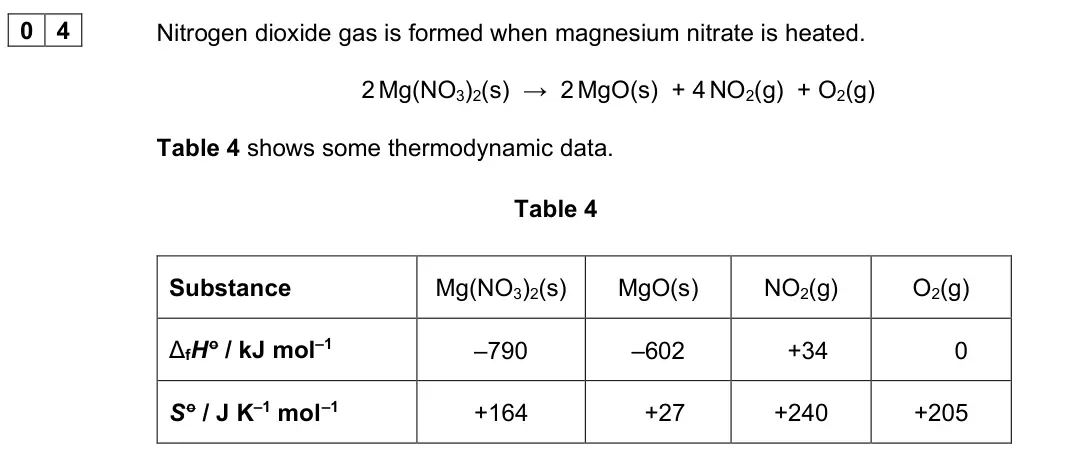
Q07.1
The whole paper ↗
Q08.1
The whole paper ↗
Q05.4
The whole paper ↗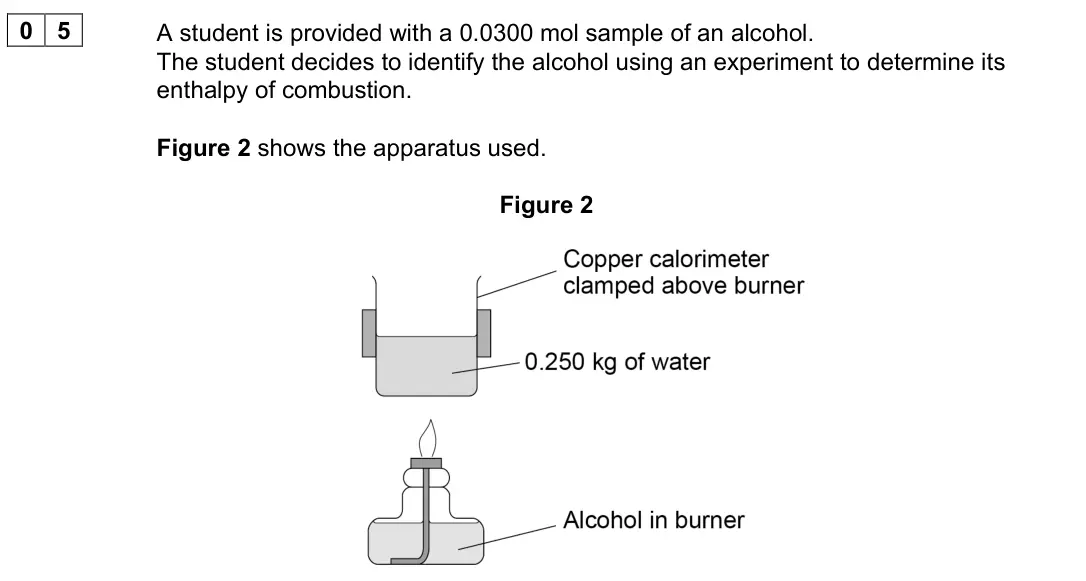
Q07.3
The whole paper ↗
Q01.1
The whole paper ↗
Q07.1
The whole paper ↗
Q08.1
The whole paper ↗
Q05.3
The whole paper ↗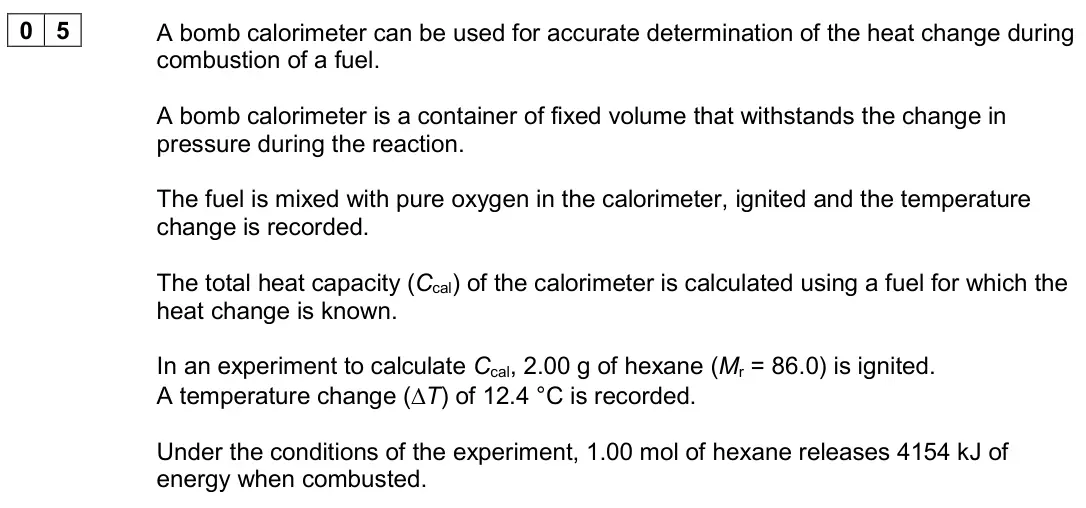
Q04.1
The whole paper ↗
Q01.1
The whole paper ↗
Q02.1
The whole paper ↗
Q04.4
The whole paper ↗
Q04.5
The whole paper ↗
All 53 questions on Enthalpy change, as a list
- June 2025, Paper 1, Q04.1 (1 mark): Give the standard conditions indicated by the symbol o in ΔfH o and S o [1 mark]
- June 2025, AS Paper 2, Q07.1 (1 mark): Define enthalpy change. [1 mark]
- June 2025, AS Paper 2, Q22 (1 mark): Which reaction at 298 K has a standard enthalpy change equal to the standard enthalpy of formation of liquid iodoethane? [1 mark] A 1 2 I2(I) + 2 C(s) + 5 2 H2(
- June 2024, AS Paper 1, Q08.1 (2 marks): Define standard enthalpy of formation. [2 marks]
- June 2023, Paper 3, Q10 (1 mark): Which reaction has a standard enthalpy change equal to the standard enthalpy of formation for barium chloride? [1 mark] A Ba(g) + Cl2(g) → BaCl2(s) B Ba2+(g) +
- June 2023, AS Paper 1, Q15 (1 mark): Which reaction has an enthalpy change equal to the standard enthalpy of formation of potassium oxide? [1 mark] A 4 K(s) + O2(g) → 2 K2O(s) B 2 K(s) + O(g) → K2O
- June 2023, AS Paper 2, Q05.4 (2 marks): The energy stored in fuels can be compared using energy density values measured in kJ dm–3 Calculate the energy density of butan-1-ol. enthalpy of combustion of
- June 2022, AS Paper 2, Q07.3 (2 marks): Table 2 shows the enthalpies of combustion of the three fuels from the fermentation of silverskin. Table 2 Fuel Standard enthalpy of combustion / kJ mol–1 Energ
- November 2021, Paper 1, Q01.1 (1 mark): State the meaning of the term enthalpy change. [1 mark]
- November 2021, AS Paper 1, Q07.1 (2 marks): State the meaning of the term standard enthalpy of combustion. [2 marks]
- November 2021, AS Paper 2, Q08.1 (1 mark): Define the term enthalpy change. [1 mark]
- November 2020, Paper 3, Q05.3 (1 mark): State why the heat change calculated from the bomb calorimeter experiment is not an enthalpy change. [1 mark]
- November 2020, Paper 3, Q09 (1 mark): Which reaction has an enthalpy change equal to the standard enthalpy of formation of silver iodide? [1 mark] A Ag(g) + 1 2 I2(g) → AgI(s) B Ag(s) + 1 2 I2(s) →
- November 2020, AS Paper 1, Q04.1 (1 mark): State the meaning of the term enthalpy change as applied to a chemical reaction. [1 mark]
- November 2020, AS Paper 1, Q12 (1 mark): Which reaction has an enthalpy change equal to the standard enthalpy of formation of lithium fluoride? [1 mark] A Li(g) + 1 2 F2(g) → LiF(s) B Li+(g) + F–(g) →
- November 2020, AS Paper 2, Q01.1 (2 marks): Define the term standard enthalpy of formation. [2 marks]
- June 2019, AS Paper 1, Q14 (1 mark): Which equation represents the reaction that has a standard enthalpy change equal to the standard enthalpy of formation for barium chloride? [1 mark] A Ba(g) + C
- June 2017, AS Paper 1, Q02.1 (1 mark): Write an equation, including state symbols, for the reaction with an enthalpy change equal to the enthalpy of formation for iron(III) oxide. [1 mark
- June 2017, AS Paper 2, Q04.4 (3 marks): Values of the enthalpy change for combustion of 1 g of some alkanes are shown in Table 2. Table 2 methane ethane propane butane pentane Enthalpy change in kJ fo
- June 2017, AS Paper 2, Q04.5 (2 marks): Isooctane (2,2,4-trimethylpentane) is an important component of petrol used in cars. When isooctane is burned, the enthalpy change is −47.8 kJ g−1 Isooctane is
- June 2016, AS Paper 2, Q02.5 (3 marks): The enthalpy of combustion of ethanol is −1371 kJ mol−1. The density of ethanol is 0.789 g cm−3. Calculate the heat energy released in kJ when 0.500 dm3 of etha
- June 2016, CHEM2 (old spec), Q2(a) (3 marks): State the meaning of the term standard enthalpy of combustion. [3 marks]
- June 2015, CHEM5 (old spec), Q2(c)(i) (1 mark): Suggest one reason why you would expect the standard enthalpy of combustion of hydrogen to be the same as the answer to Question 2 (b). [1 mark]
- June 2015, CHEM2 (old spec), Q7(d) (3 marks): Define the term standard enthalpy of combustion. [3 marks]
- June 2014, CHEM2 (old spec), Q3(c)(ii) (1 mark): Suggest why the value for the standard enthalpy of formation of liquid antimony, given in Table 1, is not zero. [1 mark]
- June 2013, CHEM2 (old spec), Q10(b) (2 marks): Write an equation for the reaction that has an enthalpy change that is the standard enthalpy of formation of ethanol. (2 marks)
- June 2013, CHEM2 (old spec), Q10(c)(i) (3 marks): Define the term standard enthalpy of combustion.
- January 2013, CHEM5 (old spec), Q1(c)(i) (1 mark): Write an equation, including state symbols, for the reaction that has an enthalpy change equal to the standard enthalpy of formation of gaseous ClF (1 mark)
- January 2013, CHEM2 (old spec), Q1(b)(ii) (2 marks): Complete Figure 2 by drawing the shape of the reaction profile from reactants to products for an exothermic reaction. Show the position of the products. Show an
- January 2013, CHEM2 (old spec), Q3(a)(ii) (1 mark): State why the value for the standard enthalpy of formation of Mn(s) is zero. (1 mark)
- June 2012, CHEM2 (old spec), Q2(a)(ii) (1 mark): State why the standard enthalpy of formation for hydrogen gas is zero. (1 mark)
- January 2012, CHEM5 (old spec), Q2(a) (1 mark): State the meaning of the symbol in ΔH . (1 mark)
- January 2012, CHEM5 (old spec), Q2(d) (1 mark): The freezing of water is an exothermic process. Give one reason why the temperature of a sample of water can stay at a constant value of 0 oC when it freezes. (
- January 2012, CHEM2 (old spec), Q4(b)(iii) (3 marks): State the meaning of the term standard enthalpy of combustion.
- January 2012, CHEM2 (old spec), Q4(d)(i) (1 mark): Write an equation for the reaction that represents the standard enthalpy of formation of carbon dioxide. (1 mark)
- January 2012, CHEM2 (old spec), Q4(d)(ii) (1 mark): State why the value quoted in part (c) for the standard enthalpy of formation of CO2(g) is the same as the value for the standard enthalpy of combustion of carb
- June 2011, CHEM2 (old spec), Q2(b) (1 mark): Give the meaning of the term enthalpy change. (1 mark)
- June 2011, CHEM2 (old spec), Q2(d) (3 marks): Define the term standard enthalpy of formation.
- June 2011, CHEM2 (old spec), Q2(e)(i) (1 mark): State why the value for the standard enthalpy of formation of Na(I) is not zero. (1 mark)
- January 2011, CHEM2 (old spec), Q9(c)(i) (3 marks): Give the meaning of the term standard enthalpy of combustion.
- June 2010, CHEM5 (old spec), Q1(b)(i) (3 marks): Define the term standard enthalpy of formation.
- June 2010, CHEM5 (old spec), Q1(b)(ii) (1 mark): Write an equation, including state symbols, for the process that has an enthalpy change equal to the standard enthalpy of formation of calcium fluoride. (1 mark
- June 2010, CHEM2 (old spec), Q1(a)(ii) (1 mark): Use the diagram to deduce whether the formation of hydrogen iodide from hydrogen and iodine is exothermic or endothermic. (1 mark)
- June 2010, CHEM2 (old spec), Q1(a)(iv) (2 marks): In terms of p and q, identify the following for this equilibrium without a catalyst. A value for the activation energy for the forward reaction A value for the
- June 2010, CHEM2 (old spec), Q4(c)(ii) (1 mark): State one condition necessary for enthalpies of formation to be quoted as standard values at a specified temperature of 298 K. (1 mark)
- January 2010, CHEM2 (old spec), Q2(a) (1 mark): State the meaning of the term enthalpy change. (1 mark)
- January 2010, CHEM2 (old spec), Q5(a)(iii) (1 mark): Suggest a reason why the catalyst remains hot during the reaction. (1 mark)
- June 2009, CHEM2 (old spec), Q2(a)(i) (3 marks): 2 (a) (i) State what is meant by the term standard enthalpy of formation. (3 marks)
- June 2009, CHEM2 (old spec), Q2(a)(ii) (1 mark): 2 (a) (ii) State why the standard enthalpy of formation of barium and that of aluminium are both zero. (1 mark)
- June 2008, CHM2 (2008 spec), Q2(a) (3 marks): 2 (a) Define the term standard enthalpy of combustion. (3 marks)
- June 2008, CHM5 (2008 spec), Q3(a) (1 mark): 3 (a) Write an equation to represent the formation of one mole of ammonia from its elements. (1 mark)
- January 2008, CHM2 (2008 spec), Q3(a) (3 marks): 3 (a) Define the term standard enthalpy of combustion. (3 marks)
- January 2008, CHM2 (2008 spec), Q3(d) (1 mark): (d) State how you would expect the value obtained in part (c) to differ if gaseous water, rather than liquid water, is formed. (1 mark)
Questions, mark schemes and examiner’s reports are © AQA, from their published past papers. Plumi isn’t affiliated with any exam board. Want whole papers? AQA A-Level Chemistry past papers.
The Plumi iPad app also offers exam-style questions with AI feedback on your handwritten working.