 plumi
Applications of Hess’s law: AQA A‑Level Chemistry questions
AQA A-Level Chemistry past-paper questions on 3.1.4.3 Applications of Hess’s law, 2008–2025, with mark schemes and examiner’s reports where available.
Paper
All papers
Exam
All years
Calculations
Q08.2
The whole paper ↗
Q08.3
The whole paper ↗Q08.7
The whole paper ↗
Q04.1
The whole paper ↗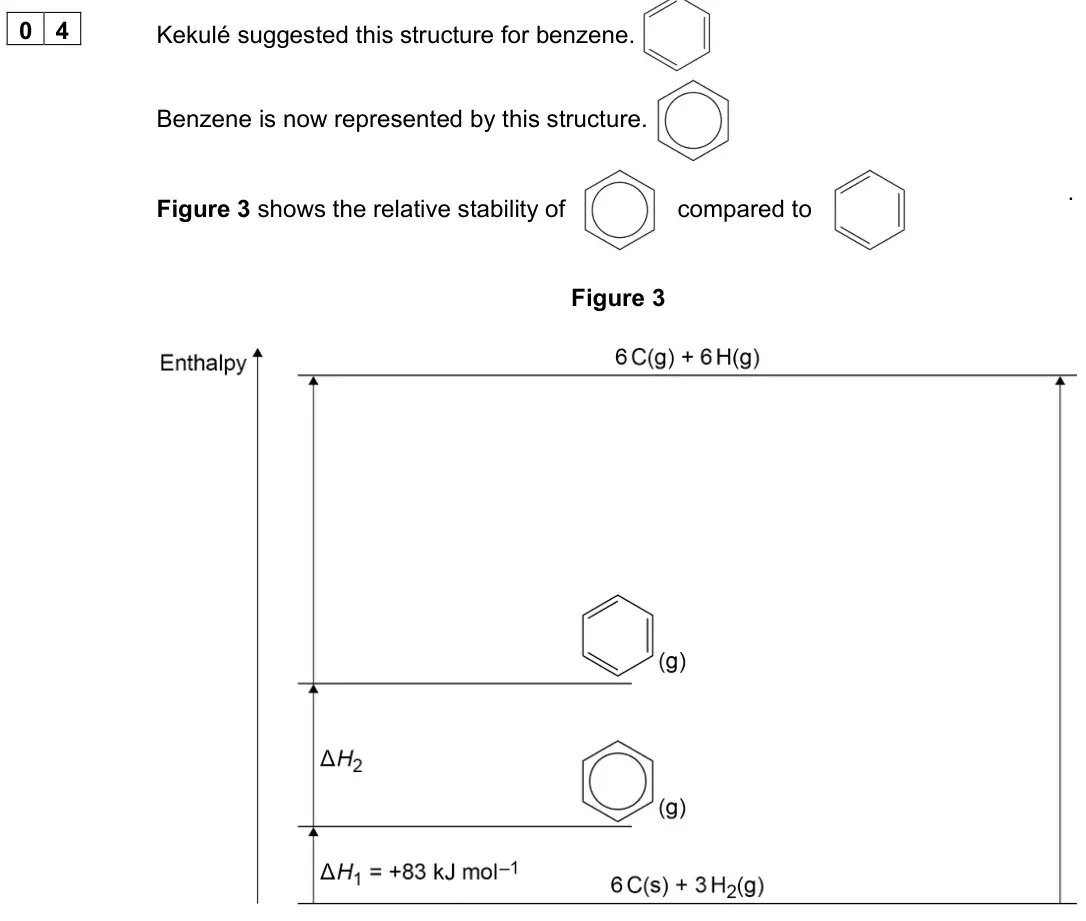
Q01.2
The whole paper ↗
- Your answer
Q03.3
The whole paper ↗
Q07.5
The whole paper ↗
Q01.2
The whole paper ↗
Q02.2
The whole paper ↗
Q02.3
The whole paper ↗Q6(a)
The whole paper ↗
Q2(b)
The whole paper ↗
Q3(a)(i)
The whole paper ↗
All 44 questions on Applications of Hess’s law, as a list
- June 2025, AS Paper 2, Q18 (1 mark): The standard enthalpies of combustion for carbon, hydrogen and benzene (C6H6) are –394, –286 and –3273 kJ mol–1 respectively. What is the standard enthalpy of f
- June 2024, AS Paper 1, Q08.2 (2 marks): Silver nitrate(V) is formed when silver nitrate(III) undergoes thermal decomposition. 2 AgNO2(s) ⟶ Ag(s) + AgNO3(s) + NO(g) ΔH = +56.2 kJ mol–1 The standard ent
- June 2024, AS Paper 1, Q08.3 (1 mark): Suggest why the enthalpy change for the thermal decomposition of solid silver nitrate(III) is difficult to determine experimentally. [1 mark]
- June 2024, AS Paper 2, Q19 (1 mark): What is the enthalpy of combustion, in kJ mol–1, of propane? [1 mark] A −211.7 B −419.7 C −2220 D −2878
- June 2024, AS Paper 2, Q20 (1 mark): What is the enthalpy change, in kJ mol–1, when butane reacts to form propane, hydrogen and carbon? [1 mark] A +21.2 B +17.5 C −17.5 D −21.2
- June 2023, Paper 2, Q08.7 (2 marks): The carbon dioxide produced from fermentation can be reacted with steam to make more ethanol. The equation for this reaction is 2 CO2(g) + 3 H2O(g) → C2H5OH(g)
- November 2021, Paper 2, Q04.1 (3 marks): Use Figure 3 and the data shown in Table 1 to calculate ΔH2 [3 marks] Table 1 ΔH / kJ mol–1 Enthalpy of atomisation for carbon +715 Enthalpy of atomisation for
- November 2020, AS Paper 1, Q20 (1 mark): Two reactions of iron with oxygen are shown. Fe(s) + 1 2 O2(g) → FeO(s) ΔH = – 272 kJ mol–1 2 Fe(s) + 3 2 O2(g) → Fe2O3(s) ΔH = – 822 kJ mol–1 What is the entha
- November 2020, AS Paper 2, Q01.2 (3 marks): The equation for a reaction used to manufacture 1-chloropropane is 3 CH3CH2CH2OH(l) + PCl3(l) → 3 CH3CH2CH2Cl(l) + H3PO3(s) The enthalpy change for this reactio
- November 2020, AS Paper 2, Q21 (1 mark): Some enthalpy change data are shown. C(s) + 2 H2(g) → CH4(g) ΔH = –75 kJ mol–1 H2(g) → 2 H(g) ΔH = +436 kJ mol–1 What is the enthalpy change, in kJ mol–1, for t
- June 2019, Paper 3, Q08 (1 mark): Nitrogen dioxide is produced from ammonia and air as shown in these equations 4 NH3(g) + 5 O2(g) → 4 NO(g) + 6 H2O(g) ΔH = –909 kJ mol–1 2 NO(g) + O2(g) → 2 NO2
- June 2019, AS Paper 2, Q03.3 (3 marks): Table 2 gives some values of standard enthalpies of combustion (∆cHo). Table 2 Substance C(s) H2(g) C6H12(l) Standard enthalpy of combustion, ∆cHo / kJ mol–1 –3
- June 2018, AS Paper 1, Q07.5 (2 marks): Potassium chlorate(VII), KClO4, is used in fireworks. When potassium chlorate(VII) decomposes, it produces potassium chloride and oxygen. Give an equation for t
- June 2018, AS Paper 2, Q20 (1 mark): What is the enthalpy of formation of buta-1,3-diene, C4H6(g)? Substance Enthalpy of combustion / kJ mol–1 C4H6(g) –2546 C(s) –394 H2(g) –286 [1 mark] A +112 kJ
- June 2017, Paper 3, Q01.2 (2 marks): Some enthalpies of solution are shown in Table 1. Table 1 Salt Enthalpy of solution / kJ mol−1 MgCl2(s) −155 MgCl2.4H2O(s) −39 Calculate the enthalpy change for
- June 2017, AS Paper 1, Q02.2 (3 marks): Table 2 contains some standard enthalpy of formation data. Table 2 CO(g) Fe2O3(s) ΔfH o / kJ mol−1 −111 −822 Fe2O3(s) + 3CO(g) → 2Fe(s) + 3CO2(g) ΔH = −19 kJ mo
- June 2017, AS Paper 1, Q02.3 (3 marks): Some enthalpy data are given in Table 3. Table 3 Process ΔH / kJ mol−1 N2(g) + 3H2(g) → 2NH3(g) −92 N2(g) → 2N(g) +944 H2(g) → 2H(g) +436 Use the data from Tabl
- June 2016, CHEM5 (old spec), Q6(a) (2 marks): Use data from Table 3 to calculate the standard enthalpy change for this reaction. [2 marks]
- June 2016, CHEM2 (old spec), Q2(b) (3 marks): The equation corresponding to the enthalpy of formation of propan-1-ol is shown. 3C(s) + 4H2(g) + –O2(g) CH3CH2CH2OH(l) Table 1 contains some standard enthalpy
- June 2015, CHEM5 (old spec), Q3(a)(i) (3 marks): Use data from Table 4 to calculate the enthalpy change, ΔH, for the reaction of steam with methane. [3 marks]
- June 2015, CHEM2 (old spec), Q9(a) (5 marks): Table 3 shows some standard enthalpy of formation data. Table 3 In the oldest method of extraction of vanadium, V2O5 is reacted with calcium at a high temperatu
- June 2014, CHEM2 (old spec), Q3(c)(i) (3 marks): Use the standard enthalpies of formation in Table 1 and the equation given below Table 1 to calculate a value for the standard enthalpy change for this reaction
- June 2013, CHEM2 (old spec), Q11(a) (5 marks): Strontium is extracted from strontium oxide (SrO) by heating a mixture of powdered strontium oxide and powdered aluminium. Consider these standard enthalpies of
- January 2013, CHEM2 (old spec), Q3(a)(i) (3 marks): Use the standard enthalpy of formation data from the table and the equation for the extraction of manganese to calculate a value for the standard enthalpy chang
- January 2013, CHEM2 (old spec), Q4(a) (1 mark): State Hess’s Law. (1 mark)
- January 2013, CHEM2 (old spec), Q4(b) (1 mark): Write a mathematical expression to show how ΔHexp, ΔH1 and ΔH2 are related to each other by Hess’s Law. (1 mark)
- January 2013, CHEM2 (old spec), Q4(c) (1 mark): Use the mathematical expression that you have written in part (b), and the data book values for the two enthalpy changes ΔH1 and ΔH2 shown, to calculate a value
- January 2013, CHEM2 (old spec), Q4(e) (1 mark): Suggest one reason why the value for ΔHexp cannot be measured directly. (1 mark)
- June 2012, CHEM5 (old spec), Q4(a) (2 marks): Calculate the enthalpy change for this reaction.
- June 2012, CHEM2 (old spec), Q2(a)(i) (3 marks): Use these standard enthalpies of formation to calculate a value for the standard enthalpy change of this synthesis. CO2(g) + 3H2(g) CH3OH(g) + H2O(g)
- January 2012, CHEM2 (old spec), Q4(b)(i) (1 mark): Suggest why it is not possible to measure the enthalpy change directly for the following combustion reaction. C(s,graphite) + –O2(g) CO(g) (1 mark) 1 2
- January 2012, CHEM2 (old spec), Q4(b)(ii) (1 mark): State Hess’s Law. (1 mark)
- January 2012, CHEM2 (old spec), Q4(c) (3 marks): Use the standard enthalpies of formation in the table below and the equation to calculate a value for the standard enthalpy change for the extraction of iron us
- June 2011, CHEM2 (old spec), Q2(c) (1 mark): State Hess’s Law. (1 mark)
- June 2011, CHEM2 (old spec), Q2(e)(ii) (3 marks): Use data from the table to calculate a value for the standard enthalpy change of the following reaction. TiCl4(g) + 4Na(I) 4NaCl(s) + Ti(s)
- January 2011, CHEM2 (old spec), Q9(c)(ii) (3 marks): Use the standard enthalpy of formation data from the table and the equation for the combustion of butan-1-ol to calculate a value for the standard enthalpy of c
- June 2010, CHEM5 (old spec), Q6(a) (3 marks): Calculate the standard enthalpy change for this reaction.
- June 2010, CHEM2 (old spec), Q4(c)(i) (3 marks): Use the standard enthalpies of formation in the table below to calculate a value for the standard enthalpy change of this reaction.
- January 2010, CHEM2 (old spec), Q2(b) (1 mark): State Hess’s Law. (1 mark)
- January 2010, CHEM2 (old spec), Q2(c) (3 marks): Consider the following table of data and the scheme of reactions. Use the data in the table, the scheme of reactions and Hess’s Law to calculate a value for ∆Hr
- June 2009, CHEM2 (old spec), Q2(a)(iii) (3 marks): 2 (a) (iii) Use the data to calculate the standard enthalpy change for the reaction shown by the equation above. (3 marks)
- June 2008, CHM2 (2008 spec), Q2(b) (1 mark): 2 (b) State Hess’s Law. (1 mark)
- June 2008, CHM2 (2008 spec), Q2(c) (3 marks): 2 (c) The equation below shows the formation of buta-1,3-diene, C4H6 4C(s) + 3H2(g) →C4H6(g) Use the following data to calculate the standard enthalpy of format
- January 2008, CHM2 (2008 spec), Q3(c) (3 marks): (c) The following table gives some standard enthalpies of formation. Use these data to calculate a value for the enthalpy of combustion, ∆Hc , of propan-1-ol, C
Questions, mark schemes and examiner’s reports are © AQA, from their published past papers. Plumi isn’t affiliated with any exam board. Want whole papers? AQA A-Level Chemistry past papers.
The Plumi iPad app also offers exam-style questions with AI feedback on your handwritten working.