 plumi
Calorimetry: AQA A‑Level Chemistry questions
AQA A-Level Chemistry past-paper questions on 3.1.4.2 Calorimetry, 2008–2025, with mark schemes and examiner’s reports where available.
Paper
All papers
Exam
All years
Calculations
Q01.2
The whole paper ↗
Q01.4
The whole paper ↗Q07.2
The whole paper ↗
Q11.1
The whole paper ↗
Q11.2
The whole paper ↗Q08.4
The whole paper ↗
Q08.2
The whole paper ↗
Q08.3
The whole paper ↗Q05.1
The whole paper ↗
Q05.1
The whole paper ↗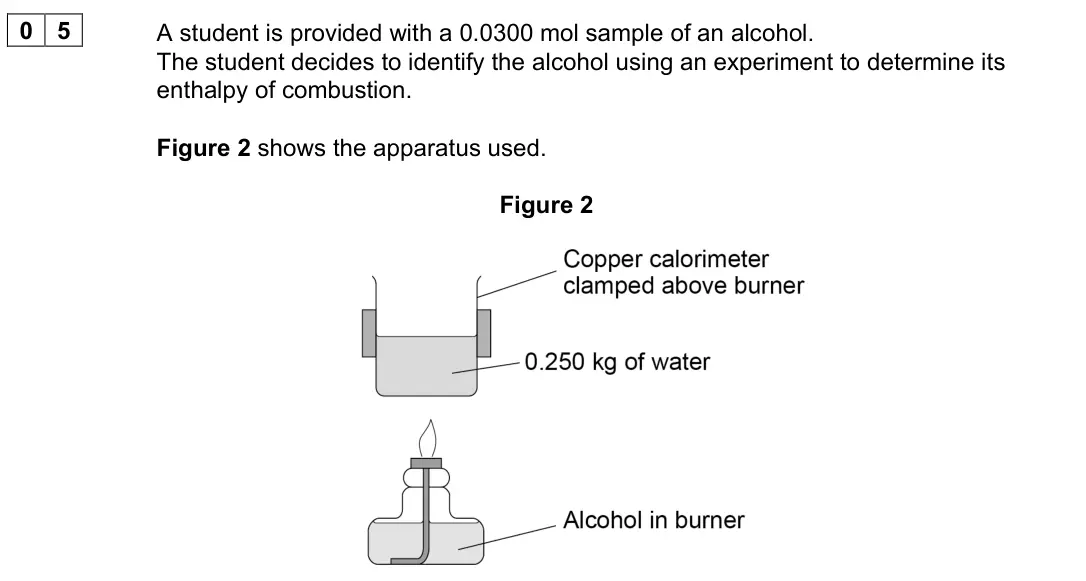
Q05.2
The whole paper ↗Q01.3
The whole paper ↗
Q01.4
The whole paper ↗Q01.5
The whole paper ↗Q01.6
The whole paper ↗Q07.4
The whole paper ↗
Q03.1
The whole paper ↗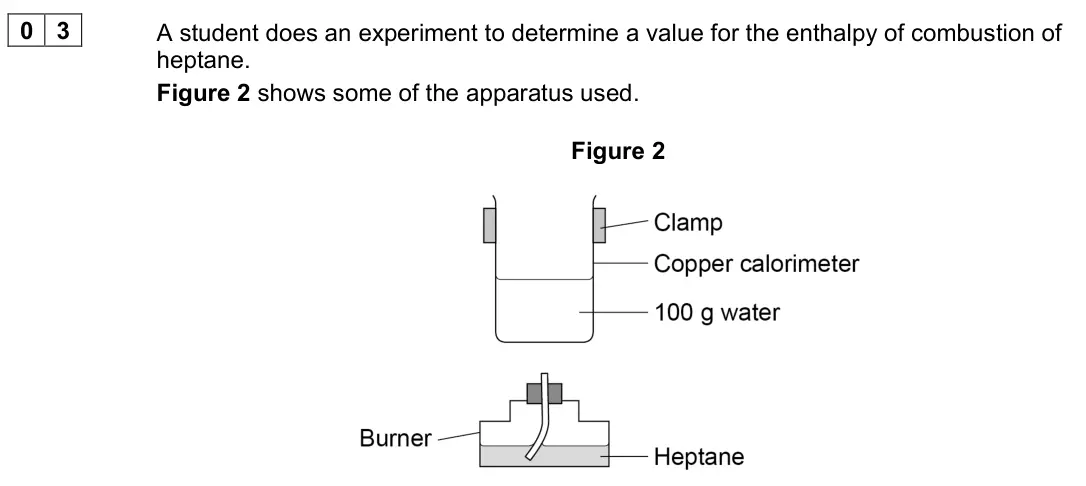
Q03.2
The whole paper ↗Q03.3
The whole paper ↗
All 72 questions on Calorimetry, as a list
- June 2025, Paper 3, Q01.2 (5 marks): A student does an experiment to determine a value for the enthalpy of solution of potassium hydroxide. The student uses this method. • Add some distilled water
- June 2025, Paper 3, Q01.4 (1 mark): Suggest why the value calculated in Question 01.3 is different from the experimental value given in Question 01.2. [1 mark]
- June 2025, AS Paper 1, Q18 (1 mark): The reaction between hydrochloric acid and sodium hydroxide is exothermic. Which row shows the solutions that will give the greatest temperature increase when m
- June 2025, AS Paper 2, Q07.2 (5 marks): The enthalpy of combustion of ethanol is –1371 kJ mol–1 A sample of ethanol is burned completely in air to raise the temperature of 55.0 g of water by 46.2 °C C
- June 2024, Paper 2, Q11.1 (4 marks): Limonene is found in the skin of citrus fruits. Figure 6 shows a diagram of the apparatus used in an experiment to determine a value for the enthalpy of combust
- June 2024, Paper 2, Q11.2 (5 marks): Table 3 shows values, obtained by different methods, for the enthalpy of combustion of a different liquid hydrocarbon. Table 3 Method Enthalpy of combustion / k
- June 2024, AS Paper 1, Q08.4 (6 marks): Identify three aspects of this method which could cause inaccurate results. Describe how the student could improve these three aspects of the method to obtain m
- June 2023, Paper 2, Q08.2 (5 marks): Palmitic acid burns in air. In a calorimetry experiment, combustion of 387 mg of palmitic acid increases the temperature of 0.150 kg of water from 23.9 °C to 37
- June 2023, Paper 2, Q08.3 (2 marks): State how the value calculated in Question 08.2 is likely to differ from data book values. Give one reason, other than heat loss, for this difference. [2 marks]
- June 2023, Paper 3, Q05.1 (3 marks): Calculate ∆Hvap for water. [1 kW = 1 kJ s–1] [3 marks] ∆Hvap kJ mol–1
- June 2023, AS Paper 2, Q05.1 (3 marks): The student finds that when all the alcohol is burned, the temperature of the water increases from 18.9 °C to 78.1 °C Calculate the enthalpy of combustion, in k
- June 2023, AS Paper 2, Q05.2 (2 marks): Table 2 shows the enthalpies of combustion of some alcohols. Table 2 Alcohol Enthalpy of combustion / kJ mol –1 Ethanol –1367 Propan-1-ol –2021 Butan-1-ol –2676
- June 2022, Paper 3, Q01.3 (3 marks): A student does an experiment to determine a value for the enthalpy of solution for ammonium nitrate. The student uses this method. • Measure 25.0 cm3 of distill
- June 2022, Paper 3, Q01.4 (1 mark): The uncertainty in each of the temperature readings from the thermometer used in this experiment is ±0.1°C Calculate the percentage uncertainty in the temperatu
- June 2022, Paper 3, Q01.5 (2 marks): Suggest a change to the student’s method, using the same apparatus, that would reduce the percentage uncertainty in the temperature change. Give a reason for yo
- June 2022, Paper 3, Q01.6 (1 mark): Another student obtained a value of +15 kJ mol−1 using the same method. Suggest the main reason for the difference between this experimental value for the entha
- June 2022, AS Paper 2, Q07.4 (4 marks): A student investigated the combustion of propanone (C3H6O) using calorimetry. A copper calorimeter containing water was heated by the complete combustion of som
- November 2021, Paper 2, Q03.1 (2 marks): Design a table to record all the readings necessary to determine an experimental value for the enthalpy of combustion for heptane in this experiment. [2 marks]
- November 2021, Paper 2, Q03.2 (2 marks): The student considered using a glass beaker on a tripod and gauze instead of the clamped copper calorimeter. Suggest two disadvantages of using a glass beaker o
- November 2021, Paper 2, Q03.3 (2 marks): Suggest two reasons why the value of enthalpy of combustion from this experiment is less exothermic than a data book value. [2 marks] Reason 1 Reason 2
- November 2021, Paper 2, Q03.4 (1 mark): Suggest one addition to this apparatus that would improve the accuracy of the enthalpy value obtained. [1 mark]
- November 2021, AS Paper 1, Q07.2 (3 marks): A student does an experiment to determine the enthalpy of combustion of propan-1-ol (CH3CH2CH2OH, Mr = 60.0). Combustion of 0.497 g of propan-1-ol increases the
- November 2021, AS Paper 1, Q07.3 (1 mark): The enthalpy of combustion determined experimentally is less exothermic than that calculated using enthalpies of formation. Give one possible reason for this, o
- November 2020, Paper 3, Q05.1 (3 marks): The heat energy released in the calorimeter, q = Ccal∆T Calculate the heat capacity (Ccal) in kJ K−1 [3 marks] Ccal kJ K−1
- November 2020, Paper 3, Q05.2 (2 marks): When the experiment is repeated with 2.00 g of octane (Mr = 114.0) the temperature change recorded is 12.2 °C Calculate the heat change, in kJ mol−1, for octane
- November 2020, Paper 3, Q05.4 (2 marks): The thermometer used to measure the temperature change of 12.2 °C in Question 05.2 has an uncertainty of ± 0.1 °C in each reading. Calculate the percentage unce
- November 2020, AS Paper 1, Q04.2 (6 marks): A student determines the enthalpy change for the reaction between calcium carbonate and hydrochloric acid. CaCO3(s) + 2 HCl(aq) → CaCl2(aq) + CO2(g) + H2O(l) Th
- November 2020, AS Paper 1, Q04.3 (5 marks): In a different experiment 50.0 cm3 of 0.500 mol dm–3 aqueous hydrochloric acid are reacted with 50.0 cm3 of 0.500 mol dm–3 aqueous sodium hydroxide. NaOH(aq) +
- November 2020, AS Paper 1, Q04.4 (1 mark): Suggest how, without changing the apparatus, the experiment in Question 04.3 could be improved to reduce the percentage uncertainty in the temperature change. [
- November 2020, AS Paper 2, Q22 (1 mark): The temperature changed from 21.8 °C to 19.2 °C during a calorimetry experiment. The uncertainty of each reading of the thermometer is ±0.1 °C What is the perce
- November 2020, AS Paper 2, Q23 (1 mark): An experiment is done to determine the enthalpy of combustion of a fuel using a calorimeter containing water. b = mass of fuel burned / g w = mass of water heat
- June 2019, AS Paper 1, Q20 (1 mark): Some fuel in a spirit burner is burned, and the heat produced is used to heat a container of water. In this experiment: The mass of water heated = m g The tempe
- June 2019, AS Paper 2, Q03.1 (4 marks): A student determined the enthalpy of combustion of cyclohexane (C6H12). The student • placed a pure sample of cyclohexane in a spirit burner • placed the spirit
- June 2019, AS Paper 2, Q03.2 (1 mark): A data book value for the enthalpy of combustion of cyclohexane is –3920 kJ mol−1 The student concluded that the temperature rise recorded in the experiment was
- June 2018, Paper 2, Q03.4 (3 marks): A student carried out an experiment to determine the enthalpy of combustion of ethanol. Combustion of 457 mg of ethanol increased the temperature of 150 g of wa
- June 2018, Paper 3, Q04.1 (5 marks): Plot a graph of temperature against time on the grid opposite. Use your graph to find the temperature rise, ∆T, at the fourth minute. Show your working on the g
- June 2018, Paper 3, Q04.2 (1 mark): The uncertainty in each of the temperature readings from the thermometer used in this experiment was ±0.1° C Calculate the percentage uncertainty in the value f
- June 2018, Paper 3, Q04.3 (1 mark): Suggest a change to the experiment that would minimise heat loss. [1 mark]
- June 2018, Paper 3, Q04.4 (2 marks): Suggest and explain another change to the experiment that would decrease the percentage uncertainty in the use of the same thermometer. [2 marks]
- June 2018, Paper 3, Q04.5 (5 marks): A second student completed an experiment to determine the enthalpy of neutralisation for the reaction between ethanedioic acid solution (HOOCCOOH) and potassium
- June 2018, Paper 3, Q04.6 (2 marks): In a similar experiment to that in Question 04.5, the enthalpy of neutralisation for the reaction between sulfuric acid and potassium hydroxide solution was fou
- June 2018, AS Paper 2, Q03.1 (4 marks): When ethanoic acid reacts with sodium hydroxide, the enthalpy change, ∆H, is –56.1 kJ mol–1 CH3COOH(aq) + NaOH(aq) ⟶ CH3COONa(aq) + H2O(l) Calculate the tempera
- June 2018, AS Paper 2, Q03.2 (2 marks): A student recorded the temperature of aqueous ethanoic acid in a polystyrene cup for three minutes. At the fourth minute, the student added sodium hydrogencarbo
- June 2017, Paper 3, Q01.1 (1 mark): Suggest one reason why the enthalpy change for this reaction cannot be determined directly by calorimetry. [1 mark]
- June 2017, Paper 3, Q01.3 (6 marks): Describe how you would carry out an experiment to determine the enthalpy of solution of anhydrous magnesium chloride. You should use about 0.8 g of anhydrous ma
- June 2017, AS Paper 1, Q03.1 (6 marks): Show by calculation which reactant was in excess. Use the data to calculate the experimental value for enthalpy of reaction in kJ mol−1(Assume that the specific
- June 2017, AS Paper 1, Q03.2 (1 mark): Another student used the same method and obtained a value for the enthalpy of reaction of −142 kJ mol−1 A data book value for the enthalpy of reaction is −310 k
- June 2017, AS Paper 1, Q03.3 (6 marks): Suggest how the students’ method, and the analysis of the results, could be improved in order to determine a more accurate value for the enthalpy of reaction. J
- June 2016, AS Paper 2, Q02.1 (4 marks): A student carried out an experiment to determine the enthalpy of combustion of methanol. Methanol was placed in a spirit burner and the mass of the spirit burne
- June 2016, AS Paper 2, Q02.2 (1 mark): Suggest one reason, other than incomplete combustion or heat transfer to the atmosphere, why the student’s value for the enthalpy of combustion of methanol is d
- June 2016, AS Paper 2, Q02.3 (1 mark): The uncertainty in each of the temperature readings from the thermometer in this experiment was ±0.25 °C. This gave an overall uncertainty in the temperature ri
- June 2016, AS Paper 2, Q02.4 (1 mark): The student said correctly that using a thermometer with an overall uncertainty for the rise in temperature of ±0.5 °C was adequate for this experiment. Explain
- Specimen, Paper 1, Q09.1 (4 marks): 9 A 5.00 g sample of potassium chloride was added to 50.0 g of water initially at 20.0 °C. The mixture was stirred and as the potassium chloride dissolved, the
- Specimen, Paper 1, Q09.2 (4 marks): Enthalpy of solution = kJ mo 5
- June 2015, CHEM2 (old spec), Q7(c) (3 marks): A student determined a value for the enthalpy change when a sample of propanone was burned. The heat produced was used to warm some water in a copper calorimete
- June 2015, CHEM2 (old spec), Q7(f) (2 marks): Suggest two reasons why the value obtained by the student in Question 7 (c) is different from the value calculated in Question 7 (e). [2 marks] Reason 1 Reason
- June 2014, CHEM2 (old spec), Q9(b) (5 marks): A student carried out a laboratory experiment to determine the enthalpy change when a sample of ethanol was burned. The heat produced was used to warm some wate
- June 2013, CHEM5 (old spec), Q2(c)(ii) (5 marks): A solution is formed when 5.00 g of potassium chloride are dissolved in 20.0 g of water. The initial temperature of the water is 298 K. Calculate the final temp
- January 2013, CHEM2 (old spec), Q4(d)(i) (3 marks): Use these data to calculate the enthalpy change, in kJ mol–1, for this reaction of copper(II) sulfate. This is the student value for ΔH1 In this experiment, you
- January 2013, CHEM2 (old spec), Q4(d)(ii) (1 mark): Suggest one reason why the student value for ΔH1 calculated in part (d) (i) is less accurate than the data book value given in part (c). (1 mark)
- June 2012, CHEM2 (old spec), Q2(e) (3 marks): A student carried out an experiment to determine the enthalpy change when a sample of methanol was burned. The student found that the temperature of 140 g of wa
- January 2011, CHEM2 (old spec), Q9(b) (3 marks): The student carried out a laboratory experiment to determine the enthalpy change when a sample of butan-1-ol was burned. The student found that the temperature
- January 2011, CHEM2 (old spec), Q9(d)(ii) (2 marks): Give two reasons why the experimental values obtained by the student are lower than the calculated values using the enthalpy of formation data.
- June 2010, CHEM2 (old spec), Q8(d) (4 marks): A student carried out a simple laboratory experiment to measure the enthalpy change for Process 3. The student showed that the temperature of 200 g of water inc
- June 2009, CHEM2 (old spec), Q3(a)(i) (1 mark): 3 (a) (i) Write an expression for the heat change (q) which relates mass (m), specific heat capacity (c) and change in temperature (∆T). (1 mark)
- June 2009, CHEM2 (old spec), Q3(a)(ii) (1 mark): 3 (a) (ii) Calculate the amount of heat required to increase the temperature of 8.80 g of ethyl ethanoate by 9.5 K during the mixing process. (You should assume
- June 2009, CHEM2 (old spec), Q3(a)(iii) (1 mark): 3 (a) (iii) Calculate the amount of heat required to increase the temperature of 11.95 g of trichloromethane by 9.5 K during the mixing process. (You should ass
- June 2009, CHEM2 (old spec), Q3(a)(iv) (2 marks): 3 (a) (iv) Using the values from parts (a) (ii) and (a) (iii), calculate the molar enthalpy change in kJ mol–1 for the mixing process. (2 marks)
- June 2009, CHEM2 (old spec), Q3(b) (1 mark): 3 (b) The students deduced that the heat change was due only to the formation of intermolecular forces between ethyl ethanoate molecules and trichloromethane mo
- June 2008, CHM5 (2008 spec), Q9(a) (5 marks): 9 (a) Calculate the mass of methanol that should be burned in order to raise the temperature of 1.00kg of water from 20.0°C to 100°C. The enthalpy of combustion
- January 2008, CHM2 (2008 spec), Q3(e) (4 marks): (e) In an experiment 0.92 g of propan-1-ol, C3H7OH, was burned and the heat given off used to raise the temperature of 250g of water. The temperature rise was 1
- January 2008, CHM2 (2008 spec), Q3(f) (1 mark): (f) Suggest why the experimental value of the enthalpy of combustion obtained in part (e) is less reliable than the value obtained in part (c). (1 mark)
Questions, mark schemes and examiner’s reports are © AQA, from their published past papers. Plumi isn’t affiliated with any exam board. Want whole papers? AQA A-Level Chemistry past papers.
The Plumi iPad app also offers exam-style questions with AI feedback on your handwritten working.