 plumi
Bond enthalpies: AQA A‑Level Chemistry questions
AQA A-Level Chemistry past-paper questions on 3.1.4.4 Bond enthalpies, 2008–2025, with mark schemes and examiner’s reports where available.
Paper
All papers
Exam
All years
Calculations
Q04.3
The whole paper ↗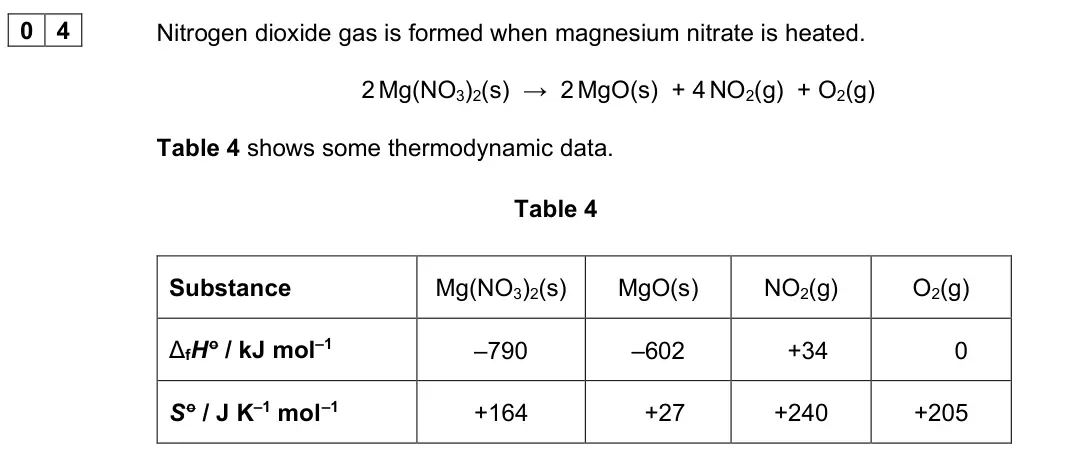
Q07.3
The whole paper ↗
Q07.4
The whole paper ↗Q11.2
The whole paper ↗
Q08.6
The whole paper ↗
Q05.3
The whole paper ↗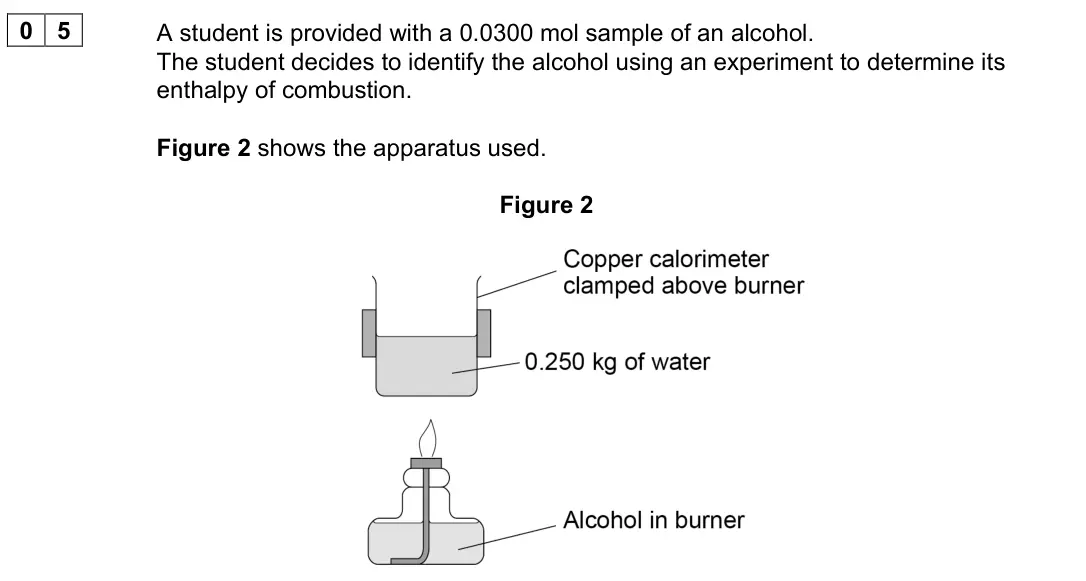
Q03.5
The whole paper ↗
Q07.5
The whole paper ↗
Q04.1
The whole paper ↗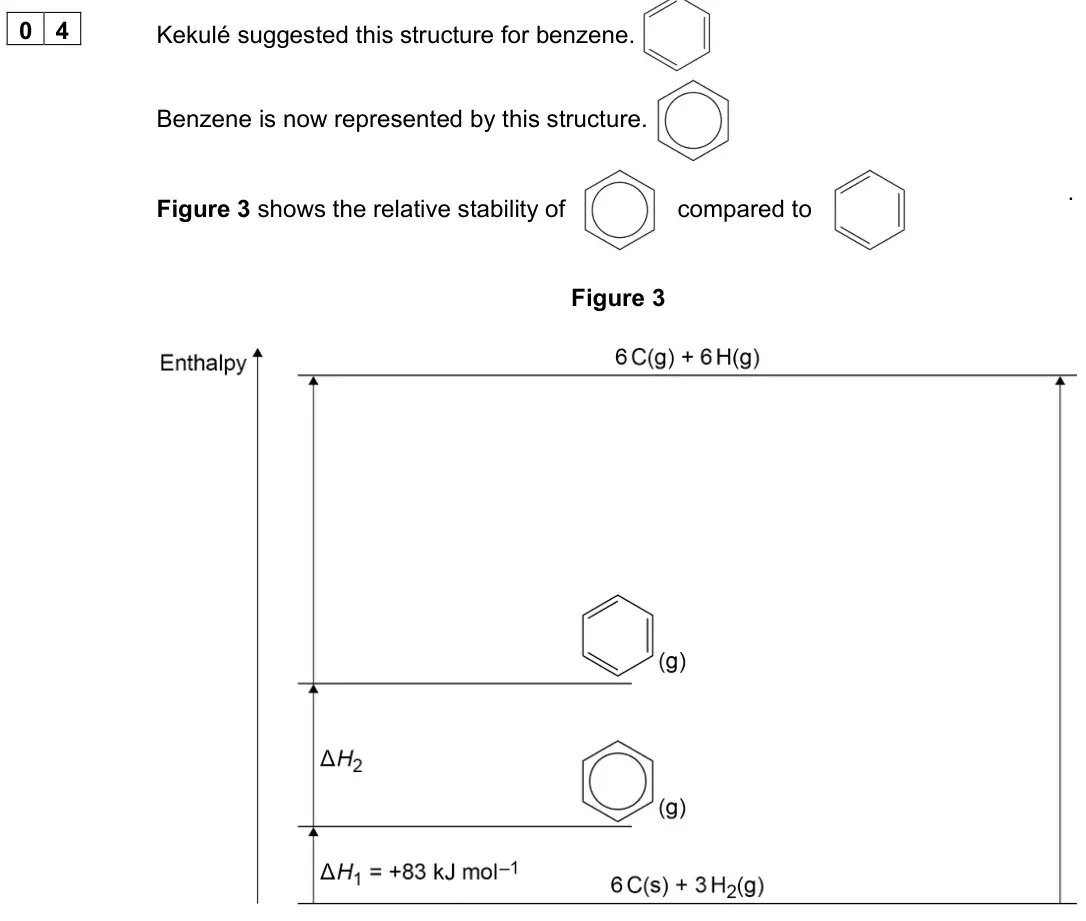
Q08.2
The whole paper ↗
Q08.3
The whole paper ↗Q01.5
The whole paper ↗
Q02.3
The whole paper ↗
Q02.4
The whole paper ↗Q04.2
The whole paper ↗
Q04.3
The whole paper ↗Q04.1
The whole paper ↗Q04.2
The whole paper ↗
All 47 questions on Bond enthalpies, as a list
- June 2025, Paper 1, Q04.3 (3 marks): Assume that the bonds between N and O in NO2 are the same. Calculate the mean bond enthalpy, in kJ mol–1, for a bond between N and O in NO2 [3 marks] Bond entha
- June 2025, AS Paper 2, Q07.3 (1 mark): Use Table 2 to show that an expression for the sum of the bond enthalpies for all the bonds in the products is 2536n + 926 [1 mark]
- June 2025, AS Paper 2, Q07.4 (3 marks): An expression for the sum of the bond enthalpies for all the bonds in the reactants is 1916n + 724 A calculated value for the enthalpy of combustion of an alkan
- June 2024, Paper 2, Q11.2 (5 marks): Table 3 shows values, obtained by different methods, for the enthalpy of combustion of a different liquid hydrocarbon. Table 3 Method Enthalpy of combustion / k
- June 2023, Paper 2, Q08.6 (3 marks): Ethanol is a biofuel that can be produced by the fermentation of glucose. C6H12O6 → 2 C2H5OH + 2 CO2 Glucose has the structural formula shown. Table 3 shows som
- June 2023, AS Paper 2, Q05.3 (3 marks): The equation for the complete combustion of gaseous pentan-1-ol is shown. CH3(CH2)3CH2OH(g) + 7 1 2 O2(g) → 5 CO2(g) + 6 H2O(g) ΔH= –3388 kJ mol–1 Table 3 shows
- June 2022, Paper 1, Q03.5 (5 marks): Hydrazine (N2H4) is used as a rocket fuel that is oxidised by hydrogen peroxide. The equation for this reaction in the gas phase is The enthalpy change for this
- June 2022, AS Paper 2, Q07.5 (3 marks): Butan-1-ol can be added to petrol for cars. An equation for the complete combustion of gaseous butan-1-ol is shown. C4H9OH(g) + 6 O2(g) → 4 CO2(g) + 5 H2O(g) ΔH
- November 2021, Paper 2, Q04.1 (3 marks): Use Figure 3 and the data shown in Table 1 to calculate ΔH2 [3 marks] Table 1 ΔH / kJ mol–1 Enthalpy of atomisation for carbon +715 Enthalpy of atomisation for
- November 2021, AS Paper 2, Q08.2 (4 marks): Propane undergoes complete combustion. C3H8(g) + 5 O2(g) ⟶ 3 CO2(g) + 4 H2O(l) ∆H = –2046 kJ mol–1 Table 3 shows some bond enthalpy data. Table 3 Bond C–H C=O O
- November 2021, AS Paper 2, Q08.3 (1 mark): Explain why the value given for the O=O bond enthalpy in Question 08.2 is not a mean value. [1 mark] Section B Answer all questions in this section. Only one an
- November 2020, Paper 3, Q10 (1 mark): Some bond enthalpies are given. Bond C H O H O=O C=O Bond enthalpy/ kJ mol–1 412 463 496 743 Which is the enthalpy change of this reaction in kJ mol−1? CH4(g) +
- June 2019, AS Paper 1, Q01.5 (3 marks): Hydrogen fluoride reacts with ethyne (C2H2) as shown in the equation. All compounds are in the gaseous state. ∆H = –179 kJ mol–1 Table 1 shows some mean bond en
- June 2017, AS Paper 1, Q02.3 (3 marks): Some enthalpy data are given in Table 3. Table 3 Process ΔH / kJ mol−1 N2(g) + 3H2(g) → 2NH3(g) −92 N2(g) → 2N(g) +944 H2(g) → 2H(g) +436 Use the data from Tabl
- June 2017, AS Paper 1, Q02.4 (1 mark): Give one reason why the bond enthalpy that you calculated in Question 2.3 is different from the mean bond enthalpy quoted in a data book (388 kJ mol−1). [1 mark
- June 2017, AS Paper 2, Q04.2 (2 marks): An expression can be derived using bond enthalpy data to estimate the enthalpy of combustion (∆cH) of an alkane. For an alkane with n carbon atoms: ∆cH = – (496
- June 2017, AS Paper 2, Q04.3 (1 mark): Suggest one reason, other than the use of mean bond enthalpies, why a value for the enthalpy of combustion of a liquid alkane is different from the value obtain
- June 2016, AS Paper 2, Q22 (1 mark): Some enthalpy data is given in Table 3. Table 3 Bond C−H O−H H−H C≡O Bond enthalpy / kJ mol−1 413 463 436 To be calculated Use the information in Table 3 and th
- Specimen, Paper 1, Q04.1 (3 marks): H–H bond enthalpy = kJ mo
- Specimen, Paper 1, Q04.2 (1 mark): A data book value for the H–H bond enthalpy is 436 kJ mol –1. Suggest one reason why this value is different from your answer to Question 4.1. [1 mark] 0 4 . 2
- June 2016, CHEM2 (old spec), Q2(c) (3 marks): An equation for the complete combustion of gaseous propan-1-ol is shown. CH3CH2CH2OH(g) + 4–O2(g) 3CO2(g) + 4H2O(g) ΔH = –1893 kJ mol–1 Table 2 shows some bond
- June 2015, CHEM5 (old spec), Q2(a) (2 marks): The value for the H–O bond enthalpy in Table 3 is a mean bond enthalpy. State the meaning of the term mean bond enthalpy for the H–O bond. [2 marks]
- June 2015, CHEM5 (old spec), Q2(b) (3 marks): Use the bond enthalpies in Table 3 to calculate a value for the enthalpy of formation of water in the gas phase. [3 marks]
- June 2015, CHEM5 (old spec), Q2(c)(i) (1 mark): Suggest one reason why you would expect the standard enthalpy of combustion of hydrogen to be the same as the answer to Question 2 (b). [1 mark]
- June 2015, CHEM5 (old spec), Q2(c)(ii) (1 mark): Suggest one reason why you would expect the standard enthalpy of combustion of hydrogen to differ slightly from the answer to Question 2 (b). [1 mark]
- June 2015, CHEM2 (old spec), Q7(e) (3 marks): Use the mean bond enthalpy data in Table 2 and the equation given below Table 2 to calculate a value for the standard enthalpy change when gaseous propanone is
- June 2015, CHEM2 (old spec), Q7(f) (2 marks): Suggest two reasons why the value obtained by the student in Question 7 (c) is different from the value calculated in Question 7 (e). [2 marks] Reason 1 Reason
- June 2014, CHEM2 (old spec), Q9(c)(i) (2 marks): Give the meaning of the term mean bond enthalpy. [2 marks]
- June 2014, CHEM2 (old spec), Q9(c)(ii) (3 marks): Consider the mean bond enthalpy data in Table 3. Table 3 Use the data in Table 3 and the equation shown to calculate a value for the bond enthalpy for the O O d
- June 2013, CHEM2 (old spec), Q10(c)(ii) (3 marks): Consider these bond enthalpy data. Use these data and the equation to calculate a value for the enthalpy of combustion of gaseous ethanol. CH3CH2OH(g) + 3O2(g)
- January 2013, CHEM5 (old spec), Q1(a) (2 marks): Define bond dissociation enthalpy as applied to chlorine.
- January 2013, CHEM5 (old spec), Q1(b) (1 mark): Explain why the enthalpy of atomisation of chlorine is exactly half the bond dissociation enthalpy of chlorine. (1 mark) 1
- January 2013, CHEM5 (old spec), Q1(c)(ii) (2 marks): Calculate a value for the bond enthalpy of the Cl F bond.
- January 2013, CHEM5 (old spec), Q1(c)(iii) (3 marks): Calculate the enthalpy of formation of gaseous chlorine trifluoride, ClF3(g). Use the bond enthalpy value that you obtained in part (c) (ii). (If you have been
- January 2013, CHEM5 (old spec), Q1(c)(iv) (1 mark): Explain why the enthalpy of formation of ClF3(g) that you calculated in part (c) (iii) is likely to be different from a data book value. (1 mark)
- January 2013, CHEM5 (old spec), Q1(d) (1 mark): Suggest why a value for the Na Cl bond enthalpy is not found in any data book. (1 mark)
- January 2013, CHEM2 (old spec), Q6(b) (2 marks): State the meaning of the term mean bond enthalpy.
- January 2013, CHEM2 (old spec), Q6(c) (3 marks): Some mean bond enthalpies are given in the table. Use these data to calculate the enthalpy change for the gas-phase reaction between hydrazine and hydrogen pero
- June 2011, CHEM5 (old spec), Q3(a)(i) (3 marks): Use data from the table to calculate a value for the enthalpy of formation for one mole of ammonia.
- June 2011, CHEM5 (old spec), Q3(a)(ii) (1 mark): A more accurate value for the enthalpy of formation of ammonia is –46 kJ mol–1. Suggest why your answer to part 3 (a) (i) is different from this value. (1 mark)
- January 2011, CHEM2 (old spec), Q8(a)(iv) (1 mark): bond enthalpy, as applied to a carbon–halogen bond. (1 mark)
- January 2011, CHEM2 (old spec), Q9(d)(i) (2 marks): In terms of bonds broken and bonds formed, explain why the calculated values of enthalpies of combustion of these alcohols, when plotted against Mr, follow a st
- June 2010, CHEM2 (old spec), Q1(a)(iii) (1 mark): State what the diagram suggests about the sum of the bond enthalpies for the reactant molecules compared with the product molecules. (1 mark)
- June 2010, CHEM2 (old spec), Q8(c) (4 marks): Use the information from the equation for Process 3 on page 16 and the mean bond enthalpies from the table below to calculate a value for the enthalpy change fo
- January 2010, CHEM5 (old spec), Q4(b) (2 marks): Explain why the bond enthalpy of a Cl–Cl bond is greater than that of a Br–Br bond.
- January 2010, CHEM2 (old spec), Q1(d) (3 marks): Hydrogen reacts with oxygen in an exothermic reaction as shown by the following equation. H2(g) + O2(g) H2O(g) ∆H = –242kJmol–1 Use the information in the equat
- June 2008, CHM2 (2008 spec), Q2(d) (3 marks): 2 (d) Buta-1,3-diene reacts with hydrogen to form butane according to the following equation. The standard enthalpy change for this reaction, ∆H = –240kJmol–1 U
Questions, mark schemes and examiner’s reports are © AQA, from their published past papers. Plumi isn’t affiliated with any exam board. Want whole papers? AQA A-Level Chemistry past papers.
The Plumi iPad app also offers exam-style questions with AI feedback on your handwritten working.